
Direct answer. A good gummy supplement formula is one that delivers a clinically meaningful active dose, holds that dose through shelf life, and survives commercial-scale cooking and depositing without texture, flavour or stability failure. In practice that comes down to seven controllable factors — active loading feasibility, ingredient compatibility, gel-system selection, pH and water-activity control, heat and process timing, flavour/colour/texture engineering, and packaging compatibility. Get any one of them wrong and a formula that works in a 5 kg R&D batch fails at 500 kg.
Why Formula Quality Decides Success or Failure in Gummy Manufacturing
Gummies are the hardest supplement format to formulate because the matrix itself is hostile to actives: it is moist, mildly acidic, and cooked hot. Capsules, tablets and powders tolerate a far wider range of ingredients with fewer stability constraints. A gummy has to suspend or dissolve the active in a sugar-and-gel system, set to a specific chew, and still contain the label dose twelve months later. That is why recipe decisions are never purely technical — they drive cost, supply-chain lead time, MOQ and whether the product can be sold into vegan, halal or clean-label channels at all.
What Do You Need to Lock Down Before You Formulate?
Most expensive reformulations happen because brands approach a manufacturer without three prerequisites fixed:
- Target consumer and ingredient hierarchy. Know exactly which actives you need, their required daily dose, and the regulatory maximum for your destination market before any cooking starts.
- Dietary scope. Vegan, halal and kosher requirements dictate the gelling agent, which in turn changes cooking temperature, drying time and final texture. A gelatin formula cannot simply swap in pectin — it is a total structural rebuild.
- Realistic budget. Account for custom tooling, moulds and MOQ, not just the per-unit price.
An industrial recipe is expressed in percentages or batch weights and validated across thousands of cycles, not in cups and teaspoons. It has to absorb variables a kitchen recipe ignores: ambient humidity, mould material, drying time and equipment throughput.
Which Seven Factors Define a Good Gummy Supplement Formula?
1. Active ingredient loading and dosage feasibility
Most 3 g gummies carry 10–25% active load while keeping texture. Low-density, high-dose minerals and hygroscopic ingredients pull that ceiling down. When total active mass exceeds roughly 750 mg–1 g per piece, move to two gummies per serving or a larger mould rather than forcing the dose into one piece.
2. Ingredient compatibility and interaction risk
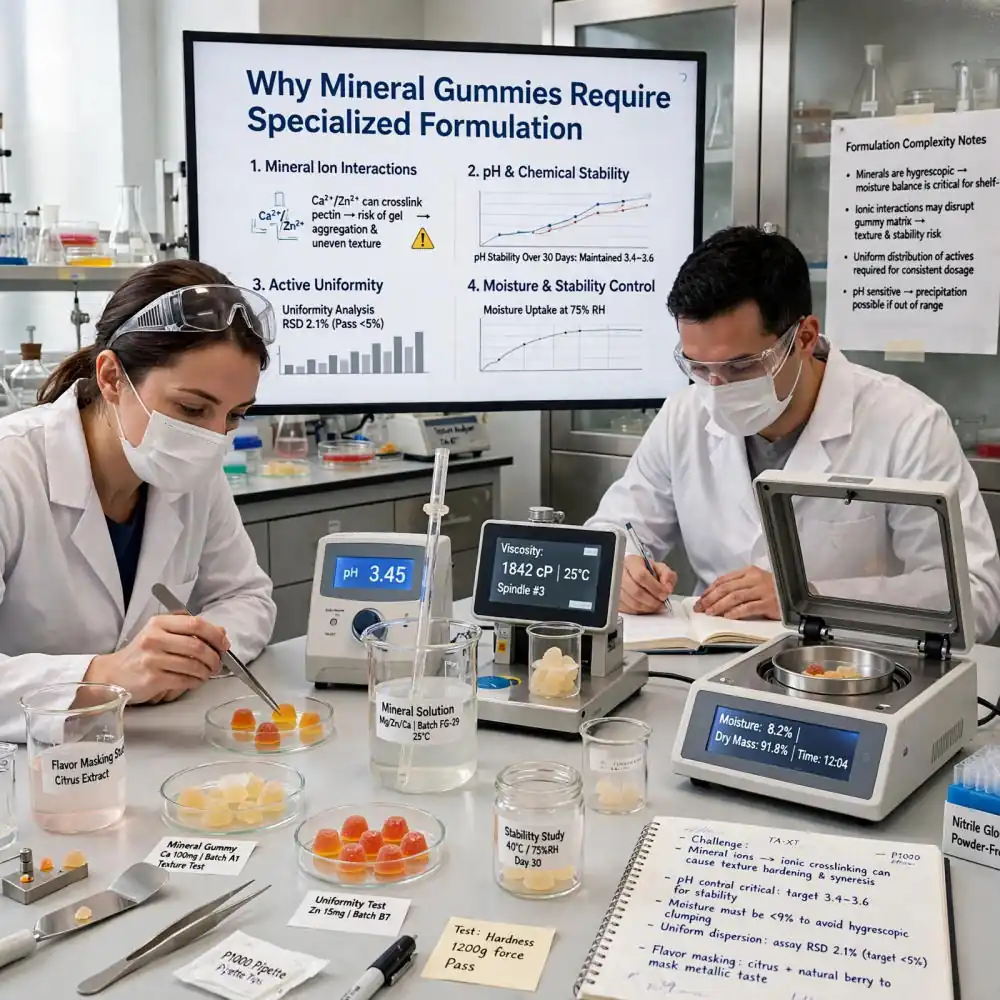
Not every vitamin or mineral belongs in a gummy. Water-soluble actives (vitamin C, B-vitamins, melatonin) disperse readily; fat-soluble actives (vitamin D, omega-3, CoQ10) need emulsification to stop separation; heat-sensitive actives need staged addition. Probiotics and enzymes must be introduced post-cooking via microencapsulated or low-temperature routes — dumping live cultures into a hot slurry sells dead bacteria. High mineral loads bring salty/bitter notes and interfere with gelation; acidic actives can drop pH far enough to hydrolyse gelatin or cause syneresis in pectin.
3. Gel system selection: pectin vs gelatin vs hybrid
Gelatin gives the classic bouncy chew and fast flavour release but excludes vegan, halal and kosher lines. Pectin is vegan with a cleaner, firmer bite but is highly pH-sensitive and more hygroscopic. Carrageenan and agar cover other vegan texture profiles. Hybrids (gelatin–pectin 70/30 or 50/50) balance chew against heat resistance. The full selection framework, the numbers behind it and the cost trade-offs are covered in our dedicated guide to pectin vs gelatin vs carrageenan in gummy manufacturing.
4. pH, water activity and stability control
High-methoxyl pectin sets only inside a narrow pH and soluble-solids window; outside it the gel fails to set or sets too fast, trapping air. Final pH typically sits around 3.0–4.0 and finished water activity around 0.65–0.75, verified after drying. Buffer systems and staged acid addition keep pH in range after the active is added. Stability — the degradation of actives over shelf life — is its own discipline, detailed in what limits gummy active ingredient stability.
5. Heat sensitivity and process timing
The gel must be cooked hot to hydrate, but heat-sensitive actives must miss that peak. The working rule is: cook the gel, cool the mass, then incorporate the heat-sensitive active. Slurry is often heated under vacuum to remove air and concentrate sugars, which prevents gummies collapsing into hard candies.
6. Flavour, colour and texture engineering
Bitter actives (B-vitamins, zinc, botanicals) need masking, not just sweetening. Clean-label colour and flavour systems (beet, spirulina, turmeric, berry anthocyanins) read better on-pack but are more heat- and pH-sensitive and vary more batch to batch — the ingredient-side view is in gummy candy ingredients for OEM/ODM projects.
7. Shelf life and packaging compatibility
Moisture management decides whether a gummy stays stable or sweats, sticks or hardens in the bottle. Packaging has to match the gel system: pectin usually needs enhanced moisture barrier and often a desiccant; gelatin works with standard HDPE/PET. A realistic general-matrix shelf life is 18–24 months, confirmed by real-time stability data, not accelerated testing alone.
How Does a Formula Survive the Move from Bench to Production Line?
Scale-up is not linear. Heat dissipation in larger cooking vessels, mixing-shear variation across tank sizes and agitator speeds, and depositing speed effects on weight consistency all change behaviour between a 5 kg trial and a 500 kg run. Starch moulding is the high-volume standard because it allows intricate shapes and clean release, but it needs a dedicated starch drying room and generates dust; silicone moulding suits simpler shapes and cleaner rooms. Leading R&D labs evaluate thousands of formulations a year purely to map how bases interact with actives at scale. Always run a pilot batch on production equipment before committing a commercial order, and confirm whether scale-up validation is included in the development fee.
What Are the Most Common Formula Mistakes?
- Adding heat-sensitive actives at cooking temperature, so they degrade before the batch is even moulded.
- Forcing an active dose into one piece instead of sizing the serving across two or three gummies.
- Treating a vegan or halal conversion as a hydrocolloid swap rather than a reformulation with a fresh stability study.
- Skipping overage calculation — the dose at manufacture is not the dose at month 12.
- Assuming the bench formula scales, then discovering it on the first production run.
- Choosing a clean-label colour/flavour system without tightening process controls to absorb its batch-to-batch variability.
What Drives Cost and MOQ in a Private Label Gummy Project?
Cost is not set by the gel alone. The levers are active dosage and overage, gummy weight and count per bottle, gel system and sweetener, natural flavour and colour, custom moulds and packaging, and the testing panel you specify. MOQ follows the cooperation model: private label from an existing formula typically starts lowest, ODM to your specification sits in the middle, and fully custom formulation runs highest because development and tooling must be amortised. A lower headline unit price that excludes testing or uses substandard inputs is not a real cost comparison, and low per-unit pricing can be offset by MOQ that ties up capital in inventory. For the full model see private label gummy MOQ and lead time explained.
How Should You Evaluate a Manufacturer for Formula Development?
Assess capability, not catalogue. Confirm in-house flavour masking for bitter actives, request a sample formulation for your specific load, and ask for batch records and CoAs from existing comparable runs rather than a purpose-made sample. Verify certifications with the issuing body, not the PDF the supplier emails you. The evaluation and audit checklist is set out in gummy contract manufacturing: a complete buyer’s guide, and the supplier red flags in how to find a reliable private label gummy manufacturer.
Quick Checklist Before Requesting an OEM/ODM Quotation
- Target consumer, active list, per-dose amounts and market regulatory maximums — written down.
- Dietary scope fixed (conventional / vegan / halal / kosher / clean-label).
- Target gummy weight, pieces per serving and per-piece active load.
- Preferred gel system, or a request for the manufacturer’s recommendation against your actives.
- Testing panel aligned to the destination market, not to the maximum list.
- Budget covering tooling, MOQ and development, not just unit cost.
Frequently Asked Questions
What is the maximum active load in a standard gummy?
Most 3 g gummies accommodate 10–25% active load while maintaining texture, depending on the ingredient. Low-density, high-dose minerals and hygroscopic ingredients reduce that limit. If total active mass exceeds roughly 750 mg–1 g per piece, use two gummies per serving or a larger mould.
Why does pectin gummy formulation require strict pH control?
High-methoxyl pectin sets only within a narrow pH and soluble-solids window. Outside it the gel either fails to set or sets too fast, trapping air and creating inconsistent texture. Buffer systems and staged acid addition keep pH in range after active addition.
Can probiotics be added to gummy formulas?
Only with low water activity, low-heat processing and oxygen-barrier packaging. Most standard high-heat gummy processes are unsuitable; you need validated low-temperature deposition, spore-forming strains and a stability protocol.
How do you prevent sugar crystallisation or sweating in gummies?
Manage water activity through the sweetener and humectant blend, hit final moisture in spec by Karl Fischer, and match the packaging moisture barrier to the gel system. Over-drying makes gummies crumble; under-drying leaves them sticky.
What affects flavour masking for mineral gummies?
Salt form, particle grade, dosage and the acid/flavour system. Buffered or coated mineral grades plus targeted masking reduce bitter and metallic notes far more than added sweetener alone.
How long does gummy formula development usually take?
Private label from an existing formula is typically 4–8 weeks. A custom formulation to first commercial run commonly runs 8–20 weeks depending on complexity, moulds and stability work.
Can any active ingredient go into a gummy?
No. Fat-soluble, heat-sensitive and highly hygroscopic actives each need a specific handling route, and some are poor fits for a moist, acidic, hot-cooked matrix. Screen compatibility before committing to the format.
Is gelatin or pectin better for my product?
It depends on dietary positioning, climate and actives. Gelatin wins on classic chew and oil-soluble actives; pectin wins on vegan/halal reach and heat stability. See the full decision framework in the pectin vs gelatin guide linked above.
What should I ask a manufacturer before starting a private label project?
In-house masking capability, sample formulation for your load, batch records and CoAs from comparable runs, certification verification, MOQ and lead time by model, and whether scale-up validation is included in the development fee.
From Concept to Commercial Formula
Formulation is where a gummy brand is won or lost, and it is inseparable from the manufacturing process that has to reproduce it at scale. For the process side see how gummies are manufactured at commercial scale; for the ingredient taxonomy see gummy candy ingredients for OEM/ODM; for gel-system selection see pectin vs gelatin.
Manufacturing support and available formats are on our gummy manufacturing page.
This article is part of the Gummy Manufacturing Knowledge Hub, under Product Innovation.