
Summary
Gummy candy ingredients determine the texture, stability, appearance, and functional performance of any gummy product, making ingredient selection a foundational decision for OEM/ODM projects. For brand owners and private label buyers, understanding these core components — gelling agents, sweeteners, acids, flavors, colors, and active ingredients — is essential to producing a market-ready gummy that meets both consumer expectations and regulatory requirements. This article outlines the key ingredient categories used in professional gummy manufacturing and what businesses should evaluate when sourcing a production partner.
Definition
Ingredients in Gummy refers to the combination of raw materials — including gelling agents, sweeteners, acidulants, flavoring systems, coloring agents, coating materials, and functional or active ingredients — that together form the structure, taste, and performance of a finished gummy product. In a B2B manufacturing context, ingredient selection directly affects product stability, shelf life, dosing accuracy, and compliance with target-market regulations.
Main Content
What Gummy Ingredients Are
A gummy formulation is built from several functional layers. The gelling system provides structure and chew; sweeteners establish taste and mouthfeel; acids balance flavor and support preservation; flavors and colors drive consumer appeal; and, for supplement gummies, active ingredients deliver the intended functional benefit. Each layer must be compatible with the others to achieve a stable, consistent final product.
Industry Background
Gummy candy originated as a confectionery format and has since evolved into a widely used delivery system for dietary supplements, vitamins, and functional ingredients. The shift from pure confectionery to nutraceutical-grade gummies has pushed manufacturers to adopt more rigorous ingredient standards, including plant-based gelling agents and reduced-sugar formulations, in response to changing consumer and regulatory demands.
Business Relevance
Ingredient choice affects sourcing cost, supply chain complexity, and production timelines. Brands entering the supplement gummy market need to understand how ingredient decisions — such as choosing pectin over gelatin, or natural colors over synthetic ones — impact both manufacturing feasibility and end-market positioning, particularly for vegan, halal, kosher, or clean-label product lines.
Core Ingredient Categories
Gelling Agents: Gelatin remains common for traditional gummies, while pectin and carrageenan are widely used for vegan or vegetarian formulations. Each gelling agent produces a different texture, set time, and heat stability profile.
Sweeteners: Options range from sucrose and corn syrup to sugar alternatives such as isomalt, allulose, or stevia, depending on whether the target product is standard, low-sugar, or sugar-free.
Acidulants: Citric acid, malic acid, and tartaric acid are commonly used to balance sweetness, enhance flavor perception, and support product preservation.
Flavors and Colors: Natural and artificial flavor systems, along with natural colorants (fruit and vegetable extracts) or approved synthetic dyes, shape consumer appeal and brand differentiation.
Coating Materials: Sugar dusting, citric acid dusting, or oil-based coatings are used to prevent stickiness and extend shelf stability.
Active Ingredients: For supplement gummies, functional actives such as vitamins, minerals, botanical extracts, or amino acids are incorporated, requiring careful evaluation of heat sensitivity, taste masking, and dosing accuracy during formulation.
Differences vs. Alternative Formats
Compared to capsules, tablets, or powders, gummies require more complex formulation work because active ingredients must remain stable through heating, molding, and drying processes while maintaining acceptable taste and texture. This makes ingredient and process expertise more critical for gummies than for many other supplement formats.
Key Advantages and Limitations
Advantages include strong consumer appeal, ease of dosing for children and adults, and flexibility in flavor and format design. Limitations include higher formulation complexity, sensitivity of certain actives to heat and moisture, and generally shorter shelf life compared to dry-format supplements.
Who Should Consider This
This information is most relevant to brand owners developing new gummy product lines, distributors evaluating supplier capabilities, and OEM/ODM buyers seeking to understand formulation trade-offs before committing to a manufacturing partner.
Compliance and Quality Considerations
Ingredient sourcing should align with the regulatory requirements of the target market, including permitted additive lists, allergen labeling, and certification needs such as GMP, halal, kosher, or vegan status. Third-party testing of raw materials helps confirm purity and consistency before large-scale production.
What Businesses Should Evaluate Before Sourcing
Before selecting a manufacturing partner, businesses should assess ingredient traceability, formulation flexibility, minimum order quantities, and the manufacturer’s ability to handle heat-sensitive or specialty actives without compromising product stability.
Technical Parameter Table
| Category | Details |
|---|---|
| Product Form | Gummy candy / functional gummy supplement |
| Key Materials / Ingredients | Gelatin, pectin, carrageenan, sweeteners, citric/malic acid, natural or synthetic flavors and colors, functional actives |
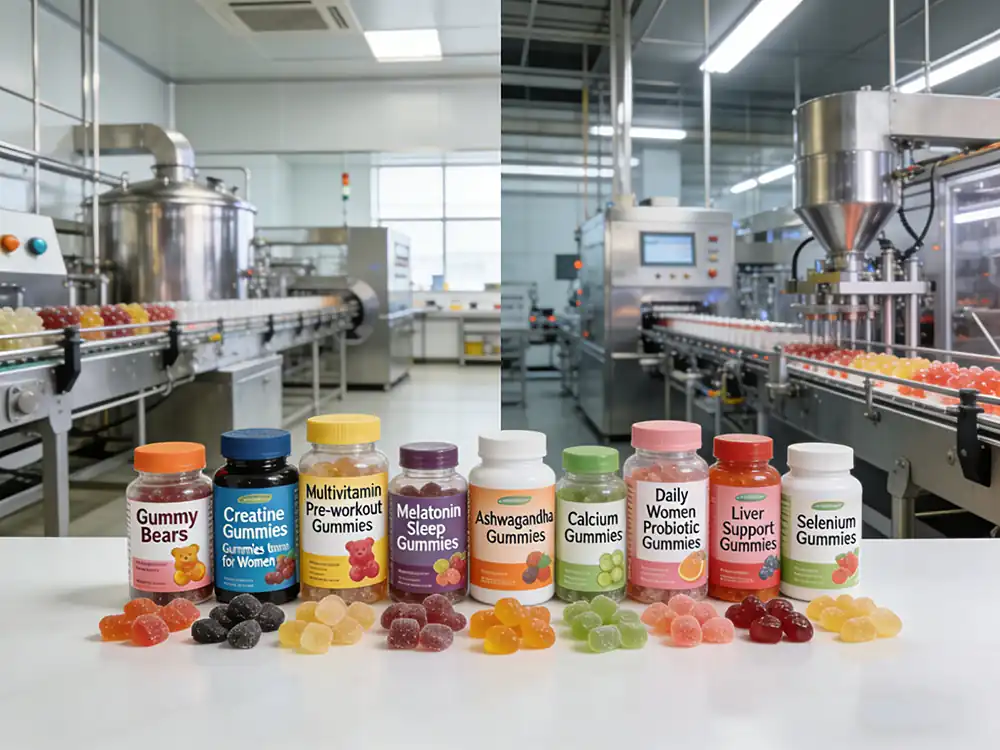
| Manufacturing Process Highlights | Formula development, cooking/mixing, depositing/molding, drying, coating, packaging |
| Quality Standards | GMP, ISO9001, ISO22000, HACCP, FDA, HALAL, KOSHER, Vegan certifications; third-party lab testing |
| Packaging Options | Bottles, pouches, blister packs, bulk packaging for private label branding |
| Scalability & Production Capacity | MOQ from 500 units; daily output up to 16 tons; annual capacity up to 5,000 tons |
| Storage & Logistics Considerations | Cool, dry storage recommended; humidity and temperature control needed to prevent stickiness or melting during transport |
Practical Insights
Manufacturing Quality & Process Control: Consistent gummy quality depends on precise control of cooking temperature, moisture content, and depositing accuracy. Variability in any of these steps can affect texture, dosing accuracy, and shelf stability.
Raw Material Sourcing Transparency: Reliable manufacturers provide documentation on ingredient origin, purity, and testing results, which supports both regulatory compliance and brand trust.
Production Scalability & Lead Time: Buyers should confirm whether a manufacturer can move smoothly from small trial batches to full commercial-scale runs without significant delays or formulation changes.
Compliance & Documentation Readiness: Certificates of analysis, allergen statements, and regulatory certifications should be readily available to support market entry in different regions.
Cost Structure Considerations: Ingredient selection, batch size, and packaging complexity all influence unit cost, so businesses should request transparent cost breakdowns during supplier evaluation.
Evaluating a Reliable Supplier: Look for manufacturers with established quality certifications, in-house R&D capability, and a track record of consistent output across multiple product lines.
B2B Decision Guide
How Brands Choose the Right Manufacturer: Brands should compare manufacturers based on certification coverage, formulation flexibility, and their ability to support the specific gelling agents or actives required for the product.
What Matters in OEM/ODM Projects: Clear communication on formulation goals, target market regulations, and packaging requirements helps prevent costly revisions during production.
How to Assess Production Capability: Reviewing a facility’s cleanroom classification, equipment capacity, and daily/annual output figures provides insight into whether it can meet both current and future order volumes.
Key Criteria for Long-Term Partnerships: Consistency in quality, responsiveness to formulation adjustments, and transparent documentation practices are strong indicators of a dependable long-term manufacturing partner.
Risk Control & Quality Assurance Checkpoints: Batch testing, stability testing, and pre-shipment quality checks help reduce the risk of product recalls or compliance issues after launch.
Conclusion
Ingredient selection is one of the most consequential decisions in gummy product development, directly shaping texture, stability, compliance, and consumer experience. For OEM/ODM buyers, working with a manufacturer that demonstrates strong formulation expertise, transparent sourcing, and certified quality systems reduces risk and supports a smoother path from concept to market-ready product.
FAQ
What are the main ingredients in gummy candy?
The main ingredients typically include a gelling agent (gelatin, pectin, or carrageenan), sweeteners, acidulants, flavors, colors, and — for supplement gummies — functional active ingredients.
Why do gummy ingredients matter for manufacturers?
Ingredient choice affects product texture, stability, shelf life, and compliance, all of which influence manufacturing feasibility and product quality.
How do gummy ingredients compare to those in capsules or tablets?
Gummy formulations require additional consideration for heat sensitivity and taste masking during the cooking and molding process, which is less of a concern in dry-format supplements like capsules or tablets.
What should businesses consider before sourcing gummy ingredients?
Businesses should evaluate ingredient traceability, regulatory compliance for the target market, and the manufacturer’s experience handling similar formulations.
What quality standards apply to gummy ingredient sourcing?
Common standards include GMP, ISO9001, ISO22000, HACCP, FDA compliance, and certifications such as HALAL, KOSHER, and Vegan, depending on the target market.
Can gummy formulations be customized for private label brands?
Yes, formulations can be adjusted for flavor, sweetness level, gelling agent, and active ingredient content to meet specific private label or OEM/ODM requirements.
About Gothink Biotech
Shenzhen Gothink Biotech Co., Ltd. is a GMP-certified contract manufacturer specializing in gummy, capsule, tablet, powder, liquid, and drop supplement production, with a 100,000-class cleanroom and daily output capacity of 16 tons, supporting an annual production capacity of 5,000 tons. The company offers full OEM/ODM/CMO/CDMO services, including formulation development, custom design, manufacturing, and packaging, with minimum order quantities starting from 500 units to accommodate both trial runs and full-scale production. Backed by a PhD-led R&D team and a 10,000-class pharmaceutical-grade laboratory, Gothink Biotech holds ISO9001, ISO22000, HACCP, FDA, HALAL, KOSHER, and Vegan certifications, supporting reliable quality control and regulatory compliance for long-term B2B partnerships across global markets.