
Abstract: Gummy supplements have become one of the fastest-growing formats in the dietary supplement industry. For brands, retailers, and entrepreneurs looking to enter this market, understanding gummy contract manufacturing — from formulation to finished packaging — is essential to making sound sourcing decisions. This guide breaks down the key stages of the gummy manufacturing process, what to look for in a qualified gummy manufacturer, how private label gummies and OEM/ODM models work, and how to evaluate costs when buying gummies in bulk or wholesale quantities. Whether you are launching a new product or scaling an existing line, this article aims to give you an honest, practical foundation.
1. What Is Gummy Contract Manufacturing?
Gummy contract manufacturing refers to the practice of outsourcing the production of gummy supplements to a specialized third-party facility. Rather than investing in their own production equipment, quality systems, and regulatory infrastructure, brands commission a contract manufacturer to produce gummies to their specifications.
This model is used across a wide range of business types, including:
- Supplement brands that want to expand their product range without capital-intensive factory investments
- E-commerce sellers building private label gummies for platforms such as Amazon or Shopify
- Retailers sourcing white label products for in-house store brands
- Startups that need flexible MOQ (minimum order quantity) options to test the market
- Health and wellness companies looking to launch functional gummies in new ingredient categories
Contract manufacturing is distinct from simply buying gummies wholesale or in bulk from a distributor. In a contract manufacturing arrangement, the product is typically built to your formula, branding, and packaging — not pulled off a generic shelf.
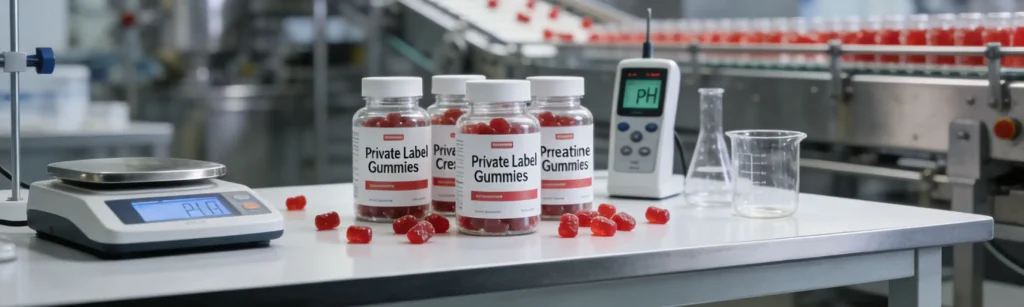
2. How the Gummy Manufacturing Process Works
A reputable gummy manufacturer follows a well-defined production workflow. Understanding each phase will help you ask the right questions when evaluating suppliers.
2.1 Formulation Development
Formulation is the starting point. This stage determines the active ingredients, their concentrations, the gelling system (gelatin, pectin, or carrageenan for vegan options), sweeteners, colorants, and flavors. For brands with existing formulas, a contract manufacturer typically validates and adapts the formula for scale. For brands starting from scratch, most full-service gummy manufacturers offer ODM (original design manufacturing) services, where their R&D team develops the formula based on your functional goals and target market.
Key questions at this stage include ingredient sourcing standards, stability testing protocols, and whether the manufacturer has experience with specific active compounds such as vitamins, botanicals, or nutraceuticals.
2.2 Raw Material Sourcing and Testing
Once a formula is confirmed, raw materials must be sourced and verified. Quality manufacturers test incoming raw materials for identity, purity, potency, and the absence of contaminants such as heavy metals, pesticides, and microbiological hazards. Third-party certificates of analysis (COAs) from ingredient suppliers should be reviewed and cross-verified.
This step is especially important for botanical and plant-based ingredients, where supply chain integrity and adulteration risks are more pronounced.
2.3 Mixing and Cooking
The gummy base — composed of gelling agents, sweeteners, water, and active ingredients — is prepared through a controlled cooking process. Temperature precision is critical at this stage to maintain ingredient stability, particularly for heat-sensitive compounds like certain vitamins or probiotics. Industrial-scale manufacturers use automated systems to ensure batch-to-batch consistency.
2.4 Molding and Depositing
The liquid gummy mass is deposited into molds under controlled conditions. The shape of the final product — whether a bear, cube, ring, or custom form — is determined by the mold design. Larger manufacturers often offer a broad selection of standard mold shapes, with custom mold creation available for branded differentiation. After molding, gummies are cooled and de-molded.
2.5 Finishing and Coating
Depending on the product specification, gummies may undergo additional finishing steps such as sanding (a sugar coating applied to prevent sticking), oiling, or the application of carnauba wax. These surface treatments affect the product’s texture, appearance, and shelf stability.
2.6 Quality Control and Testing
Before packaging, finished gummies are tested for weight, hardness, moisture content, and active ingredient potency. GMP-compliant manufacturers maintain detailed batch records and conduct in-process checks throughout production. Many brands require finished product testing by an independent third-party laboratory as an additional verification layer.
2.7 Packaging
Gummies are typically packaged in bottles, pouches, blister packs, or bulk containers. For private label gummies, the packaging is customized with your brand’s artwork, labeling, and regulatory information. The contract manufacturer may handle label printing in-house or coordinate with a third-party printing supplier.
3. OEM vs. ODM: Understanding the Difference
When engaging a gummy manufacturer, you will commonly encounter two service models:
OEM (Original Equipment Manufacturing): You provide the formula and product specification; the manufacturer produces it. This model is suitable for brands that already have a developed formulation and are looking for a production partner.
ODM (Original Design Manufacturing): The manufacturer develops the formula and product design on your behalf. You customize branding and packaging. ODM is well-suited for brands or startups that want to launch products quickly without in-house R&D capabilities.
Both models can support private label gummies, white label gummies, and custom branded supplements. The key difference lies in where the intellectual property for the formula resides and how much development work is shared between you and the manufacturer.
A third term sometimes used is CMO (contract manufacturing organization), which is effectively synonymous with contract manufacturing in this context, and CDMO (contract development and manufacturing organization), which integrates development services alongside production.
4. What to Look for in a Gummy Manufacturer
Selecting the right manufacturing partner is one of the most consequential decisions in a supplement brand’s supply chain. Here are the primary criteria worth evaluating:
4.1 Certifications and Regulatory Compliance
At a minimum, look for GMP (Good Manufacturing Practice) certification — this is the baseline quality standard for dietary supplement production globally. Additional certifications such as ISO 9001, ISO 22000, HACCP, NSF, and relevant dietary certifications (HALAL, KOSHER, Vegan) indicate a broader commitment to quality systems and enable access to different consumer markets.
If you are selling in the United States, confirm whether the manufacturer has FDA facility registration and is familiar with 21 CFR Part 111 (US dietary supplement GMP regulations). For European markets, relevant EU regulations should be confirmed separately.
4.2 Production Capacity and Lead Times
Understand the manufacturer’s daily and annual output capacity relative to your volume needs. A manufacturer with high capacity (measured in tons per day or year) offers more reliable lead times and better ability to handle demand surges. Conversely, very large manufacturers may not be the right fit for smaller brands that require more personalized service and attention to small batches.
Ask specifically about:
- Minimum order quantity (MOQ)
- Standard lead time from order confirmation to shipment
- Capacity allocation during peak periods
4.3 R&D Capabilities
A manufacturer with an in-house R&D team and laboratory can offer formulation support, ingredient recommendations, and stability testing. This is particularly valuable for ODM projects or for brands looking to develop innovative formulas. Ask about the qualifications of the scientific team, the types of testing equipment available, and previous formulation projects completed.
4.4 Ingredient Sourcing Transparency
Ask whether the manufacturer can provide documentation on raw material origins, supplier qualification processes, and COAs for key ingredients. Brands that sell in regulated markets need to be able to trace and verify their supply chain. Manufacturers who are opaque about ingredient sourcing are a risk factor.
4.5 Packaging and Customization Scope
Evaluate the manufacturer’s range of packaging formats, mold options, and labeling capabilities. For private label gummies and white label projects, the ability to fully customize the product’s appearance — including shape, color, flavor, and packaging — is important for brand differentiation.
4.6 Export Experience and Logistics Support
If you are sourcing gummies internationally, confirm that the manufacturer has experience with export documentation, customs compliance, and working with international freight partners. Some full-service manufacturers offer support with regulatory dossiers, labeling compliance review, and customs clearance coordination.
5. Private Label Gummies and White Label Gummies: Key Distinctions
These terms are sometimes used interchangeably, but there are meaningful distinctions:
Private label gummies typically involve a standard or semi-custom product that is rebranded under your label. The product formulation may be a manufacturer’s existing formula, with customization limited primarily to packaging and labeling. This approach enables faster time-to-market and lower development costs, and is common for brands launching into a category quickly.
White label gummies is a closely related term that often refers to a generic product offered to multiple buyers, each of whom applies their own branding. In practice, the line between private label and white label is often blurred in the supplement industry.
Custom OEM gummies involve a more tailored manufacturing engagement, where the formula, ingredients, dosages, and often the mold shapes are developed specifically for your brand. This creates a more differentiated product but typically requires longer development timelines and higher MOQs.
For most brands starting out, private label gummies represent the lowest-friction entry point. As brand volume and investment grow, moving toward more customized OEM or ODM products becomes more viable.
6. Buying Gummies in Bulk and Wholesale: What You Need to Know
Brands and retailers sometimes source gummies bulk or gummies wholesale as an alternative to custom contract manufacturing. Understanding the difference helps you determine which model suits your business:
Gummies bulk purchasing usually refers to buying large quantities of finished, unpackaged, or minimally packaged gummies from a manufacturer or distributor. This is common for brands that handle their own packaging and labeling in-market, or for retailers who repackage under their own brands.
Gummies wholesale typically involves buying finished, packaged products in quantity at a discounted price. This model is more common for distributors and retailers rather than brands building their own product lines.
When evaluating bulk or wholesale gummy purchases, key considerations include:
- Shelf life and storage requirements (temperature, humidity sensitivity)
- Lot traceability and COA availability
- Minimum purchase quantities and pricing tiers
- Packaging compatibility with your labeling requirements
- Compliance with destination market regulations
Some manufacturers offer both contract manufacturing and bulk/wholesale supply, which gives you flexibility as your business model evolves.
7. Common Gummy Product Categories in Contract Manufacturing
Gummy contract manufacturing spans a wide range of functional supplement categories. Some of the most in-demand product types currently include:
- Multivitamin gummies (for adults, women, men, and children)
- Sleep support gummies (typically melatonin-based)
- Immunity gummies (vitamin C, zinc, elderberry)
- Probiotic gummies (for digestive and women’s health)
- Adaptogen gummies (ashwagandha, rhodiola)
- Sports performance gummies (creatine, pre-workout blends, protein)
- Bone and joint support gummies (calcium, collagen, vitamin D3)
- Detox and liver support gummies
- Beauty and skin health gummies (biotin, collagen, hyaluronic acid)
- Mineral gummies (selenium, magnesium, iron)
The functional gummy segment continues to expand as consumers seek convenient, palatable alternatives to traditional pills and capsules. For brands, this creates both opportunity and competition — making formulation quality and differentiation increasingly important.
8. Cost Considerations in Gummy Manufacturing
Pricing in gummy contract manufacturing is influenced by several variables. Understanding these factors helps you evaluate quotes more accurately and avoid being misled by artificially low initial prices.
Factors That Drive Gummy Manufacturing Costs
- Active ingredient cost: Premium or specialty ingredients (branded actives, high-potency botanicals) add significantly to per-unit cost.
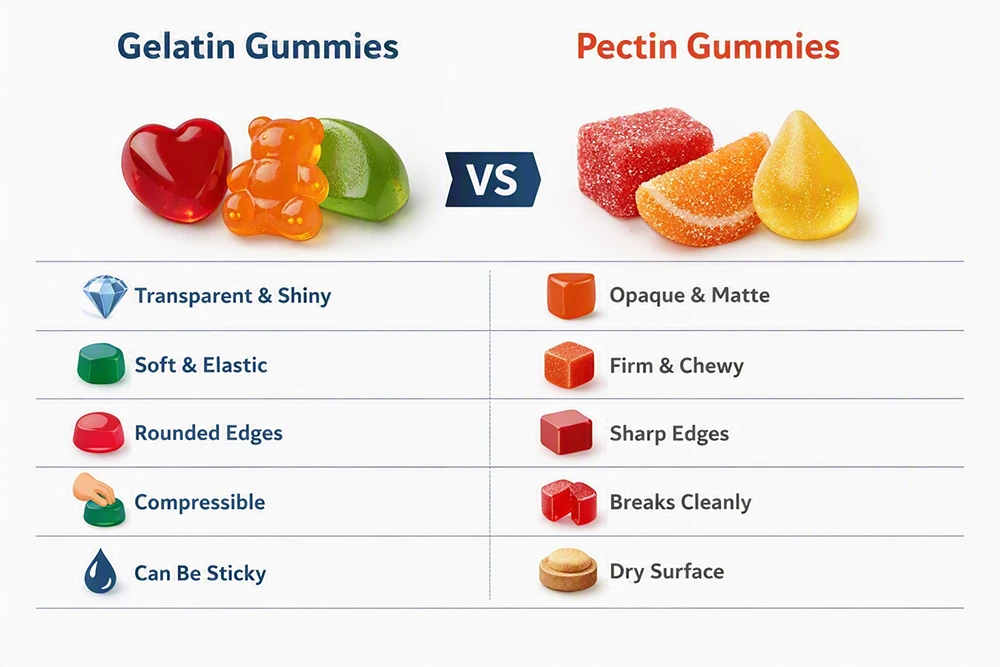
- Gelling system: Pectin-based (vegan) gummies typically cost more than gelatin-based equivalents.
- Order volume: Larger orders benefit from economies of scale. MOQ thresholds directly affect unit pricing.
- Packaging complexity: Custom molds, multi-component packaging, and specialty coatings add cost.
- Testing requirements: Third-party testing and additional certifications (organic, USDA, NSF) increase costs but enhance market positioning.
- Regulatory compliance support: Markets requiring additional documentation or label compliance review (e.g., EU, Canada, Australia) may incur service fees.
When comparing quotes from different gummy manufacturers, ensure you are comparing on an equivalent basis — the same formula, the same specifications, the same testing scope, and the same Incoterms for international shipments. A lower headline price that excludes testing, compliance support, or uses substandard ingredients is not a true cost comparison.
9. Questions to Ask Before Signing with a Gummy Contract Manufacturer
Before committing to a manufacturing partner, it is prudent to conduct proper due diligence. Here is a non-exhaustive checklist of useful questions:
- Can you provide your current GMP certification and facility audit reports?
- What is your production capacity and typical lead time for orders of our volume?
- Do you conduct in-house testing, or do you rely solely on third-party labs?
- Can we visit or audit the facility before placing an order?
- What is your policy on formula confidentiality and IP ownership?
- How do you handle non-conforming batches or product recalls?
- Do you have experience exporting to our target market?
- Can you provide references from existing brand clients?
- What is your MOQ for trial production runs versus full commercial orders?
- What packaging customization options are included, and what is the artwork approval process?
A manufacturer who responds to these questions openly, with documented evidence rather than verbal assurances, is a stronger candidate than one who deflects or provides vague answers.
Summary
Gummy contract manufacturing has matured into a well-structured industry serving brands at every scale. For supplement businesses, the key decisions center on choosing the right service model (OEM, ODM, private label, or white label), identifying a manufacturer with the right certifications and capabilities, and structuring a sourcing arrangement that balances cost, quality, and compliance.
Whether you are sourcing gummies in bulk, building a private label gummy line, or launching a fully custom OEM gummy product, the fundamentals remain consistent: insist on verifiable quality systems, understand the true cost drivers, and invest time in evaluating your manufacturer before committing to production.
The gummy supplement market continues to grow globally, and brands that establish reliable, quality-driven manufacturing partnerships are better positioned to scale sustainably.
Frequently Asked Questions (FAQ)
Q1: What is the typical minimum order quantity (MOQ) for gummy contract manufacturing?
MOQ varies widely depending on the manufacturer and the product type. Some manufacturers accept trial orders as low as a few thousand units, while large-scale facilities may require tens of thousands of units per batch. Brands at the early stage should look for manufacturers explicitly offering low-MOQ or trial production options. MOQ is often inversely related to unit price — higher volumes generally yield lower per-unit costs.
Q2: How long does gummy manufacturing take from order to delivery?
Lead times typically range from 4 to 12 weeks, depending on whether the formula is pre-existing or being developed from scratch, the complexity of packaging, and the manufacturer’s current production schedule. Custom formulations, new mold creation, and regulatory documentation requirements can extend timelines. It is advisable to plan production schedules with buffer time, particularly for first orders with a new manufacturer.
Q3: What certifications should a gummy manufacturer have?
At a minimum, GMP certification is essential for dietary supplement manufacturing. Depending on your target market and product positioning, additional certifications such as ISO 22000, HACCP, HALAL, KOSHER, Vegan, or NSF may be relevant. For the US market, FDA facility registration is important. Always request copies of current certificates and verify their validity independently where possible.
Q4: What is the difference between private label gummies and custom OEM gummies?
Private label gummies typically use the manufacturer’s existing or semi-standard formula, rebrandedunder your label. Custom OEM gummies involve developing a formulation specifically for your brand, offering greater differentiation but typically requiring more time, investment, and higher MOQs. Both approaches are valid depending on your brand’s goals, budget, and go-to-market timeline.
Q5: Can I buy gummies in bulk without custom branding?
Yes. Many manufacturers offer bulk gummy supply without custom packaging or branding. This suits businesses that handle packaging and labeling independently, or distributors who supply to multiple retail clients. When buying gummies bulk, confirm shelf life, storage conditions, COA availability, and whether the product complies with regulations in your intended market.
Q6: Are vegan gummies more expensive to manufacture than gelatin gummies?
Generally, yes. Vegan gummies use plant-based gelling agents such as pectin or carrageenan, which are typically more expensive than animal-derived gelatin and can be more technically demanding to work with in terms of achieving the right texture and stability. However, the price difference has narrowed as vegan gummy manufacturing has become more standardized, and the market premium for vegan-certified products often justifies the higher production cost.
Q7: How do I verify the quality of a gummy manufacturer before placing a large order?
Request a sample or trial production run before committing to large volumes. Ask for facility audit reports, third-party test results for recent batches, and references from existing clients. If possible, conduct an on-site or virtual audit of the facility. Reviewing quality documentation — including SOPs, batch records, and COAs — provides insight into a manufacturer’s operational discipline beyond what marketing materials convey.
About Gothink Biotech
Shenzhen Gothink Biotech Co., Ltd. is a professional gummy manufacturer and dietary supplement manufacturer based in China, offering comprehensive OEM, ODM, CMO, and CDMO services for global supplement brands, retailers, and entrepreneurs.
Our manufacturing capabilities cover the full gummy production spectrum, including vitamin gummies, functional gummies, vegan gummies, and specialty formulations across a wide range of ingredient categories. We support clients at every stage — from formulation development and raw material sourcing through production, quality control, and final packaging — enabling brands to bring products to market efficiently under their own private label or white label.
For clients who need volume flexibility, we accommodate both trial production with accessible MOQs and large-scale gummies bulk and gummies wholesale orders, backed by a daily production capacity of 16 tons and an annual capacity of 5,000 tons. Our facility operates under GMP standards in a 100,000-class cleanroom environment, and holds certifications including ISO 9001, ISO 22000, HACCP, FDA registration, HALAL, KOSHER, and Vegan.
Our R&D team, led by postdoctoral researchers with experience at leading international institutions, supports both OEM and ODM projects through a 10,000-class pharmaceutical-grade laboratory. We conduct formulation research on approximately 2,000 new products annually, reflecting our ongoing commitment to innovation in dietary supplement manufacturing.
Whether you are building a private label gummy brand, sourcing custom OEM gummies, or looking for a reliable bulk gummy supply partner, Gothink Biotech offers the technical expertise, production infrastructure, and quality systems to support your business.