
Direct answer: In 2026, gummy supplement market trends are no longer driven by general multivitamins. Growth is concentrating in three use-case categories — sleep, stress, and active nutrition — where convenience, taste, and daily ritual matter more than pill fatigue. Brands winning in these categories are not simply adding trendy ingredients to a sweet base. They are solving specific formulation problems: multi-ingredient sleep blends that stay stable, adaptogen stress formulas that taste acceptable at a clinical dose, and high-load active formulas where creatine, collagen, or protein must survive heat, acid, and moisture without degrading. For buyers, the 2026 decision is therefore less about flavor and more about manufacturability, dose integrity, and shelf-life proof. This analysis, part of our Market Intelligence coverage, maps what is growing, why it is growing, and what it takes to produce it at scale.

Executive Summary: What Is Driving Gummy Supplement Market Trends in 2026?
The answer for B2B buyers is narrow and practical. The gummy supplement market remains large and still expanding, but the incremental growth in 2026 comes from functional, occasion-based products rather than broad vitamin gummies. Sleep is moving from single-ingredient melatonin to multi-pathway blends with magnesium, L-theanine, and botanicals. Stress is moving from generic calming claims to standardized adaptogens with daytime, non-drowsy positioning. Active nutrition is moving from powders to portable formats, led by creatine gummies, collagen gummies, and protein bites for consumers who will not mix a shake every day.
Three commercial consequences follow. First, dose per serving is rising, which stresses the gummy matrix. Second, buyers are asking for assay results at end of shelf life, not only at manufacture. Third, pectin has become the default matrix for vegan, clean-label, and export-ready products, even though it is less forgiving than gelatin on pH, solids, and depositing temperature. Brands that select formulas without accounting for these constraints face recrystallization, syneresis, bitter aftertaste, or potency loss before the product reaches the retailer.
Market Context: Where the Growth Is Actually Coming From
Market sizing varies by definition, because some reports include confectionery gummies and others count only dietary supplement gummies. That variation is useful for buyers: it shows why a single headline number can mislead a sourcing plan. For dietary supplement gummies specifically, Mordor Intelligence estimates the market at USD 25.74 billion in 2025, USD 27.71 billion in 2026, and USD 40.06 billion by 2031, a 7.65% CAGR for 2026 to 2031. A narrower nutraceutical gummy definition puts 2026 at USD 21.21 billion and 2031 at USD 35.47 billion, a 10.83% CAGR, which reflects faster growth in functional formulas versus basic vitamins.
Three structural forces explain the concentration in sleep, stress, and active nutrition. First, e-commerce and TikTok Shop discovery reward products that can be explained in one use case and demonstrated in 15 seconds. A sleep gummy or creatine gummy fits that format; a generic multivitamin does not. Second, adherence is higher for gummies than for capsules among consumers who dislike swallowing pills, which matters for ingredients that require daily, consistent intake, such as magnesium, ashwagandha, or creatine. Third, private label and DTC brands can enter these categories faster than pharma-style categories because the regulatory path is clearer, provided label claims, dosage, and overage discipline are respected by market.
For procurement teams, this means SKU strategy should be built around occasions, not ingredients alone. A sleep SKU, a daytime calm SKU, and a recovery SKU can share a pectin platform, flavor system, and packaging line while serving different retail buyers. That platform approach lowers validation cost and shortens time to market compared with building three unrelated formulas from scratch.
Sleep: From Single-Ingredient Melatonin to Multi-Pathway Formulas
Direct answer: Sleep remains the largest and most mature of the three drivers, but its 2026 growth comes from blends, not from higher melatonin doses.
Melatonin still holds close to 50% share of the sleep gummy ingredient segment in 2026, and the global sleep gummy market is estimated at USD 1.8 billion in 2026, rising toward USD 3.0 billion by 2032. In the United States, gummies already represent about 41% of sleep supplement format share. The shift is in formulation logic: brands now combine a low, precise melatonin dose for sleep onset with magnesium for muscle relaxation, L-theanine for calm without next-day grogginess, and botanicals such as valerian, chamomile, or lemon balm for sleep maintenance.
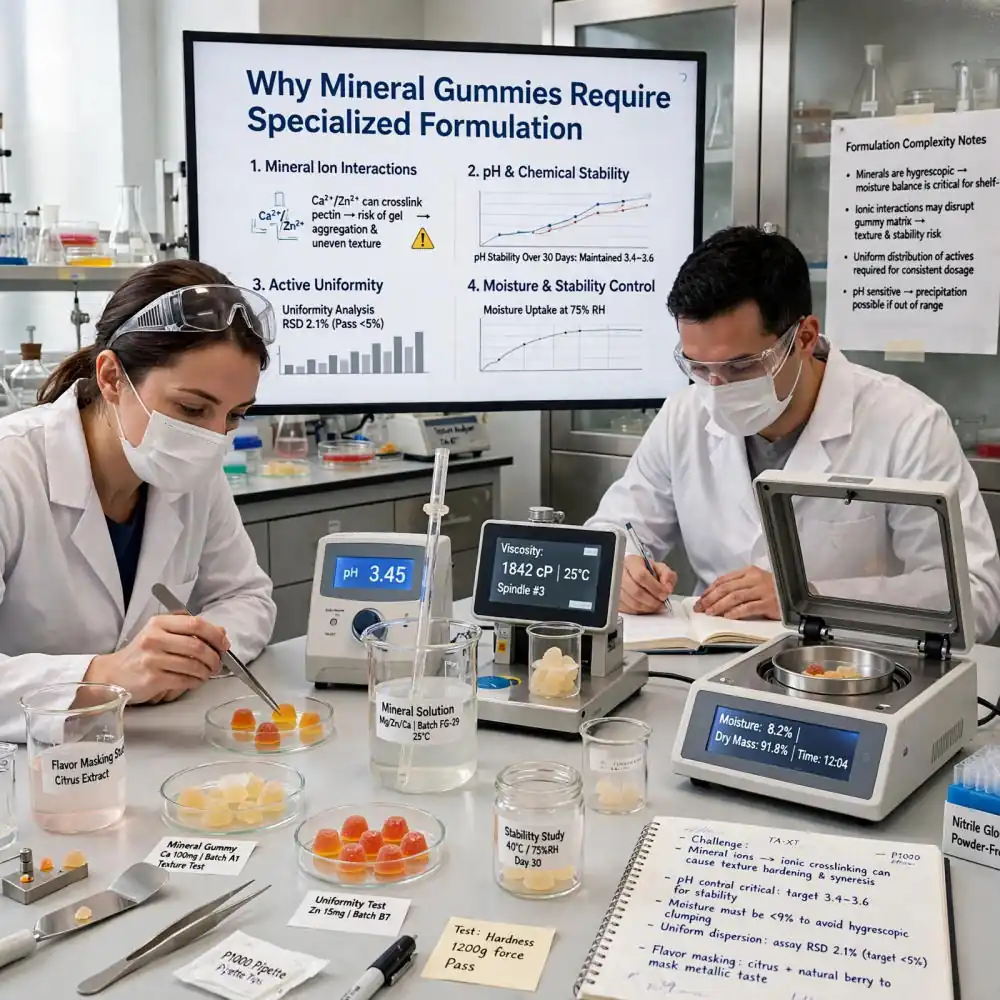
From a manufacturing view, this blend creates three trade-offs. Melatonin is relatively heat-stable but light-sensitive and subject to strict dose limits in many markets. In the US, 1 mg to 5 mg per serving is common; in the EU, many markets cap melatonin in supplements at 0.5 mg to 1 mg, which forces a completely different formula for export. Magnesium salts, especially citrate and glycinate, increase ionic strength and can interfere with pectin gelation if added too early or at too high a concentration. Botanical extracts add color, bitterness, and oxidation risk. The practical solution used by experienced manufacturers is staged addition: cook the pectin base to the target Brix, cool to a controlled depositing window, then add heat-sensitive actives, acids, and flavors late in the process to limit degradation and preserve gel structure.
Buyers should ask for two data sets before committing to a sleep blend: melatonin assay at 0, 12, and 18 months under accelerated and real-time conditions, and water activity (aw) stability. If aw rises above 0.70, gelatin gummies soften and stick; pectin gummies can lose chew and develop syneresis. Both failures show up as consumer complaints long before a potency failure appears on a certificate of analysis.
Stress: Adaptogens, Dose Discipline, and Daytime Positioning
Direct answer: Stress is the fastest-evolving category in 2026 because buyers and consumers now expect a standardized adaptogen dose, not a proprietary blend with an undeclared extract.
The global stress relief gummy market is estimated at USD 0.63 billion in 2026 and projected to reach USD 1.1 billion by 2035 at a 6.5% CAGR. Ashwagandha leads the source segment with about 31.5% share in 2026, followed by L-theanine and magnesium combinations that account for roughly 30% of the market. Ashwagandha extract demand itself is projected to grow from about USD 928 million in 2026 toward USD 1.98 billion by 2034, driven by clinical evidence on stress response and cortisol support.
Commercially, the winning stress products in 2026 are positioned for daytime use: calm focus at work, pre-meeting steadiness, or post-workout wind-down, rather than sedation. That positioning changes formulation. L-theanine at 100 mg to 200 mg per serving is heat-stable, nearly tasteless, and compatible with both pectin and gelatin. Ashwagandha is the harder ingredient. Standardized extracts such as those standardized to 5% withanolides or to specific withanolide glycosides require 300 mg to 600 mg per serving for the doses used in clinical studies. At that level, ashwagandha is earthy, bitter, and astringent, and it darkens the gummy during storage if oxidation is not controlled.
Flavor masking for stress gummies therefore cannot rely on sugar alone. Effective systems pair citrus or tropical fruit notes with a small amount of ginger or mint to cover earthiness, use encapsulated botanical extracts where the budget allows, and control final pH to 3.2 to 3.8 for pectin to maintain gel strength without making the product aggressively sour. Sugar-free versions add another constraint: sugar alcohols such as maltitol and erythritol change solids, chew, and moisture equilibrium. Without careful humectant balance, sugar-free pectin gummies become either too firm or too sticky after 60 to 90 days.
Active Nutrition: Creatine, Collagen, and Protein Move Into Gummies
Direct answer: Active nutrition is the highest-growth, highest-risk category in 2026. Demand is real, but dose physics limits what a gummy can honestly deliver.
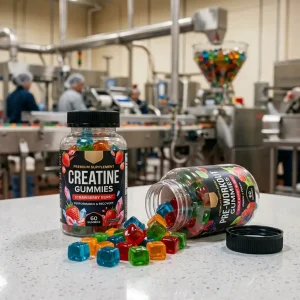
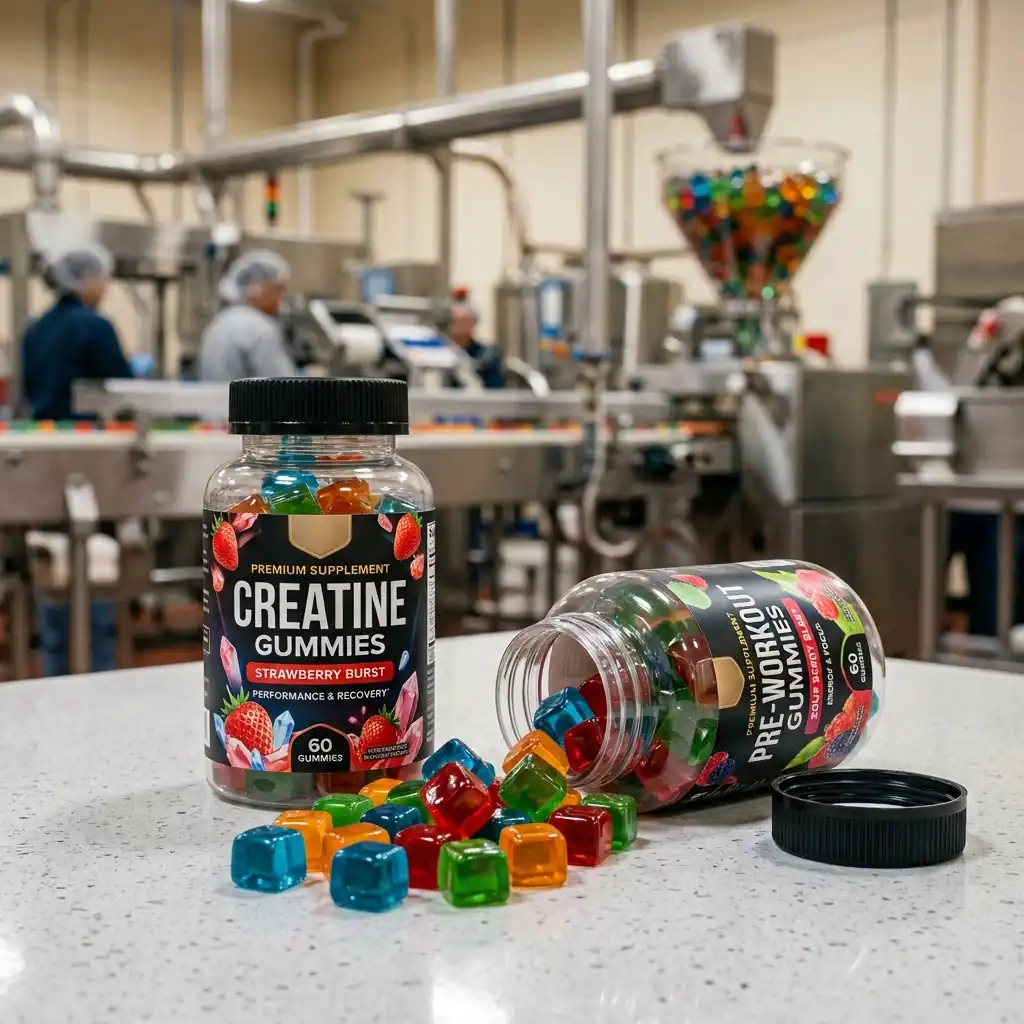
Active nutrition has led supplement category growth for five consecutive years in US tracking, and creatine is the clearest example of format migration. In Europe, the number of brands offering creatine gummies rose 48% between January 2025 and January 2026. In the US and Canada, the increase was 59% and 51% respectively. Protein gummies are smaller but growing fast, from USD 573.0 million in 2026 toward USD 903.3 million by 2030 at an 11.8% CAGR. Collagen supplements reached USD 2.6 billion in 2026, with pills and gummies accounting for about 59.7% of form share, which shows that consumers already accept gummies for beauty and joint support.
The formulation problem is loading capacity. A typical gummy weighs 3 g to 4 g. A standard creatine monohydrate maintenance dose is 3 g per day. That means a creatine gummy cannot deliver a full dose in one piece. Realistic commercial products deliver 750 mg to 1,000 mg per gummy, requiring three to four gummies per serving. That is commercially viable if the label, serving size, and cost-per-day are transparent, but it fails if a brand promises a full 3 g dose in two gummies without accounting for matrix limits.
Creatine stability is the second problem. Creatine converts to creatinine in water, especially under heat and acidic conditions. A gummy is an aqueous, acidic, heated system. If creatine is added early in cooking, a significant fraction converts before depositing. Experienced manufacturers address this by using low-moisture processing, adding creatine late at a controlled temperature, selecting a pH above 4.0 where the matrix allows, and in some cases using micronized or encapsulated creatine to reduce surface exposure. Even with those controls, buyers should require creatinine testing, not only creatine assay, across shelf life.
Collagen and protein face a different limit: volume. Collagen peptides require 2.5 g to 10 g per day for studied effects. Protein requires 15 g to 25 g for a meal replacement claim. No gummy can deliver those doses in a normal serving. The honest commercial position for collagen gummies is as a daily top-up or beauty ritual, not as a replacement for powder. For protein gummies, the position is as a portable snack or recovery bite with 2 g to 4 g protein per serving, often paired with BCAAs, collagen, or creatine to justify the format. Brands that overclaim protein content in a gummy invite label challenges and retailer rejection.
Formulation Engineering: What Makes Sleep, Stress, and Active Gummies Hard to Manufacture
Direct answer: The three categories fail for the same three reasons: heat, water, and acid. Control those, and most stability problems become manageable.
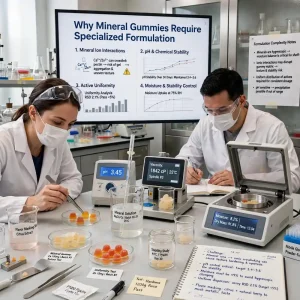
Pectin and gelatin gel by different mechanisms, and the choice shapes the entire line. Gelatin gels on cooling through triple-helix formation. It tolerates a wider pH range and produces a soft, elastic chew, but it melts at body temperature, requires animal sourcing, and is sensitive to high-temperature storage and to proteolytic ingredients. Pectin, specifically high-methoxyl pectin used for most supplement gummies, gels through hydrogen bonding and hydrophobic interaction in the presence of sugar, acid, and low water activity. It requires pH 3.0 to 3.8, soluble solids of 72% to 78% Brix, and precise depositing temperature. It produces a clean bite, a vegan claim, and better heat tolerance, but it is unforgiving if acid is added too early or if ionic salts disrupt the network.
Water activity (aw) is the master variable for shelf life. Target aw is typically 0.55 to 0.68 for pectin gummies and 0.60 to 0.70 for gelatin gummies, depending on packaging and climate. Above that range, microbial risk rises and gummies stick. Below that range, gummies harden and lose chew. Moisture equilibrium after depositing matters as much as the initial formula: gummies continue to lose or gain moisture in the pack. Nitrogen flushing, high-barrier pouches or bottles, and desiccants are not packaging extras. They are part of the stability system, especially for export to humid markets in Southeast Asia, the Middle East, and Latin America.
Degradation buffer strategy must be ingredient-specific. For vitamins such as B12 or vitamin C, manufacturers often apply a 10% to 20% overage to compensate for processing and storage loss. For melatonin, ashwagandha, or creatine, blanket overage is dangerous. Melatonin overage can push the product above a market limit. Ashwagandha overage can push bitterness and cost without benefit. Creatine overage does not solve conversion to creatinine. The correct approach is to validate loss at each step — cooking, depositing, drying, and storage — and then set a narrow, documented overage only where data supports it, with assay methods that distinguish active from degradant.
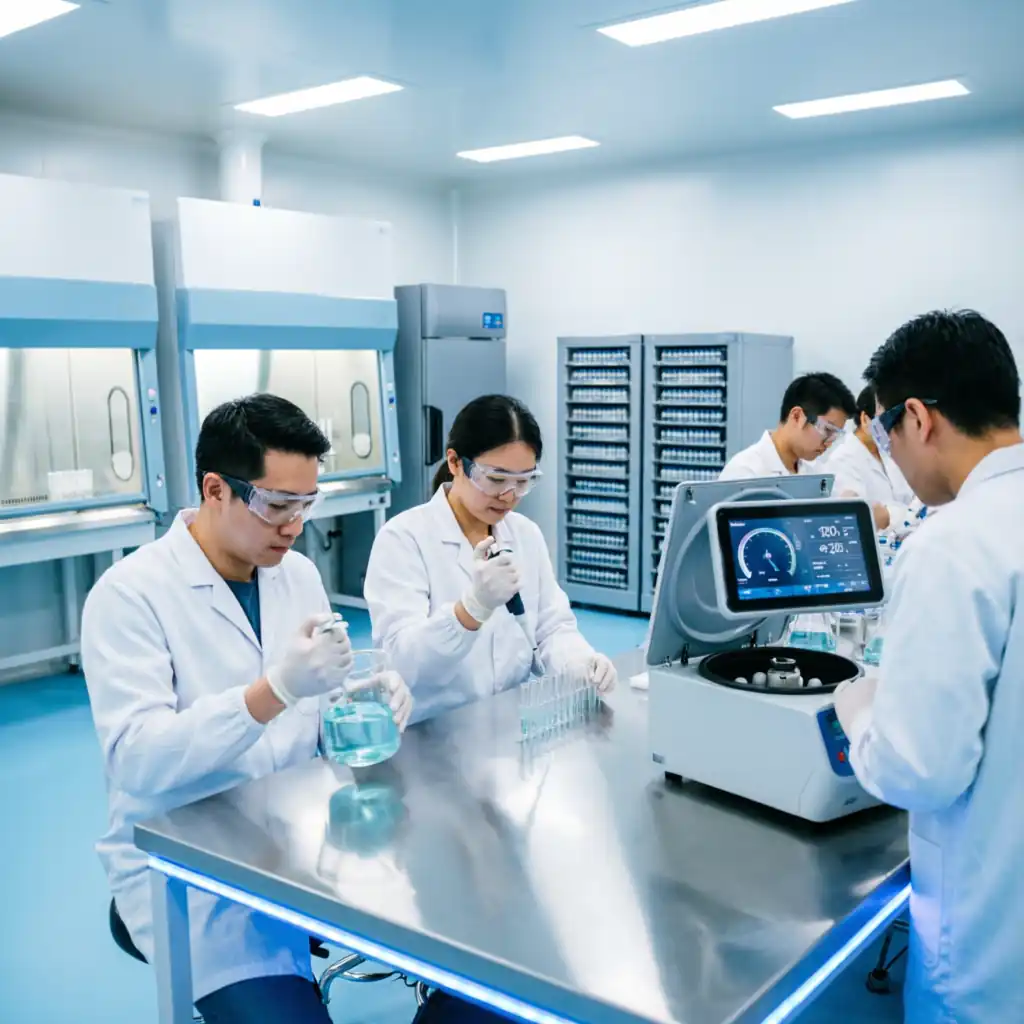
Pilot-scale validation versus commercial depositing is where many 2026 launches fail. A benchtop batch made in a kettle does not predict a high-speed depositor running at 2,000 to 4,000 pieces per minute. Viscosity rises as the batch cools, depositing nozzles clog if solids are too high, and active distribution becomes uneven if mixing is incomplete. A custom OEM gummy manufacturer should therefore provide pilot data at commercial depositing speed, including weight variation, active uniformity across the run, and depositing temperature logs, not only a lab sample. At Shenzhen Gothink Biotech Co., Ltd., for example, pilot work is run in a 100,000-class cleanroom with a 10,000-class analytical R&D lab, and commercial output reaches 16 tons per day under cGMP, NSF, FDA, ISO, HALAL, and KOSHER standards, which allows the same team to test a stress or active formula at pilot scale and then hold the same pH, aw, and Brix targets at full line speed.
Comparison: Formulation and Commercial Trade-Offs by Category
| Category | Typical Hero Actives | Dose Challenge | Key Stability Risk | Matrix Preference |
|---|---|---|---|---|
| Sleep | Melatonin, magnesium, L-theanine, valerian | Low melatonin dose, high regulatory sensitivity | Light sensitivity, magnesium interference with pectin | Pectin for vegan and clean bite; gelatin acceptable for US-only |
| Stress | Ashwagandha, L-theanine, magnesium, rhodiola | 300 mg to 600 mg botanical for clinical dose | Bitterness, color darkening, oxidation | Pectin preferred for clean label and export |
| Active Nutrition | Creatine, collagen peptides, protein, BCAAs | 3 g creatine or 5 g collagen cannot fit in 1 to 2 gummies | Creatine to creatinine conversion in heat and acid | Pectin with late-stage active addition; gelatin only if heat profile allows |
Commercial Evaluation Criteria for Buyers in 2026
Direct answer: Evaluate a supplier on stability data and process control, not on flavor samples alone.
Use this checklist when comparing quotes for sleep, stress, or active gummies:
- Assay at end of shelf life: Require results at 0, 6, 12, and 18 months for the hero active and for known degradants, such as creatinine for creatine or withanolide loss for ashwagandha.
- pH, Brix, and aw specifications: Ask for target ranges and control limits, not single values. A supplier who cannot state aw control range cannot guarantee shelf life.
- Overage policy in writing: Confirm overage percentage, rationale, and compliance with the destination market. For melatonin, confirm the overage does not breach local limits.
- Pilot-to-commercial data: Ask for weight variation, active uniformity, and depositing temperature from a pilot run at commercial speed.
- Flavor masking without excess acid: Taste the product at 90 days, not only at production. Botanical bitterness and mineral metallic notes often emerge after storage.
- Packaging barrier: Confirm pouch or bottle moisture vapor transmission rate, desiccant, and nitrogen flush for humid export markets.
- Regulatory and certification fit: Confirm cGMP, NSF, FDA registration, ISO, HALAL, and KOSHER coverage for each target market, and confirm label review for claims, allergens, and supplement facts format.
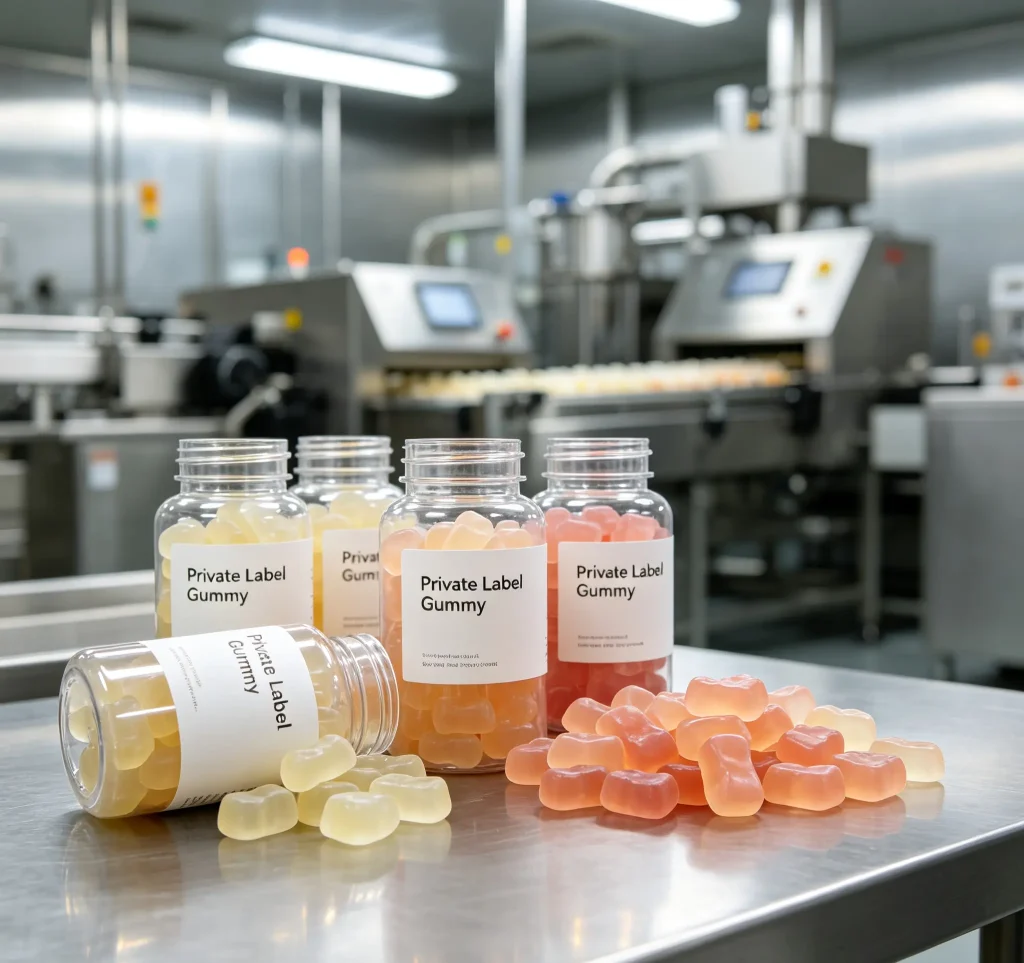
For brands that need speed without building an internal R&D team, turnkey private label gummy production can shorten the path from concept to shelf, provided the partner shares the data above and allows the brand to own the formula, specifications, and stability file. The lowest quote is rarely the lowest total cost if the product fails a retailer audit, a stability test, or a consumer taste test after 90 days.
FAQ: B2B Technical and Sourcing Questions for 2026
Why are brands shifting from single-ingredient melatonin to multi-ingredient sleep blends?
Single-ingredient melatonin is commoditized and faces dose caps in many export markets. Blends with magnesium, L-theanine, and botanicals allow differentiation, support both sleep onset and sleep maintenance, and reduce reliance on a high melatonin dose. The trade-off is higher formulation complexity, because magnesium and botanicals affect pectin gelation, taste, and color.
Can creatine be stable in a gummy for 18 to 24 months?
Yes, if the process is designed for it. Creatine must be added late, at a controlled temperature, with pH managed above the most aggressive acid range, and with packaging that limits moisture uptake. Buyers should require both creatine assay and creatinine testing across shelf life. A product that passes creatine assay alone may still have significant conversion that is not visible without degradant testing.
What is a realistic maximum dose per gummy for minerals and botanicals?
For most pectin gummies, 300 mg to 600 mg of botanical extract per serving across two gummies is workable, but it requires flavor masking and color control. For minerals, magnesium citrate or glycinate above 100 mg per serving often creates metallic taste and gel interference. Above those ranges, the brand should split the dose across three to four gummies or reconsider the format.
Should we choose pectin or gelatin for sleep, stress, and active gummies?
Choose pectin for vegan, HALAL, KOSHER, and export-ready positioning, and when heat tolerance during shipping matters. Choose gelatin only when the target market accepts animal gelatin, the formula is low in ionic salts, and the product will not be exposed to high-temperature storage. For most 2026 sleep, stress, and active launches, pectin is the safer commercial choice despite tighter process control.
How do we avoid melatonin overage and label compliance problems?
Do not apply a blanket overage to melatonin. Validate loss at each process step, set a narrow, documented overage based on that data, and test with a method that is specific to melatonin. Confirm the final label dose against the strictest market in the distribution plan, not only the US market, and keep the stability file for retailer and regulator review.
What MOQ and lead time should buyers expect for a custom 2026 formula?
MOQs vary by partner and matrix, but custom pectin formulas typically require a pilot batch, a stability checkpoint, and a commercial validation run before full production. Allow 8 to 14 weeks from approved formula to first commercial shipment for a new sleep, stress, or active product, plus additional time for packaging, label review, and export certification. Brands that compress pilot validation to save two weeks often pay for it later in rework or stability failure.
For buyers planning a 2026 launch, the priority is clear: pick an occasion, prove the dose can survive the process, and lock the packaging and stability file before scaling. Sleep, stress, and active nutrition will continue to reward brands that treat gummies as a delivery system with real chemical constraints, not as candy with added ingredients. Explore more in our Knowledge Hub for market, formulation, and channel guidance for your next product.
Jack Luo|Senior Technical Advisor, Nutrition Research Center, Gothink Biology