
Gummies originated in Germany in the early twentieth century, when confectioner Hans Riegel Sr. introduced the first gelatin-based, bear-shaped candy under the Haribo brand in 1922. Over the following century, the format expanded from confectionery novelty to a mainstream supplement delivery system adopted by global health and nutrition brands. For B2B buyers, understanding this origin helps contextualize the raw material science, manufacturing standards, and market trajectory that govern today's gummy supplement supply chain.
Definition
“Where did gummies originate” refers to the historical, technological, and commercial question of how gelatin- or pectin-based chewable confections and supplements were first developed, who created the foundational product category, and how that origin shaped today’s global gummy manufacturing industry. The answer traces directly to early-twentieth-century Germany and a single innovation in food-grade hydrocolloid processing that remains the technical basis of modern gummy production.
The Origin of Gummies: From Germany to the Global Market
The Founding Invention: Hans Riegel and Haribo
The modern gummy was invented in Germany. Hans Riegel Sr., a confectioner from Bonn, founded the Haribo company in 1920. In 1922, inspired by trained bears he observed at street markets across Europe, he created a small, fruit-flavored, gelatin-based candy he called the “Dancing Bear” (Tanzbär). Gum arabic was among the original base ingredients, which is where the word “gummy” derives. This candy, which was much larger than its later iteration, became the direct predecessor of the now-iconic Gold-Bear (Goldbär) introduced in 1967.
The innovation was not simply a new shape. Riegel’s process of combining gelatin with sweeteners, flavoring agents, and colorants — then casting the mixture into starch molds — represented a technically reproducible manufacturing method that could be scaled. This process became the foundation of all industrial gummy production that followed.
Earlier Precursors and Parallel Traditions
While Riegel’s 1922 formulation is the accepted origin of the modern gummy, softer gel-based confections have a longer historical record. Ancient Egyptian and Roman culinary traditions included honey-and-fruit-juice preparations that could be solidified. In Europe, Turkish Delight — a starch-thickened, sugar-based confection — served as an important conceptual predecessor to soft, molded candy. In the United Kingdom, Jelly Babies, a gelatin-based soft candy, were manufactured in Lancashire as early as the nineteenth century and mass-produced by Bassett’s beginning in 1918. These parallel traditions demonstrate that Riegel’s invention was less a creation from nothing and more the commercial codification of a format that European consumers were already primed to accept.
Global Expansion: From Europe to North America
After World War II, gummy candy began to cross geographic boundaries. International distribution remained limited, however, until the early 1980s, when Haribo began manufacturing gummy bears in the United States. American consumer response was immediate. Competing confectionery companies — including Hershey, Brach’s, and Farley’s — quickly developed equivalent product lines, and the gummy bear catalyzed an entire category of shaped, flavored gelatin candies including gummy worms, rings, fish, and seasonal novelty formats. By the mid-1990s, the US gummy candy market alone was generating over $135 million in annual sales.
The Pivot to Functional Supplements
The most commercially significant transition in gummy history occurred in the late twentieth and early twenty-first centuries, when health brands recognized the gummy format as an effective delivery vehicle for vitamins, minerals, and botanical extracts. Gummy vitamins for children were among the first mainstream applications; adult formulations followed as consumer preference shifted away from tablets and capsules. The sensory appeal of gummies — their taste, texture, and ease of consumption — directly improved supplement adherence rates, giving brands a measurable commercial reason to adopt the format. Today, gummy supplements span categories including multivitamins, sleep support, probiotics, collagen, omega fatty acids, and pre-workout nutrition.
Market Size and Business Relevance
The gummy format now constitutes a major segment of the global supplement industry. The global gummy market was estimated at approximately USD 12.5 billion in 2025 and is projected to reach USD 37.2 billion by 2033, growing at a compound annual growth rate of 14.7%. The nutraceutical gummies sub-segment alone is estimated to grow from USD 24.4 billion in 2025 to USD 47.8 billion by 2030, at a CAGR of 14.4%. Asia-Pacific currently accounts for the largest regional share at approximately 35.9% of global market value. For B2B buyers, this growth trajectory represents both an opportunity and a supply chain challenge: demand is outpacing existing production capacity, which is increasing pressure on contract manufacturers to expand output, shorten lead times, and diversify ingredient sourcing.
Raw Material Evolution: Gelatin, Pectin, and Plant-Based Alternatives
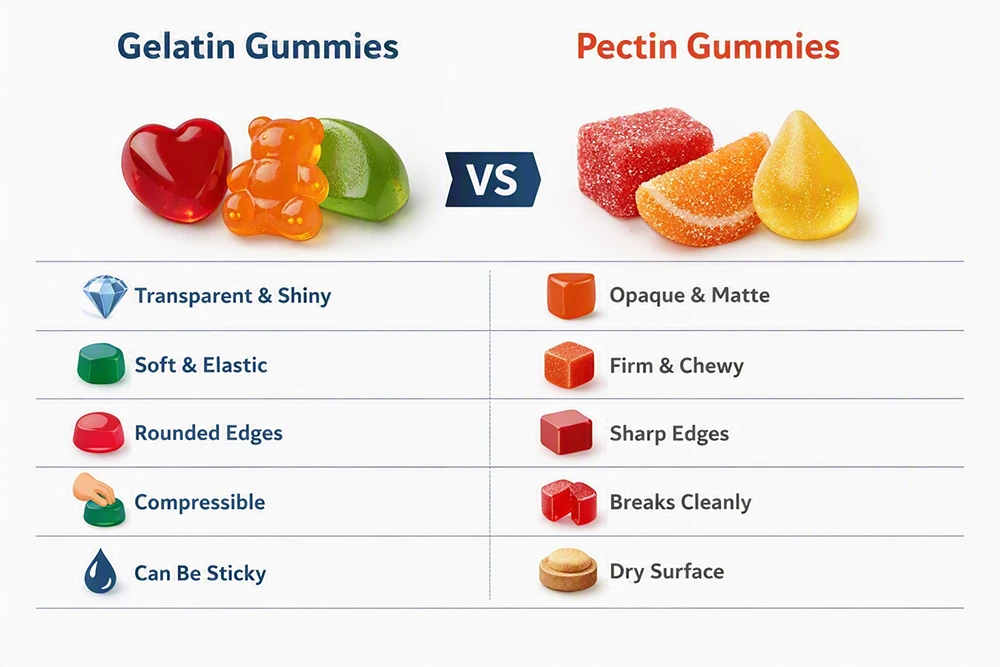
The original gummy formulation relied on animal-derived gelatin, which provides the characteristic chewiness, structural clarity, and cost-effectiveness that made the format commercially viable. In 2025, gelatin-based gummies still led the global market with approximately 60–68% of ingredient-based market share, owing to gelatin’s superior elasticity and the fact that it is 20–40% cheaper per kilogram than pectin alternatives. However, demand from vegan, halal, and kosher consumer segments has accelerated investment in plant-derived gelling agents including pectin, agar, and carrageenan. Manufacturers who can offer both gelatin and plant-based formulations hold a meaningful advantage in serving global markets with diverse dietary and regulatory requirements.
Key Differences: Confectionery Gummies vs. Supplement Gummies
Confectionery gummies and supplement gummies share a common technological origin but diverge significantly in formulation complexity, regulatory burden, and production standards. Confectionery gummies are primarily optimized for taste, appearance, and shelf stability. Supplement gummies must additionally ensure active ingredient stability, precise dosage consistency, and compliance with dietary supplement regulations in target markets such as the US (FDA DSHEA framework), the EU (food supplement directives), and other jurisdictions. The inclusion of heat-sensitive ingredients such as probiotics, certain vitamins, and botanical extracts requires specialized process controls not required in standard confectionery manufacturing. This divergence is one reason why brands increasingly choose dedicated Gummy Contract Manufacturing partners with documented supplement-specific quality systems rather than sourcing from general confectionery producers.
Who Should Consider Gummy Manufacturing Services
The gummy format is relevant for a broad range of B2B buyers: established supplement brands seeking to expand their product portfolio into a high-growth format; D2C wellness brands entering the market for the first time; retailers building private-label product lines; and functional food companies developing crossover products. The rise of e-commerce and subscription-based supplement sales has also created demand from smaller volume buyers who require flexible minimum order quantities and fast iteration cycles — both of which are addressed by OEM and ODM manufacturing arrangements.
Technical Parameter Reference Table
| Parameter | Details |
|---|---|
| Product Form | Gummy (bear, ring, cube, worm, custom shape); available in standard, sour-coated, sugar-free, and vegan variants |
| Primary Gelling Agents | Gelatin (bovine, porcine, fish); Pectin (citrus, apple); Carrageenan; Agar — selected based on dietary, regulatory, and texture requirements |
| Active Ingredient Categories | Vitamins (A, B-complex, C, D, E, K), Minerals (Zinc, Selenium, Calcium, Iron), Amino acids (Creatine, L-Theanine), Botanicals (Ashwagandha, Sea Moss, Elderberry), Probiotics, Collagen, Melatonin, Omega-3 |
| Manufacturing Process | Ingredient blending → cooking/dissolution → flavor/color addition → depositing into starch or silicone molds → cooling/demoulding → optional coating → drying → quality inspection → packaging |
| Quality Standards | GMP (Good Manufacturing Practice); ISO 9001; ISO 22000; HACCP; FDA registration; HALAL; KOSHER; Vegan certification; third-party CoA (Certificate of Analysis) |
| Packaging Options | Bottled (HDPE, PET); pouches; blister packs; bulk bags; custom-branded retail packaging with full OEM label design |
| Minimum Order Quantity (MOQ) | Varies by manufacturer; trial/startup runs typically 1,000–5,000 units; commercial scale from 50,000 units and above |
| Production Capacity (Reference) | Large-scale GMP facilities: 10–20+ tonnes per day; annual capacity 3,000–6,000+ tonnes |
| Lead Time | New product development: 4–8 weeks; repeat orders: 2–4 weeks depending on raw material availability and volume |
| Storage & Logistics | Cool, dry conditions (15–25°C); humidity-controlled storage recommended; standard shelf life 12–24 months; compatible with air and sea freight export |
| Regulatory Compliance (Export) | FDA DSHEA (US); EU Food Supplement Directive; TGA (Australia); SFDA (Saudi Arabia); documentation includes CoA, MSDS, specification sheets, and country-specific labeling compliance |
Practical Insights for B2B Buyers
Manufacturing Quality and Process Control
Gummies are technically demanding to produce at consistent quality. They are hydrocolloid gel matrices whose final texture, chewiness, and active ingredient stability depend on tightly controlled interactions between the gelling agent, sugars, acids, water activity, temperature, and humidity. Even minor deviations during the cooking or depositing stages can alter hardness, transparency, or dosage accuracy. Brands should require documented in-process quality controls, not only finished product testing, when evaluating a custom gummy manufacturer.
Raw Material Sourcing Transparency
The quality and safety profile of a finished gummy is largely determined upstream, at the raw material level. Buyers should verify that manufacturers can provide certificates of analysis, origin documentation, and allergen declarations for all key ingredients, including the gelling agent, active compounds, sweeteners, and colorants. This is particularly important for gelatin (animal source traceability) and botanical extracts (identity verification and contaminant screening).
Production Scalability and Lead Time
Brands entering the market for the first time often underestimate the relationship between order volume and lead time. A manufacturer with genuine large-scale capacity can absorb both trial batches and large commercial runs without compromising scheduling or quality. Confirm that the manufacturer’s stated daily output is supported by physical facility capacity and equipment, not theoretical figures.
Compliance and Documentation Readiness
Export-oriented brands must ensure their manufacturing partner can provide the regulatory documentation required in target markets. This includes, at minimum, GMP certificates, product-specific CoAs, MSDS sheets, and labeling compliance support. For markets with specific requirements — such as HALAL certification for Gulf Cooperation Council countries or TGA compliance for Australia — verification of active certifications is non-negotiable.
Cost Structure Considerations
Gummy supplement unit costs are influenced by gelling agent selection (gelatin vs. pectin carries a significant price difference), active ingredient inclusion rates, flavor and color complexity, packaging format, and order volume. Buyers comparing quotes should ensure they are comparing equivalent formulation specifications. A lower quoted price based on a reduced pectin ratio or an unverified botanical extract is not a meaningful cost saving.
B2B Decision Guide: Choosing a Gummy Manufacturer
How Brands Should Evaluate a Manufacturing Partner
Brands considering OEM or private label gummy production should structure their evaluation around four core dimensions: formulation capability, quality system maturity, production capacity, and commercial flexibility. A manufacturer that excels in one area but underperforms in another — for example, sophisticated R&D capability but limited cleanroom production space — may not be appropriate for scale-up scenarios.
What Matters in OEM/ODM Projects
In OEM arrangements, the brand supplies a finalized formulation and the manufacturer produces to specification. In ODM arrangements, the manufacturer contributes formulation development alongside production. Brands should clarify ownership of the formulation IP before engagement, confirm the manufacturer’s minimum batch size relative to their launch volume, and ensure the manufacturer has worked with the specific active ingredients relevant to their product category.
Assessing Production Capability
Facility visits or third-party audits remain the most reliable way to verify stated production capability. Key indicators include the classification of cleanroom space (100,000-class is standard for dietary supplements), equipment age and maintenance records, batch documentation practices, and microbiological testing infrastructure. Manufacturers holding multiple certifications — ISO 9001, ISO 22000, HACCP, and GMP simultaneously — typically demonstrate a more mature quality management system than those holding a single certification.
Key Criteria for Long-Term Supply Partnerships
Long-term B2B gummy supply relationships require more than price alignment. Brands should assess a manufacturer’s capacity buffer (whether they can absorb volume surges without impacting lead times), their raw material procurement network (domestic vs. import dependency), and their track record of regulatory compliance across export destinations. References from existing clients in comparable market segments are valuable where available.
Risk Control and Quality Assurance Checkpoints
Recommended quality assurance checkpoints include: incoming raw material testing (identity, purity, heavy metals, microbiology); in-process checks during cooking, depositing, and drying; finished product batch testing against specification (active ingredient potency, moisture, hardness, microbial counts, shelf-life stability); and pre-shipment inspection. Brands managing products across multiple markets should also confirm that batch records are retained in a format compatible with their own quality management requirements.
Conclusion
Gummies originated in Germany in 1922, when Hans Riegel Sr. translated a centuries-old tradition of soft gel-based confectionery into a commercially reproducible, gelatin-based product under the Haribo brand. Over the following century, the format evolved from a novelty confection to a dominant supplement delivery system valued precisely because it improves consumer adherence while accommodating a wide range of active ingredients. For B2B buyers — whether building a new supplement brand, expanding an existing portfolio, or sourcing for private label — understanding this origin provides a useful lens on the raw material science, manufacturing complexity, and market expectations that define the gummy category today. The global market’s sustained double-digit growth rate confirms that gummies have transitioned from trend to structural category, making manufacturing partner selection a long-term strategic decision rather than a transactional sourcing exercise.
Frequently Asked Questions
Q: Where did gummies originate?Gummies originated in Germany in 1922. Hans Riegel Sr. of the Haribo company created the first modern gummy candy — a bear-shaped, gelatin-based confection called the “Dancing Bear” — using a process derived from earlier pectin and starch formulations. Gum arabic was among the original base ingredients, giving rise to the term “gummy.”
Q: When did gummies become a supplement format?The transition from confectionery to supplement format occurred primarily in the late twentieth and early twenty-first centuries. Gummy vitamins for children were among the earliest mainstream supplement applications, with adult formulations following as brands recognized that the format improved consumer compliance compared to tablets and capsules.
Q: What is the difference between gelatin and pectin gummies?Gelatin is an animal-derived protein that provides strong elasticity, clarity, and cost-effectiveness; it accounts for approximately 60–68% of current gummy market share. Pectin is a plant-derived polysaccharide that produces a firmer, slightly less elastic texture and is suitable for vegan, halal, and kosher formulations. Pectin is typically 20–40% more expensive per kilogram than gelatin.
Q: What quality standards apply to gummy supplement manufacturing?Gummy supplement manufacturers are expected to operate under GMP (Good Manufacturing Practice) standards and, ideally, hold certifications including ISO 9001, ISO 22000, HACCP, and relevant market-specific credentials (FDA registration for US-bound products, HALAL for Middle East markets, KOSHER where required). Third-party batch testing with documented certificates of analysis is standard practice for export-grade production.
Q: How should a brand evaluate a gummy contract manufacturer?Brands should assess four core dimensions: formulation capability (does the manufacturer have relevant R&D experience with the target active ingredients?), quality system maturity (what certifications and in-process controls are in place?), production capacity (is the facility physically capable of the required volume?), and commercial flexibility (can the manufacturer accommodate the brand’s MOQ, lead time, and packaging requirements?). Facility audits or verified third-party audit reports provide the most reliable basis for evaluation.
Q: What is the market outlook for gummy supplements?The global gummy supplement market is projected to reach between USD 37 billion and USD 48 billion by 2030–2033, growing at a compound annual growth rate of approximately 14–15%. Asia-Pacific holds the largest regional market share. Growth is driven by consumer preference for convenient supplement formats, the expansion of D2C and e-commerce channels, and increasing investment in plant-based and functional gummy formulations.
About the Manufacturer
Shenzhen Gothink Biotech Co., Ltd. is a large-scale dietary supplement contract manufacturer based in Shenzhen, China, with an annual production capacity of 5,000 tonnes and a daily output of 16 tonnes. The company operates GMP-certified facilities featuring a 100,000-class cleanroom and a 10,000-class pharmaceutical-grade R&D laboratory, and holds certifications including ISO 9001, ISO 22000, HACCP, FDA, HALAL, KOSHER, GMP, and Vegan. Gothink Biotech provides comprehensive OEM, ODM, CMO, and CDMO services across gummy, capsule, tablet, powder, liquid, and drop supplement formats, supporting product categories from multivitamins and botanical extracts to functional nutrition and specialty supplements. The company’s formulation team, led by researchers with postdoctoral experience at US institutions, conducts research and development on approximately 2,000 new product formulations annually. make gummies at commercial scale with flexible minimum order quantities and full-service support covering raw material sourcing, formulation development, regulatory documentation, custom packaging design, and export logistics. Gothink Biotech is positioned to support long-term B2B partnerships with supplement brands, private label buyers, distributors, and retailers operating in global markets.