
Executive Summary
The gummy candy market has evolved from a consumer novelty into a sophisticated functional supplement category, with brands ranging from mass-market confectionery to premium nutritional formulations. Modern gummy supplements and custom gummy manufacturers now dominate the dietary supplement space, offering entrepreneurs and established brands the opportunity to launch products through flexible manufacturing solutions like OEM/ODM partnerships. Understanding the distinction between different manufacturing approaches—including private labeling, contract manufacturing, and in-house production—is essential for businesses seeking to scale efficiently while maintaining product quality and regulatory compliance.
What Are Gummy Candy Brands?
Gummy candy brands refer to companies or product lines that manufacture, distribute, or retail gummy-based products, ranging from traditional confectionery items to functional supplements containing vitamins, minerals, herbal extracts, and other bioactive ingredients. A gummy brand encompasses the entire ecosystem: formulation, manufacturing, packaging, quality assurance, marketing, and distribution. In the modern market, gummy brands operate across three primary business models: retail consumer brands (selling directly to end-users), wholesale suppliers (producing for other brands), and integrated manufacturers offering gummy contract manufacturing services to entrepreneurs and established companies seeking to expand their product portfolios without building internal manufacturing infrastructure.
The gummy category has matured significantly, transitioning from sugar-laden novelties to sophisticated health and wellness products. This evolution reflects broader consumer trends toward preventative health, convenience, and taste-forward functional nutrition.
Market Landscape: Where Gummy Candy Brands Compete
Segment Breakdown
The global gummy market operates across multiple segments, each with distinct manufacturing requirements and quality standards:
Functional Supplement Gummies dominate the fastest-growing segment, including vitamin formulations, mineral supplements, nootropics (cognitive enhancers), sports nutrition, and botanical extracts. These products command premium pricing and require pharmaceutical-grade manufacturing standards, precise dosage controls, and regulatory compliance across multiple jurisdictions (FDA in the U.S., EU regulations in Europe, NMPA standards in China).
Traditional Confectionery Gummies remain a significant market segment, emphasizing flavor, texture, and visual appeal. While these products have fewer regulatory restrictions than functional supplements, leading brands increasingly differentiate through natural ingredients, reduced sugar, or functional claims (added probiotics, collagen, etc.).
Pediatric and Senior-Focused Gummies represent specialized sub-segments with heightened safety requirements. Formulations must account for swallowing difficulty, dental considerations, and age-appropriate dosing. This category has seen explosive growth driven by consumer demand for “kid-friendly” vitamin delivery and senior wellness products.
Athletic and Performance Gummies combine functional ingredients (creatine, BCAAs, caffeine, adaptogens) with sports-specific formulations, targeting gym-goers and competitive athletes. Manufacturing here requires precise ingredient stability and bioavailability optimization.
Global Manufacturing Landscape
Manufacturing capacity is concentrated in three primary regions:
- China: Dominates global production with cost advantages, advanced facility infrastructure (100,000-class cleanrooms), GMP certification standards, and established supply chains for raw materials. Chinese manufacturers now lead in innovation for gummy formulation technology and ingredient extraction.
- United States & Europe: Premium positioning with emphasis on quality certifications, organic ingredients, clean label formulations, and regulatory pre-compliance. Higher labor costs and facility investments limit scalability for price-sensitive segments but command premium retail margins.
- India & Southeast Asia: Emerging manufacturers focusing on active pharmaceutical ingredients (APIs) and raw material extraction, increasingly offering contract manufacturing services as regulatory frameworks strengthen.
Core Manufacturing Approaches: OEM, ODM, and Private Label
Understanding manufacturing models is critical for entrepreneurs and brands evaluating outsourcing partnerships.
OEM (Original Equipment Manufacturing)
OEM services refer to contract manufacturing where the client provides complete formulation specifications, ingredients, and branding, while the manufacturer handles production and quality control. The manufacturer operates under client specifications without contributing product development or intellectual property.
Advantages for Brands:
- Maximum control over formulation and ingredient sourcing
- Ability to maintain proprietary recipes
- Flexibility in sourcing component materials
- Suitable for brands with established R&D capabilities
Operational Requirements:
- Client must supply all formulation documentation, ingredient specifications, and quality standards
- Requires clear communication protocols and detailed SOPs (Standard Operating Procedures)
- Quality assurance responsibility is shared between client and manufacturer
ODM (Original Design Manufacturing)
ODM services involve the manufacturer contributing formulation development, ingredient sourcing, and process optimization, in addition to production. The client outsources product development to the manufacturer’s R&D team, accelerating time-to-market.
Advantages for Brands:
- Rapid product development leveraging manufacturer expertise
- Access to pre-developed formulations and ingredient combinations
- Reduced R&D investment and time-to-market (typically 4-8 weeks vs. 12+ weeks for custom development)
- Lower minimum order quantities available for proven formulations
- Built-in compliance expertise for regulatory navigation
Operational Requirements:
- Client defines performance targets and functional benefits desired
- Manufacturer handles formulation science, stability testing, and regulatory filing support
- Intellectual property typically remains with the manufacturer (though custom modifications can be proprietary)
Private Label Manufacturing
Private label manufacturing allows retailers and wholesalers to rebrand existing, pre-formulated products with their own branding and packaging. This is the fastest and lowest-cost entry point into the gummy market.
Advantages:
- Shortest time-to-market (2-4 weeks)
- Lowest upfront investment in R&D
- Minimal MOQ (often 1,000-2,500 units)
- Immediate access to proven, safety-tested formulations
Trade-offs:
- No product differentiation vs. competitors using same base formula
- Limited customization of active ingredients or concentrations
- Higher per-unit costs compared to larger MOQs in custom manufacturing
The Gummy Manufacturing Process: Technical Overview
Raw Material Sourcing and Specification
Quality gummy manufacturing begins with rigorous raw material qualification. Key ingredient categories include:
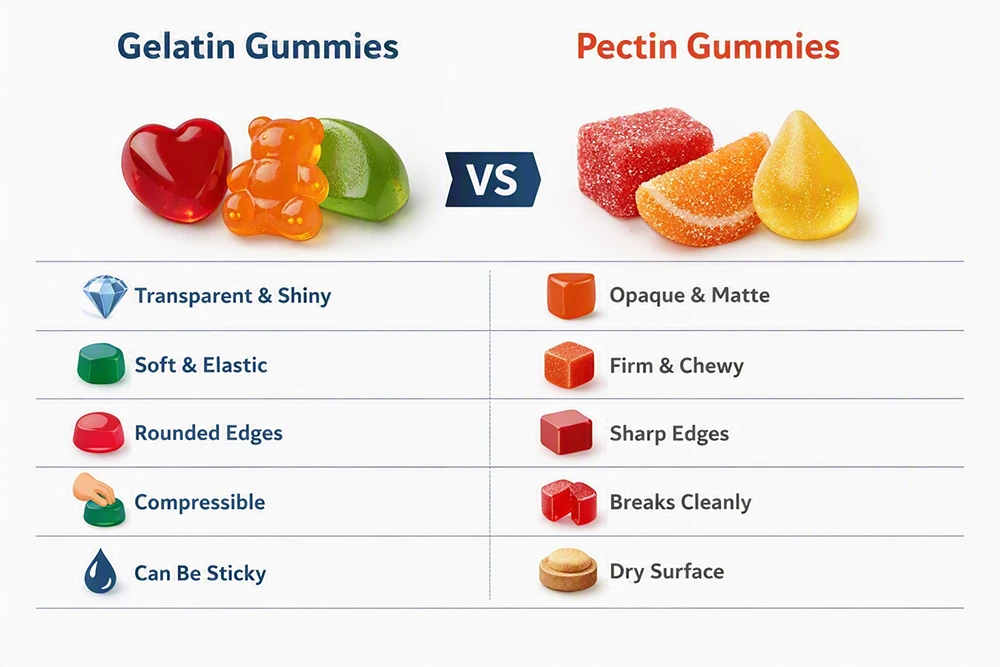
Gelling Agents: Gelatin (animal-derived) remains the industry standard, providing optimal texture, mouthfeel, and cost efficiency. However, vegetarian alternatives—pectin, carrageenan, agar, and modified starch—address dietary restrictions (vegan, vegetarian, kosher, halal) and allow for additional premiums. Pectin-based formulations require adjusted sugar/acid ratios and shorter setting times but appeal to the clean-label segment. Carrageenan offers superior texture but demands precise hydration control.
Sweetening Agents: Transition from high-fructose corn syrup and synthetic sweeteners to sugar alcohols (maltitol, sorbitol), stevia, monk fruit, and sugar blends reflects consumer health consciousness. Each sweetener influences crystallization rates, mouthfeel, and manufacturing process parameters.
Active Ingredients: Vitamins (ascorbic acid, biotin, D3), minerals (calcium carbonate, zinc gluconate), herbal extracts (ashwagandha, elderberry, echinacea), probiotics, and other bioactives require stability testing under temperature, humidity, and light exposure. Microencapsulation or coating may be necessary to prevent ingredient degradation during manufacturing and storage.
Colorants and Flavorings: Natural colors (anthocyanins, beta-carotene) command premium positioning but exhibit lower stability compared to synthetic alternatives. Flavor stability under heat (critical during cooking and molding) and palatability (masking unpleasant tastes of active ingredients) require careful formulation balancing.
Formulation and Stability Testing
Modern gummy formulation is quantitative science, not trial-and-error. Leading manufacturers employ:
Accelerated Shelf-Life Testing (ASLT): Simulating real-world storage conditions (elevated temperature, humidity) over weeks to predict actual shelf-life (typically 2-3 years) within 4-6 weeks. This allows manufacturers to optimize formulations before committing to large-scale production.
Bioavailability Assessment: For functional gummies containing active ingredients, manufacturers test absorption rates in vitro (lab-based models) and often conduct small human studies to ensure marketed claims align with actual nutrient delivery.
Microbiological Testing: Ensures absence of pathogenic bacteria, molds, and yeasts. This becomes critical for products containing probiotics or herbal extracts derived from botanical sources.
Technical Specifications and Quality Parameters
|
|---|
The Role of Quality Certifications and Compliance
Regulatory Certifications
ISO 9001: Quality Management System certification demonstrates systematic approaches to manufacturing, documentation, traceability, and continuous improvement. Essential for enterprises supplying regulated industries or larger retail chains requiring vendor audits.
ISO 22000: Food Safety Management System certification specifically addresses hazard analysis, critical control points (HACCP), allergen management, and traceability in food and supplement manufacturing.
GMP (Good Manufacturing Practice): FDA-enforced standards for dietary supplement manufacturers in the United States, requiring documented SOPs, validated equipment, trained personnel, and comprehensive testing. Non-compliance results in product recalls, warning letters, and brand damage.
HACCP (Hazard Analysis and Critical Control Points): Systematic approach identifying and controlling biological, chemical, and physical hazards throughout production. Mandatory for export to many countries.
FSMA (Food Safety Modernization Act) Compliance: U.S.-specific regulation requiring risk-based preventive controls, supplier verification programs, and traceability systems.
HALAL, KOSHER, Vegan Certifications: Expand addressable markets by meeting religious and dietary requirement communities. Each certification requires ingredient audits, process segregation, and documentation.
The Business Case for Outsourced Gummy Manufacturing
Economic Analysis: Build vs. Buy Decision
In-House Manufacturing Capital Investment:
- GMP-compliant facility with 100,000-class cleanroom: $2-5 million USD
- Production equipment (cookers, molders, coating lines): $500,000-1.5 million
- Quality control laboratory (analytical instruments): $200,000-400,000
- Personnel (R&D, production, QA): $200,000+ annually
- Total startup cost: $3-7 million+ with 18-24 month ramp-up
Contract Manufacturing Outsourcing:
- Initial R&D/formulation: $5,000-50,000 (ODM) or provided by brand (OEM)
- Tooling/molds for custom shapes: $2,000-8,000 (one-time)
- MOQ-based unit costs: $0.15-0.50 per unit (volume-dependent)
- Zero capital equipment investment
- Regulatory filing support included (many manufacturers)
Break-even Analysis: For products with retail pricing of $15-30 per bottle, contract manufacturing remains cost-advantageous until annual volumes exceed 1-2 million units. Even high-volume brands often maintain outsourced partners for agility and capacity flexibility.
Scalability and Time-to-Market
Contract manufacturing enables rapid market testing and iteration:
- Concept to market: 8-12 weeks (vs. 12-18 months for facility build)
- Product iteration: Manufacturers can rapidly reformulate based on market feedback
- Capacity flexibility: Scale from 10,000 to 500,000 units without capital constraints
- Risk mitigation: Validate market demand before committing to fixed assets
Advanced Topics: Formulation Innovation and Differentiation
Texture and Mouthfeel Engineering
Modern gummy manufacturers employ sensory science to engineer precise texture profiles:
Soft vs. Hard Formulations: Soft gummies (8-15 Shore hardness) appeal to pediatric and senior consumers but exhibit shorter shelf-life and higher stickiness risk. Hard gummies (40-60 Shore) require stronger jaw force but store longer and resist clumping. Leading brands now offer segmented product lines targeting different consumer segments.
Chewy Texture Optimization: Achieved through gelatin-to-pectin ratios, corn syrup solids content, and precise cooking times. High-end manufacturers conduct consumer testing with 200-500 respondents to validate texture preference before production scaling.
Dissolving vs. Chewable Formulations: Dissolving gummies (designed to break apart quickly on tongue) enhance perception of quality and reduce choking risk for pediatric products. Achieved through modified starch incorporation and lower gelatin concentrations.
Clean Label and Sustainability Trends
Clean Label Movement: Consumers increasingly demand recognizable, minimal ingredient lists. This drives formulation innovation toward:
- Natural colors (anthocyanins from blueberries, beta-carotene from carrots) replacing synthetic dyes
- Reduced sugar variants using stevia or monk fruit
- Plant-based gelatin alternatives (pectin, carrageenan, cellulose)
- Elimination of artificial flavors and preservatives
Sustainability Positioning: Brands differentiate through:
- Sustainable packaging (compostable pouches, glass bottles)
- Responsibly sourced botanical ingredients with traceability
- Carbon-neutral manufacturing or renewable energy usage
- Upcycled or waste-stream derived ingredients
Leading manufacturers now integrate sustainability into manufacturing design, reducing water consumption, optimizing energy usage, and establishing botanical supplier partnerships with defined sustainability criteria.
Strategic Partnerships and Vendor Selection
Evaluating Contract Manufacturers
Critical Selection Criteria:
1. Regulatory Compliance and Certifications
- Verify GMP compliance through FDA Form 483 history (publicly available)
- Confirm ISO 9001 and food safety certifications
- Review third-party audit reports (many manufacturers contract external auditors)
- Assess country of origin regulations (FDA oversight, local regulatory frameworks)
2. Capacity and Lead Times
- Annual production capacity vs. your growth projections (3-year horizon)
- Lead time flexibility during peak seasons
- Inventory management practices (can they hold buffer stock?)
- Backup capacity arrangements for disruption scenarios
3. R&D Capability Assessment
- Portfolio of completed projects (request anonymized case studies)
- Stability testing capabilities (accelerated testing equipment)
- Ingredient sourcing expertise (access to novel or hard-to-source ingredients?)
- Regulatory filing support (do they prepare IND/supplement binders for approval?)
4. Quality Control Protocols
- Third-party testing (raw materials, finished products)
- Traceability systems (can they identify a batch within 2 hours?)
- Deviation and CAPA (Corrective Action) processes
- Customer communication (transparency on testing results, issues)
5. Cost Structure Transparency
- Itemized pricing (ingredient cost, labor, overhead, profit margin)
- Volume-based pricing tiers and break points
- Tooling, packaging, and ancillary charges
- Long-term pricing stability agreements
6. Relational Factors
- Language capabilities (local team bilingual in your language)
- Time zone alignment for real-time communication
- Reference customers willing to discuss experience
- Flexibility in problem-solving and customization
Red Flags in Vendor Evaluation
- Unusually low pricing (often correlates with quality shortcuts or hidden fees)
- Reluctance to provide certifications, testing data, or facility tours (virtual acceptable)
- Inability to discuss formulation science or process details
- No third-party audit history or publicly verifiable compliance
- Pressure to commit to long-term contracts without performance history
B2B Decision Framework: Choosing Your Manufacturing Partner
Decision Matrix for Gummy Brand Founders
|
|---|
Cost Projection Model
Year 1 Product Launch (25,000 units)
- Private label sourcing: $3.50-5.00 per unit → $87,500-125,000 retail inventory cost
- Packaging & labeling: $1.00-1.50 per unit → $25,000-37,500
- Regulatory/testing: $3,000-8,000 (one-time)
- Marketing & fulfillment: Variable
Year 3 Scale-Up (500,000 units)
- Custom ODM manufacturing: $0.80-1.50 per unit → $400,000-750,000
- Packaging & labeling: $0.30-0.60 per unit → $150,000-300,000
- Regulatory (ongoing compliance): $5,000-10,000
- Quality assurance (third-party testing): $0.05-0.15 per unit → $25,000-75,000
Unit Economics at Retail Price of $20-25 per bottle (60-90 gummies):
- COGS (manufacturing + packaging): $2.50-5.00
- Gross margin: 75-87%
- Available for fulfillment, marketing, overhead, profit: $15-22.50 per unit
Practical Implementation: Launching Your Gummy Product
Phase 1: Concept Validation (Weeks 1-4)
Competitive Analysis
- Research 20-30 comparable products (Amazon, iHerb, Vitacost)
- Document positioning: price point, target demographic, unique claims, ingredient composition
- Identify white space: underserved demographics, formulation gaps, price brackets
Formulation Definition
- Define core functional benefits (energy, sleep, immunity, cognitive performance)
- Identify target ingredient combinations (3-5 primary active ingredients maximum for simplicity)
- Set target price point and work backward from COGS requirements
Manufacturer Identification
- Request RFQs (Request for Quotation) from 5-8 manufacturers
- Specify: formulation type (OEM/ODM), target MOQ, timeline, certifications required
- Evaluate responses on cost, capacity, regulatory expertise, communication clarity
Phase 2: Product Development (Weeks 5-12)
Formulation Optimization
- If ODM: Collaborate with manufacturer’s R&D to refine formula
- If OEM: Finalize all ingredient specifications and target potency levels
- Conduct stability testing (accelerated testing typical for timeline): 4-6 weeks
Regulatory Preparation
- FDA notification (dietary supplement manufacturers submit basic information to FDA)
- Ingredient documentation (safety summaries for novel ingredients)
- Structure/function claims development (claims must be substantiated; cannot imply disease prevention)
- Label compliance review (ingredients, allergen statements, directions for use)
Sample Evaluation
- Request manufacturer to prepare stability samples (3-5 unit samples)
- Conduct sensory evaluation: taste, texture, appearance, mouthfeel
- Request shelf-life samples (testing at 3, 6, 9, 12 months)
Phase 3: Production and Launch (Weeks 13-16)
Final Production Run
- Confirm MOQ and delivery timeline with manufacturer
- Establish quality acceptance criteria (microbial testing, potency verification)
- Arrange third-party testing (independent lab verification of finished goods)
Packaging and Fulfillment
- Design labels (regulatory compliance + brand differentiation)
- Arrange packaging with co-packer or integrated manufacturer service
- Establish inventory management and fulfillment logistics
Market Launch
- Omnichannel strategy: Direct-to-consumer (e-commerce), Amazon, retail partnerships
- Influencer and content marketing highlighting functional benefits and ingredient sourcing
- Customer feedback collection for continuous product iteration
Practical Insights: Production, Quality, and Scalability
Manufacturing Best Practices
1. Documentation and Traceability Implement systems allowing identification of ingredient source within 2 hours. This requires:
- Supplier ingredient lot number tracking
- In-process batch documentation
- Finished goods serialization
- Digital traceability systems (blockchain solutions emerging for premium brands)
2. Quality Consistency Across Batches Achieving consistent product despite ingredient natural variation requires:
- Ingredient specification ranges (not single values)
- Sensory standards (trained testers evaluate appearance, taste, texture)
- Automated process controls (temperature, timing, humidity)
- Statistical process control (SPC) charting for trend identification
3. Equipment Investment and Maintenance Modern gummy production equipment ($500,000-2,000,000 investment) requires:
- Preventive maintenance schedules (critical for production uptime)
- Calibration protocols (equipment accuracy verification every 6-12 months)
- Validation documentation (proving equipment produces consistent results)
- Spare parts inventory (preventing downtime from component failures)
Scalability Considerations
Linear vs. Non-Linear Scaling Most manufacturers achieve 80-90% efficiency at designed capacity. Pushing beyond design capacity typically increases:
- Waste/reject rates (2-5% at optimal; 8-15% when overstressed)
- Lead times (4-6 weeks at capacity vs. 2-3 weeks at 60% utilization)
- Quality variation (larger batches require more process control attention)
Capacity Planning Framework
- Year 1-2: Operate at 40-60% of manufacturer capacity (preserves flexibility, enables rapid iteration)
- Year 3-5: Transition to 70-85% utilization (optimizing cost structure)
- Year 5+: Evaluate in-house production if volumes exceed 2 million units annually
Compliance and Regulatory Landscape
United States FDA Framework
Dietary Supplement Status: Gummy supplements are regulated as dietary supplements under the Dietary Supplement Health and Education Act (DSHEA, 1994), not drugs. This classification provides regulatory pathway flexibility but requires rigorous substantiation of claims.
Pre-Launch Notification: While FDA approval is not required, manufacturers must:
- Submit basic facility information to FDA
- Register as food facility (required for all dietary supplement manufacturers)
- Maintain documentation proving structure/function claims are truthful and not misleading
- Establish supplier verification programs (verifying ingredient identity and quality)
Label Claims Classification:
- Structure/Function Claims (permitted): “Supports immune health,” “Promotes healthy sleep,” “May help maintain healthy cholesterol levels”
- Disease Claims (prohibited): “Treats,” “Prevents,” “Cures,” or “Mitigates” any disease
- Substantiation: Manufacturers must possess competent and reliable scientific evidence before making claims
Adverse Event Reporting: Manufacturers must report serious adverse events to FDA within 15 days of receipt, even if causality is uncertain.
International Regulatory Considerations
European Union: Stricter than FDA; novel foods/ingredients require authorization before commercialization. Many U.S.-approved ingredients face restriction (e.g., certain botanical concentrations).
China (NMPA): Gummy supplements face increasing scrutiny; NMPA has published quality standards requiring microbial testing and potency verification.
Canada (Health Canada): Natural and Non-prescription Health Products Directorate (NNHPD) requires product licensing; some ingredients restricted compared to U.S.
Australia (TGA): Requires product registration; some ingredients and dosage levels differ from U.S. standards.
FAQ: Essential Questions for Gummy Brands
1. What is the typical minimum order quantity (MOQ) for custom gummy manufacturing?
Answer: MOQs vary significantly by manufacturer and formulation complexity. For standard formulations through ODM services, MOQs typically range from 5,000 to 20,000 units. Manufacturers using pre-developed formulas (private label) often accept MOQs of 1,000-2,500 units. Custom proprietary formulations (OEM) may require higher MOQs (10,000+ units) due to formulation development and validation costs. Negotiation is possible for established manufacturers or long-term partnerships; startups should budget for higher MOQs as manufacturers transfer development risk to volume commitments.
2. How long does product development and regulatory approval take for a new gummy formula?
Answer: Timeline depends on manufacturing approach. ODM with existing formula: 6-8 weeks (formulation finalization and stability testing). Custom OEM with proprietary formula: 12-16 weeks (includes extended R&D, stability testing, and regulatory documentation). FDA pre-launch notification (required in U.S.): 2-4 weeks after submission. International markets (EU, China): 4-12 months depending on regulatory pathway. Parallel processing—beginning packaging design and label compliance while formulation testing occurs—can compress timelines by 2-3 weeks.
3. What are the most common quality issues in gummy manufacturing and how are they detected?
Answer: Primary quality issues include: (1) Potency variance (active ingredients outside ±10% of label claim)—detected through HPLC chromatography testing; (2) Microbial contamination (bacterial, mold, yeast exceeding <10^4 CFU/g limits)—detected through ISO 4833 microbiological testing; (3) Texture inconsistency (hardness variance affecting consumer experience)—detected through durometer testing; (4) Ingredient separation or clumping during storage—prevented through environmental stability testing and proper packaging (moisture barriers); (5) Staining or discoloration (color instability under light/heat)—detected through accelerated shelf-life testing. Leading manufacturers employ third-party testing (independent labs) to verify finished goods, reducing reliance on in-house bias and providing customer assurance.
4. Can I start with a smaller manufacturer and scale to larger facilities later?
Answer: Yes, this is a standard growth strategy. Startups typically begin with smaller regional manufacturers (2,000-5,000 ton annual capacity), validating product-market fit and building brand credibility at higher per-unit costs. As volumes grow (Year 2-3), transition to larger manufacturers with 5,000-10,000+ ton capacity, achieving 30-50% cost reduction through economies of scale. Some brands maintain multiple manufacturers (hedging supply chain risk) or transition to contract manufacturers in lower-cost regions (China, India) as competition intensifies. Ensure new manufacturers have GMP and equivalent certifications; switching involves reformulation validation and new stability testing (4-6 weeks), so plan transitions 3-6 months in advance.
5. What certifications are absolutely necessary vs. “nice to have” for gummy manufacturing?
Answer: Essential certifications (non-negotiable): GMP compliance (FDA-required for U.S. market), ISO 9001 (demonstrates quality systems), ISO 22000 or HACCP (food safety credibility). Necessary for specific markets: FSMA compliance (U.S. exporters), CE marking (EU), NMPA approval (China). Market-dependent certifications (enhance positioning but not legally required): HALAL, KOSHER, Vegan, Non-GMO, Organic. Prioritize certifications aligned with your target market and customer expectations. U.S. brands selling through major retailers (Whole Foods, Vitamin Shoppe) typically require GMP, ISO 9001, and organic/non-GMO certifications. Direct-to-consumer brands can launch with GMP alone, adding certifications as market demand justifies cost ($500-2,000 per certification annually).
6. How do I protect my proprietary gummy formulation if outsourcing manufacturing?
Answer: Use legal agreements (Non-Disclosure Agreements, confidentiality clauses in manufacturing contracts) defining intellectual property ownership. For OEM manufacturing, retain formulation documentation; manufacturers operate under your specifications. For ODM, negotiate ownership of modifications and custom variations (not base formula). Consider splitting ingredient sourcing—you source proprietary actives directly; manufacturer sources commodity ingredients. Advanced strategy: Use contract manufacturers in geographically diverse regions, preventing any single manufacturer from understanding your complete formulation. Microencapsulation or proprietary ingredient combinations also create barriers to imitation. Legally protect formulations through trade secrets (not patents, which require public disclosure) if not eligible for patenting. Document development history and maintain clear invention assignment documentation from your R&D team.
Conclusion
The gummy candy and supplement market represents one of the most dynamic and accessible segments within the broader health and wellness industry. Success requires understanding the intersection of manufacturing science, regulatory compliance, market positioning, and supply chain management. Whether launching your first private label product or scaling a multi-SKU brand, selecting the right manufacturing partner—aligned with your growth stage, regulatory requirements, and quality standards—is the critical foundation.
The business case for outsourced gummy contract manufacturing is compelling: entrepreneurs can launch premium products in 8-12 weeks without capital equipment investment, validate market demand with controlled risk, and scale operations elastically as demand grows. Leading manufacturers now offer comprehensive support spanning formulation optimization, regulatory navigation, quality assurance, and compliance documentation—enabling brands to focus on marketing, customer experience, and brand building rather than operational complexity.
As the gummy category matures from novelty to necessity, differentiation increasingly depends on formulation innovation (novel functional combinations, clean labels, sustainability), sensory excellence (texture, flavor, visual appeal), and authentic brand storytelling. Manufacturers offering sophisticated R&D capabilities, pharmaceutical-grade quality standards, and transparent cost structures become strategic partners enabling this differentiation.
The next three years will likely see further consolidation among manufacturers (larger facilities acquiring regional producers) and increasing specialization (manufacturers focusing on specific therapeutic categories: cognitive, sleep, immunity, beauty, etc.). Brands prepared to evaluate manufacturing partners rigorously, commit to long-term relationships, and invest in supply chain resilience will capture disproportionate value in this expanding category.
Frequently Asked Questions
Q: What is the difference between OEM and ODM gummy manufacturing?
A: OEM (Original Equipment Manufacturing) means the brand provides complete formulation specifications and ingredients; the manufacturer handles only production and quality control. ODM (Original Design Manufacturing) means the manufacturer also contributes formulation development, ingredient sourcing, and process optimization. OEM preserves proprietary control; ODM accelerates time-to-market and reduces upfront R&D investment.
Q: How much does it cost to develop a custom gummy formula?
A: ODM formulation development typically costs $5,000-50,000, depending on ingredient complexity and stability testing requirements. OEM with proprietary formulation development can range $20,000-100,000+. These are typically one-time investments amortized across units produced over years.
Q: Can I manufacture gummies for private label sales without my own facility?
A: Yes, absolutely. Outsourced private label gummy manufacturing allows you to rebrand existing formulations with custom packaging. MOQs are typically 1,000-5,000 units, and time-to-market is 2-4 weeks. This is the lowest-cost entry into the gummy market.
Q: What shelf-life can I claim for gummy supplements?
A: Standard shelf-life is 2-3 years from manufacture date, verified through accelerated shelf-life testing (ASLT) simulating real storage conditions. Achieving longer shelf-life requires superior ingredient quality, optimized moisture control, and light-protective packaging—at higher cost per unit.
Q: How do I ensure consistent quality across different production batches?
A: Implement documented SOPs (Standard Operating Procedures), third-party finished goods testing, supplier ingredient lot tracking, and statistical process controls (SPC). Reputable manufacturers maintain batch traceability systems enabling identification of ingredient sources within 2 hours and conduct microbiological and potency testing on every batch.
Q: What is the maximum gummy size and shape I can custom manufacture?
A: Most manufacturers support shapes ranging from 8mm to 25mm+ diameter; mold tooling cost increases with complexity. Simple round gummies cost $500-1,000 in tooling; elaborate custom shapes cost $3,000-8,000. Minimum mold investment is typically $1,000-2,000 even for basic shapes.
About Gothink Biology: Your Partner in Custom Gummy Manufacturing
Gothink Biology (Shenzhen Gothink Biotech Co., Ltd.) represents the modern standard in contract gummy supplement manufacturing, combining pharmaceutical-grade infrastructure with scientific expertise and customization flexibility.
Manufacturing Excellence and Capacity
Gothink operates a GMP-certified facility featuring a 100,000-class cleanroom—meeting pharmaceutical-grade manufacturing standards and exceeding dietary supplement requirements. This infrastructure enables production of 16 tons daily (5,000 tons annually), supporting everything from startup trial batches to enterprise-scale orders. The facility holds comprehensive certifications including ISO 9001, ISO 22000, HACCP, FDA, HALAL, KOSHER, and Vegan, ensuring compliance across global markets and addressing diverse consumer dietary preferences.
R&D Leadership and Innovation
Gothink’s competitive advantage originates from its scientific leadership: co-founders served as postdoctoral fellows at the California Institute of Technology, Emory University, and Ohio State University, with deep expertise in plant extraction, biomanufacturing, and formulation science. The company operates a 10,000-class pharmaceutical-grade R&D laboratory supporting precise formulation development, stability testing, and ingredient innovation.
This combination delivers measurable impact:
- 2,000 new product formulations researched annually, enabling rapid market response
- Advanced extraction and bioavailability optimization leveraging postdoctoral research backgrounds
- Comprehensive stability testing (accelerated and real-time) validating shelf-life claims before production
Flexible Manufacturing Services
Gothink specializes in the complete gummy supplement manufacturing spectrum:
Gummy Products: Vitamin gummies, herbal-infused formulations, vegan options, low-sugar variants, pediatric formulations, and specialized functional gummies (sleep, immune, cognitive, athletic performance).
Manufacturing Models:
- OEM services for brands with proprietary formulations (clients provide specifications; Gothink manufactures and QA)
- ODM services leveraging Gothink’s R&D team for rapid formulation development and market entry
- Private label solutions for fastest time-to-market with established, proven formulations
- Flexible MOQ ranging from small trial batches to full-scale production runs
Supporting Services:
- Raw material sourcing and supplier qualification
- Formulation optimization and stability testing
- Regulatory compliance documentation and FDA filing support
- Custom packaging and labeling design
- Quality assurance and third-party testing coordination
- Scalable production from 5,000 units to 5,000+ ton annual capacity
Why Brands Choose Gothink Biology
1. Quality-Assured Manufacturing Pharmaceutical-grade 100,000-class cleanroom facility, GMP certification, and comprehensive testing protocols ensure finished gummies meet pharmaceutical standards—exceeding dietary supplement category requirements and building consumer confidence.
2. Science-Backed Innovation Postdoctoral research expertise enables sophisticated formulation development, novel ingredient combinations, bioavailability optimization, and stability solutions unavailable from standard manufacturers. Brands access world-class R&D without capital investment.
3. Global Compliance Expertise Comprehensive certifications (ISO, HACCP, HALAL, KOSHER, Vegan) and regulatory experience spanning FDA, EU, NMPA, and global markets enable confident expansion into international channels. Gothink provides compliance documentation reducing brand legal and reputational risk.
4. Scalability Without Compromise From 5,000-unit trial batches to multi-million unit annual volumes, Gothink scales production while maintaining consistent quality. No capital equipment investment required; brands grow elastically without manufacturing bottlenecks.
5. Customization and Speed Whether launching proprietary formulations (OEM), leveraging R&D expertise (ODM), or rebranding existing products (private label), Gothink accommodates diverse business models and timelines. Formulation development takes 6-8 weeks; private label launches in 2-4 weeks.
Strategic Partnership Model
Gothink positions itself as a strategic manufacturing partner rather than transactional supplier. This approach includes:
- Dedicated account management for consistent communication
- Proactive regulatory monitoring and compliance updates
- Formulation consultation during product development
- Market trend insights informing product strategy
- Scaling support as brands grow across channels
Global Reach with Local Expertise
Operating from Shenzhen (China’s pharmaceutical and biotech hub), Gothink combines cost advantages, manufacturing expertise, and established supply chains with English-language support, international certifications, and comprehensive documentation enabling smooth collaboration with U.S., European, and global brands.