
Summary
Sea moss gummies are a fast-growing dietary supplement format combining the functional benefits of Chondrus crispus (Irish sea moss) with the consumer-friendly appeal of chewable gummies. For supplement brands and OEM buyers, understanding the production process, ingredient sourcing, and quality control requirements is essential to launching a compliant, market-ready product. This guide covers the full manufacturing workflow, technical parameters, and supplier evaluation criteria relevant to B2B decision-makers.
Definition
How to make sea moss gummies refers to the end-to-end process of formulating, producing, and packaging chewable gummy supplements that contain sea moss extract or powder as a primary active ingredient, typically combined with gelling agents, sweeteners, flavoring, and complementary nutrients, using food-grade or pharmaceutical-grade manufacturing equipment and processes.
Main Content
What Sea Moss Gummies Are
Sea moss gummies are soft, chewable dietary supplements derived from red algae, primarily Chondrus crispus or Gracilaria species. Sea moss is naturally rich in iodine, iron, magnesium, and carrageenan—a structural polysaccharide that also functions as a gelling agent in food production. When formulated into gummy form, sea moss becomes more palatable and accessible to a broader consumer demographic, particularly those who find capsules or powders inconvenient.
Industry Background
The global sea moss supplement market has expanded significantly alongside broader consumer interest in ocean-derived superfoods, gut health, and thyroid support. Social media momentum—particularly across wellness communities—has driven retail demand for sea moss in multiple formats. Gummies have emerged as the preferred form factor due to their convenience, taste masking capability, and alignment with existing vitamin gummy purchasing habits. This has created measurable demand for brands seeking Gummy Contract Manufacturing services capable of handling botanical and marine-derived actives.
Business Relevance
For supplement brands, sea moss gummies represent a high-margin SKU with strong e-commerce and retail placement potential. From a supply chain perspective, sea moss sourcing requires attention to geographic origin (Atlantic vs. Pacific harvest), processing method (wildcrafted vs. pool-grown), and heavy metal testing given algae’s bioaccumulation properties. Production considerations include carrageenan content variability across sea moss grades, which directly affects gummy texture, gel strength, and batch consistency.
Differences vs. Alternative Formats
|
|---|
Gummies require more formulation precision than capsules or powders but consistently outperform other formats in retail sell-through and consumer repeat purchase rates.
Key Advantages and Limitations
Advantages:
- High consumer acceptance and compliance rates
- Flexible formulation with co-actives (e.g., bladderwrack, burdock root, elderberry)
- Strong branding and packaging differentiation potential
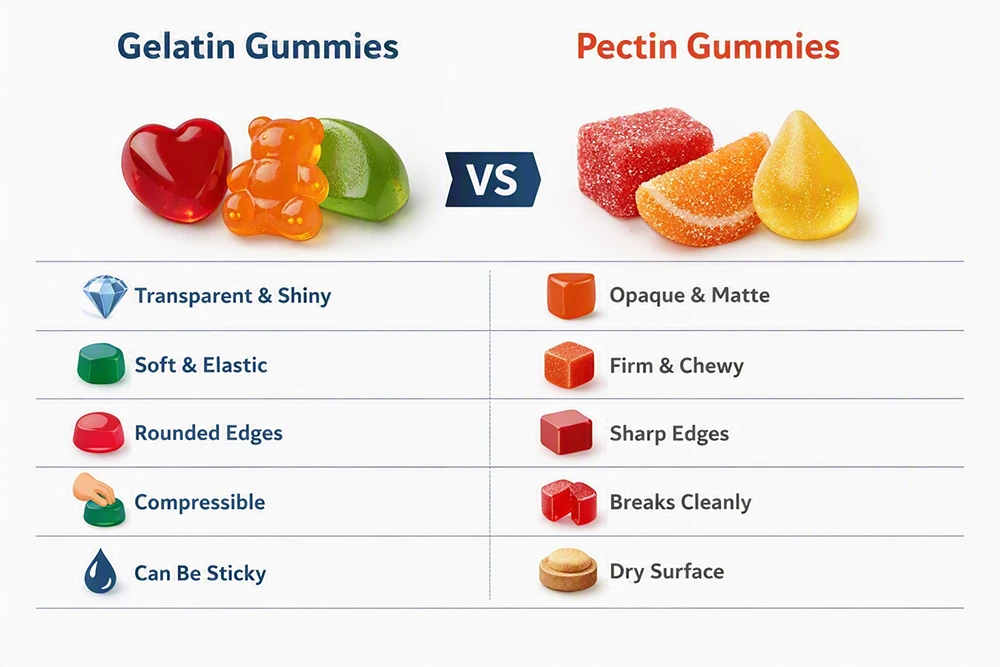
- Compatible with vegan gelling agents (pectin-based formulations)
Limitations:
- Sea moss extract introduces color and flavor challenges requiring masking strategies
- Iodine content must be carefully dosed to avoid exceeding safe upper limits
- Shelf-life management requires precise water activity control
- Heavy metal and microbial testing adds validation time and cost
Who Should Consider Sea Moss Gummies
This product format is well-suited for:
- Direct-to-consumer supplement brands targeting wellness and beauty markets
- Private label buyers seeking differentiated SKUs
- Health food retailers expanding functional food portfolios
- OEM/ODM buyers sourcing from a custom gummy manufacturer with botanical ingredient expertise
Compliance and Regulatory Considerations
In the United States, sea moss gummies fall under the FDA’s dietary supplement framework (21 CFR Part 111). Key compliance requirements include:
- Current Good Manufacturing Practice (cGMP) adherence
- Nutrition or Supplement Facts labeling per FDA guidelines
- Heavy metal testing (lead, arsenic, mercury, cadmium) is strongly recommended given algae’s bioaccumulation potential
- Iodine content disclosure and dosage alignment with established Tolerable Upper Intake Levels (UL: 1,100 mcg/day for adults per NIH)
- Allergen declarations if carrageenan-based gelling systems are used
International markets (EU, UK, Australia) impose additional requirements on novel foods, maximum nutrient levels, and labeling claims that must be addressed prior to export.
Technical Parameter Table
| Parameter | Details |
|---|---|
| Product Form | Soft chewable gummy (bear, round, ring, or custom shape) |
| Primary Active Ingredient | Sea moss extract or whole sea moss powder (Chondrus crispus, Gracilaria spp.) |
| Typical Dosage Range | 500 mg – 1,500 mg sea moss per serving (1–2 gummies) |
| Gelling Agents | Pectin (vegan), carrageenan, or gelatin (animal-derived); selection depends on target market and vegan positioning |
| Sweeteners | Organic cane sugar, tapioca syrup, glucose syrup, or low-sugar alternatives (erythritol, stevia blends) |
| Flavoring | Natural fruit flavors (citrus, berry, tropical) used to mask sea moss’s oceanic note |
| Co-active Ingredients (Optional) | Bladderwrack extract, burdock root, elderberry, vitamin C, zinc, biotin |
| Manufacturing Process | Ingredient weighing → Syrup preparation (heating, hydration of gelling agent) → Active blending → Molding/depositing → Cooling and demolding → Coating/oiling → Inspection → Packaging |
| Critical Process Controls | Temperature control during cook stage (typically 80–100°C), pH management, water activity (aw target: ≤0.60), bloom strength for gelatin, gel strength for pectin |
| Quality Standards | FDA cGMP (21 CFR Part 111), ISO 9001, ISO 22000, HACCP, GMP certification; third-party COA and heavy metal testing required |
| Testing Requirements | Heavy metals (Pb, As, Hg, Cd), microbial limits, iodine quantification, moisture content, weight uniformity, identity verification (HPLC or COA) |
| Packaging Options | PET bottles (60–120 count), pouches, blister packs, stand-up pouches; custom label and insert printing available |
| Shelf Life | 18–24 months under recommended storage conditions (cool, dry, away from direct light) |
| Storage Conditions | Temperature: ≤25°C; Relative Humidity: ≤60% |
| MOQ (Typical) | Starting from 5,000–10,000 units for trial runs; full-scale orders from 50,000+ units |
| Lead Time | Sample: 2–4 weeks; Mass production: 4–8 weeks depending on ingredient availability and order volume |
| Certifications Available | GMP, HALAL, KOSHER, Vegan, Organic (upon request) |
Practical Insights (B2B-Focused)
Manufacturing Quality and Process Control
The most technically demanding aspect of sea moss gummy production is achieving consistent gel texture given variability in sea moss extract composition—particularly carrageenan and iodine content across harvest batches. Reliable manufacturers implement incoming material testing for each raw material lot, establish standardized cook temperatures and hydration times, and conduct in-process checks for Brix levels, viscosity, and pH. Batch-to-batch reproducibility should be validated through at least three consecutive production runs before commercial scale-up.
Raw Material Sourcing Transparency
Sea moss quality varies significantly by species, harvest region, and processing method. Wildcrafted Atlantic sea moss (Ireland, Canada, Caribbean) and cultivated Gracilaria (Southeast Asia, West Africa) differ in mineral profiles and carrageenan content. B2B buyers should require full traceability documentation: supplier COA, geographic origin certificate, and independent heavy metal test reports. Pool-grown sea moss may contain lower mineral density and should be verified through assay testing rather than assumed equivalent to wildcrafted varieties.
Production Scalability and Lead Time
Well-equipped gummy manufacturers maintain depositing lines capable of producing millions of units per month. However, botanical gummies with marine actives may require dedicated or deep-cleaned equipment to prevent cross-contamination. Buyers should confirm the facility’s allergen control protocols and dedicated manufacturing schedules when placing initial orders. Scalability from trial run to commercial volume should be contractually defined, including raw material reservation policies.
Compliance and Documentation Readiness
For U.S. market entry, manufacturers must provide: cGMP compliance documentation, batch manufacturing records, finished product COA, heavy metal test results, and label review support. For EU and UK markets, additional documentation may include novel food dossiers or maximum permitted levels verification for iodine. A manufacturer’s ability to provide market-specific documentation packages is a reliable proxy for their regulatory maturity.
Cost Structure Considerations
Sea moss gummy unit costs are driven by: sea moss extract specification and concentration, gelling agent selection (pectin typically costs more than gelatin), co-active ingredient stack, packaging format, and order volume. Private label gummy projects typically benefit from economies of scale above 50,000 units. Buyers should request itemized cost breakdowns for formulation, raw materials, manufacturing, and packaging separately to identify optimization opportunities.
B2B Decision Guide
How Brands Choose the Right Manufacturer
When selecting a manufacturer for sea moss gummies, brands should prioritize facilities with documented experience handling marine-derived botanicals and a track record of iodine content management. A manufacturer’s ability to provide validated formulation development—not just tolling—indicates genuine technical capability. Request references or case studies from comparable products before committing.
What Matters in OEM/ODM Projects
In private label gummy and OEM/ODM engagements, intellectual property protection, formulation ownership agreements, and exclusivity clauses are non-negotiable for brand protection. Define clearly in contracts: who owns the formulation, whether the manufacturer can produce identical products for competitors, and minimum purchase commitments that trigger exclusivity provisions.
How to Assess Production Capability
Evaluate a facility’s annual production capacity, cleanroom classification, equipment age and type (continuous depositing lines vs. batch systems), and quality management system certification status. Request an audit or facility tour where feasible, or review a third-party GMP audit report. A facility producing sea moss gummies at commercial scale should have HACCP plans that specifically address marine allergens and iodine control points.
Key Criteria for Long-Term Supply Partnerships
Long-term supply stability depends on the manufacturer’s raw material sourcing resilience (multi-supplier capability for sea moss), financial stability, and communication responsiveness. Establish agreed-upon reorder lead times, safety stock policies, and annual price review mechanisms from the outset of the relationship.
Risk Control and Quality Assurance Checkpoints
Pre-production: Approve raw material COAs and retain reference samples. In-process: Monitor cook temperature, Brix, and pH at defined intervals. Pre-shipment: Independent third-party testing of finished goods for heavy metals, microbial load, and iodine content. Post-market: Maintain stability testing program to validate shelf-life claims.
Conclusion
Understanding how to make sea moss gummies from a B2B perspective requires more than a basic recipe—it demands careful attention to ingredient sourcing integrity, formulation precision, regulatory compliance, and manufacturing scalability. As consumer demand for functional marine superfoods continues to grow, brands that invest in technically rigorous production partnerships and transparent supply chains will be better positioned to build lasting market presence. Selecting the right private label gummy manufacturer with documented botanical and marine ingredient expertise is the single highest-leverage decision in bringing a sea moss gummy product to market successfully.
FAQ
Q1: What is the standard process for making sea moss gummies at a manufacturing scale? The process involves hydrating a gelling agent (pectin or gelatin), heating a sugar-syrup base to the appropriate temperature, blending in sea moss extract and any co-actives, depositing the mixture into molds, cooling and demolding, then coating and packaging. Temperature, pH, and water activity are the primary critical control points.
Q2: Why is heavy metal testing particularly important for sea moss gummies? Sea moss is a marine algae with a natural capacity to bioaccumulate heavy metals from its growing environment, including lead, arsenic, and mercury. Heavy metal testing on both raw sea moss inputs and finished gummy products is essential for consumer safety compliance and regulatory approval in all major markets.
Q3: How do sea moss gummies compare to sea moss capsules or powder? Gummies offer higher consumer acceptability and compliance rates but require more complex manufacturing, more rigorous water activity control, and greater formulation development investment. Capsules and powders are simpler to produce and lower cost but have lower retail appeal and consumer repeat-purchase rates.
Q4: What should B2B buyers verify before sourcing sea moss gummies from a manufacturer? Buyers should verify GMP certification status, heavy metal testing protocols, sea moss raw material traceability, iodine content management, minimum order quantities, lead times, and the manufacturer’s experience with marine-derived botanical actives specifically.
Q5: What quality standards apply to sea moss gummy manufacturing? Applicable standards include FDA cGMP (21 CFR Part 111) for U.S. market products, ISO 22000 for food safety management, HACCP plans covering marine allergens and iodine control, and third-party COA verification for each finished batch. HALAL, KOSHER, and Vegan certifications apply where relevant to the target market.
Q6: What is a realistic MOQ for a private label sea moss gummy launch? Most qualified contract manufacturers offer trial runs starting at 5,000 to 10,000 units, with commercial production typically scaled from 50,000 units upward. Pricing per unit improves meaningfully at higher volumes, making scalability planning an important part of initial project budgeting.
About the Manufacturer
Shenzhen Gothink Biotech Co., Ltd. is a GMP-certified dietary supplement manufacturer based in China, operating a high-capacity production facility with a 100,000-class cleanroom and a pharmaceutical-grade 10,000-class R&D laboratory. The company provides comprehensive OEM, ODM, and private label gummy manufacturer services across gummy, capsule, tablet, powder, and liquid supplement formats, with an annual production capacity of 5,000 tons. Gothink’s formulation team, led by researchers with postdoctoral experience at U.S. institutions, supports custom formulation development for botanical and marine-derived supplement categories including sea moss gummies. The facility holds ISO 9001, ISO 22000, HACCP, FDA, GMP, HALAL, KOSHER, and Vegan certifications, supporting global regulatory compliance across key export markets. The company supplies supplement brands, distributors, and OEM buyers with scalable manufacturing solutions, bulk ingredient supply, and full documentation packages suitable for U.S., EU, and international market entry.