
Complete Strategic Guide from Formulation to Market Launch
Executive Summary
Creating a successful gummy supplement brand requires strategic planning across formulation, manufacturing, regulatory compliance, and market positioning. This guide covers the complete process—from concept validation and ingredient sourcing through partnering with a gummy contract manufacturing provider, scaling production, and building customer trust. Whether you’re launching an independent brand or scaling an existing product line, understanding manufacturing capabilities, OEM/ODM service options, and compliance frameworks will determine your competitive advantage.
Creating a gummy supplement brand refers to the end-to-end process of developing, manufacturing, and commercializing gummy-based nutritional products under your own brand identity. This encompasses market research, formulation development, manufacturing partnership selection (including custom gummy manufacturer options), regulatory compliance, packaging design, and distribution strategy. The process can leverage OEM (Original Equipment Manufacturing) or ODM (Original Design Manufacturing) models to accelerate time-to-market without requiring in-house manufacturing infrastructure.
Step 1: Validate Your Market Concept
Identify Your Target Segment
Begin by defining your precise target audience. The gummy supplement market spans multiple segments: fitness enthusiasts seeking gummy bear manufacturing of performance formulas, women’s wellness consumers, children’s nutrition, seniors, and specialized health categories (sleep, immunity, cognitive support). Research competitor positioning, pricing strategies, and customer pain points within your chosen segment.
Analyze Market Demand & Trends
Evaluate whether your product addresses genuine market demand. Conduct keyword research, analyze e-commerce sales data, and monitor social media conversations around your product category. Study regulatory trends—for example, claims substantiation requirements and approved ingredients vary by geography. Validate that your product concept aligns with current regulatory frameworks in your target markets (North America, EU, Asia-Pacific).
Competitive Positioning Strategy
Map existing competitors: their formulations, pricing tiers, marketing angles, and distribution channels. Identify white space—underserved customer needs or unique formulation combinations. Your differentiation might center on ingredient quality, taste/texture innovation, sustainability, price accessibility, or health outcomes targeting.
Step 2: Develop Your Formulation
Partner with Expert R&D Teams
Working with a gummy contract manufacturing partner offering advanced R&D capabilities accelerates formulation development. Leading manufacturers employ postdoctoral scientists and specialized laboratories equipped with pharmaceutical-grade facilities. These teams understand bioavailability challenges, ingredient compatibility, and stability requirements that separate premium formulas from commodity products.
Define Active Ingredients & Potencies
Select primary active ingredients based on clinical evidence and regulatory approval status. Specify exact potencies per gummy serving, ensuring alignment with regulatory maximums (e.g., maximum daily values for vitamins, compliance with botanicals regulations). Consider ingredient sourcing: certifications like organic, non-GMO, and third-party testing enhance credibility and support premium positioning.
Optimize Gummy Matrix & Texture
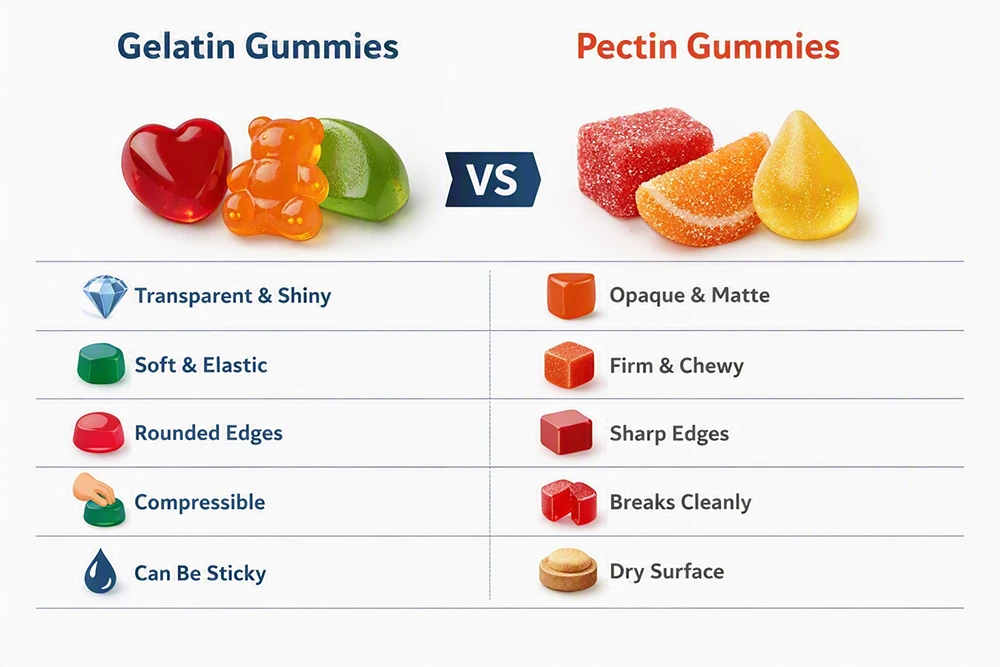
Gummy formulations require balancing multiple technical factors: gel strength (pectin, carrageenan, gelatin alternatives), water activity control, color stability, and shelf-life extension. Manufacturers can adjust formulas to achieve desired texture—chewy vs. harder gummies suit different consumer preferences and demographic targets. Conduct consumer preference testing with prototype batches before committing to production-scale manufacturing.
💡 Key Insight: Stability Testing
Invest in accelerated stability testing (typically 6-12 months) before market launch. This verifies ingredient stability, potency retention, and shelf-life claims. Test under varied storage conditions (temperature, humidity). This data becomes critical for label compliance and customer trust.
Step 3: Select the Right Manufacturing Partner
Understanding OEM vs. ODM Models
OEM (Original Equipment Manufacturing) means you provide the formulation and design specifications; the manufacturer produces to your blueprint. ODM (Original Design Manufacturing) involves the manufacturer designing the complete product—formula, packaging, even marketing strategy—which you then private label under your brand. Choose OEM for proprietary formulas or full creative control; select ODM for faster market entry with less development investment.
Evaluating Manufacturer Capabilities
Critical evaluation criteria include: GMP certification (pharmaceutical-grade quality standards), production capacity (daily output and annual capacity), cleanroom specifications (100,000-class or better for gummies), R&D laboratory quality (10,000-class pharmaceutical-grade facilities), and certifications (ISO9001, ISO22000, HACCP, FDA, HALAL, KOSHER, Vegan). Request process documentation, quality control protocols, and third-party audit results.
| Manufacturer Selection Criteria | What to Verify | Red Flags |
|---|---|---|
| GMP Certification | Current FDA/EU GMP audit certification; facility inspection records | Expired certifications or refusal to share audit reports |
| Production Capacity | Daily output (tons), annual capacity, lead time for new SKUs | Vague capacity claims or inability to handle anticipated growth |
| Quality Control | In-house testing capabilities, third-party lab partnerships, CoAs (Certificates of Analysis) | No documented QC processes or reluctance to provide testing data |
| Regulatory Support | Guidance on label claims, compliance documentation, export support | No regulatory expertise or inability to support multi-market launches |
| Pricing & MOQ | Transparent pricing; flexible minimum order quantities (MOQ); volume discounts | Fixed high MOQs or refusal to negotiate terms for startups |
| Client References | Verifiable client list; willingness to connect with past clients | No references or only indirect references via brokers |
Assessing R&D Capabilities
A manufacturer’s R&D strength directly impacts formulation innovation. Look for teams with published research backgrounds, advanced extraction/processing technologies, and documented innovation history (number of new formulations annually). Request examples of proprietary formulations they’ve developed and the timeline for custom development projects.
Step 4: Ensure Regulatory Compliance
Understand Your Market’s Regulatory Framework
Dietary supplement regulations differ significantly across territories. In the U.S., supplements are regulated under DSHEA (Dietary Supplement Health and Education Act)—less stringent than pharmaceuticals but with strict rules on claims substantiation and facility reporting. The EU requires novel food authorization for some ingredients. China and other Asian markets have distinct approval processes. Partner with manufacturers experienced in your target markets to navigate these requirements.
Ingredient Sourcing & Documentation
Every ingredient requires full traceability documentation: Certificates of Analysis (CoAs), non-GMO/organic certifications where applicable, and allergen statements. Establish protocols with your manufacturer for ingredient qualification, contamination testing (microbiological, heavy metals, pesticides), and regulatory status verification. Maintain detailed batch records and supplier documentation for potential FDA inspections.
Label Claim Substantiation
Structure health claims carefully to comply with regulations. Structure-function claims (e.g., “supports immune health”) require less evidence than disease claims. Use qualified health claims (e.g., “supports bone health”) sparingly and only for ingredients with sufficient scientific backing. Maintain a substantiation file documenting all claims before market launch. Your manufacturer’s regulatory team should guide claim development.
⚠️ Compliance Priority
Non-compliance risks include product seizures, warning letters, and brand damage. Invest in regulatory consulting (typically $5,000–$15,000 USD for comprehensive review) before launch. The cost is negligible compared to correction expenses.
Step 5: Design Packaging & Brand Identity
Packaging Strategy & Requirements
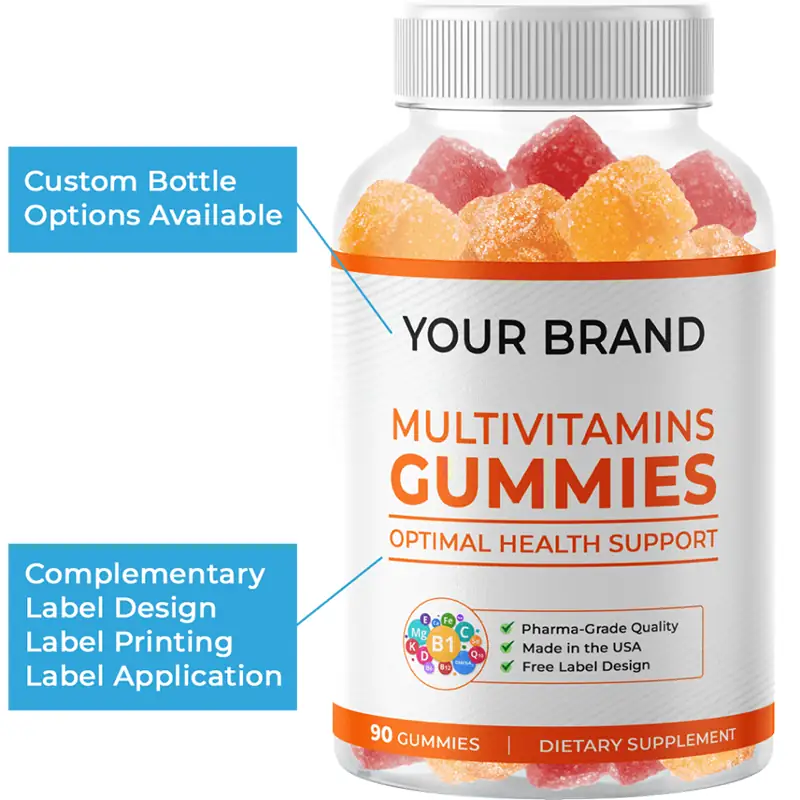
Gummy supplements typically use amber glass bottles, opaque plastic containers, or stand-up pouches depending on shelf-life requirements and target channel (e-commerce, retail). Ensure packaging includes: mandatory compliance information (ingredient list, supplement facts panel, usage directions, warnings), QR codes for traceability, and branding elements. Consider sustainability trends—recyclable or compostable packaging appeals to eco-conscious segments.
Label Design & Regulatory Elements
Your label must include the Supplement Facts panel (specific formatting required by FDA), ingredient disclosure, allergen warnings, and company contact information. Leave room for country-specific regulatory translations (e.g., French labels for Canadian distribution). Invest in professional label design that communicates product benefits while maintaining regulatory compliance—an inconsistent or poorly formatted label signals low quality.
Brand Positioning & Story
Develop a cohesive brand narrative that resonates with your target segment. This might emphasize ingredient sourcing transparency, scientific backing, sustainability, or efficacy. Your brand story influences packaging color, typography, and overall aesthetic. Private label gummy strategies particularly benefit from strong brand differentiation to justify premium pricing against commodity competitors.
Step 6: Plan Production & Quality Assurance
Production Workflow & Timeline
A typical production cycle from purchase order to delivery takes 6–8 weeks for custom formulations, shorter for existing formulas. Manufacturers typically require 30% deposit to initiate production, with balance due before shipment. Communicate your sales forecast and seasonal demand patterns—this allows optimized production planning and inventory management.
Quality Control & Testing Protocols
Establish comprehensive QC protocols covering: in-process controls (uniformity, potency), finished product testing (disintegration, moisture content, microbial limits), and stability data. Reputable manufacturers conduct third-party testing for critical parameters. Request Certificates of Analysis for every batch before accepting shipment. Document all testing data for regulatory inspection readiness.
Batch Traceability & Recall Preparedness
Implement systems enabling product traceability from raw materials through final distribution. Develop recall procedures identifying affected batch codes, communication templates, and distribution channels. Maintain relationships with your logistics partners for rapid recall execution. This preparedness demonstrates regulatory sophistication and protects brand reputation.
| Production Phase | Timeline | Key Activities |
|---|---|---|
| Formulation Finalization | 2-8 weeks | Prototype testing, consumer validation, stability studies |
| Manufacturing Setup | 1-3 weeks | Raw material sourcing, equipment calibration, batch record preparation |
| Production Run | 1-2 weeks | Gummy manufacturing, packaging, quality testing |
| QC & Release | 1-2 weeks | Third-party testing, CoA review, regulatory release approval |
| Logistics & Delivery | 2-4 weeks | Customs clearance, final destination delivery, inventory receipt |
Step 7: Build Distribution Channels & Scale
Multi-Channel Distribution Strategy
Gummy supplements reach consumers through multiple channels: direct-to-consumer (e-commerce), Amazon/online marketplaces, retail chains (health food stores, pharmacies, supermarkets), subscription services, and wholesale distribution. Each channel requires distinct packaging formats (e.g., bulk bottles for retail vs. single-serve sachets for subscriptions), pricing strategies, and marketing approaches. Start with one channel and expand methodically—most brands leverage direct-to-consumer for brand control and margin optimization.
Wholesale & Private Label Opportunities
Once you establish brand traction, private label gummy manufacturer partnerships offer rapid expansion. Retailers or larger distributors may request your formula under their private label brand, providing high-volume orders without direct consumer marketing costs. This channel diversifies revenue but requires manufacturing flexibility and willingness to share formulation IP.
Production Scaling & Inventory Management
As demand grows, coordinate with your manufacturer on capacity increases. Leading manufacturers capable of 5,000+ tons annual capacity can support rapid scaling. Maintain 90-180 days inventory to balance cash flow against demand variability. Establish contracts with tiered pricing reflecting volume commitments—larger orders yield per-unit cost reductions improving margins.
📊 Scaling Insight
First-year production commonly starts at 10,000–50,000 units per batch. Year-over-year growth of 200–300% is typical for successful brands. Plan manufacturing capacity 12 months ahead to avoid stockouts during peak demand.
B2B Decision Framework: Manufacturer & Model Selection
Use this framework to evaluate manufacturing partnerships and business model alignment:
🏭 Manufacturing ScaleMatch your growth projections (Year 1, Year 3, Year 5) to manufacturer capacity. Start with small-batch capability but ensure partner can support 5x growth without renegotiation.
🔬 R&D SophisticationProprietary formulations demand advanced R&D partnerships. Off-the-shelf formulas suit faster market entry. Assess innovation frequency (annual new product formulations completed).
💰 Pricing ModelEvaluate cost structures: per-unit pricing, setup fees, volume discounts, and payment terms. Transparent pricing prevents hidden costs. Negotiate volume-based tiering.
🌍 Market CoverageChoose manufacturers experienced in your target geographies. Regulatory expertise in multi-market expansion (U.S., EU, Australia) accelerates international scaling.
📋 OEM vs. ODMOEM suits brands with differentiated formulas and full control requirements. ODM accelerates launch timelines but limits unique positioning.
🤝 Partnership StabilityAssess manufacturer financial health, ownership structure, and long-term strategy. A stable, well-capitalized partner supports sustainable growth.
Practical Implementation Roadmap
Phase 1: Concept & Validation (Months 1-3)
- Conduct market research and competitive analysis
- Define target customer segment and value proposition
- Validate product concept through surveys/focus groups
- Identify 3-5 potential manufacturing partners
Phase 2: Formulation & Partnership (Months 3-6)
- Select primary manufacturing partner
- Develop initial formula with R&D team
- Conduct stability testing and consumer preference testing
- Establish regulatory compliance strategy
Phase 3: Launch Preparation (Months 6-9)
- Finalize label design and packaging
- Develop marketing content and brand story
- Complete first production run and quality testing
- Arrange distribution channels (e-commerce, retail, wholesale)
Phase 4: Market Launch & Optimization (Months 9+)
- Execute marketing campaigns across selected channels
- Gather customer feedback and iterate formula if needed
- Plan inventory and production for scaling
- Explore additional SKUs or adjacent product lines
Financial Considerations & Cost Structures
Typical Cost Breakdown for Gummy Supplement Launch
| Cost Category | Typical Range (USD) | Notes |
|---|---|---|
| Formulation Development | $5,000–$25,000 | Less for ODM, more for proprietary formulas with extended R&D |
| Regulatory & Compliance | $5,000–$15,000 | Multi-market compliance more expensive; U.S.-only lower cost |
| First Production Batch (10,000–30,000 units) | $15,000–$50,000 | Depends on formula complexity, potency, packaging quality |
| Packaging Design & Label Production | $3,000–$10,000 | Professional design + first print run; higher for premium packaging |
| Branding & Marketing Launch | $10,000–$50,000+ | E-commerce ads, influencer partnerships, content creation |
| Total Pre-Launch Investment | $38,000–$150,000 | Highly variable based on strategy and scale ambitions |
Per-Unit Pricing Model
Manufacturing cost-per-unit typically ranges $0.80–$2.50 for gummies at volumes of 10,000+ units annually (including formula, raw materials, manufacturing, packaging, and testing). Retail margins follow convention: manufacturer sells to distributor at 40% markup, distributor to retailer at 30%, retailer marks up 100%+. Direct-to-consumer bypasses intermediaries, enabling 60–75% gross margins after COGS and returns.
Advanced Topics: Differentiation & Growth
Innovation in Gummy Formulation
Premium formulation innovations include: delayed-release technologies improving bioavailability, synergistic ingredient blending (e.g., curcumin + black pepper for absorption), taste masking for less palatable actives, and texture optimization. Partner with R&D teams capable of 15–20+ annual new product formulations to stay competitive. Innovation-led brands command 20–30% price premiums versus generic competitors.
Sustainability & Clean Label Positioning
Growing consumer segments demand: natural gelling agents (pectin, carrageenan vs. gelatin), transparent sourcing (single-origin ingredients where possible), minimal additives, recyclable/compostable packaging, and carbon-neutral production. These attributes justify premium pricing and attract environmentally conscious demographics. Document sustainability practices through third-party certifications (B-Corp, carbon neutral, plastic-free).
Data-Driven Customer Retention
E-commerce brands leveraging subscription models, loyalty programs, and customer data analytics achieve 3–5x lifetime value improvements. Use customer feedback to refine products, identify adjacent SKU opportunities, and optimize dosing/serving sizes. A/B testing label messaging, flavor variants, and packaging formats yields continuous margin and conversion improvements.
Frequently Asked Questions
What is the minimum order quantity (MOQ) for gummy manufacturing?
MOQ varies by manufacturer but typically ranges 5,000–30,000 units. Some experienced manufacturers offer ODM programs with lower MOQs (2,000–5,000 units) to accelerate market entry for startups. Negotiate MOQ based on your cash flow constraints and market entry strategy. Larger upfront commitments generally yield better per-unit pricing.
How long does formulation development typically take?
For OEM custom formulations with stability testing, expect 4–8 weeks. ODM programs using existing formulas launch faster (2–4 weeks). This timeline includes prototype iterations, consumer preference testing, and stability data generation. Work with manufacturers offering concurrent activities (e.g., label design during stability testing) to compress timelines.
What certifications must my gummy manufacturer hold?
Essential certifications: GMP (FDA/EU), ISO9001 (quality management), ISO22000 (food safety), and HACCP. Additional certifications—HALAL, KOSHER, Vegan, Organic—support market-specific positioning but aren’t universally required. Request current, audited certification documentation before partnership. Expired or claimed-but-unverified certifications are red flags.
Can I use a private label model without developing my own formulation?
Yes. ODM manufacturers offer complete formulation and design—you provide branding and marketing. This accelerates launch (8–12 weeks total) but limits differentiation. Alternatively, select private label gummy manufacturer partners offering 20–50 pre-formulated options you customize with your branding. This balances speed with baseline differentiation.
What quality assurance steps protect my brand reputation?
Implement comprehensive QC: in-process testing (potency, uniformity), finished product validation (disintegration, microbial limits), stability studies, and third-party verification of critical batches. Maintain detailed batch records and Certificates of Analysis. Develop rapid recall procedures identifying affected batches. These systems demonstrate regulatory sophistication and protect against product liability.
How do I evaluate manufacturer pricing to ensure fair terms?
Request itemized quotes including: raw materials, manufacturing labor, packaging, quality testing, overhead allocation, and profit margin. Compare quotes from 3–5 manufacturers for identical specifications. Validate assumptions (e.g., potency levels, packaging quality). Negotiate volume discounts at 20,000 and 50,000+ unit tiers. Build relationships with manufacturers—long-term partnerships often yield 10–15% price reductions versus one-off orders.
Transform Your Vision Into Market-Ready Gummy Supplements
Whether you’re launching your first supplement brand or scaling an established product line, partnering with experienced gummy contract manufacturing providers accelerates your path to market while maintaining stringent quality standards. Shenzhen Gothink Biotech exemplifies the advanced capabilities required to support ambitious supplement entrepreneurs.
World-Class Manufacturing Infrastructure
Our facilities feature 100,000-class cleanrooms ensuring pharmaceutical-grade production environments. With 16-ton daily output and 5,000-ton annual capacity, we support brands from initial small-batch validation through high-volume wholesale distribution. Advanced R&D capabilities—backed by postdoctoral researchers from leading U.S. universities—enable proprietary formula development distinguishing your brand in competitive markets.
Comprehensive OEM/ODM & Custom Services
- Gummy Manufacturing: Complete solutions from formulation through final packaging—gummy bears, vitamin gummies, functional gummies with 30+ shape options
- OEM Services: Bring your proprietary formulation; we handle manufacturing, quality control, and packaging under your specifications
- ODM Solutions: Leverage our existing formulations or co-develop custom formulas; we manage design-to-delivery for rapid launches
- Flexible MOQ: Scalable production from trial batches to 5,000+ annual tons
- Multi-Format Expertise: Capsule, tablet, powder, liquid, and drop supplements using identical quality standards
Certification & Quality Assurance
We maintain ISO9001, ISO22000, HACCP, FDA, HALAL, KOSHER, and Vegan certifications alongside a 10,000-class pharmaceutical-grade R&D laboratory. Every batch undergoes rigorous testing—potency verification, microbial analysis, heavy metals screening, and stability confirmation—ensuring regulatory compliance across North America, Europe, and Asia-Pacific markets.
Strategic Partnership Advantages
Expert R&D Support
Postdoctoral scientists guide formulation innovation, bioavailability optimization, and ingredient synergy development annually researching 2,000+ new product concepts.
Regulatory Excellence
Navigate complex compliance landscapes across multiple territories. We provide label support, claim substantiation guidance, and export documentation for seamless market entry.
Quality Consistency
Pharmaceutical-grade processes ensure batch-to-batch consistency, precise dosing, and extended shelf-life. Third-party testing validates every production run.
Scalable Solutions
Start small—test market demand with trial batches—then scale seamlessly. Our capacity supports explosive growth without renegotiation or quality compromise.
Customization at Scale
Private label, custom formulations, proprietary packaging designs—all manufactured at competitive per-unit pricing reflecting your volume commitment.
Turnkey Support
From formulation through market launch—product consultation, design, manufacturing, packaging, and marketing support reduce your operational burden.
Partner With Experienced Leadership
Our chief scientist and co-founder brings postdoctoral research experience from Caltech, Emory University, and Ohio State University, with published expertise in structural biology, biochemistry, and novel drug discovery mechanisms. This scientific foundation elevates every formulation—ensuring products deliver promised efficacy while maintaining regulatory integrity.
Ready to launch or scale your gummy supplement brand? Partner with a manufacturer that combines world-class science, scalable infrastructure, and deep market expertise. Let’s transform your vision into market-ready products that build lasting customer relationships.
Conclusion: Your Path Forward
Creating a successful gummy supplement brand requires strategic orchestration across formulation, manufacturing, compliance, and market positioning. The most successful brands combine three elements: innovative, clinically-backed formulations; manufacturing partnerships ensuring consistent quality at scale; and customer-centric positioning addressing genuine market needs.
Whether you opt for OEM approaches providing complete control, ODM models accelerating market entry, or hybrid strategies balancing both, the manufacturer partnership fundamentally determines your success trajectory. Prioritize partners demonstrating pharmaceutical-grade quality standards, advanced R&D capabilities, regulatory expertise across your target markets, and proven ability to scale production meeting demand growth.
The dietary supplement market continues expanding as consumers prioritize preventive health and personalized wellness. Gummy supplements—combining efficacy, convenience, and consumer appeal—represent one of the fastest-growing categories. With professional execution and strategic manufacturing partnerships, you can build a brand capturing meaningful market share while delivering genuine value to health-conscious consumers globally.
Start with clear market validation, partner with manufacturers embodying quality and innovation, maintain unwavering focus on regulatory compliance, and continuously optimize based on customer feedback. Your gummy supplement brand succeeds when customers trust your products and recommend them to others.