
Selecting the right manufacturing partner is one of the most consequential decisions a supplement brand will make. A qualified supplier combines technical formulation capability, regulatory compliance, production scalability, and transparent communication to deliver consistent, market-ready products.
This guide covers the core criteria, due-diligence checkpoints, and evaluation frameworks that procurement teams, brand owners, and OEM/ODM buyers should apply when sourcing a gummy supplement manufacturing partner.
Definition
Choosing a reliable gummy supplement manufacturing supplier refers to the structured process by which a brand, distributor, or product owner identifies, evaluates, and contracts with a contract manufacturer capable of producing compliant, high-quality gummy dietary supplements at the required scale, cost structure, and timeline. The process encompasses factory audits, formulation verification, quality standard review, regulatory documentation, and long-term partnership assessment.
Why Supplier Selection Matters in Gummy Manufacturing
The gummy supplement category has grown rapidly into one of the most consumer-preferred delivery formats in the dietary supplement industry. Behind that growth lies significant manufacturing complexity: gummy production involves precise thermal control, gelling agent management, moisture regulation, and flavor consistency across batches. Selecting an unsuitable manufacturer early can result in product recalls, missed launch windows, labeling non-compliance, or formulation instability.
For brands entering or scaling in this category, the supplier relationship is not transactional — it is a technical partnership. A manufacturer’s R&D capability, quality infrastructure, and regulatory posture directly affect a brand’s ability to compete and remain compliant in regulated markets, including the United States, European Union, and Australia.
Industry Context
The global gummy supplement market is projected to continue double-digit growth, driven by consumer preference for palatability, convenience, and format novelty. This demand has attracted a large number of contract manufacturers globally, particularly in China, the United States, and Europe, with varying levels of GMP compliance, testing rigor, and formulation expertise. For buyers, differentiating genuine capability from marketing claims requires systematic due diligence.
OEM vs. ODM: Understanding Your Sourcing Model
Brands typically engage manufacturers under one of two primary models. In an OEM (Original Equipment Manufacturing) arrangement, the brand provides its own formula and the manufacturer produces to specification. In an ODM (Original Design Manufacturing) arrangement, the manufacturer develops the formulation on behalf of the brand, which then sells under its own label. A third model — private label gummy supply — offers pre-formulated, shelf-ready products that brands can brand and sell with minimal development investment. Understanding which model fits your stage of development is a prerequisite for evaluating suppliers accurately.
Key Advantages of Working With a Specialized Gummy Manufacturer
- Access to dedicated gummy production lines, including depositing, cooling tunnel, and demolding equipment
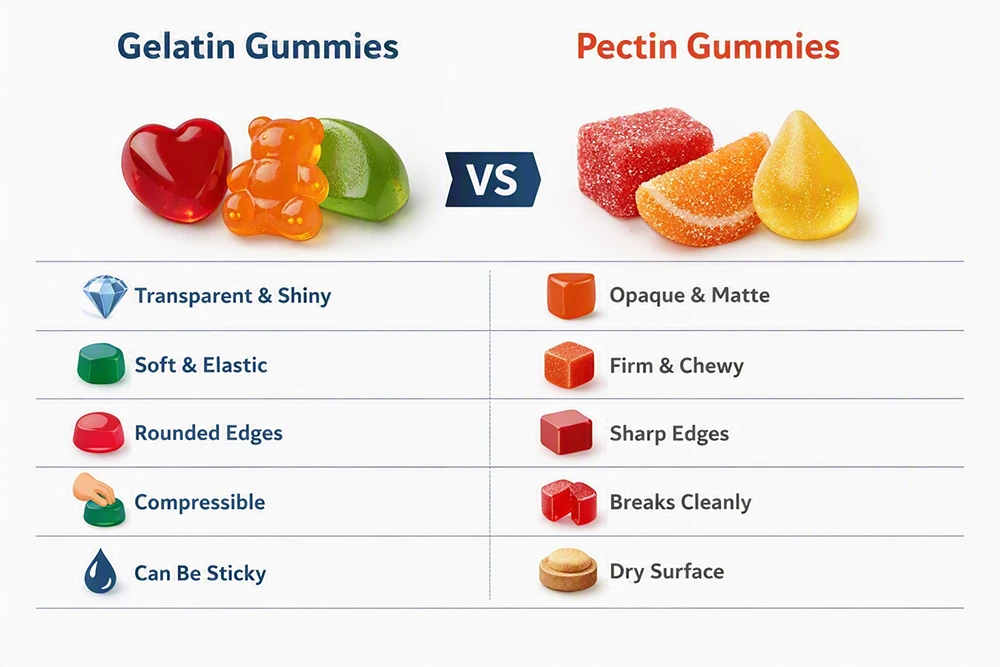
- Formulation expertise in pectin-based, gelatin-based, and vegan gelling systems
- In-house flavor and color library to accelerate development cycles
- Experience navigating FDA and international dietary supplement regulations
- Established raw material supply chains for bulk ingredient sourcing
Key Limitations to Be Aware Of
- Not all manufacturers hold current GMP certifications or submit to third-party audits
- Minimum order quantities (MOQs) vary significantly, affecting startups and small brands
- Lead times for custom formulations can range from 8 to 20 weeks depending on complexity
- Intellectual property protections for proprietary formulas require formal contractual safeguards
Who Should Prioritize This Process
This evaluation process is essential for supplement brand owners launching or relaunching gummy product lines, Amazon and DTC sellers requiring consistent, compliant supply, health and wellness distributors managing private label portfolios, and retailers seeking reliable co-manufacturing partners for own-brand products.
Compliance and Regulatory Considerations
In the United States, dietary supplements are regulated under 21 CFR Part 111, which mandates Current Good Manufacturing Practice (cGMP) standards. A qualified dietary supplement manufacturer must demonstrate documented batch records, specification testing, and identity verification for all incoming raw materials. For international markets, additional certifications such as ISO 22000, HACCP, Halal, Kosher, or EU GMP equivalence may be required. Brands must verify that their prospective manufacturer holds certifications applicable to their target markets.
Technical Parameter Reference Table
The following table summarizes the key manufacturing parameters and supplier evaluation criteria relevant to gummy supplement production.
| Parameter Category | Specification / Criteria | What to Verify With Supplier |
|---|---|---|
| Product Form | Gummy (pectin, gelatin, carrageenan base); shapes include bears, rings, cubes, custom molds | Confirm available mold library and custom mold lead time/cost |
| Key Ingredients / Gelling Agents | Pectin (vegan), gelatin (bovine/porcine), carrageenan; active ingredients including vitamins, minerals, herbal extracts, amino acids | Request COAs and supplier qualification records for raw materials |
| Manufacturing Process | Cooking → Mixing → Depositing → Cooling → Demolding → Coating/Oiling → Inspection → Packaging | Ask for process flow documentation; confirm temperature control specs |
| Quality Standards | GMP (21 CFR Part 111 or equivalent), ISO 9001, ISO 22000, HACCP; optional: NSF, USP, Informed Sport | Request current certificates; verify expiry dates and issuing body |
| Third-Party Testing | Heavy metals, microbiology, identity, potency, pesticide residue, allergen screening | Ask which tests are performed per batch and by which accredited lab |
| Minimum Order Quantity (MOQ) | Varies: 1,000–10,000 units for trial runs; 50,000–500,000+ units for full-scale production | Confirm MOQ per SKU and whether trial batch pricing is available |
| Production Capacity | Daily output ranges from 500 kg to 16+ tons depending on facility size; annual capacity up to 5,000 tons | Request capacity utilization data; ask about peak-season lead times |
| Packaging Options | Bottles (HDPE, PET), pouches, sachets, blister packs; custom label printing and shrink-wrap available | Confirm in-house packaging vs. outsourced; request samples |
| Lead Time | New formulation: 8–16 weeks; reorder of existing formula: 4–8 weeks | Get written confirmation of timeline milestones in the production agreement |
| Storage & Logistics | Temperature-controlled warehousing (15–25°C); moisture-sensitive products require desiccant packaging; shelf life typically 18–24 months | Confirm warehouse conditions; request stability study data if available |
| Regulatory Documentation | COA, MSDS, product specification sheet, batch records, certificate of origin for export | Request sample documentation package before committing to an order |
| Facility Cleanliness Grade | 100,000-class cleanroom for production; 10,000-class laboratory for R&D and quality control | Request facility photos or audit access; confirm ISO classification |
Practical Insights for B2B Buyers
Manufacturing Quality and Process Control
In gummy manufacturing, process consistency is the primary driver of product quality. Subtle variations in cooking temperature, mixing duration, or depositing speed can affect gummy texture, active ingredient uniformity, and moisture content. Buyers should ask prospective manufacturers for their in-process quality control documentation, including temperature logs, weight-check frequencies, and batch rejection criteria. A manufacturer that cannot articulate its control parameters in writing is unlikely to deliver consistent batches at scale.
Raw Material Sourcing Transparency
The quality of finished gummy products is directly constrained by the quality of input materials. Buyers should request ingredient source disclosure for all major actives, gelling agents, and colorants. Reputable manufacturers maintain qualified supplier lists and perform incoming raw material testing against registered specifications. Certificate of Analysis (COA) documentation from ingredient suppliers should be available on request. Opacity in this area is a significant procurement risk.
Production Scalability and Lead Time Management
A manufacturer capable of handling a 5,000-unit trial order may not have the capacity or scheduling flexibility to support 500,000-unit quarterly reorders without disruption. When evaluating scalability, buyers should ask about current capacity utilization, how peak-season demand is managed, and whether the facility has redundant production lines. Contractual provisions for priority scheduling or reserved capacity should be negotiated for high-volume partnerships.
Compliance and Documentation Readiness
For brands selling in regulated markets, the manufacturer’s documentation package is a product input, not a formality. Incomplete or inaccurate batch records, missing COAs, or lapsed certifications can trigger import holds, regulatory action, or retailer delisting. Before placing an initial order, buyers should request a sample documentation package and verify that it meets the compliance requirements of their target market.
Certifications should be treated as a minimum threshold, not a differentiator. GMP compliance confirms a baseline process standard; it does not verify formulation quality, ingredient sourcing integrity, or customer service reliability. Use certifications to qualify candidates, then conduct deeper evaluation.
Cost Structure Considerations
Gummy manufacturing cost is driven by several variables: ingredient costs (active concentrates can represent 40–70% of COGS), packaging material selection, order volume, and complexity of the formulation. Buyers should request itemized cost breakdowns rather than all-in unit pricing to understand where cost reduction is possible at scale. Low unit pricing without ingredient transparency may indicate ingredient substitution risk, which poses both quality and regulatory liability.
Evaluating Supplier Reliability
Beyond certifications, supplier reliability is demonstrated through reference checks, on-time delivery history, responsiveness to technical questions, and the clarity of their production agreements. Established manufacturers with a track record of international export, experience with FDA-regulated markets, and a dedicated account management structure are better positioned to support complex B2B supply chains than newer entrants offering low prices without documented process maturity.
B2B Decision Guide: Choosing the Right Manufacturing Partner
Step 1 — Define Your Product Requirements First
Before approaching manufacturers, brands should have clear documentation of their formulation goals, target market, regulatory jurisdiction, desired format (vegan, sugar-free, fortified), packaging requirements, and launch timeline. Manufacturers can only provide accurate proposals and timelines when supplied with complete briefs. Ambiguous briefs lead to misquoted costs and misaligned expectations.
Step 2 — Qualify on Compliance Before Price
Filter manufacturers first by whether they hold the certifications required for your target market. For the U.S. market, GMP certification under 21 CFR Part 111 is non-negotiable. For EU markets, verify equivalent food or supplement manufacturing compliance. For Halal or Kosher markets, confirm those specific certifications. Manufacturers who cannot provide current, audited compliance documentation should be disqualified regardless of pricing.
Step 3 — Assess Formulation Capability Directly
Request technical data sheets or sample formulations to assess the manufacturer’s R&D depth. Ask whether they have in-house food scientists or formulators. Inquire about their experience with specific active ingredients relevant to your product. For a custom gummy manufacturer, the ability to develop a stable, bioavailable formulation — not merely to fill molds — is the core capability being purchased.
Step 4 — Evaluate Communication and Project Management
Manufacturing partnerships involve ongoing coordination across sample review, artwork approval, production scheduling, and shipment logistics. A manufacturer that responds slowly to RFQ inquiries, provides vague answers to technical questions, or lacks a clear point of contact for project management is likely to create operational friction at scale. Communication quality during the evaluation phase is a reliable indicator of partnership quality after commitment.
Step 5 — Request Samples Before Committing
Physical samples are non-negotiable for gummy products. Texture, flavor, color consistency, and active ingredient uniformity cannot be assessed from a specification sheet. Reputable manufacturers should be willing to provide development samples at defined costs, with documented formulation records. Brands should test samples under conditions simulating end-consumer use and, where relevant, submit samples to third-party labs for potency verification.
Key Criteria Checklist for Long-Term Partnerships
- Current GMP certification verified with issuing body
- ISO 22000 or equivalent food safety management certification
- Third-party heavy metal and microbiology testing per batch
- Transparent raw material sourcing documentation (COAs available)
- Demonstrated capacity at target order volumes
- Written production agreements covering IP, batch records, and lead times
- Regulatory documentation package suitable for target market
- Proven export history to your target market
- Dedicated account management or project coordinator
- Willingness to undergo factory audit (virtual or on-site)
Risk Control and Quality Assurance Checkpoints
After contract execution, quality assurance does not end. Brands sourcing from contract manufacturers should establish pre-production specification approval, in-process quality check schedules, finished goods testing protocols, and clear non-conformance handling procedures. For high-volume or long-term programs, periodic factory audits — either directly or through third-party audit firms — are a standard component of professional supply chain management in the dietary supplement industry.
Conclusion
Choosing a reliable gummy supplement manufacturing supplier is a multidimensional decision that affects product quality, regulatory standing, cost efficiency, and long-term brand growth. The process requires moving beyond surface-level certifications to evaluate formulation depth, production consistency, documentation maturity, and the manufacturer’s demonstrated capacity for partnership rather than mere transaction.
Brands that invest in rigorous supplier evaluation — qualifying on compliance, assessing formulation capability, requesting samples, and establishing contractual quality controls — position themselves to scale confidently and compete in an increasingly sophisticated market. Gummy contract manufacturing partnerships built on transparency, technical alignment, and mutual accountability deliver substantially better outcomes than those driven primarily by unit price.
As the gummy supplement category continues to expand, the manufacturers who support long-term brand success will be those who combine GMP-compliant infrastructure with genuine R&D capability, scalable production, and a professional approach to customer partnership.
FAQ
What does choosing a gummy supplement manufacturing supplier involve?
It involves evaluating a contract manufacturer’s GMP compliance, formulation capability, raw material sourcing practices, production capacity, documentation readiness, and communication quality before entering a production agreement. The goal is to identify a partner capable of delivering consistent, compliant products at the required scale.
Why does GMP certification matter when selecting a gummy manufacturer?
GMP (Good Manufacturing Practice) certification confirms that a facility operates under documented, audited process controls that meet regulatory requirements for dietary supplement production. In the U.S., compliance with 21 CFR Part 111 is legally required for manufacturers supplying the American market. Brands sourcing from non-GMP-certified facilities face significant regulatory and liability exposure.
What is the difference between OEM and ODM in gummy supplement manufacturing?
In an OEM arrangement, the brand supplies its own formulation and the manufacturer produces to those specifications. In an ODM arrangement, the manufacturer develops the formulation on behalf of the brand, which then markets the product under its own label. Private label gummy supply is a variant of ODM using pre-existing, shelf-ready formulas.
How should brands evaluate a manufacturer’s raw material transparency?
Brands should request Certificate of Analysis (COA) documentation for all major active ingredients and gelling agents, ask for the manufacturer’s qualified supplier list, and confirm that incoming raw materials are tested against registered specifications. Manufacturers unable or unwilling to provide this documentation present a sourcing integrity risk.
What is a reasonable lead time for a custom gummy supplement formulation?
New custom formulation development typically requires 8 to 16 weeks from specification sign-off to finished goods, depending on formulation complexity, regulatory documentation requirements, and packaging lead times. Reorders of an existing, validated formula generally require 4 to 8 weeks. These timelines should be documented in the production agreement.
What quality testing should a reliable gummy supplement manufacturer perform?
At minimum, finished gummy products should be tested for heavy metals (lead, arsenic, cadmium, mercury), microbiology (total plate count, yeast/mold, pathogens), identity of active ingredients, and potency against labeled claims. Testing should be performed by accredited third-party laboratories, and certificates of analysis should be available per batch.
About Shenzhen Gothink Biotech Co., Ltd.
Shenzhen Gothink Biotech Co., Ltd. is a GMP-certified contract manufacturer based in China, specializing in the production of gummy, capsule, tablet, powder, liquid, and drop dietary supplements. The company operates a 100,000-class cleanroom production facility with a daily output capacity of 16 tons and an annual production capacity of 5,000 tons, supporting both small-batch trial production and high-volume commercial supply.
Gothink Biotech provides comprehensive OEM, ODM, CMO, and CDMO services, covering formulation development, custom design, manufacturing, packaging, and export documentation. The company’s R&D team is led by postdoctoral researchers with international academic backgrounds in structural biology and biochemistry, supported by a 10,000-class pharmaceutical-grade laboratory. The facility holds ISO 9001, ISO 22000, HACCP, GMP, Halal, Kosher, and Vegan certifications, enabling compliance with quality and regulatory requirements across multiple international markets.
The company offers flexible minimum order quantities to accommodate brands at different stages of growth, from startups requiring trial runs to established distributors managing large-scale supply programs. Raw material sourcing, quality documentation, and finished goods testing are conducted in accordance with current GMP standards, with batch records and certificates of analysis available for all production runs. Gothink Biotech maintains long-term B2B manufacturing partnerships with supplement brands, distributors, and retailers globally.