
Gummy Supplement Manufacturing is a specialized segment of the dietary supplement industry that combines food-science precision with pharmaceutical-grade quality control to produce functional, consumer-friendly products. The quality and cost of gummy supplements are shaped by a defined set of variables—including raw material selection, gelling agent type, active-ingredient stability, and GMP compliance—that B2B buyers must evaluate before committing to a manufacturing partner. Understanding these factors enables brands, private-label operators, and OEM/ODM buyers to make informed sourcing decisions and build competitive, compliant products.
Definition
Gummy Supplement Manufacturing refers to the industrial process of producing chewable, gelatin- or pectin-based dietary supplements that encapsulate vitamins, minerals, herbal extracts, and other functional ingredients in a palatable, confectionery-style delivery form. Unlike tablets or capsules, gummy supplements require a multi-stage production workflow that integrates precise cooking, mixing, depositing, and coating processes, all while preserving the potency and stability of heat-sensitive active ingredients.
What Is Gummy Supplement Manufacturing?
At its core, make gummies at a commercial level means transforming a liquid slurry of gelling agents, sweeteners, active nutrients, and flavoring compounds into a solid, shelf-stable chewable product. The process is more technically demanding than it appears: each ingredient interacts differently under heat, pH variation, and humidity, and any deviation in the cooking or depositing stage can result in inconsistent texture, inaccurate dosing, or degraded bioactives.
Modern gummy manufacturing facilities use continuous depositing lines, temperature-controlled starch mogul systems or starchless depositors, and inline quality checks to maintain product consistency at scale. Pharmaceutical-grade environments—typically 100,000-class cleanrooms—are increasingly required by major market regulators and large retail buyers.
Industry Background
The global gummy supplement market has grown rapidly over the past decade, driven by consumer demand for more enjoyable supplement formats and the expansion of functional nutrition into mainstream retail. The United States, Europe, and Asia-Pacific represent the largest demand centers, and global contract manufacturers in China, India, and the United States have scaled infrastructure to serve these markets. Regulatory frameworks such as FDA 21 CFR Part 111 (U.S.), EU Directive 2002/46/EC, and TGA guidelines (Australia) have raised the bar for GMP compliance across the supply chain.
Business Relevance
For supplement brands and distributors, gummy products typically command higher retail margins than equivalent capsule or tablet formats due to their perceived consumer value. However, the higher complexity of gummy production translates directly into higher per-unit manufacturing costs. OEM and ODM buyers must therefore assess manufacturing partners carefully, weighing cost efficiency against quality assurance infrastructure.
Supply chain considerations—particularly the sourcing of consistent, traceable active ingredients such as vitamins, collagen peptides, botanical extracts, or novel functional compounds (e.g., creatine, NMN, ashwagandha)—add additional layers of complexity. Ingredient availability and pricing fluctuations can significantly affect production planning and final product cost.
Gummy Supplements vs. Alternative Delivery Formats
Compared to capsules and tablets, gummy supplements offer superior consumer acceptance, particularly among children, elderly users, and individuals with difficulty swallowing pills. However, gummies have inherent limitations: sugar and caloric content (unless reformulated as sugar-free), lower active-ingredient loading capacity per unit, and greater sensitivity to temperature and humidity during storage and transit.
Compared to liquid drops or powders, gummies offer superior convenience and dosing consistency. The trade-off is a higher unit cost and a more complex manufacturing process. For brands targeting premium retail or DTC e-commerce, this cost difference is generally acceptable given the stronger market positioning of gummy formats.
Key Advantages
- High consumer acceptance and repeat purchase rates
- Flexible formulation: supports a wide range of vitamins, minerals, botanical extracts, and functional ingredients
- Strong retail shelf differentiation through shape, color, and flavor customization
- Compatible with vegan (pectin-based), halal, kosher, and allergen-free formulations
- Well-suited for private label and OEM/ODM product development
Key Limitations
- Higher production cost per unit relative to tablets and capsules
- Limited active-ingredient payload per gummy piece (typically 2–5g per unit)
- Heat-sensitive ingredients (e.g., probiotics, certain vitamins) require specialized encapsulation or cold-fill processes
- Shorter shelf life than tablets under suboptimal storage conditions
- Greater regulatory scrutiny in markets that classify gummies as food-drug hybrids
Who Should Consider Gummy Manufacturing?
Gummy supplements are most commercially viable for brands targeting the mass retail, e-commerce, and specialty health channels. They are particularly well suited for children’s nutrition, women’s wellness, beauty supplements (collagen, biotin), sleep support (melatonin), sports nutrition (creatine, pre-workout), and immune health (elderberry, vitamin C, zinc). OEM/ODM buyers launching private-label lines with differentiated sensory attributes—unique shapes, natural colors, or novel flavor profiles—will find gummy formats especially competitive.
Compliance and Regulatory Considerations
In the United States, gummy dietary supplements must comply with FDA Current Good Manufacturing Practice (cGMP) regulations under 21 CFR Part 111. Manufacturers must maintain batch records, conduct identity testing of all incoming ingredients, perform finished-product testing for identity, purity, strength, and composition, and implement robust Hazard Analysis and Critical Control Points (HACCP) protocols. In the EU and UK, gummy supplements may be classified as food supplements subject to food law, requiring compliance with permissible ingredient lists and labeling regulations. Export markets may require additional certifications such as HALAL, KOSHER, or market-specific registrations.
What Businesses Should Evaluate Before Sourcing
Before engaging a custom gummy manufacturer, B2B buyers should evaluate: the manufacturer’s GMP certification status and inspection history; in-house R&D capabilities for formulation development; raw material sourcing transparency and COA documentation standards; minimum order quantities and production lead times; packaging and labeling customization options; and the ability to provide third-party testing documentation. Cost benchmarking across multiple suppliers is advisable, as pricing for gummy contract manufacturing varies significantly based on ingredient complexity, order volume, and the level of turnkey services included.
Technical Parameter Table: Gummy Supplement Manufacturing
| Parameter | Standard Range / Options | Notes for B2B Buyers |
|---|---|---|
| Product Form | Gummy (standard bear, ring, cube, custom shapes); pectin-based or gelatin-based | Shape tooling costs vary; custom molds typically require NRE fees |
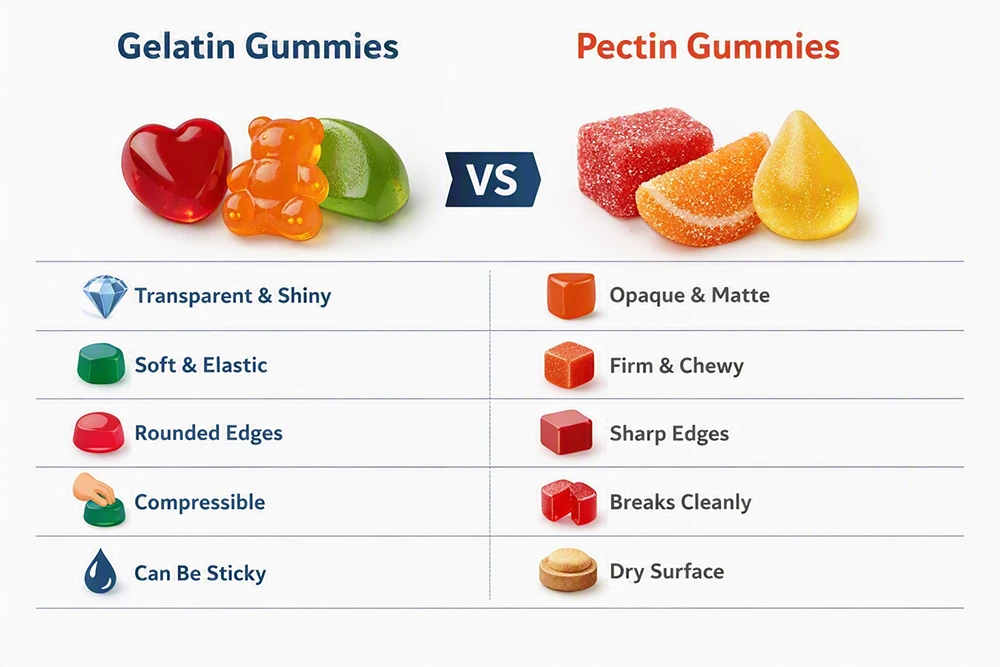
| Gelling Agents | Gelatin (bovine/porcine), Pectin (vegan), Carrageenan, Agar | Pectin is preferred for vegan/halal/kosher compliance; affects texture and price |
| Active Ingredient Loading | Typically 50–800 mg per gummy piece; up to ~1,000 mg with compression-assisted formats | High-dose actives (e.g., creatine 1,000+ mg) may require 2-per-serving formats |
| Sweeteners | Cane sugar, glucose syrup, isomalt, erythritol, allulose, stevia blends | Sugar-free formulations increase cost but expand diabetic/keto-friendly positioning |
| Flavors & Colors | Natural or artificial flavors; natural colorants (fruit/vegetable concentrates) or synthetic dyes | Natural colors cost more and may shift under heat; important for EU/UK label compliance |
| Manufacturing Process | Cooking → blending → depositing (mogul or starchless) → drying/curing → coating → QC → packaging | Starchless depositing yields cleaner product; mogul systems support higher volume |
| Cleanroom Class | 100,000-class (ISO 8) production floor; 10,000-class (ISO 7) R&D lab standard | Higher cleanroom class = lower contamination risk; required by pharmaceutical-grade buyers |
| Quality Standards | GMP (cGMP/FDA), ISO 9001, ISO 22000, HACCP, HALAL, KOSHER, Vegan certification | Third-party audit reports and COA documentation are minimum expectations for professional buyers |
| Minimum Order Quantity (MOQ) | Typically 5,000–50,000 units per SKU depending on manufacturer and formulation complexity | Low-MOQ runs are viable for market testing but carry higher per-unit costs |
| Production Lead Time | Sample: 2–4 weeks; bulk production: 4–8 weeks from formula approval | Custom formulations or novel ingredients may extend timelines |
| Packaging Options | HDPE bottles, pouches, blister packs, stand-up zipper bags; private label label printing | Child-resistant and tamper-evident packaging required for most U.S. and EU markets |
| Annual Production Capacity | Varies widely; large-scale contract manufacturers: 1,000–5,000+ metric tons/year | Capacity alignment is critical for brands planning rapid scale-up |
| Shelf Life | Typically 18–24 months; varies by moisture activity, coating, and packaging barrier | Accelerated stability testing (AST) should be requested for new formulations |
| Storage & Logistics | Cool, dry, <25°C, <60% RH; avoid direct sunlight; standard palletized freight compatible | Tropical market exporters should specify enhanced moisture-barrier packaging |
Practical Insights for B2B Buyers
Manufacturing Quality and Process Control
The single greatest determinant of gummy supplement quality is the consistency of the manufacturing process. Temperature control during the cooking stage (typically 105–115°C) directly affects gelling agent performance and active-ingredient degradation rates. Depositing accuracy—measured in milligrams of fill weight per piece—determines dosing consistency across a batch. B2B buyers should request documented process validation data and in-process quality control records before approving a manufacturer.
Raw Material Sourcing Transparency
Ingredient quality is inseparable from product quality. Reputable manufacturers maintain a qualified supplier list (QSL) for all raw materials and provide certificates of analysis (COA), heavy metal testing results, and microbiological test data for each incoming batch. For high-value or novel ingredients—such as NMN, ashwagandha extract, or marine collagen—buyers should confirm the identity testing method used (HPLC, NIR, etc.) and whether the manufacturer conducts independent verification or relies solely on supplier COAs.
Production Scalability and Lead Times
Understanding a manufacturer’s production scheduling model is essential for supply chain planning. High-volume facilities running continuous depositing lines offer better price-per-unit at scale but may have longer queue times during peak seasons. Smaller, more flexible manufacturers can accommodate faster turnaround for smaller runs but may lack the capacity for rapid scale-up. Buyers should negotiate capacity reservation agreements for high-velocity SKUs.
Compliance and Documentation Readiness
For exports to the U.S., EU, Australia, or Canada, manufacturers must be able to provide a comprehensive documentation package: GMP certificate, facility audit report (third-party preferred), Certificate of Analysis for each batch, stability data, allergen declarations, and country-of-origin documentation. Incomplete documentation is one of the most common causes of import delays and regulatory rejections. Verify documentation availability before production, not after.
Cost Structure Considerations
Gummy manufacturing costs are driven by four primary levers: (1) ingredient cost, which varies based on active compound pricing, organic certification, and sourcing geography; (2) gelling agent type, with pectin typically costing 20–40% more than gelatin; (3) production complexity, including number of formulation steps, custom tooling, and coating requirements; and (4) order volume, where per-unit costs decrease significantly at MOQs above 50,000 units. Buyers should request itemized cost breakdowns to identify which levers offer the most optimization potential.
Evaluating a Reliable Supplier
A reliable private label gummy manufacturer should demonstrate: GMP certification with current audit status; in-house R&D capability for formulation support; transparent raw material sourcing and COA documentation; clear MOQ and lead-time policies; and reference accounts or case studies from comparable brand clients. Site visits—or third-party facility audits in lieu of in-person visits—remain the gold standard for supplier qualification.
B2B Decision Guide: Choosing the Right Gummy Manufacturer
How Brands Choose the Right Manufacturer
Selecting a Gummy Contract Manufacturing partner requires a structured evaluation process. Start by defining product requirements: target formulation, dosage, format (shape, size, count), intended markets, and regulatory requirements. Then shortlist manufacturers based on GMP certification, production capacity, ingredient compatibility, and export experience. Request samples, review COAs, and—where possible—conduct facility audits before finalizing a contract.
What Matters in OEM/ODM Projects
In OEM projects, the buyer provides the formulation and the manufacturer executes production to specification. In ODM projects, the manufacturer contributes formulation expertise and the buyer selects from existing or co-developed formulas. For ODM engagements, the manufacturer’s R&D depth—including access to novel ingredients, stability data libraries, and formulation IP—is a critical differentiator. Buyers should clarify IP ownership for any customized formulations developed during the project.
Assessing Production Capability
Key capability indicators include: annual production tonnage, number and type of depositing lines, cleanroom classification, in-house analytical laboratory capabilities (HPLC, ICP-MS for heavy metals, microbiological testing), and the breadth of active ingredients previously manufactured. Manufacturers with a track record of producing complex formulations—such as multi-ingredient sports gummies, probiotic gummies with cold-fill technology, or high-potency vitamin matrices—offer lower development risk for sophisticated buyers.
Key Criteria for Long-Term Partnerships
Long-term partnership value is built on three pillars: quality consistency across batches, supply reliability (ingredient sourcing stability, production scheduling reliability), and regulatory adaptability (the ability to reformulate or re-label products as market regulations evolve). Manufacturers who invest in continuous GMP improvement, maintain ISO certifications, and proactively communicate regulatory changes are the most valuable long-term partners for growing supplement brands.
Risk Control and Quality Assurance Checkpoints
A robust quality assurance framework for dietary supplement manufacturer partnerships should include: incoming raw material testing (identity, purity, contaminants); in-process checks at cooking, depositing, and drying stages; finished-product release testing (dissolution, weight uniformity, active content); stability testing under ICH Q1A-aligned protocols; and retain sample archiving for a minimum of two years post-production. Buyers should confirm these checkpoints are documented and auditable.
Conclusion
Gummy supplement manufacturing is a technically complex, quality-sensitive process where the decisions made at every stage—from gelling agent selection and ingredient sourcing to process validation and regulatory documentation—directly determine the commercial viability and compliance of the final product. For B2B buyers, the core strategic value lies in selecting a manufacturing partner with the infrastructure, expertise, and systems to deliver consistent quality at commercially competitive cost, while supporting the brand’s long-term growth trajectory. A well-chosen private label gummy manufacturing partner is not merely a production vendor but a strategic enabler of market competitiveness.
Frequently Asked Questions
About Shenzhen Gothink Biotech Co., Ltd.
Shenzhen Gothink Biotech Co., Ltd. is a GMP-certified contract supplement manufacturer based in Shenzhen, China, offering OEM, ODM, CMO, and CDMO services across a full range of supplement formats including gummies, capsules, tablets, powders, liquids, and drops. The company operates a 100,000-class cleanroom manufacturing facility with a daily output of 16 tons and an annual production capacity of 5,000 tons, supporting both large-scale production and flexible low-MOQ runs for brands at all stages of development.
Gothink Biotech maintains a 10,000-class pharmaceutical-grade R&D laboratory led by postdoctoral researchers with international academic backgrounds, enabling precise custom formulation development across a wide range of functional ingredient categories. The company holds certifications including ISO 9001, ISO 22000, HACCP, GMP, HALAL, KOSHER, and Vegan, ensuring regulatory compliance for major global markets including the United States, European Union, and Australia.
The company provides end-to-end turnkey solutions covering product consultation, formulation development, custom packaging design, manufacturing, quality control, and export documentation. Its private label and custom formulation services are available to supplement brands, distributors, retailers, and e-commerce operators seeking reliable, long-term B2B manufacturing partnerships. For sourcing inquiries, technical consultations, or sample requests, visit gttbio.com.