
Summary
A professional Gummy Factory ensures quality and safety through certified production environments, controlled raw material sourcing, standardized manufacturing processes, and third-party testing at multiple stages. For supplement brands and OEM/ODM buyers, partnering with a qualified facility directly affects product consistency, regulatory compliance, and long-term brand credibility. Understanding how a gummy factory maintains these standards helps businesses evaluate potential manufacturing partners with confidence.
Definition
How a professional gummy factory ensures quality and safety refers to the combination of certified facilities, documented quality management systems, controlled production processes, and verified testing protocols that a manufacturer applies to consistently produce safe, compliant, and market-ready gummy supplements for brands and distributors.
Main Content
What This Process Involves
Quality and safety assurance in gummy manufacturing is not a single step but a continuous system that spans raw material intake, formulation, production, packaging, and post-production testing. A professional facility integrates checkpoints at each stage rather than relying on final inspection alone.
Industry Background
As gummy supplements have grown from a niche format into a mainstream delivery method for vitamins, minerals, and functional ingredients, regulatory scrutiny and consumer expectations around safety have increased accordingly. This has pushed contract manufacturers to adopt pharmaceutical-adjacent standards, even though gummies are classified as dietary supplements rather than drugs in most markets.
Business Relevance
For brands, the manufacturing partner’s quality infrastructure directly determines product shelf stability, batch consistency, and the ability to pass retailer or import audits. Supply chain reliability also depends on whether a factory can document its sourcing and testing history when required by distributors or regulators.
Differences vs. Alternative Formats
Compared to tablets, capsules, or powders, gummies present distinct manufacturing challenges: moisture control, ingredient stability under heat during the gelling process, and microbial risk from sugar-based matrices. This means gummy-specific quality controls differ somewhat from those used in dry-form supplement manufacturing.
Key Advantages and Limitations
A well-controlled gummy production process results in consistent dosing, longer shelf life, and fewer product recalls. Limitations can include higher sensitivity to temperature and humidity during storage and transport compared to solid dosage forms, which requires attentive logistics planning.
Who Should Consider This
This information is relevant to supplement brands, distributors, and OEM/ODM buyers evaluating or auditing a manufacturing partner, as well as private label operators preparing to launch a new gummy product line.
Compliance and Regulatory Considerations
Facilities operating under GMP guidelines, supported by ISO9001 and ISO22000 systems, along with HACCP-based hazard controls, are better positioned to meet the documentation requirements of most export markets. FDA registration, along with HALAL, KOSHER, and Vegan certifications, further supports market access for brands targeting diverse consumer segments.
What Businesses Should Evaluate Before Sourcing
Before committing to a manufacturer, brands should review the facility’s certification portfolio, cleanroom classification, testing protocols, and willingness to share batch documentation. These factors indicate whether a factory can reliably support long-term production needs.
Technical Parameter Table
| Category | Details |
|---|---|
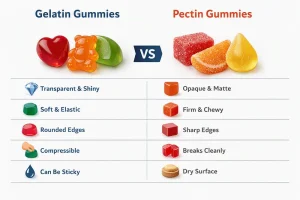
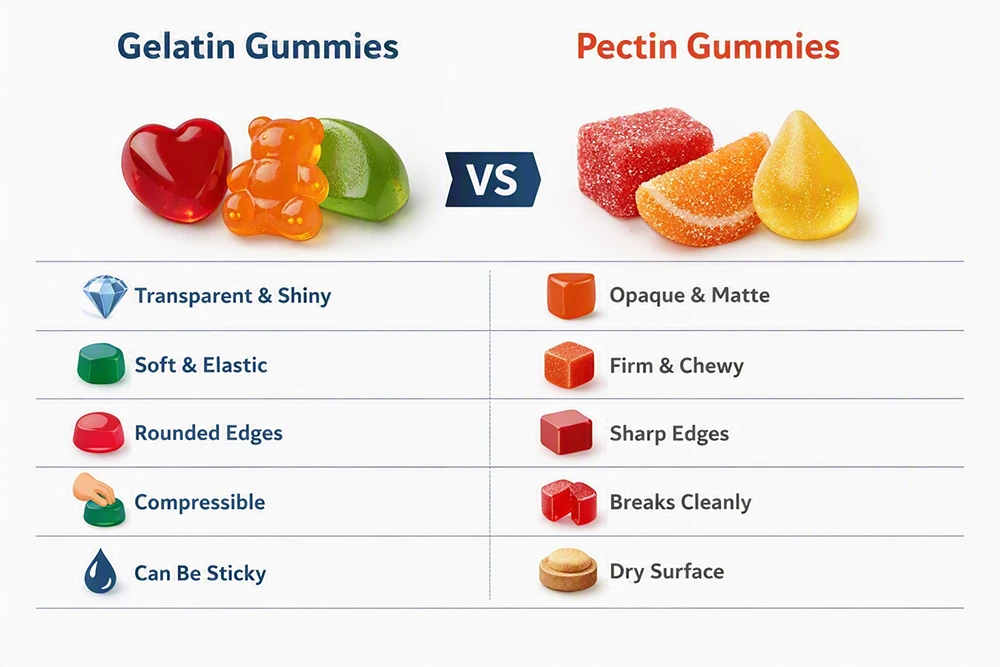
| Product Form | Pectin-based and gelatin-based gummies, various shapes and sizes |
| Key Materials / Ingredients | Natural gelling agents (pectin, carrageenan), active ingredients, flavoring and coloring agents |
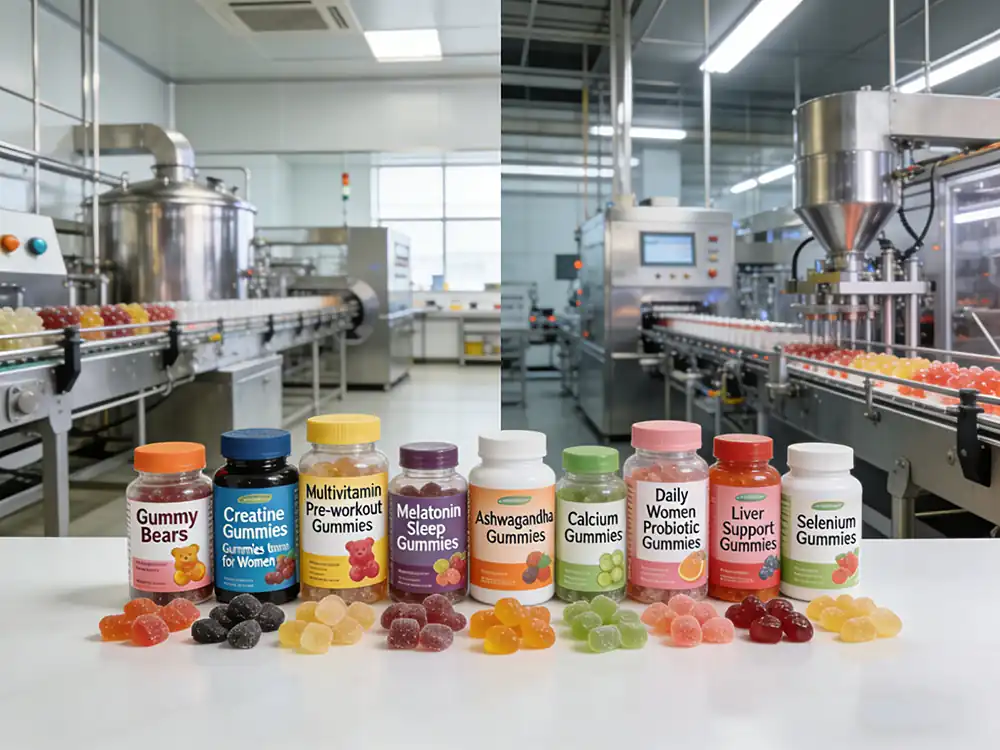
| Manufacturing Process Highlights | Controlled cooking temperature, precise depositing, cooling and drying, inline weight checks |
| Quality Standards | GMP, ISO9001, ISO22000, HACCP, FDA, third-party lab testing |
| Packaging Options | Bottles, pouches, blister packs, custom private label packaging |
| Scalability & Production Capacity | Daily output up to 16 tons; annual capacity up to 5,000 tons |
| Storage & Logistics Considerations | Temperature and humidity-controlled storage; stable packaging for export logistics |
Practical Insights
Manufacturing Quality & Process Control
Consistent product quality depends on standardized recipes, calibrated equipment, and trained production staff who follow documented standard operating procedures at every stage of the process.
Raw Material Sourcing Transparency
Reliable suppliers provide certificates of analysis for incoming raw materials and maintain traceability records, which allows brands to confirm ingredient origin and purity when needed.
Production Scalability & Lead Time
Facilities with higher daily and annual production capacity are generally better equipped to handle both small trial batches and large repeat orders without significant lead time fluctuations.
Compliance & Documentation Readiness
A manufacturer’s ability to promptly provide GMP certificates, testing reports, and facility audit documentation is often a practical indicator of overall organizational readiness.
Cost Structure Considerations
Pricing typically reflects raw material quality, certification overhead, minimum order quantity, and packaging complexity, so brands should request itemized quotes for accurate comparison.
How to Evaluate a Reliable Supplier
Site visits or virtual facility tours, sample testing, and review of existing client references are practical steps for assessing whether a manufacturer’s actual operations match its stated capabilities.
B2B Decision Guide
How Brands Choose the Right Manufacturer
Brands typically weigh certification status, production capacity, formulation flexibility, and communication responsiveness when selecting a long-term manufacturing partner.
What Matters in OEM/ODM Projects
For OEM/ODM projects, clarity around intellectual property ownership, formulation customization limits, and packaging design support are important considerations beyond price.
How to Assess Production Capability
Reviewing a factory’s cleanroom classification, equipment list, and batch record examples provides a more accurate picture of production capability than marketing materials alone.
Key Criteria for Long-Term Partnerships
Consistent quality performance over multiple orders, transparent communication, and stable pricing structures tend to indicate a manufacturer suited for ongoing collaboration.
Risk Control & Quality Assurance Checkpoints
Establishing agreed-upon quality checkpoints, such as pre-shipment inspection and batch testing thresholds, helps reduce risk before products reach the brand’s own quality team or end market.
Conclusion
How a professional gummy factory ensures quality and safety is central to the reliability of any supplement brand’s supply chain. Certified facilities, documented sourcing, and structured testing protocols give brands and OEM/ODM buyers a practical basis for evaluating manufacturing partners and reducing operational risk over the long term.
FAQ
What does quality and safety assurance in gummy manufacturing include?
It includes raw material verification, controlled production processes, facility certifications, and finished product testing.
Why does this matter for supplement brands?
It directly affects product consistency, regulatory compliance, and the brand’s ability to pass retailer or import audits.
How does gummy manufacturing differ from tablet or capsule production in terms of quality control?
Gummies require additional controls for moisture, temperature stability, and microbial risk due to their sugar-based, semi-moist composition.
What should businesses check before sourcing from a gummy manufacturer?
Certification portfolio, cleanroom classification, testing protocols, and documentation availability should be reviewed before committing to a supplier.
What certifications typically indicate a reliable gummy factory?
GMP, ISO9001, ISO22000, HACCP, FDA registration, and applicable HALAL, KOSHER, or Vegan certifications are common indicators.
Can small brands request trial batches before full-scale production?
Many manufacturers offer flexible minimum order quantities, allowing brands to test formulations before committing to larger production runs.
About Gothink Biotech
Shenzhen Gothink Biotech Co., Ltd. is a GMP-certified dietary supplement and gummy contract manufacturer offering large-scale production capacity, with a daily output of 16 tons and an annual capacity of 5,000 tons. The company provides OEM, ODM, CMO, and CDMO services, including custom formulation development, bulk and wholesale supply, and private label solutions with flexible minimum order quantities starting from 500 units. Its manufacturing facility operates within a 100,000-class cleanroom and holds ISO9001, ISO22000, HACCP, FDA, HALAL, KOSHER, and Vegan certifications, supporting strict quality control and global regulatory compliance. Gothink Biotech works with supplement brands, distributors, and private label operators seeking a long-term B2B manufacturing partner for gummy and other dietary supplement formats.