
Executive Summary: Jelly candies and gummy supplements share similar production technologies but serve distinctly different markets with different regulatory frameworks, ingredient standards, and manufacturing specifications. This guide provides manufacturers, brand owners, and distributors with a comprehensive comparison of formulation approaches, production processes, quality assurance requirements, and sourcing strategies to inform strategic manufacturing decisions.
Understanding the Core Definitions
What Jelly Candy Refers to
Jelly candy refers to a confectionery product manufactured using gelatin, pectin, or other gelling agents combined with sugar, glucose syrup, and flavorings. Jelly candies are classified as food products for recreational consumption, designed for taste and enjoyment with no therapeutic health claims. These products typically contain higher sugar content, use food-grade coloring and flavoring agents, and fall under food safety regulations rather than dietary supplement regulations. Common examples include gummy bears, jelly beans, and fruit-flavored gummies sold in candy aisles.
What Gummy Supplement Refers to
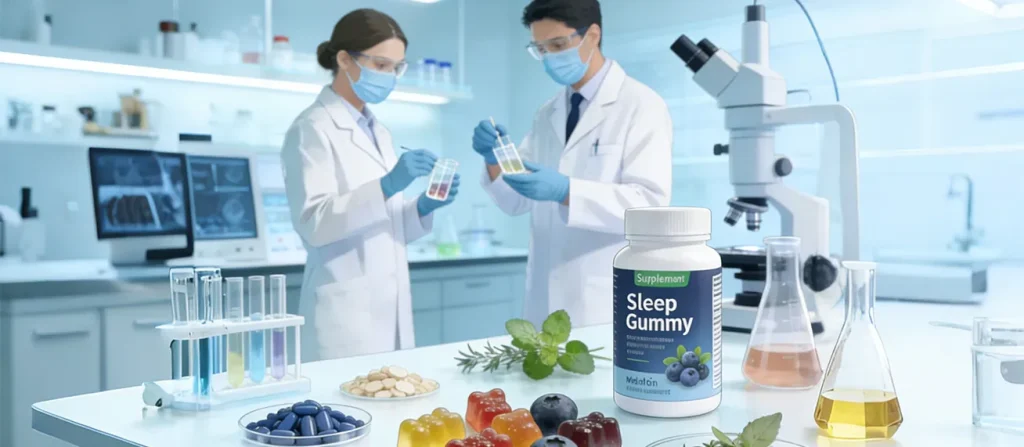
A gummy supplement refers to a nutritional or dietary supplement delivered in gummy form, containing active pharmaceutical or nutraceutical ingredients such as vitamins, minerals, herbal extracts, amino acids, or probiotics. Gummy supplements are regulated as dietary supplements or nutritional products, subject to stricter quality standards, ingredient declarations, and manufacturing compliance requirements (such as GMP—Good Manufacturing Practice). These products require precise dosage, ingredient traceability, and third-party testing for potency and purity.
Critical Differences Between Jelly Candy and Gummy Supplements
1. Regulatory Framework and Classification
The most significant distinction between jelly candies and gummy supplements lies in their regulatory classification. Jelly candies are regulated as conventional food products under food safety authorities in each market (FDA in the US, EFSA in Europe, etc.). Regulatory focus centers on food additives, allergen labeling, and hygiene standards. Conversely, gummy supplements are classified as dietary supplements or nutraceuticals and must comply with stricter pharmaceutical-grade regulations, including GMP (Good Manufacturing Practice) certification, dosage verification, ingredient potency testing, and adverse event reporting requirements.
Manufacturing Insight: Brands manufacturing gummy supplements require third-party laboratory testing for active ingredient potency, microbial contamination, and heavy metals. Jelly candies require basic safety testing but do not require dosage or active ingredient verification.
2. Ingredient Composition and Sourcing
Jelly candy formulations prioritize taste, texture, and shelf stability. Typical ingredients include:
- High concentrations of sugar or corn syrup (40-60% of formula)
- Gelatin or pectin (5-10% gelling agent)
- Food-grade colorants (synthetic FD&C dyes)
- Artificial or natural flavorings optimized for taste intensity
- Corn starch or other dusting agents
Gummy supplement formulations prioritize bioavailability and ingredient stability. Typical ingredients include:
- Reduced sugar or sugar-free matrices (using erythritol, stevia, or monk fruit)
- Natural gelling agents (pectin, carrageenan, or tapioca starch)
- Pharmaceutical-grade active ingredients (vitamin powders, mineral chelates, standardized herbal extracts)
- Natural or organic colorants (anthocyanins, spirulina, beta-carotene)
- Stabilizers to preserve ingredient potency (ascorbic acid, mixed tocopherols)
Sourcing implication: Dietary supplement manufacturers must source ingredients with full documentation (Certificate of Analysis, origin verification, supplier audits). Jelly candy manufacturers have greater flexibility in ingredient sourcing.
3. Production Process Variations
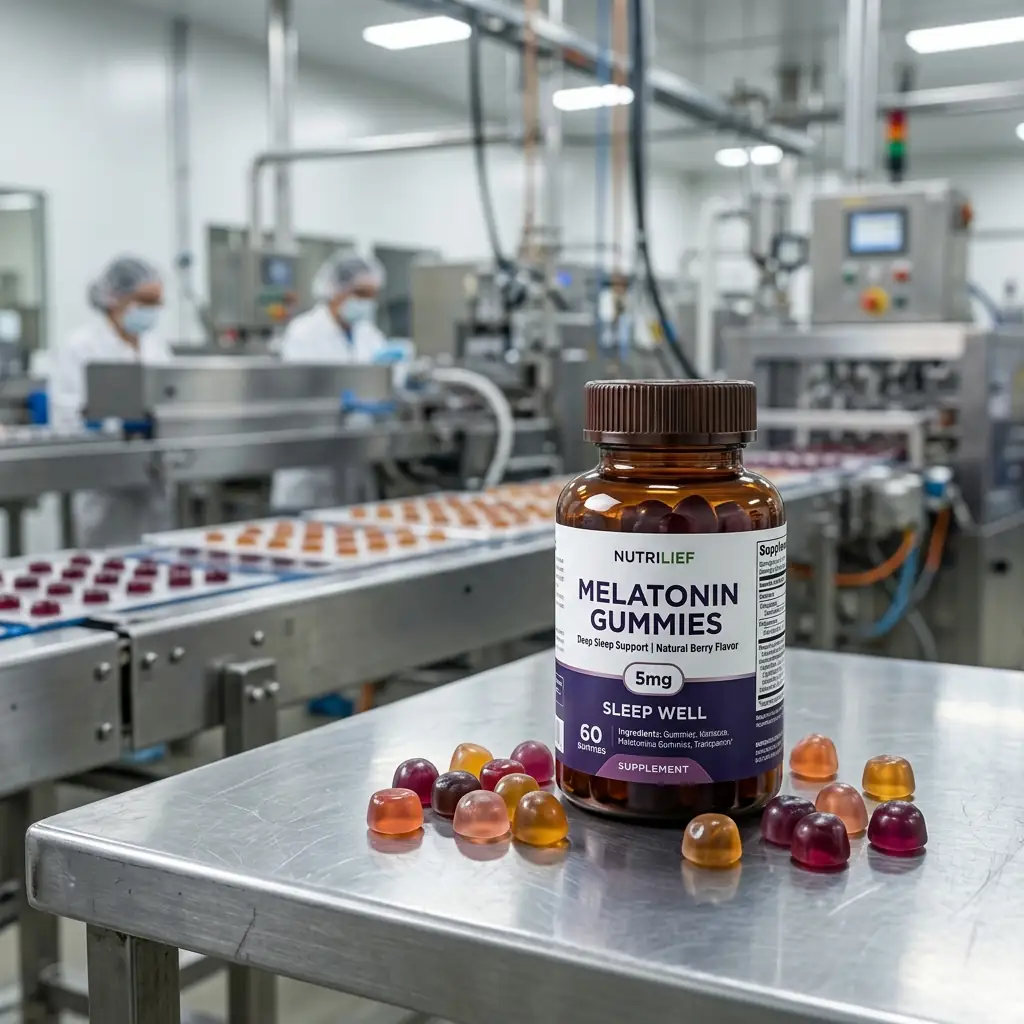
While both products use similar core manufacturing equipment (mixing tanks, cooling tunnels, molding machines), the operational details differ substantially:
| Production Aspect | Jelly Candy | Gummy Supplement |
|---|---|---|
| Temperature Control | Moderate (70-85°C cooking) | Strict temperature management (preserve heat-sensitive vitamins) |
| Mixing Duration | Standard (30-45 minutes) | Extended with oxygen minimization (prevent oxidation) |
| Molding Method | Starch molds, rapid demold | Starch or silicone molds, controlled demold timing |
| Coating/Dusting | Heavy sugar or wax coating for shelf life | Light dusting (minimal sugar) or uncoated |
| Quality Testing | Visual inspection, microbial sampling | Potency testing, heavy metals, microbial, allergen verification |
| Production Speed | High speed (500-800 kg/hour) | Moderate speed (300-600 kg/hour) |
4. Sugar Content and Nutritional Profile
Jelly candies are designed as indulgent products with high sugar content (typically 60-75% of final weight), delivering sweetness as the primary attribute. Gummy supplements are formulated to deliver therapeutic dosages of active ingredients while minimizing sugar or using sugar alternatives. Modern gummy supplements often contain 0-5g of sugar per serving, utilizing stevia, monk fruit, erythritol, or xylitol as sweetening agents.
Market Insight: The growing demand for low-sugar and keto-friendly gummy supplements has driven innovation in alternative sweetener technology. Custom gummy manufacturers increasingly offer both sugar-based and sugar-free formulation options to meet diverse market demands.
5. Dosage Accuracy and Consistency
Jelly candies require basic weight consistency (±10-15% variance acceptable). Gummy supplements demand tight dosage uniformity (±5-10% variance maximum) because consumers rely on the product for therapeutic benefit. This requirement drives investment in advanced quality control equipment, including automated weight sorters and potency sampling protocols.
Technical Manufacturing Specifications
| Specification Parameter | Jelly Candy Standard | Gummy Supplement Standard |
|---|---|---|
| Moisture Content | 12-18% | 8-14% |
| Texture Firmness (Shore A) | 45-55 | 50-65 |
| Shelf Life (ambient) | 12-24 months | 12-36 months (depending on actives) |
| Storage Conditions | Room temp (15-25°C), 40-60% RH | Room temp (15-25°C), 30-60% RH preferred |
| pH Range | 3.0-4.0 (slightly acidic for taste) | 2.8-4.5 (variable based on actives) |
| Typical Dosage Form | 1-3g per piece | 1-4g per piece (precision dosed) |
| Required Certifications | Food safety, FSSC, local food authority | GMP, NSF/ISMP, FDA facility registration, local dietary supplement authority |
Practical Manufacturing Insights for Producers
Formulation Development Strategy
The formulation phase is critical for both products but addresses different objectives. For jelly candies, the focus centers on achieving desired taste profile, bright coloration, and appealing mouthfeel. Developers typically conduct consumer sensory panels and adjust sweetness, acid levels (citric acid, malic acid), and flavorings iteratively.
For gummy supplements, formulation must balance ingredient stability, bioavailability, palatability, and manufacturing processability. Vitamin C supplements, for instance, require antioxidant protection (ascorbic acid can oxidize quickly); iron supplements need chelation to prevent flavor impact; and probiotics require microencapsulation to survive production heat. Make gummies with active ingredients requires testing stability through accelerated aging studies (heat/humidity chambers) to validate shelf life and potency retention.
Quality Assurance and Testing Protocols
Jelly candy quality control focuses on sensory evaluation, visual appearance inspection, and routine microbial sampling (coliform, E. coli, Salmonella). The testing regime is straightforward and cost-effective.
Gummy supplement QA is substantially more comprehensive. Protocols typically include:
- Potency testing via HPLC (High-Performance Liquid Chromatography) to verify active ingredient content
- Microbial limit testing (aerobic plate count, yeast/mold, pathogenic organisms)
- Heavy metal analysis (lead, cadmium, mercury, arsenic)
- Allergen testing if cross-contamination risk exists
- Disintegration/dissolution testing to confirm bioavailability
- Stability testing (temperature, humidity) at multiple timepoints
Cost Implication: Gummy supplement manufacturing incurs 15-25% higher testing and documentation costs compared to jelly candy production. Budget accordingly when selecting a gummy contract manufacturing partner.
Scale and Capacity Considerations
Production scalability differs between the two categories. Jelly candies, with simpler formulations and fewer regulatory constraints, can scale rapidly from pilot batches (50-100 kg) to full commercial production (5,000+ kg daily) with minimal process adjustment. Gummy supplements require more careful validation. When scaling a supplement formulation, custom gummy manufacturers must re-validate stability, dosage accuracy, and manufacturing consistency at increased batch sizes—a process requiring 2-4 weeks per scale-up.
Raw Material Supply Chain and Compliance
Jelly candy manufacturers source basic ingredients (gelatin, sugar, flavoring) from standard food suppliers. Ingredient variability is managed through quality checks but is generally predictable. Gummy supplement manufacturers must establish supplier relationships that include pharmaceutical-grade documentation: Certificates of Analysis (CoA), material safety data sheets (MSDS), third-party testing results, and supplier audits. This complexity extends supplier lead times by 2-4 weeks and increases ingredient costs by 10-30%.
B2B Decision Framework: Choosing the Right Manufacturing Partner
Key Questions for Evaluating a Gummy Manufacturing Partner
1. Does the manufacturer hold GMP certification?
Verify ISO 9001 and pharmaceutical GMP compliance. Request audit reports from third-party inspectors. GMP certification is mandatory for gummy supplement manufacturing and signals quality commitment.
2. What testing capabilities does the facility provide?
Ask whether the manufacturer maintains in-house testing laboratories or outsources to third-party labs. In-house HPLC capability, microbial testing, and stability chambers reduce time-to-market and provide faster quality feedback.
3. What is the minimum order quantity (MOQ)?
For gummy supplements, typical MOQ ranges from 10,000 to 50,000 units, depending on complexity and the manufacturer’s production scheduling. Dietary supplement manufacturers with flexible MOQ policies can better serve emerging brands and startups.
4. Does the manufacturer offer full OEM/ODM services?
OEM (Original Equipment Manufacturer) means the brand provides the formulation; ODM (Original Design Manufacturer) means the manufacturer develops the formulation. Full-service partners offer both, enabling brands to outsource formulation development or maintain proprietary control. Verify whether the partner can manage regulatory compliance documentation (supplement facts label, ingredient declaration, claims substantiation) for your target market.
5. What is the manufacturer’s experience with your specific active ingredients?
Ask for case studies and references. Experience with vitamin C formulation differs substantially from herbal extract formulation or probiotic encapsulation. Specialized expertise reduces development time and technical risk.
6. What packaging and label customization options are available?
Verify whether the manufacturer offers private label gummy services, including bottle design, label printing, and secondary packaging (carton, shipper design). Full-service capabilities simplify go-to-market timelines.
Cost Structure and Pricing Models
Jelly candy manufacturing typically costs $2-5 per kg (bulk commodity pricing). Gummy supplements cost $8-20 per kg, depending on active ingredient complexity, volume, and testing requirements. When budgeting for gummy supplement development, account for:
- Formulation development fees: $2,000-8,000
- Stability testing and validation: $3,000-10,000
- GMP production setup and batch records: $1,000-5,000 per batch
- Third-party testing (potency, microbial, heavy metals): $500-2,000 per batch
- Mold tooling for custom shapes: $1,000-5,000 (one-time)
Production Workflow: From Concept to Market
Gummy Supplement Development Timeline
A typical gummy supplement development cycle requires 8-16 weeks from initial brief to first saleable batch:
Weeks 1-2: Formulation Design
Discuss target market, active ingredients, therapeutic dosage, flavor preferences, color scheme, and pricing constraints. The manufacturer develops 2-3 prototype formulations for evaluation.
Weeks 3-4: Prototype Testing and Stability
Conduct sensory evaluation, perform basic stability testing (heat/humidity challenge), verify dosage accuracy, and evaluate manufacturing processability at small scale.
Weeks 5-6: Scale-Up and Process Optimization
Transition to pilot-scale manufacturing, validate batch consistency, refine process parameters (mixing time, temperature, molding), and conduct first formal potency and microbial testing.
Weeks 7-12: Regulatory Documentation and Validation
Prepare Supplement Facts label, ingredient sourcing documentation, supplier audits, stability testing reports, and shelf-life determination. Conduct validation batches to confirm manufacturing consistency and stability at 3-month and 6-month timepoints.
Weeks 13-16: Final Production Run and Packaging
Manufacture full commercial batch, conduct final testing release, coordinate packaging and labeling, and prepare for distribution.
Development Note: Jelly candy development follows a similar timeline but typically compresses weeks 7-12 (regulatory validation is simpler) and completes in 6-10 weeks total.
Compliance Framework: Regional Regulatory Requirements
United States
Jelly Candy: Regulated by FDA as conventional food under 21 CFR Part 117 (Food Safety Modernization Act). Requirements include facility registration, hazard analysis, preventive controls, and allergen management.
Gummy Supplement: Regulated by FDA as a dietary supplement under 21 USC 321(ff) and 21 CFR Part 111 (Dietary Supplement Current Good Manufacturing Practice). Requirements are more stringent, including written quality standards, batch testing records, adverse event reporting, and annual facility inspection compliance.
European Union
Jelly Candy: Regulated under Regulation (EC) 1169/2011 (food information) and Regulation (EC) 1333/2008 (food additives). Must comply with permitted colorant and additive lists.
Gummy Supplement: Regulated under Directive 2002/67/EC (supplementary foods) with stricter limits on ingredient claims and mandatory pre-market notification in certain countries. Natural health products may require individual country authorization (e.g., UK, Germany).
China and Asian Markets
Jelly Candy: Regulated as food products under China’s Food Safety Law with standard food hygiene and labeling requirements.
Gummy Supplement: Registered as “health food” or “nutritional supplement” requiring pre-market approval from the relevant health authority (NMPA in China). Registration requires safety and efficacy substantiation and can require 6-12 months.
Scalability and Production Economics
Volume Pricing and Minimums
Manufacturing economies of scale strongly influence unit costs in gummy production. A typical cost structure shows:
- 10,000-25,000 units: $12-18 per kg (higher setup and testing overhead)
- 25,000-100,000 units: $8-12 per kg (moderate production runs)
- 100,000-500,000 units: $6-9 per kg (optimized batch processing)
- 500,000+ units: $5-8 per kg (premium capacity allocation)
Understanding volume dynamics is critical when evaluating total cost of ownership. Smaller brands benefit from partnering with gummy contract manufacturing specialists who can aggregate multiple clients’ orders into larger production runs, reducing per-unit costs while maintaining flexibility.
Lead Time and Inventory Management
Gummy supplement manufacturing typically requires 6-8 weeks from order placement to delivery (including formulation validation if needed). Plan inventory accordingly to avoid stockouts during peak demand seasons (January-February for New Year’s resolutions; September-October for back-to-school).
At-a-Glance Comparison Summary
Jelly Candy
- Classified as conventional food product
- Higher sugar content (60-75%)
- Standard food safety regulations
- Lower testing requirements
- Simpler ingredient sourcing
- Higher production speed (500-800 kg/hr)
- Lower manufacturing costs ($2-5/kg)
- Rapid scale-up capability
- Focus on taste and appearance
- Flexible MOQ options available
Gummy Supplement
- Classified as dietary supplement
- Reduced sugar (0-5g per serving)
- Pharmaceutical GMP requirements
- Comprehensive testing protocols
- Pharmaceutical-grade sourcing
- Moderate production speed (300-600 kg/hr)
- Higher manufacturing costs ($8-20/kg)
- Careful validation required for scale-up
- Focus on bioavailability and efficacy
- Higher typical MOQ (10,000-50,000 units)
Frequently Asked Questions (FAQ)
Q1: Can the same manufacturer produce both jelly candies and gummy supplements?Yes, but with important caveats. The facility must maintain separate production lines, equipment, and documentation to prevent cross-contamination and regulatory violations. A manufacturer with GMP certification for supplements can produce candies, but a food-only facility cannot manufacture supplements without GMP certification upgrade. This separation increases operational costs and requires careful scheduling to avoid mix-ups.
Q2: What is the difference between OEM and ODM services for gummy manufacturing?OEM (Original Equipment Manufacturing) means you provide the complete formulation, and the manufacturer produces according to your specifications. ODM (Original Design Manufacturing) means the manufacturer develops the formulation based on your requirements and target market. ODM is faster for market entry but offers less proprietary differentiation. OEM requires more upfront R&D investment but provides stronger brand differentiation.
Q3: How long does gummy supplement formulation development typically take?Development typically requires 8-16 weeks from initial concept to first commercial batch. Simple formulations (single-ingredient vitamins) can compress to 6-8 weeks. Complex formulations (multi-ingredient proprietary blends) may extend to 12-20 weeks. Factors affecting timeline include ingredient sourcing, stability testing requirements, and regulatory approval pathways in your target market.
Q4: What testing is mandatory for gummy supplements before market launch?Mandatory testing includes potency verification (HPLC), microbial safety testing, and shelf-life stability at 3-6 month intervals. Heavy metals, allergen testing, and disintegration testing are often recommended depending on active ingredients and target market. US FDA regulations require that all dietary supplements meet Current Good Manufacturing Practice (cGMP) standards, including in-process testing and batch documentation. Budget $500-2,000 per batch for third-party testing costs.
Q5: What is the typical shelf life for gummy supplements?Most gummy supplements maintain potency for 12-36 months when stored in cool, dry conditions (15-25°C, 30-60% RH). Shelf life depends on active ingredient stability (vitamin C degrades faster; minerals are more stable), packaging (opaque, moisture-barrier packaging extends shelf life), and storage conditions. Always conduct accelerated aging studies to determine actual shelf life for your specific formulation.
Q6: How do I choose between a private label gummy manufacturer versus building my own brand?Private label partnerships accelerate time-to-market (6-10 weeks vs. 12+ months for building from scratch) and reduce upfront investment. However, private label products offer less differentiation and may compete against the manufacturer’s house brand. Evaluate whether your market positioning requires proprietary formulations (OEM) or if established formulations with custom branding (private label) meet your market strategy.
Conclusion: Strategic Recommendations for Manufacturers and Brands
Jelly candies and gummy supplements represent distinct product categories with overlapping manufacturing technologies but fundamentally different regulatory, quality, and commercial requirements. Jelly candies prioritize taste, appearance, and cost efficiency for recreational consumption. Gummy supplements prioritize active ingredient efficacy, bioavailability, and regulatory compliance for health benefit delivery.
For manufacturers evaluating entry into the gummy market, the choice between these two categories should reflect your target customer, regulatory capability, and competitive positioning. Jelly candy manufacturing offers lower barriers to entry, simpler supply chains, and faster commercialization—ideal for confectionery brands seeking to diversify. Gummy supplement manufacturing requires substantial regulatory infrastructure, testing protocols, and quality expertise but commands premium pricing and aligns with the high-growth dietary supplement industry.
Success in either category requires partnership with experienced, certified manufacturers who understand the technical nuances, compliance requirements, and supply chain complexity. Whether you pursue gummy contract manufacturing, build a private label gummy line, or develop a proprietary custom gummy manufacturer relationship, prioritize partners with proven quality systems, transparent testing practices, and demonstrated experience in your specific ingredient focus.
The global gummy market is expanding at 7-10% annually, driven by consumer preference for convenient, palatable supplement delivery. By understanding the regulatory, technical, and commercial distinctions between jelly candies and gummy supplements, brand owners and manufacturers can make informed sourcing decisions and position their products for sustainable growth.