
Abstract
Whether you’re launching a private label supplement line, sourcing bulk gummies for retail, or exploring wholesale partnerships with a contract manufacturer, understanding how gummies are made is foundational to making informed decisions. This guide walks through the full gummies manufacturing process — from raw ingredient selection to finished product packaging — with practical insights for brands, startups, and buyers at every scale. The goal is to give you a transparent, expert-level view of what happens inside a professional gummy manufacturing facility, so you can evaluate suppliers more confidently and build a better product.
1. Why the Manufacturing Process Matters for Buyers and Brands
Many buyers focus heavily on price and minimum order quantities when sourcing private label gummies or negotiating gummies wholesale agreements. While those factors are important, the manufacturing process itself is where quality is either built in — or compromised.
Variables like gelation method, mixing temperature, active ingredient stability, and drying duration all directly affect the final product’s texture, potency, appearance, and shelf life. A gummy that looks good on arrival may degrade within months if the process wasn’t well-controlled. For brands staking their reputation on a supplement product, understanding what “GMP-compliant manufacturing” actually means in practice is not optional — it’s essential.
2. Core Ingredients in Gummy Formulation
Before the gummies manufacturing process begins, formulators must carefully select and verify each ingredient. The primary components include:
Gelling Agents The gelling agent determines texture, chewiness, and suitability for different consumer segments. The most commonly used options are:
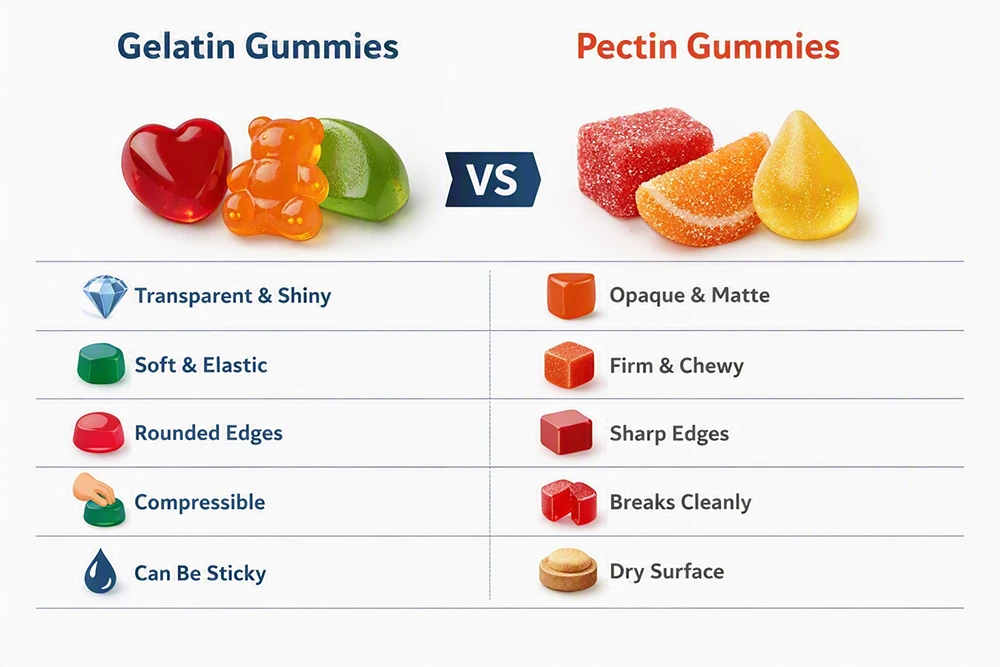
- Gelatin – Derived from animal collagen, gelatin produces a firm, classic gummy texture. It is widely used but unsuitable for vegetarian, vegan, or halal/kosher audiences without modification.
- Pectin – A plant-based alternative extracted from citrus peel or apple pomace. Pectin-based gummies are softer and more suitable for vegan formulations, though they require precise pH and sugar ratio control.
- Carrageenan – Derived from red seaweed, carrageenan is another vegan option with a firmer bite than pectin. It is often blended with other hydrocolloids to optimize texture.
Sweeteners and Syrups Glucose syrup and sucrose are the traditional base sweeteners. Modern formulations increasingly incorporate alternatives such as allulose, erythritol, or tapioca syrup for low-sugar, keto-friendly, or clean-label positioning.
Active Ingredients For dietary supplement gummies, the active payload — vitamins, minerals, herbal extracts, adaptogens, probiotics, or amino acids — must be incorporated at precise concentrations while surviving the heat and pH conditions of manufacturing. Stability testing is critical at this stage.
Flavorings, Colorants, and Acidulants Natural fruit flavors, botanical colorants (e.g., spirulina, turmeric, black carrot extract), and citric acid are used to achieve the sensory profile expected by consumers. Regulatory requirements for colorants vary significantly by market (US, EU, AU), which formulation teams must account for.
3. Step-by-Step: The Gummies Manufacturing Process
A professional gummy manufacturing facility follows a structured sequence of steps. Here is a detailed breakdown:
Step 1 — Ingredient Weighing and Preparation
All raw materials are weighed according to the validated batch formula. This step occurs in controlled environments where temperature and humidity are monitored. For active ingredients with low stability, handling protocols are particularly strict.
Step 2 — Dissolution and Hydration of Gelling Agents
The gelling agent (gelatin, pectin, or carrageenan) is hydrated in purified water at specific temperatures:
- Gelatin typically requires hydration at 60–80°C.
- Pectin is dissolved in hot water (above 85°C) and combined with sugars before cooling.
Improper hydration leads to lumping, uneven texture, or gelation failure in the finished gummy.
Step 3 — Syrup Cooking
Sweeteners and syrups are cooked to a precise temperature (usually 110–130°C depending on the formula) to reduce moisture content to target levels. Controlling the final water activity is critical — too much moisture causes sticking and mold growth; too little results in hard, brittle gummies.
Step 4 — Blending of Active Ingredients and Additives
Once the cooked syrup reaches the appropriate temperature for addition, active ingredients, flavorings, colorants, and acidulants are introduced. This is the most technically sensitive stage:
- Heat-sensitive compounds (e.g., certain probiotics, vitamin C) must be added at lower temperatures to avoid degradation.
- pH-sensitive actives must be introduced after acidulant addition is complete.
- Mixing must be thorough to ensure homogeneity across the batch, which directly affects per-gummy dosage consistency.
Step 5 — Depositing (Molding)
The liquid gummy mass is deposited into molds using automated depositing equipment. Two main molding systems are used:
- Starch Mogul System — The gummy mass is deposited into trays filled with corn starch, which acts as a mold and absorbs surface moisture. This method is highly versatile and supports complex shapes.
- Hard Mold (Silicone or Polycarbonate) — Used for pectin-based and certain vegan gummies. Molds are precision-engineered for consistent shape and fill weight.
The temperature of the depositing head and the timing of the deposit affect fill accuracy and bubble formation.
Step 6 — Cooling and Gelation
After deposition, gummies are moved to climate-controlled cooling tunnels or rooms where gelation occurs. Gelatin gummies typically require 30–60 minutes at 10–18°C, while pectin gummies may set faster but require careful pH conditions. Premature disturbance during this phase leads to deformation.
Step 7 — Demolding and Tumbling
Once set, gummies are removed from molds. In starch-mogul production, this involves separating gummies from starch, which is then reclaimed and recycled. Demolded gummies are tumbled in a coating drum where a light layer of:
- Oil (for a glossy finish),
- Wax (for extended shelf stability), or
- Sour sugar (for sugar-coated varieties)
…is applied depending on the product specification.
Step 8 — Drying and Conditioning
Gummies are conditioned in temperature- and humidity-controlled rooms to reach target moisture content and water activity levels. This step, often lasting 12–48 hours, is critical to preventing sticking, mold growth, and texture degradation during shelf life.
Step 9 — Quality Control and Testing
Rigorous QC occurs at multiple checkpoints throughout the process, and again on finished gummies before release. Standard tests include:
- Weight and dimension uniformity — Ensures consistent dosing.
- Moisture and water activity testing — Confirms shelf stability.
- Active ingredient assay — Verifies potency matches the label claim.
- Microbial testing — Screens for yeast, mold, and pathogen contamination.
- Sensory evaluation — Flavor, color, and texture are assessed against approved standards.
For dietary supplements specifically, Certificate of Analysis (CoA) documentation should accompany every batch.
Step 10 — Packaging
Finished gummies proceed to packaging lines where they are filled into bottles, pouches, or blister packs. Automated counting, filling, sealing, and labeling equipment is used at scale. For private label gummies, the packaging stage is where brand-specific artwork, label compliance copy, and secondary packaging are applied.
Desiccants are typically included in bottle packaging to maintain moisture control during transit and storage.
4. Cleanroom Standards and Facility Certifications
The environment in which gummies are manufactured has a direct impact on microbial safety and product quality. Professional manufacturers operate within classified cleanroom environments:
- 100,000-class (ISO 8) cleanrooms are standard for dietary supplement gummy production and control airborne particulate levels, temperature, humidity, and air exchange rates.
- 10,000-class (ISO 7) environments are typically reserved for R&D and high-sensitivity formulation work.
Certifications to look for when evaluating a gummies Manufacturer include: GMP (Good Manufacturing Practice), ISO 9001, ISO 22000, HACCP, FDA registration, HALAL, KOSHER, and Vegan certification. These are not just credentials — they reflect documented systems, auditable records, and trained personnel.
5. Key Differences: OEM vs. ODM vs. Private Label vs. White Label
Buyers sourcing gummies bulk or building supplement brands often encounter these terms. Here’s a practical distinction:
|
|---|
For gummies wholesale buyers purchasing pre-made stock SKUs, white label is often the most efficient path. For brands building differentiated products, ODM or full OEM with custom formulation is more appropriate.
6. Common Quality Failures and How to Prevent Them
Understanding failure modes helps buyers ask better questions of their suppliers:
Dosage Inconsistency — Often caused by poor mixing homogeneity or inconsistent depositing. Ask suppliers for within-batch potency variation data.
Sticking and Clumping — A result of excessive water activity, inadequate drying, or insufficient coating. Request water activity targets and shelf-life stability data.
Color Fading — Natural colorants are photosensitive. Packaging selection (UV-blocking materials) and colorant choice both play a role.
Short Shelf Life — Typically traced to moisture management failures or incompatible active ingredient combinations. Always request stability study data for the specific formula, not just the format.
Off-Flavor Development — Can occur when certain active ingredients (e.g., fish oil, some B vitamins) interact with sweeteners or heat. Encapsulation and masking technologies can mitigate this.
7. Scaling from Samples to Bulk Production
One of the least-discussed challenges in gummy manufacturing is scale-up. A formula that performs well in a 5kg R&D batch may behave differently at 500kg production scale due to:
- Heat dissipation differences in larger cooking vessels
- Mixing shear variation at different agitator speeds and tank sizes
- Depositing speed effects on gummy weight consistency
Reputable manufacturers conduct pilot batches at intermediate scales before committing to full gummies bulk production runs. Buyers should ask whether scale-up validation is included in the development process.
8. Regulatory Considerations for Different Markets
The regulatory environment affects formulation, labeling, and testing requirements significantly:
- United States (FDA) — Dietary supplements fall under DSHEA. FDA registration of the manufacturing facility is required. Claims must comply with 21 CFR Part 101.
- European Union — Supplements are regulated as food. Permitted ingredient lists, maximum levels, and labeling requirements vary by member state.
- Australia (TGA) — Complementary medicines require ARTG listing or registration depending on claim type.
- Canada (Health Canada) — Natural Health Products require a product license (NPN) before sale.
A qualified gummies Manufacturer should be able to advise on market-specific compliance requirements or connect brands with regulatory consultants familiar with their target markets.
Article Summary
The gummies manufacturing process is a technically demanding sequence requiring precise ingredient chemistry, controlled environments, validated equipment, and rigorous quality systems. For buyers and brands sourcing private label gummies, gummies bulk, or gummies wholesale, a thorough understanding of this process is the single most effective way to evaluate suppliers, negotiate contracts, and prevent quality failures before they reach consumers.
Key takeaways:
- Gelling agent selection (gelatin, pectin, carrageenan) shapes both product performance and market positioning.
- Active ingredient handling during blending is where supplement potency is protected or lost.
- Drying and conditioning, though invisible to buyers, are critical to shelf stability.
- Certifications like GMP, ISO 22000, and HACCP are meaningful indicators of process discipline.
- Understanding OEM, ODM, private label, and white label models helps align sourcing strategy with product goals.
FAQ
Q1: What is the minimum order quantity (MOQ) for custom gummy manufacturing? MOQ varies by manufacturer and product complexity. Many professional contract manufacturers offer small trial runs for formula validation before scaling to full production. It is worth discussing tiered MOQ structures if you’re launching a new SKU and want to test market response before committing to bulk inventory.
Q2: How long does the gummies manufacturing process take from formulation to finished product? For a new custom formulation, the full timeline — including R&D, stability testing, packaging procurement, and production — typically ranges from 8 to 16 weeks. For private label or white label products using existing formulas, timelines can be compressed to 3–6 weeks depending on packaging customization requirements.
Q3: Can gummies be manufactured without gelatin for vegan consumers? Yes. Pectin and carrageenan are well-established vegan alternatives that are widely used in commercial gummy production. Pectin is particularly popular in the US and European markets for clean-label positioning. The formulation and process parameters differ from gelatin-based production, but outcomes in terms of texture and stability are comparable when executed properly.
Q4: What certifications should I require from a gummies manufacturer? At minimum, look for GMP certification and FDA facility registration if you’re selling into the US market. ISO 22000 and HACCP reflect robust food safety management systems. If your target audience includes Muslim, Jewish, or vegan consumers, HALAL, KOSHER, and Vegan certifications respectively are important. Always request copies of current certificates, not just logos on a website.
Q5: How is potency consistency ensured across a bulk gummies production run? Consistency is achieved through validated mixing protocols, regular in-process weight checks during depositing, and finished-product assay testing. A reliable manufacturer will provide a Certificate of Analysis (CoA) for each batch documenting active ingredient levels measured against label claims. Ask for historical CoA data across multiple batches to assess process control capability.
Q6: What is the difference between private label and OEM gummies? Private label typically means applying your brand to a manufacturer’s existing formula and packaging format, allowing for rapid launch with minimal development cost. OEM (Original Equipment Manufacturer) involves producing to your proprietary specification — you own the formula and the manufacturer produces to your exact requirements. OEM offers greater differentiation but requires more upfront development investment.
Q7: How do I evaluate whether a gummies wholesale supplier is reliable? Request facility audit reports or third-party inspection results, review their quality system documentation, ask for client references in your market, and request sample batches for independent testing before committing to large orders. Price alone is a poor proxy for reliability in supplement manufacturing.
About Gothink Biotech
Shenzhen Gothink Biotech Co., Ltd. is a professional gummies Manufacturer and dietary supplement contract manufacturer based in China, serving global brands across North America, Europe, Australia, and beyond. We specialize in the full-spectrum gummies manufacturing process, producing pectin, carrageenan, and gelatin-based gummies in a GMP-certified facility featuring a 100,000-class cleanroom with a daily output of 16 tons and annual capacity of 5,000 tons.
Our R&D team, led by postdoctoral researchers with experience at leading U.S. institutions, supports precise formulation development in a 10,000-class pharmaceutical-grade laboratory. We offer comprehensive OEM, ODM, private label gummies, and white label solutions — from formula development and raw material sourcing through production, quality control, and export packaging.
Whether you need gummies bulk production for large retail programs, gummies wholesale fulfillment for distribution networks, or turnkey support for a new supplement brand launch, Gothink Biotech provides end-to-end service with the quality systems, certifications (ISO9001, ISO22000, HACCP, FDA, GMP, HALAL, KOSHER, Vegan), and technical depth to support your goals reliably and compliantly.