
Summary
Private label gummies use pre-existing formulas that brands customize with packaging and branding, while custom formula gummies are built from scratch to match specific ingredient, dosage, and market requirements. Private label is faster and lower-cost, while custom formulation offers greater differentiation and control over the finished product. The right choice depends on a brand’s budget, timeline, and long-term positioning goals.
Definition
Private label vs custom formula gummies refers to the two primary sourcing models available to supplement brands when they want to bring a gummy product to market. In the private label model, a manufacturer already has a finished formula, and the brand owner selects from existing options, applying its own label and packaging. In the custom formula model, the manufacturer’s R&D team develops a new formulation from the ground up, based on the brand’s specific active ingredients, dosage targets, flavor profile, and shape requirements.
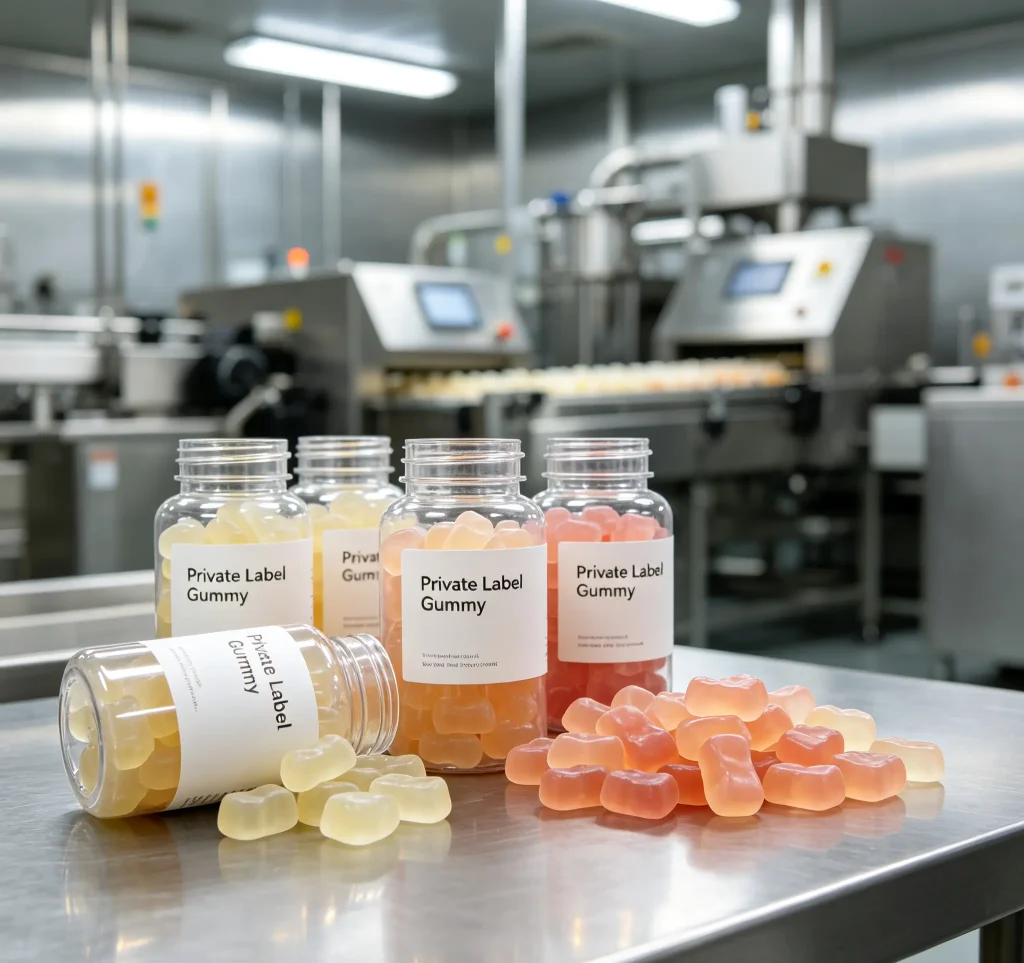
Private Label Gummies: How the Model Works
Private label gummies are built on a manufacturer’s existing product library. A brand reviews available formulas, ingredient combinations, and flavor options, then selects a product that fits its target market. Because the formulation, stability testing, and production process are already established, this route typically moves from order confirmation to finished goods in a shorter timeframe than custom development.
This approach works well for brands entering the supplement gummy category for the first time, brands testing a new product line before committing R&D budget, or brands that want to launch quickly around a seasonal or trending ingredient.
Custom Formula Gummies: How the Model Works
Custom formula gummies start with a brief from the brand: target ingredients, dosage per gummy, sugar or sugar-free requirements, texture preferences, and any regulatory constraints for the destination market. The manufacturer’s R&D team then develops, tests, and refines a formula that meets those specifications, followed by stability testing and small-batch trial production before scale-up.
This route suits brands that need a specific active ingredient concentration not available in existing catalogs, brands building a proprietary product for patent or trademark purposes, or brands whose positioning depends on formulation uniqueness rather than packaging alone.
Private Label vs Custom Formula: Key Comparison
| Factor | Private Label Gummies | Custom Formula Gummies |
|---|---|---|
| Development Time | Shorter, typically weeks | Longer, typically months |
| Minimum Order Quantity (MOQ) | Generally lower | Generally higher, due to R&D cost recovery |
| Formula Ownership | Shared or non-exclusive | Can be exclusive to the brand |
| Ingredient Flexibility | Limited to existing catalog | Fully customizable |
| Upfront Cost | Lower | Higher, includes R&D and testing |
| Best Fit | New brands, fast market entry, testing demand | Established brands, unique positioning, proprietary IP |
Practical Insights: Production, Quality Control, and Scalability
Production consistency depends on the manufacturer’s process controls regardless of which model is chosen. A qualified manufacturer will apply the same batch testing, molding precision, and packaging standards to both private label and custom formula runs. Brands should request certificates of analysis (COA) for every batch, whether the formula is shared or exclusive.
Quality control considerations include verifying active ingredient potency at time of manufacture and again near expiration, confirming microbiological testing results, and reviewing stability data if the product will be shipped to markets with different temperature and humidity conditions. Brands sourcing private label products should still ask for full documentation, since ownership of the formula does not change the need for verified quality data.
Scalability differs between the two models. Private label products can often scale production quickly since the formula and process are already validated. Custom formulas require an additional scale-up phase after initial small-batch approval, during which the manufacturer confirms that the recipe performs the same way at commercial volume as it did in trial batches.
Regulatory compliance applies to both models. Brands should confirm that the manufacturer holds relevant certifications such as GMP, ISO 22000, and HACCP, and that any health claims on packaging are supported by the actual formulation and permitted in the target market.
B2B Decision Support: Choosing the Right Model for Your Brand
Brand owners evaluating how to make gummies for their product line should weigh timeline, budget, and differentiation goals before selecting a path. A brand with a limited launch budget and a need to enter the market quickly is generally better served by private label. A brand building a long-term product identity around a specific ingredient blend or dosage claim will likely find custom formulation more aligned with its goals, even with the added time and cost.
Working with a Private Label Gummy Manufacturer that also offers custom development capabilities gives a brand the option to start with an existing formula and transition to a proprietary one later, without switching suppliers. This is a common path for brands that want to validate market demand before investing in R&D.
Procurement teams comparing suppliers should also confirm MOQ terms, lead time for both private label and custom orders, and whether the manufacturer supports formula adjustments after the initial launch, since ingredient sourcing or regulatory changes may require future updates.
Conclusion
Private label gummies offer speed and lower upfront investment, while custom formula gummies offer control and differentiation for brands with specific formulation needs. Neither model is universally better; the right choice depends on a brand’s stage of growth, budget, and long-term product strategy. Many brands begin with private label products and move toward custom formulation as their market position matures.
FAQ
What is the main difference between private label and custom formula gummies?
Private label gummies use an existing formula that a brand packages under its own name, while custom formula gummies are developed specifically for that brand’s ingredient and dosage requirements.
Which option has a lower minimum order quantity?
Private label gummies generally have a lower MOQ because the formula and production process are already established.
Can a brand start with private label and switch to custom formula later?
Yes, many brands launch with private label gummies to test market demand, then move to a custom formula once the product line is established.
Do private label gummies still require quality testing?
Yes, brands should request certificates of analysis and stability data for private label products, since verified quality documentation is necessary regardless of formula ownership.
Is custom formulation more expensive than private label?
Custom formulation typically involves higher upfront costs due to R&D, testing, and a higher MOQ, while private label products have lower initial investment requirements.
What should a brand look for when choosing between private label vs custom formula manufacturing?
Brands should compare development timeline, MOQ, formula ownership terms, and whether the ingredient flexibility of private label gummies meets their positioning needs, or whether a custom formula is required for differentiation.
This article is provided by Gothink Biology, a globally recognized dietary supplement manufacturer, offering.
About Gothink Biology
Shenzhen Gothink Biology Technology Co., Ltd. is a global leading nutrition supplement supplier and dietary supplement manufacturer specializing in OEM, ODM, CMO, and CDMO services for health and wellness brands worldwide. With extensive industry expertise and international certifications including ISO9001, ISO22000, HACCP, FDA, HALAL, GMP, KOSHER, BRC, FSSC 22000, PJPH, and Vegan, we deliver high-quality custom formulation, contract manufacturing, and wholesale solutions for B2B clients across global markets.
For more information, please visit our official website: https://gothinkbio.com/ or contact our expert team.