
Abstract
Private label gummies have become one of the fastest-growing segments in the dietary supplement industry. Whether you are an e-commerce seller, a brick-and-mortar retailer, a health brand, or a startup exploring functional nutrition, launching your own gummy product line presents a significant market opportunity — but only when done with the right manufacturing partner and a clear understanding of the process.
This guide covers everything you need to know about private label gummies: what they are, how the manufacturing process works, what to look for in a gummy manufacturer, and the key decisions that determine whether your product succeeds in a competitive market. We also address common questions about gummies bulk orders, gummies wholesale sourcing, OEM/ODM services, and quality compliance requirements.
1. What Are Private Label Gummies?
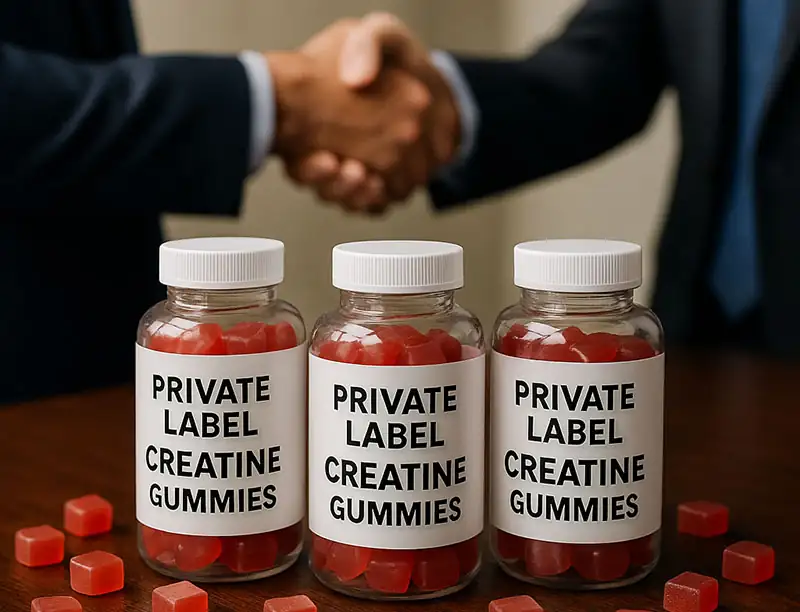
Private label gummies are finished supplement products manufactured by a third-party facility and sold under your own brand name. The manufacturer handles formulation, production, quality testing, and often packaging — while you own the brand identity, marketing, and customer relationship.
This model is distinct from reselling someone else’s branded product. With private label (also called white label), the product is customized to your specifications, from the active ingredients and dosage to the flavor, color, shape, and packaging design. Consumers see your brand, not the factory’s name.
Private label vs. OEM vs. ODM: These terms are often used interchangeably but carry meaningful distinctions. Private label typically refers to using a manufacturer’s existing base formulas and packaging them under your brand. OEM (Original Equipment Manufacturing) implies the brand provides its own formulation to be manufactured. ODM (Original Design Manufacturing) means the manufacturer designs both the formula and packaging based on your brief. Most modern gummy manufacturers offer all three models, giving brands significant flexibility.
2. Why Gummies? The Market Case for This Format
Consumer preference for gummies over traditional capsules and tablets has grown considerably over the past decade. Several factors explain this trend:
- Gummies offer a pleasant taste and texture that many consumers — particularly those who dislike swallowing pills — find more accessible.
- They are easy to dose, easy to carry, and tend to have higher compliance rates than other supplement formats.
- Gummies are highly brandable. Shape, color, flavor, and packaging can all be customized, making them well-suited for differentiated retail and DTC (direct-to-consumer) strategies.
- The gummy format accommodates a wide range of active ingredients: vitamins, minerals, adaptogens, probiotics, sleep aids, collagen, creatine, and many others.
For supplement brands, these characteristics translate into strong repeat purchase rates and favorable shelf appeal — both critical for sustainable revenue. For gummies wholesale buyers and bulk gummies distributors, the format’s broad consumer appeal makes inventory easier to move.
3. Key Steps in Gummy Manufacturing
Understanding the production process helps brands set realistic timelines, evaluate manufacturer claims, and ask the right questions. A reputable gummy manufacturer typically follows these stages:
3.1 Formulation Development
Every gummy product starts with a formula. If you are working under an ODM model, the manufacturer’s R&D team proposes a formulation based on your target health claim, ingredient preferences, regulatory requirements, and cost parameters. Under an OEM model, you supply your own formula, and the manufacturer validates it for production feasibility.
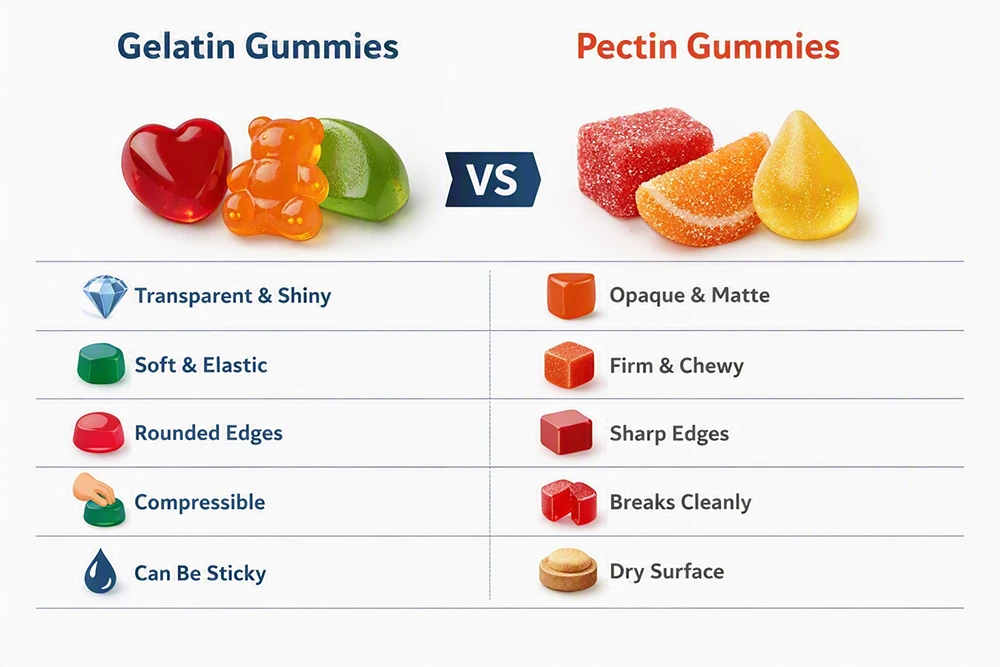
Key formulation decisions include: active ingredient selection and dosage, gelling agent (pectin for vegan-friendly products, gelatin for traditional), sweetener type (sugar-based vs. sugar-free or low-sugar), flavor and color profile, and any coating or dusting requirements.
3.2 Raw Material Sourcing and Testing
The quality of raw materials directly determines the quality of the finished product. Responsible gummy manufacturers test incoming raw materials for identity, purity, potency, and contaminants — including heavy metals and microbials — before they enter production. Look for manufacturers who can provide certificates of analysis (COA) for raw materials and who have established supplier qualification programs.
3.3 Production and Quality Control
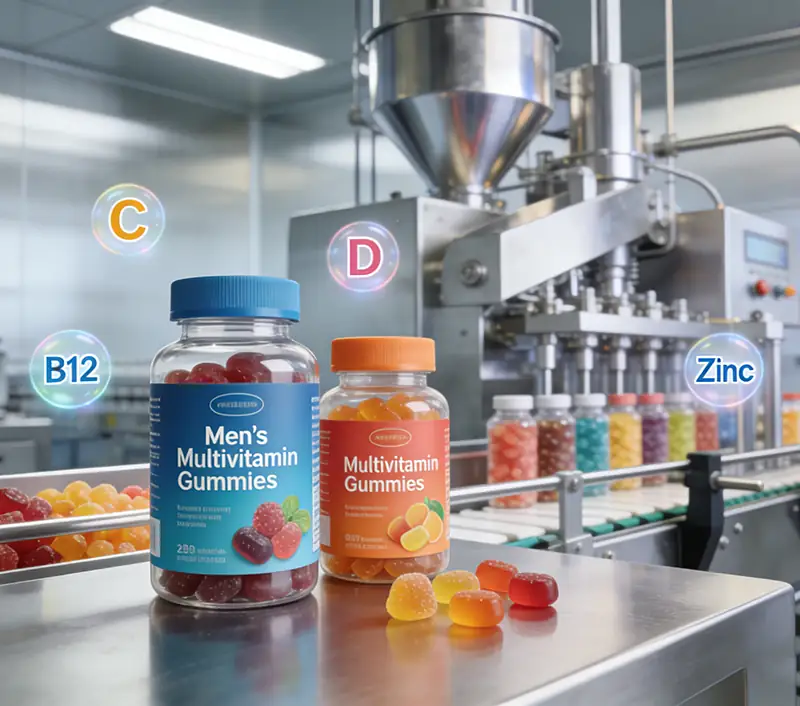
Gummy production involves several interdependent steps: preparing the base mixture (dissolving gelling agents and active ingredients), cooking and depositing the mixture into molds, cooling and demolding, optional coating or dusting, and packaging. Each step requires precise temperature and timing controls, which is why pharmaceutical-grade cleanroom environments matter.
For brands sourcing gummies bulk or at wholesale scale, manufacturing capacity is a critical consideration. A facility with a daily output capacity of 16 tons and annual capacity around 5,000 tons can handle large purchase orders without compromising batch quality or delivery timelines.
3.4 Finished Product Testing and Certification
Before release, finished batches should be tested for label accuracy (potency verification), microbiological safety, and physical characteristics. Certifications such as GMP (Good Manufacturing Practice), ISO 9001, ISO 22000, HACCP, and third-party audits provide independent verification that a manufacturer’s processes meet international standards.
For brands targeting specific markets or consumer segments, additional certifications — such as Halal, Kosher, or Vegan — may be relevant. Confirm that your manufacturer can supply documentation for whichever certifications your market requires.
3.5 Packaging and Labeling
For private label gummies, packaging is brand-defining. The manufacturer typically offers a range of packaging formats (pouches, bottles, jars, blister packs) and can work with your graphic design files to produce finished, retail-ready packaging. Some manufacturers offer in-house design support as part of their turnkey service offering.
Labeling must comply with the regulatory requirements of your target market. In the United States, for example, dietary supplement labels must include a Supplement Facts panel, ingredient disclosure, net quantity, and appropriate disclaimer language. An experienced gummy manufacturer with export experience can guide you through these requirements.
4. How to Evaluate a Gummy Manufacturer
Not all gummy manufacturers are equal. When assessing potential partners, consider the following:
4.1 Certifications and Regulatory Standing
A credible gummy manufacturer will hold current GMP certification and ideally additional certifications relevant to your target markets. Request copies of current certificates and verify their validity. For U.S. market products, FDA-registered facilities are preferred.
4.2 R&D Capability
Formulation science matters, particularly for complex functional gummies. Manufacturers with in-house research teams — ideally with academic or pharmaceutical backgrounds — are better positioned to create stable, efficacious formulations. Ask about their process for active ingredient stability testing and how they validate that stated label potency is maintained throughout shelf life.
4.3 MOQ and Scalability
Minimum order quantities (MOQs) vary widely across manufacturers. For startups or brands testing a new product, low MOQ options are essential for managing inventory risk. Established brands scaling existing SKUs benefit from manufacturers who can handle large gummies bulk and gummies wholesale orders without quality degradation.
Clarify not only the MOQ but also production lead times, capacity during peak periods, and how the manufacturer manages demand surges.
4.4 Transparency and Communication
Private label manufacturing involves an ongoing relationship, not a single transaction. Evaluate how responsive and transparent a manufacturer is during the inquiry phase — that behavior typically reflects the working relationship you can expect long-term. Factories that proactively share test results, production timelines, and potential issue escalations are more reliable partners than those who minimize problems.
4.5 Intellectual Property and Confidentiality
If you are bringing a proprietary formula or unique product concept to a manufacturer, ensure that non-disclosure agreements (NDAs) and IP ownership terms are clearly defined in your contract before sharing sensitive information.
5. Private Label vs. White Label Gummies: What Is the Difference?
These terms are sometimes used interchangeably, but in practice they describe slightly different service models:
White label gummies refer to standardized, pre-formulated products that the manufacturer produces in bulk. Multiple brands can purchase the same base product and market it under their own labels with minimal customization.
Private label gummies generally imply a greater degree of customization — the formula, flavor, shape, and packaging are tailored specifically for your brand. The product is not identical to what competitors buy from the same factory.
For brands building long-term equity and consumer loyalty, true private label customization is typically preferable. White label may suit brands testing the market with limited initial investment before committing to a bespoke product.
6. Regulatory Considerations for Gummy Supplements
Regulatory compliance is non-negotiable. The rules vary by country, and a supplement sold legally in one market may require label reformulation, different certification, or additional testing to be sold in another.
- United States: Dietary supplements are regulated by the FDA under the Dietary Supplement Health and Education Act (DSHEA). GMP compliance is mandatory. Labels must not make unauthorized disease claims.
- European Union: Supplements fall under food law. Authorized health claims are tightly restricted. Novel food regulations may apply to certain ingredients.
- Canada: Natural Health Products are regulated by Health Canada and require a product license (NPN) before sale.
- Australia: Therapeutic Goods Administration (TGA) oversees listed and registered complementary medicines.
Working with a manufacturer experienced in multi-market export simplifies compliance. They can advise on ingredient restrictions, documentation requirements, and labeling rules relevant to your target geography.
7. Pricing Structure and Cost Factors
Gummy manufacturing costs are influenced by multiple variables. Understanding these helps brands budget realistically and make informed sourcing decisions.
- Active ingredient costs: Commodity vitamins (C, D, B12) are relatively inexpensive. Specialty ingredients such as ashwagandha extract, NMN, or branded probiotics carry a premium.
- Gelling agent: Pectin (vegan) is generally more expensive than gelatin.
- Flavor and color complexity: Natural flavors and colors cost more than synthetic alternatives.
- Order volume: Per-unit costs decrease significantly at higher volumes. Gummies bulk and gummies wholesale orders command better pricing than small trial runs.
- Packaging: Custom packaging, particularly complex designs with embossing or special finishes, adds cost.
- Certification requirements: Products requiring Kosher, Halal, or Vegan certification may involve additional fees.
Request a detailed cost breakdown from your manufacturer that separates material costs, production costs, testing, and packaging. This transparency helps identify areas where value engineering is possible without compromising product quality.
8. Turnkey Solutions: End-to-End Manufacturing Support
Many gummy manufacturers now offer turnkey or full-service OEM/ODM programs that extend beyond physical production. These programs typically include:
- Formulation consultation and ingredient sourcing
- Regulatory guidance and documentation support
- Packaging design assistance
- Quality testing and certification management
- Export logistics support
For brands launching their first supplement product, or for established brands expanding into new categories, turnkey solutions reduce operational complexity and compress time-to-market. Rather than managing formulation, production, and compliance separately, all functions are coordinated by a single manufacturing partner.
When evaluating turnkey providers, ask specifically about the depth of support in each area. Some manufacturers offer nominal design support while others have in-house design teams capable of producing retail-ready artwork. The difference in scope can significantly affect your launch timeline and total cost.
9. Summary
Private label gummies represent a compelling opportunity for supplement brands, retailers, and entrepreneurs seeking to build differentiated, high-margin products in a growing market. The gummy format’s consumer appeal, versatility, and brandability make it a durable category across functional health niches.
Success in this category depends on selecting a qualified gummy manufacturer with strong R&D capability, verifiable quality certifications, appropriate production capacity, and genuine transparency in their processes. Whether you are placing a small trial order or sourcing gummies wholesale at scale, the same principles apply: validated formulations, third-party tested ingredients, GMP-compliant production, and packaging that meets your target market’s regulatory requirements.
The private label model — whether OEM, ODM, or white label — gives brands significant flexibility to control product differentiation while relying on specialized manufacturing expertise. Brands that approach this relationship with clear specifications, realistic timelines, and a focus on long-term partnership tend to achieve better outcomes than those treating manufacturing as a purely transactional activity.
Frequently Asked Questions (FAQ)
Q1: What is the typical minimum order quantity (MOQ) for private label gummies?
MOQ varies by manufacturer and product type. Some factories offer small trial runs of a few thousand units for brands testing new products, while standard commercial MOQs often start at 10,000 to 50,000 units per SKU. If low MOQ flexibility is important to your business model, confirm this explicitly before selecting a manufacturing partner.
Q2: How long does it take to produce private label gummies from start to finish?
For a new product with custom formulation, the end-to-end timeline — from initial brief to finished goods — typically ranges from 60 to 120 days. This includes formulation development, raw material procurement, pilot production, testing, and packaging. Re-orders of established formulas are generally faster. Discuss your timeline requirements early in the process to ensure they align with your manufacturer’s production schedule.
Q3: Can I use my own proprietary formula with a contract gummy manufacturer?
Yes. Under an OEM model, you supply your formulation and the manufacturer produces it to your specifications. Ensure that any proprietary formula or ingredient blend is protected by a non-disclosure agreement before sharing details with a prospective manufacturer. Also confirm that the manufacturer has experience working with your specific ingredients and can validate the formula for production stability.
Q4: What certifications should I look for in a gummy manufacturer?
At a minimum, GMP (Good Manufacturing Practice) certification is essential for supplement manufacturing. ISO 9001 and ISO 22000 indicate strong quality management and food safety systems. For specific markets or consumer segments, Halal, Kosher, Vegan, and FDA registration may be required or commercially valuable. Always request copies of current certificates rather than relying on claims alone.
Q5: What is the difference between gummies bulk ordering and gummies wholesale?
Gummies bulk typically refers to purchasing unpackaged or semi-finished product in large quantities, often for repackaging or further processing by the buyer. Gummies wholesale generally refers to purchasing finished, packaged products in large quantities for resale. Many manufacturers support both models, though the pricing, lead times, and documentation requirements may differ.
Q6: Are vegan gummies more expensive than gelatin-based gummies?
Generally, yes. Pectin — the plant-derived gelling agent used in vegan gummies — is more expensive than gelatin, and vegan formulations can require additional processing adjustments to achieve comparable texture. However, the cost premium has narrowed in recent years as demand for vegan products has increased and pectin sourcing has improved. For many brands targeting health-conscious consumers, the market positioning value of vegan certification outweighs the incremental cost difference.
Q7: How do I verify the quality of a gummy manufacturer before placing a large order?
Request current certifications and audit reports. Ask for references from existing clients if possible. Request a product sample — ideally from a production batch rather than a one-off sample — to evaluate texture, flavor consistency, appearance, and label accuracy. For critical quality claims, consider commissioning independent third-party testing of samples before committing to a full production run.
About Gothink Biotech — Your Gummy Manufacturing Partner
Shenzhen Gothink Biotech Co., Ltd. is a professional dietary supplement manufacturer and gummy manufacturer headquartered in Shenzhen, China. We offer end-to-end OEM, ODM, CMO, and CDMO services designed to support supplement brands at every stage — from concept to commercial launch.
Our GMP-certified facility operates a 100,000-class cleanroom with a daily production output of 16 tons and an annual manufacturing capacity of 5,000 tons, supporting both small-batch private label programs and large-scale gummies bulk and gummies wholesale production runs. Our 10,000-class pharmaceutical-grade R&D laboratory, led by postdoctoral researchers with experience at institutions including Emory University and The Ohio State University, supports precise and innovative formulation development across all supplement formats.
We specialize in the full spectrum of gummy contract manufacturing — including vitamin gummies, functional gummies, probiotic gummies, adaptogen gummies, sleep gummies, collagen gummies, and more — using both gelatin and vegan pectin-based gelling systems. Our services extend beyond gummies to include capsule, tablet, powder, liquid, and drops supplement manufacturing, making us a comprehensive one-stop manufacturing partner.
For brands seeking white label or private label gummy solutions, we provide flexible MOQ options, complete formulation customization, packaging design support, regulatory documentation, and export logistics assistance. Our certifications include ISO 9001, ISO 22000, HACCP, GMP, FDA registration, Halal, Kosher, and Vegan, ensuring that your product meets quality and compliance standards across global markets.
For inquiries regarding private label gummies, OEM/ODM manufacturing, bulk gummies production, or wholesale supplement sourcing, contact the Gothink Biotech team at gttbio.com.