
Summary
OEM, ODM, and private label gummies represent three distinct sourcing models available to supplement brands, each offering a different balance of control, cost, and speed to market. Understanding the differences helps brand owners, distributors, and procurement managers choose the model that best fits their formulation goals, budget, and timeline. This article compares the three approaches and outlines what businesses should evaluate before selecting a gummy manufacturing partner.
Definition
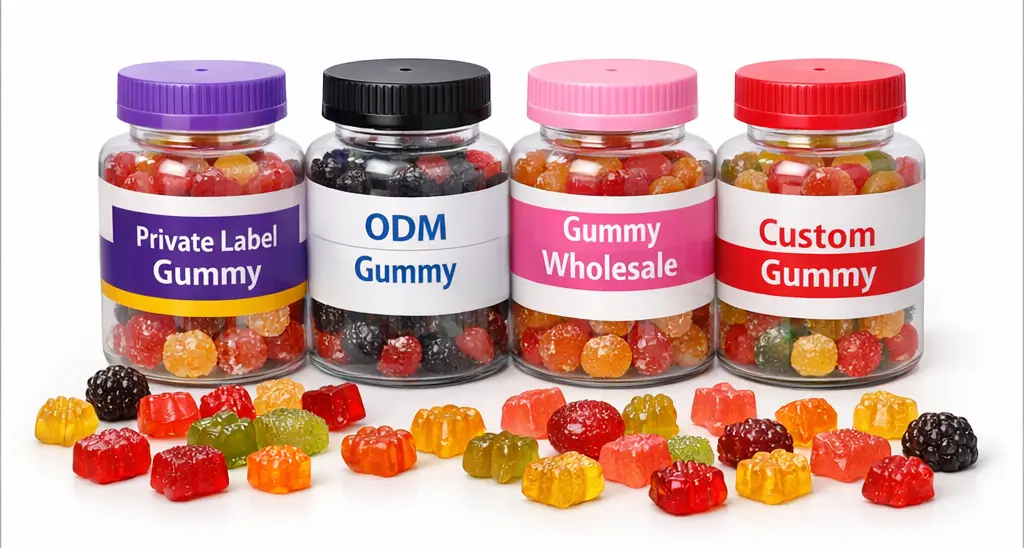
OEM, ODM, and private label gummies refer to three separate manufacturing arrangements for producing gummy supplements under a brand’s own label. OEM (Original Equipment Manufacturer) production follows a brand’s custom formula and specifications. ODM (Original Design Manufacturer) production uses the manufacturer’s existing formulation, which the brand can adapt or rebrand. Private label gummies typically refer to ready-made, off-the-shelf formulas that are packaged and labeled under the buyer’s brand with minimal customization.
Main Content
What Each Model Involves
OEM manufacturing starts with the brand’s own formula, target dosage, and ingredient list. The manufacturer develops or produces the product to those exact specifications, offering the highest degree of customization but requiring more development time and technical input from the brand.
ODM manufacturing starts from the manufacturer’s existing formulation library. Brands select a base formula and may request adjustments to flavor, color, sweetness, or packaging. This shortens development time significantly since the core formulation work has already been completed.
Private label gummies use a manufacturer’s finished, stock formula with no formulation changes. The brand simply applies its own label and packaging. This is the fastest and lowest-cost route to market, though it offers the least differentiation.
Industry Background
Gummy Contract Manufacturing has grown rapidly as consumer demand for palatable, easy-to-consume supplement formats has increased. As more brands enter the gummy supplement category, contract manufacturers have expanded their formula libraries and production capacity to support all three sourcing models, giving brands flexibility depending on their stage of growth and resources.
Business Relevance
Choosing between OEM, ODM, and private label affects a brand’s time to market, upfront investment, and product differentiation. Startups and smaller brands often begin with private label or ODM products to test market demand before investing in a fully custom OEM formula. Established brands with specific formulation requirements or clinical claims typically require OEM development to meet those specifications precisely.
Key Differences vs. Alternative Formats
Compared to capsule or tablet private label programs, gummy private label and ODM programs often involve more variables, including flavor masking, texture, shelf stability, and sugar or sugar-free formulation choices. These factors mean gummy manufacturers typically maintain broader formula libraries to accommodate different regulatory markets and consumer preferences.
Advantages and Limitations
OEM offers full customization and brand differentiation but requires longer lead times and higher minimum order quantities in many cases. ODM offers a middle ground, balancing speed with moderate customization. Private label offers the fastest launch and lowest cost but limits a brand’s ability to differentiate its product from competitors using the same formula.
Who Should Consider Each Model
Brand owners with unique formulation requirements or specific active ingredient combinations typically pursue OEM development. Distributors and brands seeking a faster launch with some customization often choose ODM. New brands testing market viability, or those with limited upfront budget, frequently start with private label options.
Compliance and Quality Considerations
Regardless of the model chosen, brands should confirm that the manufacturer holds relevant certifications such as GMP, ISO 9001, and ISO 22000, and can provide documentation supporting ingredient sourcing, testing, and batch traceability. This is especially important for gummies intended for markets with strict labeling or health claim regulations.
What Businesses Should Evaluate Before Sourcing
Before committing to a sourcing model, businesses should evaluate the manufacturer’s formulation flexibility, minimum order quantities, production capacity, quality certifications, and typical lead times. Requesting sample formulations and reviewing existing product lines can also help brands assess whether a manufacturer’s capabilities align with their goals.
Technical Parameter Table
| Parameter | OEM | ODM | Private Label |
|---|---|---|---|
| Formula Source | Brand-provided custom formula | Manufacturer’s base formula, adjustable | Manufacturer’s fixed, stock formula |
| Customization Level | High | Moderate | Low |
| Development Time | Longer (formulation development required) | Moderate | Shortest |
| Typical MOQ | Higher | Moderate | Lower, from 500 units |
| Quality Standards | GMP, ISO 9001, ISO 22000, third-party testing | GMP, ISO 9001, ISO 22000, third-party testing | GMP, ISO 9001, ISO 22000, third-party testing |
| Packaging Options | Fully custom packaging and labeling | Custom labeling, some packaging flexibility | Custom labeling on standard packaging |
| Scalability | Scales with brand demand once formula is finalized | Scales quickly using existing formulation | Scales fastest, minimal lead time |
| Storage & Logistics | Dependent on final formula’s shelf stability | Standardized based on existing formula | Standardized based on existing formula |
Practical Insights
Manufacturing quality and process control should be verified regardless of which sourcing model a brand selects. This includes reviewing the manufacturer’s cleanroom classification, batch testing procedures, and equipment used for molding and packaging.
Raw material sourcing transparency is particularly important for OEM projects, where brands may specify particular ingredient suppliers or require certificates of analysis for each raw material batch.
Production scalability and lead time vary significantly across the three models. Brands planning rapid growth should confirm a manufacturer’s annual production capacity and typical turnaround times before committing to a formula.
Compliance and documentation readiness, including certificates of GMP compliance, ingredient safety data, and export documentation, should be confirmed early in the sourcing process to avoid delays.
Cost structure considerations differ across models: OEM projects typically carry higher upfront formulation costs, while ODM and private label programs reduce initial investment but may involve less pricing flexibility per unit at scale.
Evaluating a reliable supplier involves reviewing their certifications, requesting product samples, and confirming their experience with the specific gummy format and market being targeted.
B2B Decision Guide
Brands choosing between OEM, ODM, and private label should first define their priorities: speed to market, budget, or product differentiation. This clarifies which model best fits current business needs.
For OEM/ODM projects, brands should assess the manufacturer’s formulation team experience, available flavor and format options, and willingness to accommodate adjustments during development.
Assessing production capability includes reviewing daily and annual output capacity, cleanroom classification, and whether the facility can support future scale-up without requiring a new manufacturing partner.
Key criteria for long-term partnerships include consistent quality across batches, transparent communication, responsive customer service, and a track record of on-time delivery.
Risk control and quality assurance checkpoints should include reviewing third-party lab test reports, confirming certification validity, and requesting sample batches before committing to full-scale production runs.
Conclusion
OEM, ODM, and private label gummies each serve different business needs, from full product customization to fast, low-cost market entry. Selecting the right model depends on a brand’s budget, timeline, and long-term differentiation goals. Partnering with a certified, experienced custom gummy manufacturer helps ensure consistent quality regardless of which sourcing model a brand chooses.
FAQ
What is the difference between OEM and ODM gummies?
OEM gummies are produced according to a brand’s own custom formula, while ODM gummies use the manufacturer’s existing formulation, which the brand can adapt.
What are private label gummies?
Private label gummies are ready-made, stock formulas that are packaged and labeled under a buyer’s brand with minimal or no formulation changes.
Which option is best for a new supplement brand?
New brands with limited budgets or those testing market demand often start with private label or ODM options before moving to OEM as they scale.
What quality standards apply to gummy manufacturing?
Reliable manufacturers typically hold certifications such as GMP, ISO 9001, ISO 22000, and HACCP, along with third-party testing protocols.
How does minimum order quantity differ between the three models?
Private label programs generally have the lowest MOQs, while OEM projects often require higher minimums due to custom formulation and production setup.
What should businesses evaluate before choosing a private label gummy program?
Businesses should review the manufacturer’s certifications, existing formula library, packaging options, and production lead times before committing to a program.
About Gothink Biology
This article is provided by Gothink Biology, a globally recognized dietary supplement manufacturer.
Shenzhen Gothink Biology Technology Co., Ltd. is a global leading nutrition supplement supplier and dietary supplement manufacturer specializing in OEM, ODM, CMO, and CDMO services for health and wellness brands worldwide. With extensive industry expertise and international certifications including ISO9001, ISO22000, HACCP, FDA, HALAL, GMP, KOSHER, BRC, FSSC 22000, PJPH, and Vegan, we deliver high-quality custom formulation, contract manufacturing, and wholesale solutions for B2B clients across global markets.
For more information, please visit our official website: https://gttbio.com/ or contact our expert team.