
Summary
Making vitamin gummy bears involves a structured manufacturing process that combines active nutrient ingredients with gelling agents, sweeteners, flavors, and colorants to produce a chewable, consumer-friendly supplement format. For supplement brands, distributors, and private label buyers, understanding this process is essential for evaluating Gummy Contract Manufacturing partners, managing production quality, and bringing differentiated products to market efficiently. This guide outlines every key stage — from formulation design to packaging — and provides actionable guidance for B2B sourcing decisions.
Definition
How to make vitamin gummy bears refers to the end-to-end manufacturing process by which vitamin-enriched gummy confections are developed, formulated, produced, quality-tested, and packaged for commercial sale as dietary supplements. This process encompasses raw material selection, gelling system preparation, active ingredient blending, depositing, setting, demolding, coating, and final packaging — all governed by applicable GMP and regulatory standards.
Industry Background
Gummy vitamins represent one of the fastest-growing segments within the global dietary supplement industry. Originally developed as a child-friendly alternative to hard tablets and capsules, vitamin gummies have expanded significantly into the adult market over the past decade. Consumers increasingly prefer formats that are easy to consume, pleasant in taste, and visually appealing — driving sustained demand across retail, e-commerce, and subscription wellness channels.
For contract manufacturers, private label brands, and OEM/ODM buyers, gummy bear vitamins present both a high-margin opportunity and a technically demanding production challenge. Compared to capsules or tablets, gummy manufacturing requires tighter process control, specialized equipment, and more complex formulation expertise — particularly when incorporating heat-sensitive vitamins or functional botanical extracts.
Core Manufacturing Process: How Vitamin Gummy Bears Are Made
Step 1 — Formulation Development
The process begins with formulation design. A qualified R&D team determines the active vitamin blend (such as Vitamin C, Vitamin D3, B-complex, or multivitamin combinations), selects the appropriate gelling agent, and establishes the sugar or sugar-substitute base. Key formulation decisions include:
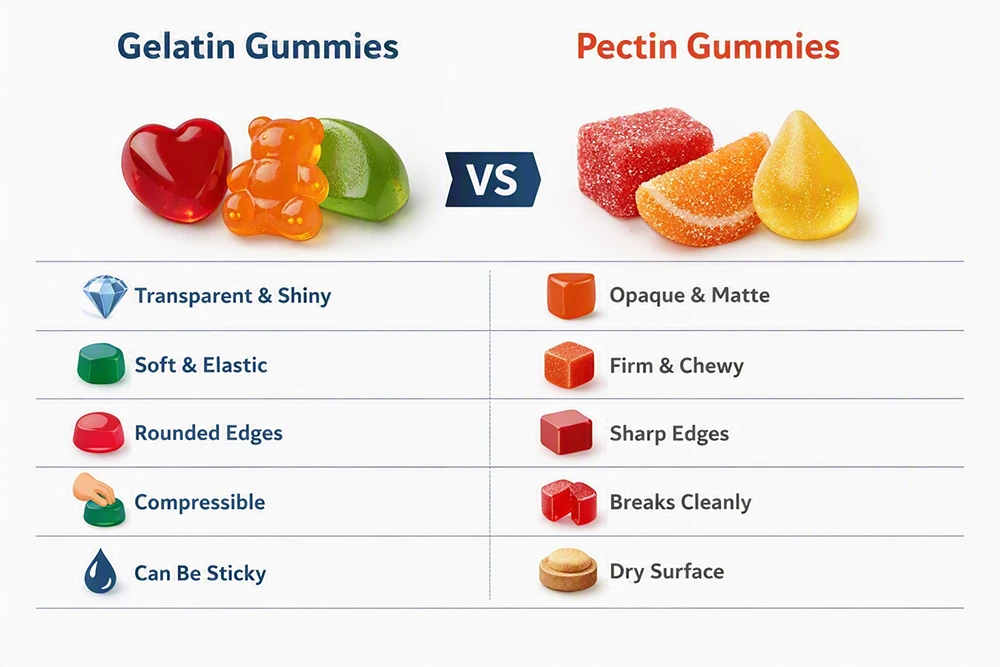
- Gelling agent selection: pectin (for vegan-compliant products) or gelatin (for conventional formulas)
- Active vitamin load per gummy, accounting for overage to compensate for heat degradation
- pH management (critical for pectin-based systems)
- Flavor, color, and texture targets aligned to target consumer profile
- Sugar content and sweetener strategy (regular, reduced-sugar, or sugar-free)
Step 2 — Ingredient Weighing and Premixing
Once formulation is finalized, raw materials are weighed according to the batch formula. Dry vitamins and actives are pre-blended separately from the syrup base to ensure uniform distribution. Ingredient traceability at this stage is essential for GMP compliance and lot documentation.
Step 3 — Cooking and Syrup Preparation
The gelling agent is hydrated and dissolved in water, then combined with sugar (or sugar alternatives such as erythritol or maltitol) and glucose syrup. This mixture is heated to a precise temperature — typically between 107°C and 115°C — to achieve the correct Brix level and moisture content. Overheating degrades heat-sensitive vitamins; underheating produces a soft, unstable final product.
Step 4 — Active Ingredient Incorporation
Once the base syrup cools to a safe blending temperature (typically below 85°C for heat-sensitive actives), vitamins, botanical extracts, colorants, and flavors are added and mixed homogeneously. Precise temperature management at this stage protects vitamin potency and ensures label claim accuracy.
Step 5 — Depositing into Molds
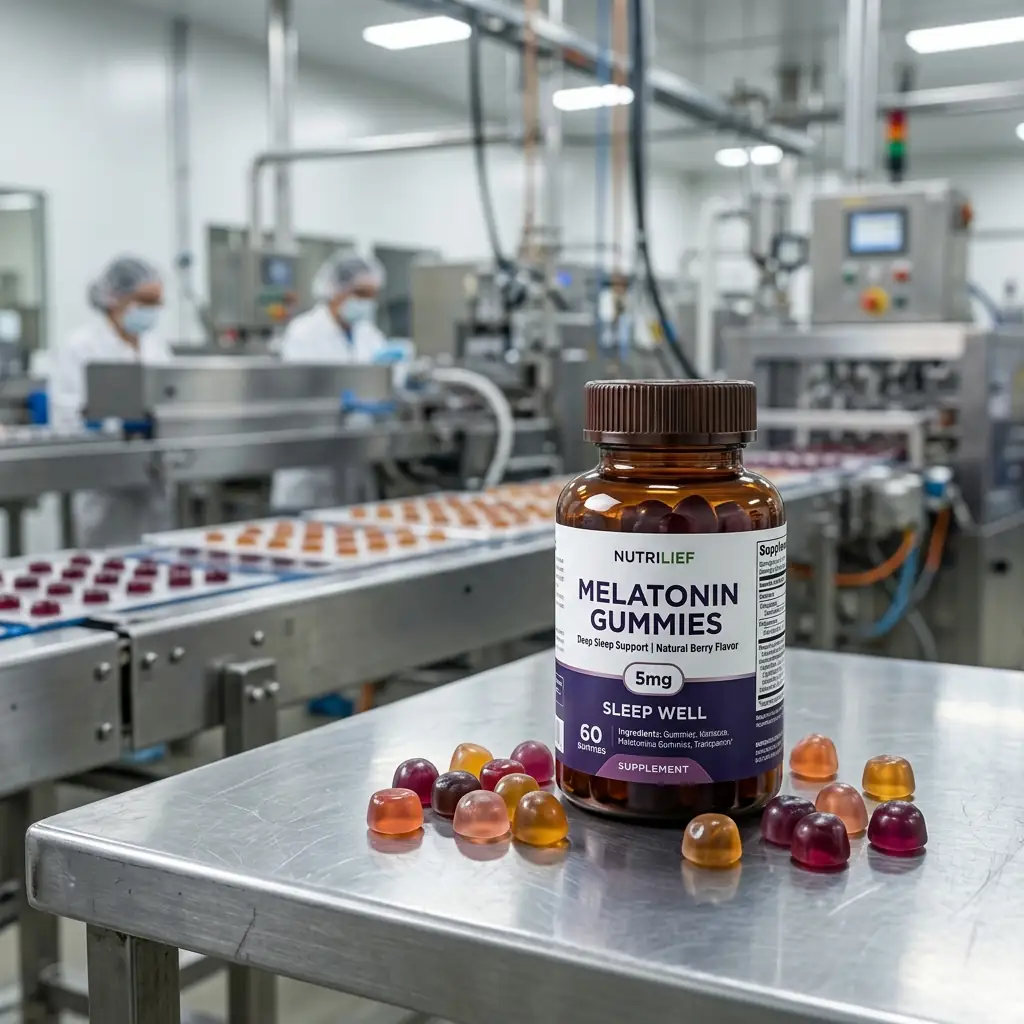
The liquid gummy mass is deposited into bear-shaped molds using automated depositing equipment. Modern facilities use continuous depositing lines capable of high throughput. Mold design affects the final product shape, weight consistency, and demolding efficiency. Starch mogul systems and silicone mold systems each offer distinct tradeoffs in speed, flexibility, and cleaning requirements.
Step 6 — Setting and Cooling
Filled molds are conveyed through temperature- and humidity-controlled setting tunnels or rooms. Gelatin-based gummies typically require 24–48 hours at controlled ambient conditions; pectin-based gummies set more rapidly at lower temperatures. Proper setting is critical for achieving the correct firmness, elasticity, and water activity.
Step 7 — Demolding, Oiling, and Polishing
Set gummies are demolded and transferred to tumbling drums, where a light application of food-grade oil (carnauba wax or beeswax alternatives for vegan lines) is applied to prevent sticking and improve appearance. Polishing enhances surface sheen and shelf appeal.
Step 8 — Quality Control Testing
Before packaging, finished gummies undergo in-process and final quality testing, including: weight per unit, moisture content, hardness/texture, pH, microbial limits, heavy metal screening, and label-claim vitamin potency verification by third-party or in-house laboratories.
Step 9 — Packaging
Gummies are filled into bottles, stand-up pouches, blister packs, or sachets. Automated counting and filling lines ensure accuracy. Child-resistant closures, tamper-evident seals, and label compliance with FDA (or destination market) requirements are applied at this stage.
Technical Parameter Table
| Parameter | Standard Specification |
|---|---|
| Product Form | Bear-shaped gummy (2g–5g per unit; custom shapes available) |
| Gelling Agent Options | Gelatin (bovine/porcine), Pectin (vegan), Carrageenan, Agar |
| Active Vitamin Types | Single vitamins (C, D3, B12, etc.), multivitamin blends, botanical actives |
| Cooking Temperature | 107°C–115°C (syrup preparation stage) |
| Active Addition Temperature | ≤85°C (to protect heat-sensitive vitamins) |
| Setting Time | Gelatin: 24–48 hrs; Pectin: 4–12 hrs (temperature dependent) |
| Moisture Content (finished) | 15%–20% (typical; varies by formulation) |
| Water Activity (Aw) | 0.55–0.65 (microbial stability range) |
| Quality Standards | GMP (21 CFR Part 111 / ISO 22000), HACCP, third-party lab verification |
| Certifications Available | ISO9001, ISO22000, HALAL, KOSHER, Vegan, FDA-registered facility |
| Packaging Formats | HDPE bottles, stand-up pouches, blister packs, sachets; custom label printing |
| MOQ (Typical) | From small trial batches to full-scale commercial runs (varies by manufacturer) |
| Production Capacity | High-capacity facilities: 10+ tons/day; annual capacity 3,000–5,000+ tons |
| Shelf Life | 18–24 months (standard; dependent on formulation and packaging) |
| Storage Conditions | Cool (below 25°C), dry environment; avoid direct sunlight and humidity above 65% RH |
| Lead Time (OEM) | 4–10 weeks (depending on formulation complexity and order volume) |
Practical Insights for B2B Buyers
Manufacturing Quality and Process Control
Gummy production is one of the more quality-sensitive supplement formats. Inconsistencies in syrup temperature, Brix concentration, or active ingredient blending directly translate into potency variance, texture defects, or stability failures. When evaluating a custom gummy manufacturer, buyers should request documentation of in-process control checkpoints, not just finished-product certificates of analysis (COAs).
Raw Material Sourcing Transparency
Active vitamin ingredients, gelling agents, and excipients vary widely in purity and traceability depending on their source. Reputable manufacturers provide raw material COAs, supplier qualification records, and — for regulated markets — full ingredient disclosure. Buyers sourcing for the US, EU, or Australian markets should confirm that all actives meet pharmacopeial standards (USP, EP, or equivalent).
Production Scalability and Lead Time
A manufacturer’s ability to scale from trial runs to full commercial batches without compromising consistency is a critical operational factor. Buyers launching new SKUs should assess whether a supplier has dedicated R&D capacity for formulation trials and whether production line scheduling can accommodate growth without extended queue delays.
Compliance and Documentation Readiness
For products entering the US market, manufacturers must operate under 21 CFR Part 111 (dietary supplement GMP). EU-bound products require compliance with applicable EU food supplement directives. Buyers should verify that suppliers maintain batch records, retain samples, and can provide full documentation packages for import customs and regulatory audits.
Cost Structure Considerations
Gummy bear vitamin pricing is influenced by active ingredient cost (especially premium botanicals or high-dose vitamin D3), gelling system choice (pectin typically costs more than gelatin), packaging format, and order volume. Buyers should obtain itemized cost breakdowns rather than per-unit pricing alone to accurately assess cost drivers and negotiate effectively.
B2B Decision Guide: Choosing a Vitamin Gummy Bear Manufacturer
For Brands and Private Label Buyers
When selecting a private label gummy manufacturer, the core evaluation criteria go beyond price. Brands should prioritize:
- Formulation capability: Does the manufacturer have an in-house R&D team capable of developing novel actives, adjusting texture profiles, or creating vegan-certified formulas?
- Regulatory fluency: Can the supplier support label compliance review, FDA facility registration, and documentation for import into your target market?
- Quality assurance infrastructure: Is third-party testing conducted routinely, and are results shared proactively?
- Flexibility on MOQ: For new product launches, smaller initial runs reduce inventory risk; confirm whether the manufacturer accommodates trial-scale production.
For OEM/ODM Projects
OEM buyers bringing their own formula require manufacturers who can validate the formula for process compatibility, advise on overage levels for heat-sensitive vitamins, and reproduce consistent results at scale. ODM buyers relying on the manufacturer’s formulations should request access to formula stability data and prior batch results as part of due diligence.
Assessing Long-Term Partnership Potential
Volume commitments, payment terms, and exclusivity clauses should be negotiated clearly before production begins. Buyers scaling rapidly should assess whether the manufacturer has reserve production capacity and whether lead times have remained consistent across recent quarters. References from existing clients in similar product categories provide meaningful validation beyond facility audits.
Risk Control and Quality Assurance Checkpoints
Key checkpoints to build into any supply agreement include: pre-production raw material COA review, in-process weight and texture audits, finished-product third-party potency testing, and retention sample policies. Specifying these contractually — rather than relying on verbal assurances — is standard practice for professional B2B supplement sourcing.
Conclusion
Understanding how to make vitamin gummies at a manufacturing level equips brands and procurement teams to make better sourcing decisions, ask more precise qualification questions, and manage product quality more effectively. Vitamin gummy bears require a technically disciplined production process, qualified raw material inputs, and strong GMP infrastructure. For B2B buyers — whether sourcing through a private label gummy program or commissioning full OEM/ODM development — selecting the right manufacturing partner is the single most consequential decision in bringing a gummy vitamin product to market. Evaluate suppliers on formulation expertise, regulatory capability, process transparency, and scalable capacity rather than price alone.
FAQ
What is the basic process for making vitamin gummy bears?
Vitamin gummy bears are made by dissolving a gelling agent (gelatin or pectin) with sweeteners and heating the mixture to the correct concentration, then blending in active vitamins and flavors at safe temperatures, depositing into bear-shaped molds, allowing the gummies to set, demolding, oiling for non-stick finish, quality testing, and packaging.
Why does gelling agent choice matter for gummy manufacturing?
The gelling agent determines texture, setting time, temperature tolerance, and market positioning. Pectin-based gummies are vegan-compatible and preferred in health-conscious markets but require tighter pH control. Gelatin-based gummies offer a softer chew and faster processing but are not suitable for vegan, halal-without-certification, or kosher-without-certification products.
How does vitamin potency hold up through the gummy manufacturing process?
Heat-sensitive vitamins (such as Vitamin C and certain B vitamins) are susceptible to degradation during cooking. Manufacturers address this by adding actives after the syrup cools below a critical threshold (typically ≤85°C) and by incorporating potency overages at formulation stage to ensure label claims are met at end of shelf life.
What quality standards apply to vitamin gummy bear manufacturing?
US-market products must be manufactured under 21 CFR Part 111 (GMP for dietary supplements). Additional applicable standards include ISO22000, HACCP, and facility-level certifications such as HALAL, KOSHER, and Vegan. Third-party testing for potency, heavy metals, and microbial limits is standard practice for credible supplement brands.
What should businesses evaluate before sourcing gummy bear vitamins from a contract manufacturer?
Key evaluation criteria include: the manufacturer’s GMP certification status and facility standards, R&D formulation capability, raw material traceability, third-party testing practices, MOQ flexibility, production capacity and lead times, and documented compliance support for the target export market.
How does gummy bear manufacturing compare to capsule or tablet supplement production?
Gummy manufacturing involves greater process complexity — including syrup cooking, temperature-sensitive active blending, mold depositing, and humidity-controlled setting — compared to capsule filling or tablet compression. Per-unit production costs are typically higher, but gummies command stronger consumer preference and retail pricing in many categories, making the format commercially attractive despite higher manufacturing demands.
About the Manufacturer
Shenzhen Gothink Biotech Co., Ltd. is a GMP-certified contract manufacturer based in China, operating a 100,000-class cleanroom facility with a daily production output of 16 tons and an annual capacity of 5,000 tons. The company provides comprehensive OEM, ODM, CMO, and CDMO services for dietary supplements, including gummy, capsule, tablet, powder, liquid, and drop formats. Gothink Biotech supports full product lifecycle development — from formulation research and raw material sourcing through to manufacturing, quality control, packaging, and export compliance. The company holds certifications including ISO9001, ISO22000, HACCP, GMP, HALAL, KOSHER, and Vegan, and maintains a 10,000-class pharmaceutical-grade R&D laboratory led by researchers with postdoctoral backgrounds from US institutions. The facility is equipped to accommodate both small-scale trial production and large-volume commercial orders, supporting long-term supply partnerships with supplement brands, distributors, and private label buyers globally.