
Summary
Gelatin gummies have become one of the most popular delivery formats in the dietary supplement industry. Whether you are a startup launching your first private label product or an established brand scaling production through contract manufacturing, understanding how gelatin gummies are made is foundational to making informed decisions about formulation, sourcing, and manufacturing partnerships.
This guide walks through the complete gummy manufacturing process — from raw material selection to finished product — with practical detail relevant to brands, buyers, and anyone evaluating a gummy supplement manufacturer. It also addresses common quality considerations, production variables, and what to look for when selecting an OEM or ODM partner.
What Are Gelatin Gummies and Why Do They Matter?
Gelatin gummies are soft, chewable confections made primarily from gelatin — a protein derived from animal collagen, typically from bovine or porcine sources. In the supplement industry, they serve as a vehicle for delivering vitamins, minerals, herbal extracts, and other bioactive compounds in a format that consumers find palatable and convenient.
The appeal of gummy supplements is well-supported by market data. Consumer preference for gummies over traditional capsules and tablets has grown steadily, driven largely by taste, texture, and ease of consumption — particularly for children and adults who struggle with swallowing pills. For supplement brands, this translates into stronger repeat purchase rates and broader consumer reach.
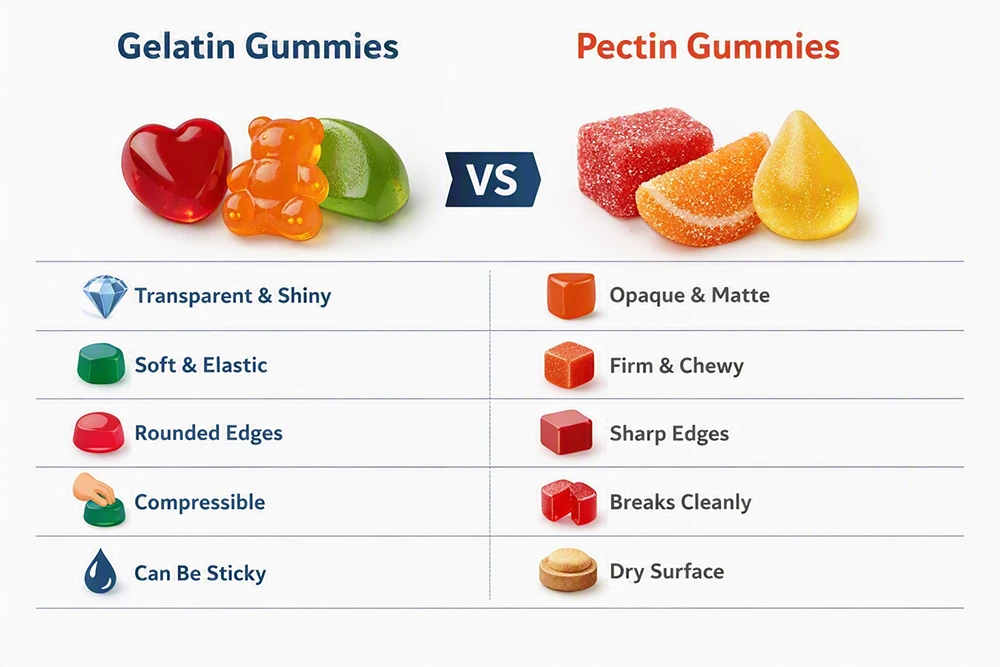
Unlike plant-based gelling agents such as pectin or carrageenan — which are common in vegan gummies — gelatin offers a distinct elastic, chewy texture that many consumers associate with the traditional gummy experience. Choosing between gelatin and non-gelatin bases is one of the first formulation decisions a brand must make, and it has downstream implications for manufacturing process, cost, and target market positioning.
Key Ingredients in Gelatin Gummy Manufacturing
A standard gelatin gummy formulation contains several core components. Each plays a role in the final product’s texture, stability, taste, and efficacy.
1. Gelatin
Gelatin is the primary gelling agent. Bloom strength — a measurement of gel firmness — is a critical parameter. Most gummy supplement formulations use gelatin with a Bloom value between 150 and 250. Higher Bloom values produce firmer gummies; lower values yield softer textures. The source of gelatin (bovine vs. porcine) also matters for regulatory and consumer compliance purposes, particularly for markets with religious or dietary restrictions.
2. Sweeteners
Sucrose and glucose syrup are the traditional sweeteners in gummy manufacturing. They contribute to texture, moisture retention, and shelf life as well as taste. Sugar-reduced or sugar-free formulations — increasingly in demand — substitute these with alternative sweeteners such as maltitol, erythritol, or stevia, though adjustments to the gelling process are required to compensate for textural differences.
3. Active Ingredients
This is the supplement component. Common actives include vitamins (C, D, B12), minerals (zinc, magnesium), melatonin, herbal extracts (ashwagandha, elderberry), and functional ingredients like collagen or probiotics. Each active ingredient presents its own formulation challenges related to heat sensitivity, solubility, and compatibility with the gelatin matrix.
4. Acidulants and Flavorings
Citric acid and malic acid are commonly used to adjust pH, which affects gelling behavior, preservation, and flavor profile. Natural and artificial flavorings are added to create product-specific taste profiles. These must be carefully balanced against the gelatin’s own flavor characteristics.
5. Colorants
Both natural (e.g., fruit and vegetable concentrates, beta-carotene) and synthetic colorants are used depending on market regulations and brand preferences. Natural colorants are increasingly preferred in clean-label supplement positioning, though they can be less stable under heat and light exposure.
6. Humectants and Preservatives
Sorbitol and glycerin help manage water activity and prevent gummies from becoming too dry or too sticky during storage. Preservatives such as potassium sorbate may be added to extend shelf life, particularly for products destined for long supply chains.
Step-by-Step: How Gelatin Gummies Are Made in a Manufacturing Setting
The following describes the core production process used in a professional gummy supplement manufacturing facility. While small-scale artisan production exists, commercial-grade gummy manufacturing for supplement brands requires controlled environments, precision equipment, and validated processes.
Step 1: Formulation and Recipe Development
Before any production begins, a detailed formulation is developed. This includes specifying the type and grade of gelatin, the active ingredient blend, sweetener ratio, flavoring, and coloring. In an OEM or ODM manufacturing relationship, this phase often involves close collaboration between the brand’s development team and the manufacturer’s R&D scientists.
Formulation development must account for active ingredient stability across the production process — particularly important given that gummy manufacturing involves heat. Ingredients like vitamin C and certain probiotics require special handling to ensure label claim potency is preserved through processing and over shelf life.
Step 2: Gelatin Hydration and Dissolving
Gelatin granules or sheets are first hydrated (“bloomed”) in cold water. This process typically takes 10 to 30 minutes, depending on gelatin type and concentration. After hydration, the gelatin is gently heated — usually between 60°C and 80°C — to fully dissolve into a clear liquid. Overheating can degrade gelatin quality and reduce Bloom strength, so precise temperature control at this stage is essential.
Step 3: Syrup Cooking
In a separate vessel, sweeteners (sucrose and glucose syrup) are combined with water and heated to a precise temperature — typically 107°C to 115°C — to reduce water content and achieve the correct sugar concentration. The resulting syrup is then cooled to a temperature compatible with gelatin addition.
Step 4: Blending the Gummy Mass
The gelatin solution and cooked syrup are combined in a mixing vessel. Flavorings, colorants, acidulants, and active ingredients are added at this stage. Temperature management is critical: the mixture must remain warm enough to stay fluid but cool enough to avoid degrading heat-sensitive actives. Industrial-scale gummy manufacturers use jacketed mixing tanks with precise temperature control systems to manage this process consistently across large batches.
Step 5: Depositing into Molds
The warm gummy mass is deposited into starch molds (in a mogul system) or silicone/metal molds using automated depositing machinery. Starch molding — the traditional method — uses trays filled with food-grade corn starch into which mold shapes are impressed. The warm liquid is then deposited into these impressions. Starch helps absorb surface moisture and facilitates demoulding.
Modern gummy manufacturing increasingly uses starchless depositing systems, which eliminate the starch step, improve hygiene, and reduce processing time. The choice of mold system affects the range of achievable shapes and the final surface texture of the gummy.
Step 6: Setting and Drying
After depositing, gummies must set — a process where the gelatin solidifies as the mixture cools. Setting times vary depending on the formulation and the production environment but typically range from several hours to overnight. Following initial setting, gummies undergo a controlled drying phase to reduce moisture content to the target level, which affects texture, microbial stability, and shelf life.
In commercial gummy supplement manufacturing, drying rooms with controlled temperature and humidity are used. Insufficient drying leads to sticky, unstable gummies; over-drying makes them too hard and brittle.
Step 7: Demoulding and Inspection
Set gummies are removed from molds and inspected for visual defects, weight consistency, and dimensional accuracy. At scale, this step is automated using demoulding equipment, with inline inspection systems flagging off-spec units.
Step 8: Oiling or Coating
To improve appearance, prevent sticking, and enhance palatability, gummies are typically tumbled with a food-grade oil (such as carnauba wax or vegetable oil) or coated with a fine sugar layer. This step also contributes to shelf life by sealing the gummy’s surface against moisture exchange.
Step 9: Quality Control Testing
Before release, gummy batches undergo comprehensive quality control testing. This typically includes weight verification, moisture content analysis, active ingredient potency testing, microbial testing, and sensory evaluation. In GMP-certified facilities, these tests are conducted according to validated methods, and results are documented as part of the batch record.
For supplement brands selling into regulated markets — particularly the US, EU, UK, and Australia — the manufacturer’s quality documentation is directly relevant to regulatory compliance. This makes choosing a manufacturer with robust quality systems a critical business decision, not merely a preference.
Step 10: Packaging
Finished gummies are packaged according to customer specifications. Common formats include bottles, pouches, and blister packs. Packaging lines in modern gummy manufacturing facilities are typically equipped with counting, filling, sealing, and labeling equipment. For private label gummy products, packaging customization — including label printing, embossing, and insert inclusion — is usually handled at this stage.
Critical Quality Factors in Gelatin Gummy Production
Understanding the production process is useful, but for brands and buyers, the more actionable knowledge relates to the factors that most commonly affect gummy quality and consistency. These include:
Gelatin grade and sourcing: The quality of the gelatin input directly affects the texture and consistency of the final gummy. Reputable gummy manufacturers use pharmaceutical or food-grade gelatin from audited suppliers and can provide certificates of analysis and source documentation.
Active ingredient verification: Label claims for supplement gummies must reflect what is actually in the product at the time of consumption — not just at manufacture. This requires overage formulation to account for degradation, combined with rigorous finished-product testing.
Water activity control: High water activity in finished gummies supports microbial growth and accelerates degradation. Proper drying and packaging are essential to achieving target water activity levels.
Temperature management throughout production: Heat-sensitive actives (certain vitamins, probiotics, enzymes) require low-temperature addition strategies or encapsulation technologies to survive the manufacturing process with acceptable potency retention.
GMP compliance and cleanroom standards: For supplement gummies, GMP (Good Manufacturing Practice) certification is the baseline expectation. Facilities should operate in controlled environments with defined procedures for hygiene, equipment qualification, and deviation management.
Gelatin vs. Pectin and Carrageenan: Choosing the Right Gelling Agent
One of the foundational formulation decisions for any gummy supplement manufacturer is the choice of gelling agent. Gelatin, pectin, and carrageenan are the three most common options, each with distinct characteristics.
Gelatin produces gummies with the classic chewy, elastic texture that most consumers associate with the format. It is well-understood, cost-effective, and works well across a broad range of formulations. However, it is derived from animal sources and is therefore unsuitable for vegetarian, vegan, or halal/kosher consumers without appropriate certification.
Pectin — derived from citrus or apple sources — is the standard choice for plant-based and vegan gummies. Pectin gummies tend to have a softer, less elastic texture than gelatin-based products and are more sensitive to pH and sugar concentration during manufacturing.
Carrageenan, derived from red seaweed, can produce a firmer gel than pectin and is also used in vegan gummy formulations. It is more commonly used in Asian markets and in specific functional food applications.
The decision between these options has direct implications for target market, price point, manufacturing complexity, and regulatory labeling. An experienced OEM gummy manufacturer will be able to advise on the most appropriate gelling system for a given product concept and market.
What to Look for in a Gummy Supplement Manufacturer
For brands seeking a contract manufacturing partner or evaluating private label gummy suppliers, the following criteria provide a useful framework for due diligence.
- GMP certification and regulatory compliance: Verify that the facility holds current GMP certification relevant to the target market. For US-focused brands, look for FDA-registered facilities operating under 21 CFR Part 111.
- In-house R&D capabilities: Strong gummy manufacturers have dedicated formulation scientists who can translate a product concept into a validated, manufacturable formula. This matters particularly for novel functional ingredients or complex formulations.
- Quality testing infrastructure: The manufacturer should conduct both in-process and finished-product testing using validated analytical methods. Ask for examples of certificates of analysis and testing scope.
- Transparent sourcing: Reputable suppliers can provide documentation on the source and quality of raw materials, including gelatin, active ingredients, and excipients.
- Flexible MOQ and production capacity: For brands at different stages of growth, MOQ flexibility is important. A manufacturer with both small trial run capability and large-scale production capacity can grow with your brand.
- Packaging and private label support: End-to-end OEM/ODM service — covering formulation through to branded packaging — simplifies the supply chain and reduces coordination overhead for brand owners.
- Communication and project management: Particularly for international buyers, clear and responsive communication throughout the production process is a practical quality indicator that is easy to overlook during initial evaluation.
Regulatory Considerations for Gelatin Gummy Supplements
Gummy supplements sold in regulated markets are subject to dietary supplement or nutraceutical regulations that govern labeling, claims, manufacturing practices, and ingredient safety. Key considerations include:
In the United States, dietary supplements — including gummy supplements — are regulated under the Dietary Supplement Health and Education Act (DSHEA) and must be manufactured in accordance with 21 CFR Part 111 GMP regulations. The FDA does not approve dietary supplements before sale, but manufacturers and brand owners are responsible for ensuring products are safe, accurately labeled, and manufactured in compliant facilities.
In the European Union, food supplements are regulated under Directive 2002/46/EC, with additional national-level regulations in individual member states. Ingredient lists, maximum permitted levels, and labeling requirements vary by country.
For brands sourcing from international gummy manufacturers — including those in China — understanding how the manufacturer’s quality systems map to destination market requirements is critical. Look for manufacturers with documented export experience to your target markets and familiarity with the applicable regulatory frameworks.
Conclusion
Making gelatin gummies at a commercial level is a multi-step process that demands precise formulation, controlled manufacturing conditions, rigorous quality testing, and appropriate regulatory compliance. For supplement brands and buyers, understanding this process — even at a high level — enables better decisions about product design, manufacturing partnership selection, and quality expectations.
Whether you are developing a new private label gummy supplement, scaling an existing product through OEM contract manufacturing, or simply evaluating suppliers, the fundamentals covered in this guide provide a practical foundation for that work. The best outcomes in gummy supplement manufacturing come from clear product specifications, well-chosen manufacturing partners, and ongoing quality oversight throughout the supply chain.
Frequently Asked Questions (FAQ)
Q: What is the minimum order quantity for gelatin gummy manufacturing?
MOQ varies significantly between manufacturers. Smaller contract manufacturers or those offering private label gummy services may accept trial runs as low as 1,000 to 5,000 units, while large-scale facilities typically have higher minimums due to the setup requirements of industrial depositing lines. Always confirm MOQ early in discussions with a potential gummy manufacturer.
Q: How long does it take to produce a batch of gelatin gummies?
Lead time from order confirmation to finished product typically ranges from 4 to 12 weeks, depending on formula complexity, raw material availability, and facility scheduling. First-time productions — which include formulation finalization and pilot batches — may take longer. Established reorders with existing formulas can often be turned around more quickly.
Q: Can heat-sensitive ingredients like probiotics or certain vitamins be included in gelatin gummies?
Yes, but it requires careful formulation strategy. Techniques include low-temperature addition (adding heat-sensitive ingredients after the gummy mass has cooled to a safe temperature), microencapsulation to protect actives during processing, and overage formulation to compensate for expected degradation. A qualified gummy supplement manufacturer with in-house R&D capability can advise on the best approach for a specific ingredient.
Q: What certifications should I look for in a gummy supplement manufacturer?
At a minimum, look for GMP certification relevant to your target market (e.g., FDA registration and cGMP compliance for the US market). Additional certifications that may be relevant depending on your product and market include ISO 9001, ISO 22000, HACCP, HALAL, KOSHER, and Vegan certification. For organic products, look for applicable organic certification from a recognized body.
Q: What is the difference between OEM and ODM in gummy supplement manufacturing?
OEM (Original Equipment Manufacturer) refers to a manufacturing arrangement where the brand provides the formulation and the manufacturer produces the product to those specifications. ODM (Original Design Manufacturer) refers to an arrangement where the manufacturer also develops the product design and formulation — the brand then markets the finished product under its own label. Many supplement brands use a hybrid approach, working with an ODM manufacturer to develop a customized formulation that then enters OEM production.
Q: Are gelatin gummies suitable for vegetarian or vegan consumers?
Gelatin is derived from animal collagen and is not suitable for vegetarians or vegans. For plant-based gummy supplements, pectin or carrageenan are used as alternative gelling agents. If your target market includes consumers with these dietary preferences, or if you are targeting markets where porcine-derived gelatin is restricted, a plant-based gelling system is the appropriate choice. Discuss this with your gummy manufacturer during the formulation stage.
Q: How are active ingredient levels verified in finished gummy supplements?
Reputable gummy supplement manufacturers conduct finished-product potency testing using validated analytical methods — such as HPLC, UV spectrophotometry, or ICP-MS for minerals — to verify that active ingredient levels meet label claims. Results are documented on certificates of analysis (CoA) that accompany each production batch. Brands should request CoAs for every batch and, for higher-value or regulated products, may wish to conduct independent third-party testing.
About Gothink Biotech — Professional Gummy Manufacturer & Dietary Supplement Manufacturer
Shenzhen Gothink Biotech Co., Ltd. is a full-service gummy manufacturer and dietary supplement manufacturer based in China, serving supplement brands, private label buyers, wholesalers, online sellers, and retailers across global markets.
Our gummy manufacturing capabilities cover gelatin gummies, pectin-based vegan gummies, and carrageenan gummies, available in over 30 customizable shapes and a full range of functional formulations — including multivitamin gummies, melatonin sleep gummies, probiotic gummies, ashwagandha gummies, collagen gummies, and more.
We offer comprehensive OEM, ODM, CMO, and CDMO services — from formulation development and raw material sourcing through to production, quality control, and export packaging. Whether you need a small pilot run, bulk wholesale production, or a complete turnkey private label gummy solution, our team can support your project at every stage.
Our facility operates under GMP standards in a 100,000-class cleanroom, with daily output capacity of 16 tons. We hold certifications including ISO 9001, ISO 22000, HACCP, FDA, HALAL, GMP, KOSHER, and Vegan, ensuring that our manufacturing meets the quality and compliance requirements of international markets.
Our R&D team — led by scientists with postdoctoral research backgrounds at leading U.S. institutions — works closely with clients to develop precise, effective formulations tailored to target consumer needs and market requirements.
For brands evaluating contract manufacturing partners, wholesale gummy suppliers, or private label gummy manufacturers, we welcome inquiries and are happy to discuss your project requirements in detail.