
Executive Summary
The global dietary supplement market is undergoing a structural shift. Among all product formats — capsules, tablets, powders, and liquids — gummies have emerged as the fastest-growing segment. Functional gummy supplements are no longer a novelty; they are a mainstream consumer preference driven by taste, convenience, and accessibility. For supplement brands, private label entrepreneurs, and wholesale distributors, selecting the right supplement maker is one of the most consequential decisions in the product lifecycle. This guide examines what to look for in a gummy manufacturer, how the production process works, what questions to ask before signing a contract, and how to evaluate suppliers for quality, scalability, and regulatory compliance.
Why Functional Gummies Are Dominating the Supplement Market
Consumer behavior data consistently shows that gummies outperform traditional supplement formats in purchase intent among millennials and Gen Z buyers. Several converging factors explain this trend:
Sensory appeal and compliance. A significant percentage of adults report difficulty swallowing capsules or tablets. Gummies eliminate this barrier entirely. When a product is enjoyable to consume, adherence rates improve — and repeat purchase rates follow.
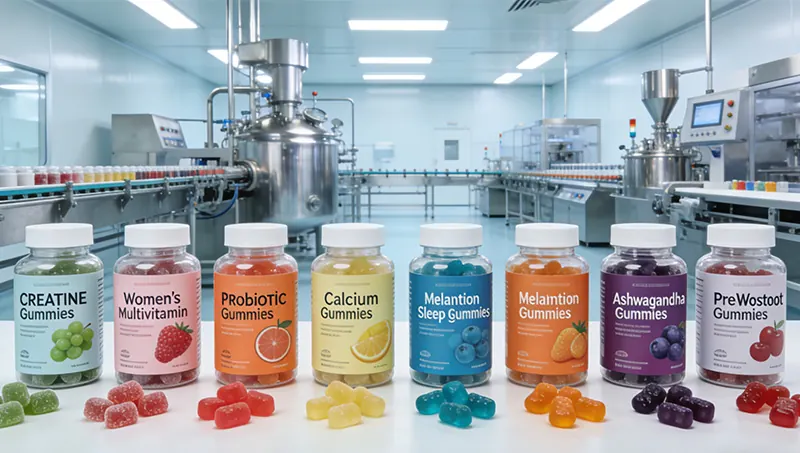
Product versatility. Modern gummy manufacturing technology allows supplement makers to encapsulate an expanding range of active ingredients. Sleep support formulas using melatonin, adaptogen blends featuring ashwagandha, sports nutrition products with creatine or pre-workout compounds, women’s health formulas with probiotics or iron, and general wellness multivitamins are all successfully delivered in gummy format today.
Retail shelf impact. Gummies in custom shapes, vibrant colors, and branded packaging perform well in both physical retail and e-commerce. The format naturally lends itself to visual marketing — an advantage for private label brands competing on platforms like Amazon, TikTok Shop, or Shopify.
Premium positioning. Functional gummies command higher price points than equivalent capsule or powder formats. For supplement brands, this translates directly to better margins.
The implication for anyone building a supplement brand or sourcing through bulk or wholesale channels is clear: gummy manufacturing capability should be a core criterion when evaluating any supplement maker.

What a Qualified Supplement Maker Actually Does
The term “supplement maker” is broad. In practice, the services offered vary significantly between manufacturers, and understanding the distinctions matters before entering any sourcing relationship.
Contract Manufacturing (CMO)
A contract manufacturer produces supplements to a brand’s existing specifications. The buyer provides the formulation, and the manufacturer executes production. This model suits established brands with proprietary recipes who need production capacity without owning a facility.
OEM (Original Equipment Manufacturing)
In an OEM arrangement, the supplement maker uses standardized formulations and processes while the brand applies its own labeling and packaging. This is a common entry point for new supplement brands and those exploring private label gummies for the first time.
ODM (Original Design Manufacturing)
ODM goes further: the manufacturer handles formulation development, manufacturing, and packaging design. The brand receives a finished product ready for market. For entrepreneurs and smaller brands without in-house R&D, ODM partnerships with experienced gummy manufacturers offer the fastest path to launching a differentiated product.
Private Label Gummies
Private label refers specifically to finished formulations that a manufacturer offers as white-label products — the buyer sources the product, applies their branding, and sells it as their own. Private label gummies are widely used by supplement brands looking to expand their product lines quickly without the investment of custom formulation.
Bulk and Wholesale Gummies
Some buyers — distributors, large retailers, or brands sourcing for co-packing — purchase gummies in bulk, either in finished form or as semi-finished product. Gummies bulk purchasing typically involves larger minimum order quantities and pricing structures negotiated per kilogram or per unit at volume thresholds. Gummies wholesale channels serve intermediaries who redistribute finished products to downstream sellers.
The Gummy Manufacturing Process: What Happens Inside a Qualified Facility
Understanding the production workflow helps buyers ask better questions and evaluate supplier claims more accurately.
1. Formulation and ingredient sourcing. A professional gummy manufacturer begins with ingredient selection and ratio optimization. Active ingredient stability in a gummy matrix differs from capsules — some compounds degrade under the heat required for gelling, and a competent supplement maker will flag these issues during formulation review.
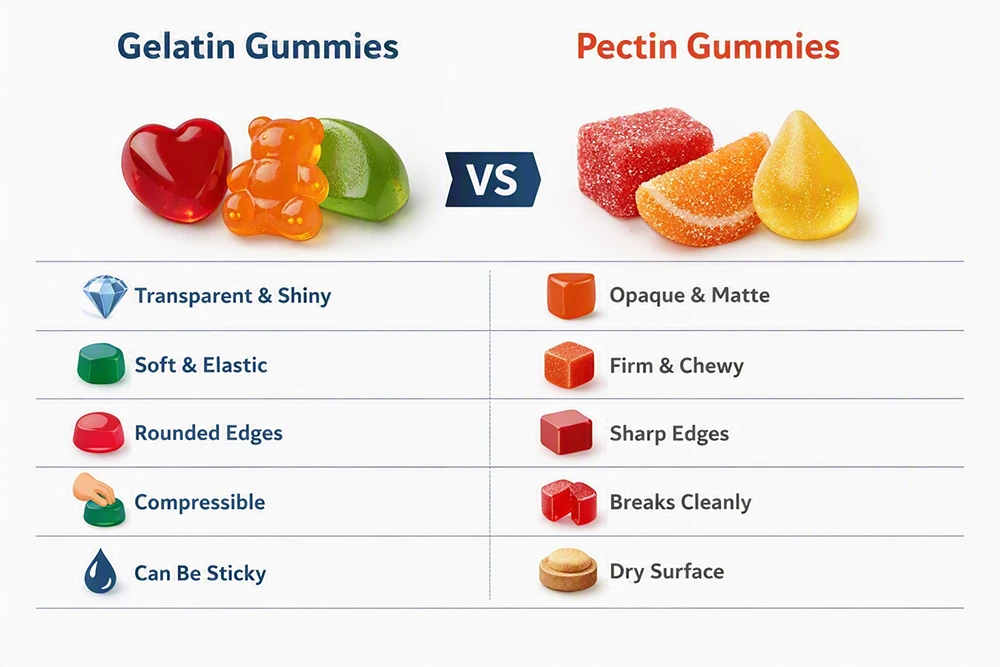
2. Gelling agent selection. The base matrix determines whether a gummy is gelatin-based, pectin-based (vegan), or uses carrageenan. Each gelling agent has distinct texture profiles, melting points, and compatibility characteristics with active ingredients. Vegan gummies using pectin are increasingly in demand, and not all manufacturers have equal experience producing them at scale.
3. Mixing and cooking. Ingredients are blended, cooked to precise temperatures, and combined with flavoring, coloring (natural or synthetic), and sweeteners. Temperature control at this stage directly affects active ingredient potency.
4. Depositing and molding. Liquid gummy mixture is deposited into molds, which determine the shape — bears, rings, cylinders, custom branded shapes, or functional geometries designed for specific dosing. Leading gummy manufacturers offer a wide range of shape options.
5. Drying and curing. Gummies are dried under controlled humidity and temperature conditions. This step affects texture, shelf stability, and moisture content — all of which influence the final product’s consumer experience and shelf life.
6. Coating and finishing. Some gummies receive a sugar coating, beeswax coating (for shine and moisture barrier), or oil coating. Sugar-free and vegan variants require alternative finishing approaches.
7. Quality control testing. A qualified gummy manufacturer tests finished product for potency (active ingredient content), microbial contamination, moisture, pH, hardness, and weight uniformity. Third-party testing adds an additional layer of verification.
8. Packaging. Finished gummies are packaged in bottles, pouches, or blister packs, with labeling applied per regulatory requirements for the destination market.
Key Certifications to Look for in a Gummy Manufacturer
Certifications are not marketing claims — they are audited, third-party-verified standards that indicate a manufacturer’s operational discipline. When evaluating any supplement maker, the following certifications matter:
GMP (Good Manufacturing Practice). GMP certification — whether under FDA 21 CFR Part 111 (U.S. standard), ISO 22716, or pharmaceutical-grade equivalents — establishes that a facility operates with documented processes, personnel training, equipment calibration, and quality systems. GMP is the baseline requirement for any supplement manufacturer supplying regulated markets.
ISO 9001 and ISO 22000. ISO 9001 covers general quality management systems; ISO 22000 is specific to food safety management. Both reflect systematic approaches to process control and continuous improvement.
HACCP (Hazard Analysis and Critical Control Points). HACCP certification indicates that a manufacturer has formally identified and controls biological, chemical, and physical hazards throughout production.
HALAL and KOSHER. For brands targeting Muslim or Jewish consumer segments, these certifications confirm that ingredients and production processes meet religious dietary requirements.
Vegan certification. Relevant for gummy products using plant-based gelling agents (pectin or carrageenan) rather than gelatin.
FDA registration. For U.S. market export, the manufacturing facility should be FDA-registered. This is a legal requirement for dietary supplement manufacturers exporting to the United States, not simply a quality indicator.
Evaluating a Supplement Maker: Questions That Matter
Before entering a manufacturing agreement — whether for custom gummies, private label gummies, or bulk gummy orders — these questions reveal the depth of a supplier’s capability:
What is your minimum order quantity (MOQ) for gummy manufacturing? MOQ varies widely. Some manufacturers require large production runs (tens of thousands of units) that may be impractical for emerging brands. Others offer flexible MOQs for trial runs. A supplier that accommodates small initial orders demonstrates genuine interest in brand partnerships, not just volume transactions.
Can you share your certificate of analysis (COA) from third-party testing? A COA from an independent laboratory confirms that tested products match label claims for active ingredient content. Reputable supplement makers provide these as standard documentation.
What is your production lead time? Lead times for gummy manufacturing vary based on formulation complexity, ingredient sourcing, and production scheduling. Typical ranges run from 4 to 12 weeks for finished product. Realistic lead time communication is a sign of operational transparency.
What active ingredients have you successfully manufactured in gummy format? Not all active ingredients behave identically in gummy matrices. Vitamin C, for instance, degrades rapidly at gummy processing temperatures without proper stabilization. A manufacturer with extensive ingredient experience across categories — vitamins, minerals, amino acids, herbal extracts, probiotics — is better positioned to advise on formulation stability.
Do you offer in-house formulation development? For buyers pursuing ODM or custom development, in-house R&D capability at the manufacturer level eliminates coordination friction and reduces development timelines.
What packaging options do you support? Packaging is part of the product. A full-service supplement maker should support bottles, pouches, and custom packaging, with artwork and labeling services available.
Regulatory Considerations for Different Markets
Gummy supplements sold in different markets face different regulatory frameworks. A competent supplement maker understands these distinctions and can support compliance documentation accordingly.
United States. Dietary supplements are regulated under DSHEA (Dietary Supplement Health and Education Act) by the FDA. Manufacturers must comply with 21 CFR Part 111 GMP requirements. Label claims are regulated — structure/function claims are permitted; disease claims are not.
European Union. Food supplements in the EU are governed by Directive 2002/46/EC. Individual member states apply additional national regulations. Authorized ingredient lists and maximum permitted levels vary by country.
United Kingdom. Post-Brexit, the UK applies its own food supplement regulations. MHRA oversight applies to products making certain health claims.
Canada. Natural Health Products (NHPs) in Canada require a product license (NPN) from Health Canada. The regulatory pathway is distinct from the U.S. and requires specific documentation.
When sourcing through gummies wholesale or bulk purchasing channels for international distribution, confirming that the supplement maker can supply the required documentation for target market compliance is essential due diligence.
Trends Shaping Gummy Manufacturing in 2026 and Beyond
Several developments are influencing what buyers should look for in a supplement maker today:
Functional ingredient expansion. Beyond vitamins and basic minerals, gummy manufacturers are now producing products with adaptogens (ashwagandha, rhodiola), nootropics, probiotics, collagen peptides, and sports nutrition compounds (creatine, beta-alanine). Brands differentiating on ingredient innovation benefit from manufacturers with strong formulation R&D capability.
Low-sugar and sugar-free formats. Consumer health consciousness has driven demand for gummies using alternative sweeteners (erythritol, stevia, allulose) or reduced-sugar formulations. Sugar-free gummy manufacturing requires different formulation expertise and equipment.
Vegan and allergen-free products. The shift toward plant-based products has accelerated demand for pectin-based gummies. Allergen-free manufacturing — free from common allergens including gluten, soy, and dairy — is increasingly requested in premium product lines.
Sustainable packaging. Brands are increasingly requesting eco-friendly packaging options: recyclable bottles, compostable pouches, reduced plastic. Supplement makers that offer sustainable packaging alternatives provide a competitive edge for environmentally positioned brands.
Direct-to-consumer brand growth. The DTC channel has expanded the number of supplement brands in market. Many are small operations launching through e-commerce first, which has increased demand for low-MOQ gummy manufacturing and private label gummy programs that enable brands to test market before scaling.
Common Mistakes When Sourcing from a Gummy Manufacturer
Avoiding these pitfalls saves time, money, and regulatory exposure:
Selecting based on price alone. The lowest-cost supplement maker is not necessarily the best value. Manufacturing shortcuts — underfilled capsules, substituted ingredients, inadequate testing — can result in product recalls, negative reviews, and regulatory action. Total cost of quality includes testing, compliance documentation, and post-sale warranty.
Not requesting samples before full production. A physical sample review — evaluating taste, texture, appearance, and smell — should precede any full production commitment. Samples also allow for third-party potency testing before committing to a production run.
Overlooking lead times in launch planning. Gummy manufacturing lead times of 6–10 weeks are common. Brands that underestimate lead times face stockouts at launch or rushed production schedules that can compromise quality.
Failing to establish intellectual property ownership. For custom formulations developed in partnership with a manufacturer, contracts should specify who owns the formula. Without clear IP terms, proprietary formulations may be licensed to competing brands.
Not auditing suppliers periodically. Supplier qualification is not a one-time event. Annual audits — physical or documentation-based — maintain visibility into manufacturing standards over time.
Summary
The supplement market’s rapid growth, led by functional gummies, has created significant opportunity for supplement brands, private label buyers, and wholesale distributors. Selecting the right supplement maker is foundational to realizing that opportunity. Buyers should evaluate gummy manufacturers on the basis of certified quality systems (GMP, ISO, HACCP), R&D depth, active ingredient expertise, production capacity, regulatory support, and transparency in communication. Whether the sourcing model is custom OEM/ODM manufacturing, private label gummies, or bulk/wholesale purchase, the principles of supplier evaluation remain consistent: verify certifications, test before committing, understand the production process, and confirm regulatory documentation for target markets.
The gummy format is not a passing trend. Consumer preference for enjoyable, effective supplements continues to grow, and the brands that build supply chain relationships with qualified gummy manufacturers today are positioned to capture that growth durably.
Frequently Asked Questions (FAQ)
Q: What is the typical minimum order quantity (MOQ) for private label gummies? MOQ varies significantly by manufacturer and product complexity. For standardized private label gummy formulas, some supplement makers offer runs starting at a few thousand units, while custom formulations typically require larger initial orders. It is advisable to ask prospective manufacturers for both trial-run MOQ and full-production MOQ before committing.
Q: How long does gummy manufacturing take from formulation approval to finished product? A standard production timeline for a gummy supplement — assuming formulation is finalized and raw materials are in stock — ranges from 4 to 10 weeks. Custom formulation development, regulatory documentation, or ingredient sourcing can extend this timeline. Planning a 10–14 week buffer from brief to first finished goods is reasonable for first-time production runs.
Q: What is the difference between OEM and ODM gummy manufacturing? OEM (Original Equipment Manufacturing) involves the buyer providing a formulation that the manufacturer produces. ODM (Original Design Manufacturing) involves the manufacturer developing the formulation, manufacturing process, and packaging — the buyer receives a finished product under their brand. ODM is suited for buyers without in-house formulation expertise; OEM is suited for brands with proprietary recipes seeking manufacturing capacity.
Q: Are vegan gummies more expensive to manufacture than gelatin-based gummies? Generally, yes. Pectin and carrageenan — the primary gelling agents for vegan gummies — typically cost more than gelatin, and the formulation process can be more technically demanding. However, the price differential has narrowed as vegan gummy manufacturing has scaled. The premium is typically justified by access to the growing vegan and vegetarian consumer segment.
Q: What certifications should I require from a gummy manufacturer for the U.S. market? At minimum, look for FDA registration and GMP certification (21 CFR Part 111 compliance). ISO 22000 and HACCP are additional quality indicators. For specific product claims or consumer segments, HALAL, KOSHER, or Vegan certifications may be relevant.
Q: Can I source gummies in bulk without custom branding? Yes. Many supplement makers offer gummies wholesale and bulk gummy purchasing without custom labeling. This model is common for distributors, co-packers, and brands that handle labeling downstream. Pricing for gummies bulk orders is typically negotiated at volume thresholds per kilogram or per unit.
Q: How do I verify that a gummy manufacturer’s product matches label claims? Request a Certificate of Analysis (COA) from a third-party, ISO-accredited laboratory for each production batch. The COA should verify active ingredient potency, microbiological safety, and absence of contaminants. Reputable supplement makers provide COAs as standard; reluctance to share them is a warning sign.
About Gothink Biotech
Shenzhen Gothink Biotech Co., Ltd. is a professional gummy manufacturer and dietary supplement manufacturer based in China, offering comprehensive OEM, ODM, white label, and private label gummy manufacturing services to supplement brands, retailers, and distributors worldwide.
Our gummy manufacturing capabilities span the full spectrum of functional formats: multivitamin gummies, melatonin sleep gummies, ashwagandha gummies, creatine gummies, probiotic gummies, calcium gummies, liver support gummies, selenium gummies, pre-workout gummies, and custom formulations developed to your specification. We support gelatin-based, pectin-based (vegan), and carrageenan-based gummy production across 30+ mold shapes with flexible customization in flavor, color, coating, and packaging.
Our facility operates under pharmaceutical-grade GMP standards with a 100,000-class cleanroom, daily output capacity of 16 tons, and an annual production capacity of 5,000 tons — supporting brands from small trial production runs through full-scale bulk and wholesale gummy supply.
Quality certifications include ISO9001, ISO22000, HACCP, FDA registration, GMP, HALAL, KOSHER, and Vegan, providing the regulatory documentation required for U.S., European, and international market compliance.
Our R&D team, led by researchers with postdoctoral experience at U.S. institutions, supports formulation development across 2,000 new products annually, enabling brands to access innovation without maintaining in-house laboratory infrastructure.
Whether you are launching a new private label gummy line, scaling an established brand, or sourcing gummies in bulk or wholesale quantities, Gothink Biotech provides the manufacturing foundation to bring your product to market efficiently and reliably.