
A Science-Based Comparison for Brands, Retailers & Supplement Buyers
Abstract
The dietary supplement market has witnessed explosive growth in gummy-format products over the past decade. Consumers increasingly prefer gummies over traditional capsules for their taste, texture, and ease of use. But a common question persists among health-conscious shoppers and supplement brands alike: do gummy vitamins actually work as well as capsules? This article examines the science behind both delivery formats, evaluates their respective strengths and limitations, and provides practical guidance for supplement brands, private label buyers, and wholesale distributors making formulation decisions. The short answer: yes, high-quality gummy supplements can deliver comparable bioavailability to capsules — but formulation quality matters enormously.
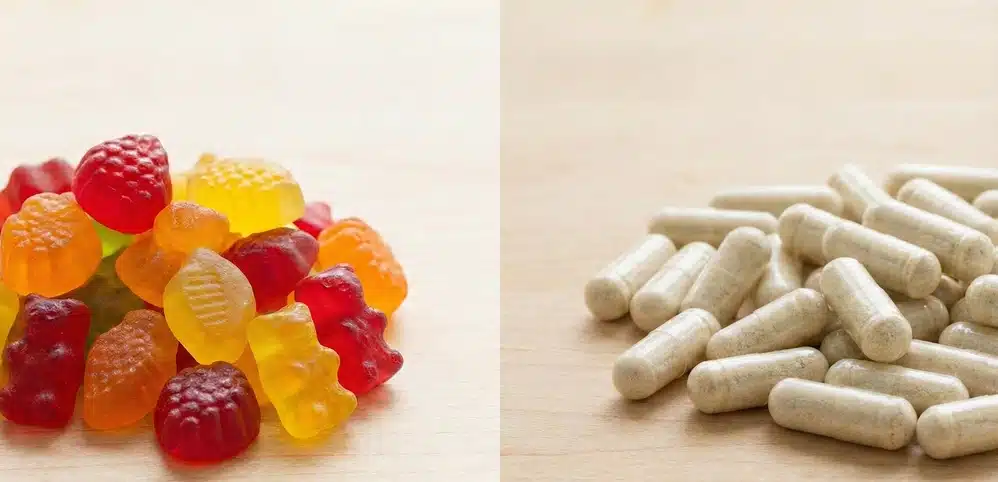
1. The Rise of Gummy Supplements: Market Context
Over the past decade, gummy vitamins have evolved from a niche children’s product into a mainstream supplement category spanning all age groups. Global demand for gummy supplements has grown significantly, driven by consumer preference for enjoyable, easy-to-take formats. For supplement brands, retailers, and private label buyers, the growth of this category presents both an opportunity and a responsibility: launching a gummy product that performs as well as it tastes.
For B2B buyers — whether you are sourcing gummy vitamins bulk, building a private label gummy vitamins line, or exploring gummy vitamins wholesale partnerships — understanding the scientific differences between delivery formats is essential to building a trustworthy, effective product.
2. How Gummies and Capsules Differ: Formulation Fundamentals
2.1 Gummy Supplement Structure
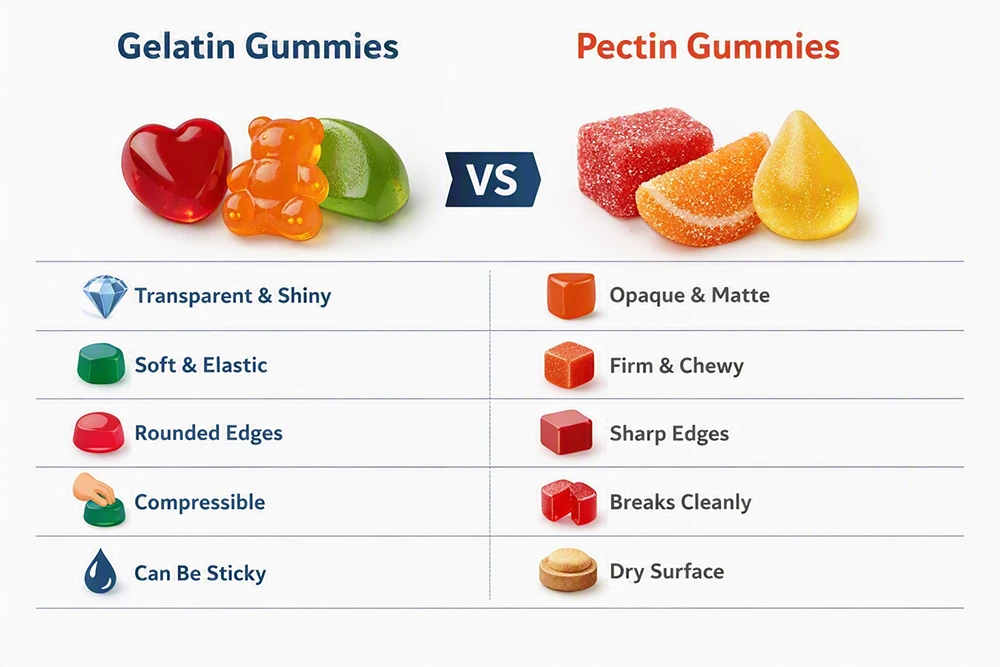
Gummy supplements are typically made from a gelatin or pectin-based matrix combined with sweeteners, flavorings, colorants, and active ingredients. The gelling agents — most commonly pectin (plant-derived and vegan-friendly) or gelatin (animal-derived) — encapsulate the nutrients. During digestion, the gummy matrix breaks down in the stomach, releasing its active compounds.
The key variables affecting a gummy’s efficacy include:
- The stability of active ingredients within the sugar/water matrix
- The type of gelling agent and its dissolution rate
- The pH environment during manufacturing and storage
- The concentration of active ingredients per serving
- The addition of binding excipients and preservatives
2.2 Capsule Supplement Structure
Capsules — whether gelatin-based (hard or soft) or vegetarian (HPMC) — encase powdered, liquid, or semi-solid active ingredients in a protective shell. The shell dissolves in the gastrointestinal tract, releasing its contents. Capsules generally allow for higher ingredient loads, better protection of sensitive compounds from oxidation, and more precise dosing.
The critical insight: delivery format alone does not determine efficacy. The quality of raw materials, the stability of active compounds during manufacturing, and the overall formulation strategy are the deciding factors.
3. Bioavailability: What the Evidence Says
Bioavailability refers to the proportion of an active ingredient that is absorbed and available for use by the body. Research comparing gummies and capsules reveals the following key findings:
3.1 Fat-Soluble Vitamins (A, D, E, K)
Fat-soluble vitamins require a lipid environment for optimal absorption. Studies on Vitamin D, for example, have shown that gummy formulations using oil-based or emulsified vitamin D3 can achieve bioavailability comparable to — or in some cases superior to — standard powder-filled capsules. The reason: gummies often contain small amounts of fat-based ingredients or emulsifiers that can support lipid absorption pathways. The key is whether the gummy manufacturer has incorporated appropriate lipid carriers into the formula.
3.2 Water-Soluble Vitamins (B-Complex, C)
Water-soluble vitamins generally absorb well in both formats. However, Vitamin C and certain B vitamins are sensitive to heat, humidity, and pH — conditions that gummy manufacturing processes can intensify. A professional gummy manufacturing operation with rigorous quality control will use low-temperature processing, pH-buffered formulations, and moisture-controlled environments to preserve potency.
3.3 Minerals (Calcium, Magnesium, Iron, Zinc)
Minerals present a significant formulation challenge for gummies. The ionic nature of many mineral salts can interact with the gelling matrix, affecting both texture and bioavailability. For this reason, many gummy products use chelated mineral forms (e.g., calcium citrate, zinc gluconate) that are more stable and better absorbed than inorganic salts. Capsules, by contrast, can accommodate higher doses of minerals with fewer compatibility issues.
Industry note: Iron supplementation is rarely offered in gummy format due to the metallic taste and oxidation challenges — capsules remain the preferred delivery method for high-dose iron.
3.4 Herbal Extracts and Functional Ingredients
Botanical extracts such as ashwagandha, elderberry, turmeric, and probiotics are increasingly popular in gummy supplements. These ingredients require careful stability testing, as heat-sensitive compounds (like curcumin or live probiotic cultures) may degrade during gummy production. Advanced manufacturers use encapsulation technologies and low-temperature molding to maintain ingredient integrity.
4. Where Gummies Have a Clear Advantage
Despite the formulation challenges, gummy supplements offer several documented advantages that go beyond taste preference:
- Adherence and compliance: Consumers are significantly more likely to take supplements consistently when they enjoy the experience. Multiple consumer studies have confirmed higher daily compliance rates for gummy formats compared to capsules, particularly among children, elderly users, and individuals with swallowing difficulties.
- Chewable pre-digestion: The chewing process begins mechanical breakdown and potentially increases the surface area of active ingredients before they reach the stomach.
- Psychological palatability: The sensory experience of gummies reduces ‘pill fatigue,’ a real barrier to consistent supplementation in many demographics.
- Brand differentiation: For supplement brands, launching a well-formulated gummy line creates strong brand recall, retail shelf appeal, and opportunities for premium positioning.
5. Where Capsules Retain an Edge
For supplement brands and formulators, it is equally important to understand scenarios where capsules remain the more suitable format:
- High-dose minerals and amino acids: Capsules can accommodate significantly higher ingredient loads per unit.
- Sensitive probiotic strains: Certain live cultures require gastric protection that capsule shells (especially enteric-coated versions) provide more reliably.
- Exact pharmaceutical-grade dosing: Capsules allow for more precise filling tolerances, critical for clinical-grade products.
- Clean-label, additive-free positioning: Gummies require sweeteners, flavors, and gelling agents; consumers seeking minimal-ingredient formulas may prefer capsules.
- Heat-sensitive or rapidly oxidizing compounds: Capsules provide better isolation from environmental factors during shelf life.
6. The Role of Manufacturing Quality in Efficacy
The most important factor in determining whether gummy supplements work as well as capsules is not the format itself — it is the quality of the manufacturing process. A poorly produced gummy may under-deliver active ingredients due to heat degradation, uneven mixing, or moisture absorption. A well-manufactured gummy, produced under GMP-certified conditions with validated formulation protocols, can deliver equivalent nutritional impact.
Key manufacturing quality indicators for gummy supplements include:
- GMP (Good Manufacturing Practice) certification with documented SOPs
- Certificate of Analysis (COA) for each batch verifying active ingredient potency
- Dissolution testing confirming that the gummy matrix releases nutrients at the correct rate
- Stability testing (accelerated and real-time) to verify shelf-life potency claims
- Cleanroom production environments that minimize contamination
For brands sourcing through a gummy vitamins Manufacturer, requesting documentation for all of the above is not just best practice — it is a fundamental due diligence step that protects your brand and your customers.
7. Practical Guidance for Supplement Brands and B2B Buyers
Whether you are launching a new private label gummy vitamins line, exploring bulk purchasing, or considering a white label gummy program, the following framework helps ensure product quality:
- Define your target ingredient and dosage first — then ask your manufacturer if gummy format is scientifically appropriate for that ingredient.
- Request third-party lab testing to verify that finished gummy products contain the labeled amount of active ingredients.
- Evaluate your target consumer: age group, dietary restrictions (vegan, halal, kosher), taste preferences, and daily routine.
- Ensure your manufacturer can provide stability data showing that the active ingredients retain potency through the stated shelf life.
- For minerals or heat-sensitive botanicals, explore whether dual-format offerings (gummy + capsule) could serve different customer segments.
8. A Comparison Summary: Gummies vs. Capsules
| Factor | Gummy Supplements | Capsules |
|---|---|---|
| Consumer Compliance | High — enjoyable format | Lower — pill fatigue common |
| Dosing Precision | Moderate | High |
| Fat-Soluble Vitamins | Comparable (with lipid carriers) | Good |
| Minerals (High Dose) | Limited | Excellent |
| Heat-Sensitive Ingredients | Requires advanced processing | Better protection |
| Vegan / Halal / Kosher Options | Available (pectin-based) | Available (HPMC capsules) |
| Shelf Appeal / Branding | High | Moderate |
| Added Sugars / Excipients | Yes (inherent to format) | Minimal |
| Cost Per Serving | Typically higher | Typically lower |
Conclusion
The question of whether gummy vitamins work as well as capsules does not have a single universal answer — it depends on the specific ingredient, the formulation quality, and the manufacturing standards applied. For many nutrients, including fat-soluble vitamins, antioxidants, and herbal extracts, well-manufactured gummies can deliver bioavailability equivalent to capsules. For high-dose minerals, sensitive probiotic strains, or pharmaceutical-grade applications, capsules may retain a technical edge.
For brands building supplement lines, the format decision should be driven by your target consumer, your ingredient profile, and — most critically — your manufacturer’s capabilities. A high-quality gummy is the result of rigorous formulation science, not just a pleasant taste. Sourcing from a certified, experienced manufacturer with validated quality systems is the single most important factor in delivering a gummy supplement that truly performs.
The bottom line: Format is not destiny. Quality is. A well-formulated, GMP-manufactured gummy supplement can be just as effective as a capsule — and significantly more likely to be taken consistently.
Frequently Asked Questions (FAQ)
Q1: Are gummy vitamins as effective as regular vitamins?
For most vitamins — particularly fat-soluble vitamins (A, D, E, K) and water-soluble vitamins (B-complex, C) — high-quality gummy formulations can be equally effective to capsules or tablets when manufactured under proper GMP conditions with validated potency. The key factor is manufacturing quality and ingredient stability, not the format itself.
Q2: Do gummy supplements have lower doses than capsules?
Often, yes. The physical and chemical constraints of the gummy matrix limit how much active ingredient can be incorporated per unit, particularly for minerals. Brands should review the Supplement Facts panel carefully and compare doses between formats rather than assuming equivalency based on format alone.
Q3: Are gummy vitamins suitable for adults, or just children?
Gummy supplements are formulated for all age groups. The adult gummy supplement market is now larger than the children’s segment in many categories, including sleep support, immunity, weight management, and sports nutrition. Many adults prefer gummies due to convenience, palatability, and improved compliance.
Q4: What should I look for when sourcing gummy supplements in bulk or for private label?
Prioritize manufacturers with GMP certification, documented quality testing (COA per batch), stability data, and transparency regarding raw material sourcing. Ask specifically about their dissolution testing procedures and whether they conduct third-party ingredient verification. For private label gummy vitamins, ensure the manufacturer can provide regulatory compliance documentation relevant to your target market.
Q5: Can gummy supplements be vegan or allergen-free?
Yes. Pectin-based gummies are inherently vegan and are commonly used as a gelatin alternative. Reputable manufacturers can also produce gummies that are free of common allergens, artificial colors, and added sugars upon request. When sourcing gummy vitamins wholesale or in bulk, always specify dietary certifications (vegan, halal, kosher, gluten-free) at the formulation stage.
Q6: How do I evaluate the quality of a gummy vitamins manufacturer?
Look for ISO, GMP, HACCP, and FDA registration. Request a facility tour or audit report. Ask for stability testing protocols, in-process quality checkpoints, and documentation of raw material traceability. A credible manufacturer will be transparent about all of these processes.
About Gothink Biotech — Contract Gummy Supplement Manufacturer
Shenzhen Gothink Biotech Co., Ltd. is a professional supplement contract manufacturer specializing in the development and production of a comprehensive range of gummy supplements, including vitamins, minerals, herbal formulas, and functional nutrition products.
We provide complete OEM and ODM manufacturing services, covering formulation development, raw material sourcing, production, quality control, packaging design, and export compliance — giving brands and entrepreneurs a true one-stop solution. Our services are designed to support every business model, from gummy vitamins bulk and gummy vitamins wholesale orders to fully customized private label gummy vitamins programs and white-label turnkey products.
Our manufacturing facility features a 100,000-class GMP-certified cleanroom with a daily capacity of 16 tons, supported by an on-site 10,000-class pharmaceutical-grade R&D laboratory. We hold certifications including ISO9001, ISO22000, HACCP, FDA registration, GMP, HALAL, and KOSHER, ensuring that every product we manufacture meets the highest international quality standards.
Our R&D team, led by postdoctoral researchers with experience at leading U.S. institutions, conducts formulation research on over 2,000 new products annually — enabling us to bring innovative, efficacious, and market-ready supplement formulas to life across all gummy formats: pectin, gelatin, vegan, sugar-free, and functional.
Whether you are an established supplement brand, a startup exploring the gummy market, an online retailer seeking reliable bulk supply, or a distributor building a wholesale gummy portfolio, Gothink Biotech has the capacity, expertise, and quality infrastructure to be your manufacturing partner.
Contact us to request formulation consultations, MOQ information, or facility documentation.