
Definition
Gummies with or without gelatin refers to the strategic choice of using gelatin—a protein derived from animal collagen (primarily porcine or bovine)—or plant-based alternatives as the primary gelling agent in gummy supplement formulations. The presence or absence of gelatin significantly impacts product positioning, target market appeal, manufacturing processes, and regulatory compliance. This decision directly influences formulation development, production efficiency, cost structure, and brand differentiation in the dietary supplement market.
Industry Background & Market Context
The global gummy supplement market has experienced explosive growth over the past decade, with consumer preferences increasingly driving product innovation. Historically, gelatin dominated the gummy manufacturing sector due to its cost-effectiveness, proven texture properties, and established manufacturing protocols. However, market expansion has introduced diverse consumer segments with specific dietary, religious, and ethical requirements.
The rise of vegan, halal, and kosher dietary movements has fundamentally reshaped gummy formulation strategies. According to industry data, gelatin-free and plant-based gummy products now represent a substantial and rapidly expanding market segment. This shift reflects broader consumer consciousness regarding ingredient sourcing, sustainability, and religious/ethical alignment—factors that directly influence purchasing decisions across retail channels, e-commerce platforms, and institutional buyers.
Manufacturers and brands must now evaluate gelatin inclusion not merely as a technical ingredient decision, but as a strategic market positioning choice that affects brand identity, product scalability, supply chain complexity, and competitive differentiation.
What Gelatin Is in Gummy Manufacturing
Gelatin functions as the primary gelling and texturizing agent in traditional gummy formulations. Derived from hydrolyzed collagen—extracted through prolonged thermal treatment of animal bone, skin, and connective tissue—gelatin provides the characteristic firm yet elastic texture that defines consumer perception of gummy quality.
In manufacturing, gelatin acts through a straightforward mechanism: dissolved gelatin in heated liquid solidifies during cooling, creating a three-dimensional gel network that traps moisture and active ingredients. This property enables consistent dosage delivery, extended shelf stability, and predictable product performance across temperature fluctuations.
Gelatin concentrations in gummy formulations typically range from 5–12% by weight, depending on desired firmness, ingredient compatibility, and intended storage conditions. Higher gelatin concentrations produce firmer gummies with extended shelf life; lower concentrations create softer textures suitable for pediatric or elderly consumers.
Gelatin vs. Plant-Based Alternatives: Functional & Market Differences
Gelatin-Based Gummies
Key Properties:
- High gel strength and texture stability
- Cost-effective and widely available
- Established manufacturing protocols and supplier relationships
- Excellent moisture retention and extended shelf life
- Faster setting times during production
Limitations:
- Not suitable for vegan, vegetarian, or plant-based-focused brands
- Religious restrictions (halal, kosher certifications require specialized sourcing)
- Source transparency concerns and animal welfare considerations
- Potential allergen concerns for sensitive populations
Plant-Based Alternatives
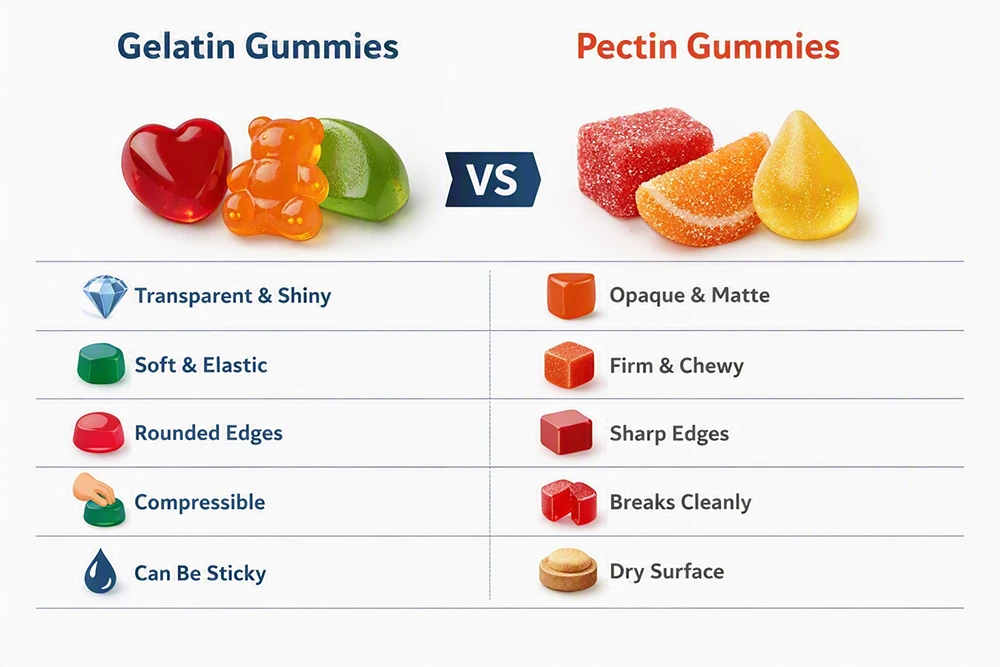
Pectin: A soluble fiber extracted from fruits, offering natural positioning, transparent sourcing, and vegan certification. However, pectin-based gummies require extended gelling time and are more sensitive to moisture fluctuations.
Carrageenan: A seaweed-derived polysaccharide providing excellent gel texture and clean-label appeal. Offers superior stability in humid climates compared to pectin. Growing acceptance in international markets, though some consumer perception concerns regarding processing remain.
Agar and Other Botanicals: Emerging alternatives offering distinct textural properties and premium positioning. Higher cost and production complexity limit widespread adoption, though demand among premium supplement brands continues rising.
Market Positioning: Plant-based gummies command premium pricing (15–30% higher) but access substantially larger addressable markets including vegan consumers, religious groups, and ethically conscious buyers. Brands using gelatin-free formulations report improved market penetration in EU and North American markets where ingredient transparency drives purchasing decisions.
Business Relevance: Why Gelatin Decisions Matter
Market Segmentation & Revenue Opportunity
Gelatin inclusion directly impacts addressable market size. Brands offering gelatin-free alternatives access premium market segments, particularly among younger, ethically conscious demographics. Conversely, gelatin-based gummies maintain cost leadership in value-oriented channels, particularly in emerging markets where price sensitivity dominates purchasing behavior.
Supply Chain Complexity & Sourcing Transparency
Gelatin sourcing requires transparency documentation: animal origin certification, slaughter methods (for halal compliance), and traceability systems. Plant-based alternatives simplify supply chain documentation while enabling cleaner sourcing narratives—critical for direct-to-consumer (DTC) brands emphasizing sustainability.
Regulatory Compliance Across Markets
Gelatin sourcing affects regulatory approvals across jurisdictions. The European Food Safety Authority (EFSA), FDA, and regional regulatory bodies impose varying documentation requirements based on animal origin. Plant-based alternatives reduce regulatory friction in sensitive markets, particularly following BSE (mad cow disease) concerns that continue influencing procurement policies in certain jurisdictions.
Manufacturing Scalability & Production Efficiency
Gelatin-based production offers established manufacturing processes with minimal R&D investment. Plant-based alternatives introduce variable processing requirements: pectin demands pH management and extended cooling cycles; carrageenan requires specialized temperature control and equipment calibration. These factors directly influence production lead times, manufacturing capacity utilization, and cost structures for custom manufacturers.
Technical Considerations for Business Buyers
Formulation Stability & Shelf Life
Gelatin provides superior moisture barrier properties, extending shelf life to 24–36 months under standard storage conditions (room temperature, <40% relative humidity). Plant-based alternatives, particularly pectin, show increased moisture sensitivity, potentially reducing shelf life to 12–18 months without enhanced packaging investments.
Texture & Consumer Perception
Gelatin creates the “gold standard” gummy texture consumers recognize: firm exterior, elastic bite, clean release from packaging. Plant-based formulations produce variable textures requiring consumer education. Pectin gummies exhibit slightly grainy texture; carrageenan formulations demonstrate improved texture consistency but require precise manufacturing control.
Dosage Accuracy & Active Ingredient Integration
Gelatin’s chemical stability ensures consistent active ingredient suspension throughout product shelf life. Oil-soluble actives (vitamin D, vitamin E) disperse uniformly in gelatin matrices. Plant-based alternatives demonstrate variable dispersion characteristics, requiring reformulation and stability testing for ingredient-specific applications.
Who Should Consider This Analysis
Supplement Brands launching new product lines must evaluate gelatin inclusion based on target market positioning, competitive differentiation, and supply chain complexity tolerance.
Retailers & Distributors managing SKU portfolios benefit from understanding gelatin/alternative dynamics to optimize shelf space allocation, merchandising strategies, and customer education initiatives.
OEM/ODM Buyers require transparent supplier communication regarding formulation options, technical capabilities, and production scalability across both gelatin-based and alternative platforms.
Contract Manufacturers must maintain technical proficiency across both gelatin and plant-based production systems to serve diverse customer requirements and market segments.
Technical Parameter Comparison Table
| Parameter | Gelatin-Based Gummies | Pectin-Based Gummies | Carrageenan-Based Gummies |
|---|---|---|---|
| Primary Gelling Agent | Animal collagen-derived gelatin | Plant fiber (fruit extract) | Seaweed polysaccharide |
| Manufacturing Process | Dissolve in warm liquid, mold, chill; 2–4 hours setting time | Precise pH control required; 4–8 hours setting time | Temperature-controlled molding; 3–6 hours setting time |
| Typical Concentration | 5–12% by weight | 6–14% by weight | 5–10% by weight |
| Shelf Life (Standard Conditions) | 24–36 months | 12–18 months | 18–24 months |
| Moisture Sensitivity | Low (excellent moisture barrier) | High (requires desiccant packaging) | Medium (moderate humidity tolerance) |
| Texture Profile | Firm, elastic, clean release | Slightly grainy, variable firmness | Smooth, uniform firmness |
| Cost Structure | Low-to-moderate ($0.02–0.04 per unit) | Moderate-to-high ($0.03–0.06 per unit) | Moderate ($0.03–0.05 per unit) |
| Suitability for Religious Certifications | Halal/Kosher (specialized sourcing required) | Vegan, Halal, Kosher (naturally aligned) | Vegan, Halal, Kosher (naturally aligned) |
| Stability with Oil-Soluble Actives | Excellent dispersion and retention | Variable; requires additional stabilizers | Good; moderate optimization needed |
| Quality Standards Compatibility | ISO 9001, GMP, HACCP, FDA-compliant | ISO 9001, GMP, HACCP, FDA-compliant | ISO 9001, GMP, HACCP, FDA-compliant |
| Production Scalability | High capacity; minimal equipment modification | Moderate capacity; requires pH monitoring systems | High capacity; requires temperature control systems |
| Packaging Requirements | Standard HDPE/PET; minimal moisture barrier required | Enhanced moisture barrier; desiccant recommended | Moderate moisture barrier; controlled environment storage |
Practical B2B Insights for Manufacturing & Sourcing
Manufacturing Quality & Process Control
Gelatin-based production benefits from established standard operating procedures (SOPs) that have been refined across decades of industrial use. Most contract manufacturers maintain proven gelatin-sourcing relationships with documented quality records. However, gelatin-sourcing transparency remains a competitive differentiator—manufacturers demonstrating traceable, ethically-sourced gelatin gain market advantage among premium brands.
Plant-based formulations demand enhanced process control precision. Pectin-based production requires real-time pH monitoring to ensure consistent gel formation. Temperature fluctuations directly impact carrageenan gel properties, necessitating climate-controlled manufacturing environments. These technical demands translate to increased labor costs and equipment investment, but provide competitive advantage for brands emphasizing manufacturing transparency and ingredient integrity.
Raw Material Sourcing & Supplier Reliability
Gelatin sourcing concentrates among 3–5 major global suppliers, creating supply chain risk exposure during market disruptions. Diversified pectin sourcing (citrus-based, apple pomace, high-methoxyl variants) reduces single-supplier dependency. Carrageenan supply remains concentrated among Asian producers, introducing geopolitical considerations for North American and European brands.
Transparent supplier relationships directly impact cost structure. Establishing long-term supply partnerships with gelatin manufacturers enables volume discounts (15–25% reduction) and preferential treatment during supply constraints. Plant-based alternative suppliers increasingly offer ingredient customization and technical support, enabling formulation optimization for specific product applications.
Production Scalability & Lead Time Management
Gelatin-based gummy production scales efficiently from 100 kg trial batches to 50+ ton monthly production runs without fundamental process changes. Lead times typically span 4–6 weeks from order confirmation to delivery, reflecting established supply chain predictability.
Plant-based alternatives introduce variable lead times. Pectin-based formulations require 6–8 week lead times due to pH formulation customization. Carrageenan-based production manages 5–7 week timelines but demands climate-controlled storage facilities, increasing logistics complexity. Brands planning private label gummy launches must account for these temporal considerations during go-to-market planning.
Regulatory Compliance & Documentation Readiness
Gelatin sourcing requires animal-origin documentation, particularly for halal and kosher certifications. FDA compliance demands bovine spongiform encephalopathy (BSE) attestations and source country verification. These documentation requirements, while manageable, introduce administrative complexity absent in plant-based alternatives.
Plant-based formulations streamline regulatory pathways in sensitive markets. European Union regulations increasingly favor clear, transparent botanical ingredient sourcing. North American retailers increasingly demand non-GMO verification and clean-label positioning—criteria naturally aligned with plant-based gummy formulations.
Cost Structure Analysis & Financial Modeling
Gelatin-Based Gummies: Ingredient costs approximate $0.15–0.25 per unit (including gelling agent, active ingredients, additives, and packaging) at 10,000+ unit volumes. Manufacturing overhead averages $0.08–0.12 per unit, yielding total production costs of $0.23–0.37 per unit.
Plant-Based Gummies: Ingredient costs range $0.20–0.35 per unit due to premium botanical ingredient pricing. Manufacturing overhead increases $0.10–0.15 per unit due to extended production cycles and process control requirements. Total production costs typically reach $0.30–0.50 per unit, reflecting 20–30% cost premium relative to gelatin-based alternatives.
Brands must evaluate cost premiums against market pricing opportunities. Plant-based gummies command retail price premiums of 25–40% in premium and natural product channels, potentially offsetting production cost increases and improving gross margin performance despite higher manufacturing costs.
B2B Decision Framework: Selecting Gelatin vs. Plant-Based Formulations
Strategic Evaluation Criteria
Market Positioning & Target Demographics: Define primary customer segment (value-conscious consumers, premium/natural products, religious/ethical market, clinical/medical channel). Gelatin formulations optimize for cost-conscious, mainstream markets; plant-based alternatives position for premium, ethically-conscious segments with higher price tolerance.
Channel Strategy & Retail Environment: Natural product channels (Whole Foods, specialty retailers, e-commerce) increasingly emphasize gelatin-free positioning. Mainstream retail (mass-market pharmacies, grocery chains) accepts gelatin-based products without friction. Evaluate channel composition and growth trajectory—rapidly expanding e-commerce and DTC channels increasingly demand plant-based positioning.
Geographic Market Priorities: European Union markets show accelerating preference for plant-based ingredients; regulatory pathways favor botanical sourcing. North American markets demonstrate increasing but not universal preference for gelatin-free positioning. Asian and emerging markets maintain cost-conscious orientation, supporting gelatin-based formulation economics.
Competitive Differentiation Strategy: Assess competitive landscape—if major competitors utilize gelatin, plant-based alternatives provide differentiation opportunity. Conversely, if market leaders already offer plant-based options, gelatin-based positioning may struggle unless supported by cost leadership or specialized formulation advantages.
Manufacturer Selection & Capability Assessment
Single-Platform vs. Dual-Platform Capability: Evaluate whether potential manufacturers maintain expertise in both gelatin and plant-based production. Single-platform specialists offer optimization depth but introduce supply chain risk; dual-platform providers offer flexibility but may sacrifice formulation excellence in either category.
Technical R&D Capability: Request detailed formulation development case studies demonstrating experience with target application (multivitamin gummies, herbal formulations, functional health products). Assess laboratory capacity and third-party testing relationships—indicators of quality commitment and technical rigor.
Scalability Infrastructure: Confirm manufacturing capacity aligns with growth projections. Request production equipment specifications, facility certifications, and quality control systems. Evaluate cleanroom classifications (100,000-class vs. 10,000-class pharmaceutical-grade) and their impact on product quality and regulatory positioning.
Compliance & Certification Documentation: Verify ISO 9001, ISO 22000, HACCP, GMP, FDA, HALAL, KOSHER, and Vegan certifications. Request third-party audit reports and regulatory pre-approval documentation—indicators of compliance rigor and reduced risk exposure for supply partnerships.
Quality Assurance & Risk Management
Stability Testing Protocols: Request accelerated shelf-life stability data (ASLT) conducted under ICH guidelines (International Council for Harmonisation). Assess testing comprehensiveness: temperature, humidity, light exposure conditions. Plant-based formulations require extended testing protocols due to inherent moisture sensitivity.
Active Ingredient Bioavailability & Interaction Testing: Confirm testing of target actives within proposed gelling matrix. Oil-soluble ingredients (vitamin D, vitamin E, CoQ10) demonstrate variable bioavailability across gelatin vs. plant-based matrices. Request dissolution testing data and bioavailability assessment.
Microbial & Contaminant Testing: Verify routine pathogenic bacteria testing (E. coli, Salmonella, Listeria), mycotoxin screening, and heavy metal analysis (lead, cadmium, mercury). Request test method documentation and third-party laboratory verification. This becomes particularly critical for plant-based formulations utilizing botanical actives.
Foreign Material & Allergen Control: Assess allergen management systems, particularly for gelatin (mammalian protein allergen), pectin (tree fruit sourcing considerations), and carrageenan (shellfish-derived concern, though scientific evidence disputes cross-reactivity). Request documented allergen control procedures and cross-contamination prevention protocols.
Practical Sourcing Checklist for Contract Gummy Manufacturers
- Formulation flexibility: Can the manufacturer accommodate custom gelatin or plant-based alternatives without minimum order quantity penalties?
- Lead time transparency: What are realistic lead times for gelatin-based vs. plant-based formulations? Are expedited timelines available?
- Quality documentation: Will the manufacturer provide certificate of analysis (CoA) for all raw materials and finished products?
- Regulatory readiness: Does the manufacturer maintain FDA pre-approval documentation, GRAS (Generally Recognized as Safe) ingredient verification, and regulatory submission support?
- Intellectual property protection: What confidentiality agreements and IP protection mechanisms does the manufacturer maintain for custom formulations?
- Minimum order economics: At what volume do significant cost reductions materialize? Are there intermediate pricing tiers for growing brands?
- Long-term partnership structure: What mechanisms support supply continuity, pricing stability, and exclusive territory arrangements?
Conclusion
The gelatin decision represents far more than a technical ingredient choice—it fundamentally shapes brand positioning, supply chain strategy, manufacturing complexity, and market accessibility. Gelatin-based gummies continue dominating cost-sensitive channels and mainstream retail environments, offering production efficiency and established manufacturing protocols. Plant-based alternatives, though commanding production cost premiums of 20–30%, enable access to rapidly expanding premium, ethical, and religious market segments that reward ingredient transparency and brand values alignment.
Successful brands evaluate gelatin inclusion within integrated business strategy encompassing target market definition, channel positioning, competitive differentiation, and long-term supply chain resilience. Manufacturers and OEM/ODM partners must maintain dual-platform proficiency—combining deep gelatin-production expertise with emerging plant-based formulation capabilities—to serve diverse market requirements and support brand growth across evolving consumer preferences.
The optimal decision emerges not from ingredient superiority, but from strategic alignment: matching formulation choice to target market positioning, manufacturing capability, and competitive differentiation objectives. Brands investing in comprehensive supplier evaluation, rigorous quality assessment, and transparent partnership structures position themselves for sustainable growth across both gelatin and plant-based market segments.
Frequently Asked Questions (FAQ)
A: No. While gelatin has historically been the standard gelling agent in gummy manufacturing, the market now offers substantial product diversity. Pectin-based, carrageenan-based, and other plant-derived alternatives represent 20–30% of the global gummy market and are rapidly expanding. Brands targeting vegan, halal, kosher, or ethically conscious consumers increasingly utilize plant-based formulations. However, gelatin remains dominant in mainstream retail and cost-sensitive channels due to superior production efficiency and lower ingredient costs.
A: Gelatin offers significant manufacturing and cost advantages: (1) Proven production processes with minimal quality variability; (2) Superior texture and shelf-life stability (24–36 months vs. 12–18 months for pectin); (3) Lower ingredient costs ($0.02–0.04 per unit vs. $0.03–0.06 for alternatives); (4) Established supplier relationships and supply chain predictability. For brands prioritizing cost leadership and mainstream retail positioning, gelatin-based gummy contract manufacturing provides superior economics. Plant-based alternatives justify premium pricing primarily in channels rewarding ingredient transparency and brand values alignment.
A: Pectin, derived from fruit fiber, offers clean-label positioning and excellent vegan/religious certification alignment, but exhibits higher moisture sensitivity and shorter shelf life (12–18 months). Carrageenan, extracted from seaweed, provides improved texture consistency and moderate shelf life (18–24 months), though requires precise temperature control during manufacturing. Both alternatives enable private label gummy production with premium positioning, but introduce 15–25% production cost premiums and extended manufacturing timelines (6–8 weeks vs. 4–6 weeks for gelatin-based formulations). Selection depends on brand positioning, shelf-life requirements, and supply chain complexity tolerance.
A: Reputable gummy manufacturers should maintain ISO 9001 quality management systems, ISO 22000 food safety standards, HACCP (Hazard Analysis Critical Control Point) protocols, and GMP (Good Manufacturing Practices) compliance. FDA registration, HALAL and KOSHER certifications, and third-party laboratory testing documentation are essential. Manufacturing facilities should feature appropriate cleanroom classifications (100,000-class or 10,000-class pharmaceutical-grade), demonstrate pathogenic bacteria and mycotoxin testing protocols, and provide accelerated shelf-life stability data. Request certificates of analysis (CoA) for all raw materials and finished products. These standards apply uniformly across gelatin and plant-based formulations and are non-negotiable indicators of manufacturer reliability.
A: Evaluate manufacturers across: (1) Technical capability—verify dual-platform expertise (gelatin and plant-based), formulation development capacity, and experience with target actives; (2) Scalability—confirm production capacity aligns with growth projections and that equipment supports scaling from trial to commercial volumes without reformulation; (3) Quality infrastructure—assess certifications, laboratory capabilities, and third-party testing relationships; (4) Regulatory readiness—request FDA pre-approval documentation, GRAS ingredient verification, and evidence of successful regulatory submissions; (5) Supply chain resilience—evaluate geographic supplier diversity, lead time transparency, and contingency planning for disruptions; (6) Intellectual property protection—confirm confidentiality agreements and custom formulation safeguards. Request references from existing customers and request facility audits to confirm documented practices.
A: Plant-based formulations typically carry 20–30% production cost premiums relative to gelatin-based alternatives: gelatin-based gummies cost approximately $0.23–0.37 per unit (including ingredients, manufacturing, and packaging) at volume; plant-based gummies cost $0.30–0.50 per unit. However, plant-based formulations command retail price premiums of 25–40% in premium and natural product channels, potentially offsetting production cost increases. Brands should model channel-specific economics—mainstream retail may not absorb plant-based cost premiums, while premium and DTC channels frequently reward ingredient transparency with enhanced pricing tolerance.
About Gothink Biology: Your Strategic Partner in Custom Gummy Manufacturing
Shenzhen Gothink Biotech Co., Ltd. stands as one of China’s leading supplement manufacturers, offering comprehensive OEM, ODM, CMO, and CDMO services for the global dietary supplement industry. The company specializes in private label gummy manufacturer solutions, delivering end-to-end support spanning product consultation, custom formulation development, manufacturing, and packaging optimization.
Manufacturing Scale & Capacity: Gothink operates a GMP-certified facility featuring a 100,000-class cleanroom with daily production capacity of 16 tons and annual scalability reaching 5,000 tons—enabling efficient scaling from trial formulations to commercial-volume production. The facility maintains a 10,000-class pharmaceutical-grade R&D laboratory supporting precise formulation development and technical innovation across gelatin and plant-based gummy platforms.
Formulation Expertise & Technical Leadership: The company’s R&D team, led by postdoctoral researchers from leading U.S. institutions including California Institute of Technology, Emory University, and Ohio State University, conducts formulation research on approximately 2,000 new products annually. This world-class scientific foundation enables sophisticated custom formulation development, precise active ingredient integration, and bioavailability optimization for diverse product applications.
Quality Assurance & Global Compliance: Gothink maintains ISO 9001, ISO 22000, HACCP, FDA, HALAL, GMP, KOSHER, and Vegan certifications, ensuring comprehensive regulatory alignment across international markets. The company’s quality infrastructure supports rigorous third-party testing, stability documentation, and regulatory pre-approval processes essential for successful market entry across North America, Europe, and Asia-Pacific regions.
Flexible MOQ & Scalability: Recognizing diverse brand development stages, Gothink offers adaptable minimum order quantities and customization options suitable for online sellers, retailers, established brands, and startup companies. The company provides comprehensive support for gummy contract manufacturing projects, enabling brands to transform product concepts into market-ready solutions with professional manufacturing rigor and regulatory compliance.
End-to-End Service Integration: Beyond manufacturing excellence, Gothink delivers full business support including supply chain optimization, packaging design consultation, regulatory documentation assistance, and strategic partnership structures aligned with long-term brand growth. This integrated approach enables brands to focus on market positioning and customer acquisition while delegating manufacturing complexity to experienced, capacity-proven partners.