
Abstract
Custom shaped gummies have become one of the most commercially significant product formats in the global dietary supplement industry. Whether you are launching a new health brand, scaling an existing product line, or sourcing through private label channels, understanding the technical and commercial dimensions of custom shape gummy manufacturing is essential for making informed decisions. This guide covers formulation principles, shape and mold engineering, regulatory considerations, minimum order quantities, and key factors to evaluate when choosing a gummy supplement manufacturer — offering practical, experience-based insight rather than promotional claims.
What Are Custom Shaped Gummies and Why Do They Matter?
In the supplement industry, gummy format products have consistently outperformed other delivery formats in consumer preference surveys over the past decade. Custom shaped gummies go one step further — they give brands the ability to tie product shape directly to brand identity, product category, or consumer target group. A children’s vitamin shaped like a bear, a sports nutrition gummy shaped like a lightning bolt, or a women’s wellness gummy shaped like a flower are not purely aesthetic decisions. They function as silent brand communication at the point of sale.
From a manufacturing standpoint, custom shapes are achieved through precision-engineered molds used in the starch molding (mogul) process or silicone tray casting, depending on the production scale and formula requirements. Each approach has implications for texture, production speed, cost per unit, and minimum order quantity — all of which need to be weighed before committing to a shape.

The Technical Foundation: How Custom Gummy Shapes Are Made
Understanding the manufacturing process helps buyers set realistic expectations and communicate more effectively with their gummy contract manufacturing partner.
Gelling Agents and Texture
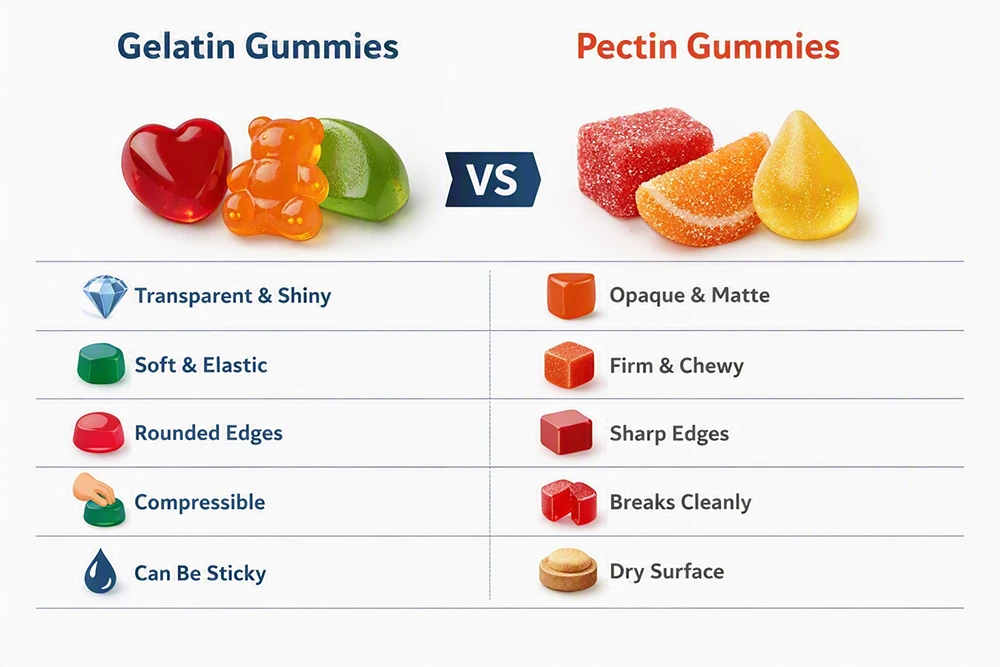
The gelling system is the backbone of any gummy formulation. The three most common options are gelatin (animal-derived, delivers the classic chew), pectin (plant-based, suitable for vegan and halal markets), and carrageenan (seaweed-derived, used in certain vegan formulas). Each gelling agent behaves differently at various temperatures and concentrations, which directly affects how cleanly a shape can be demolded and how well fine details are retained. Pectin-based gummies, for example, are inherently softer and require modified processing parameters to hold intricate shapes compared to gelatin-based formulas.
Mold Engineering and Shape Complexity
Custom molds are the primary cost driver in launching a new shape. Industrial starch-tray molds used in high-volume gummy manufacturing are formed by pressing master stamps into trays of starch powder. The stamp design determines what detail level is achievable. Simpler shapes — ovals, stars, bears, rings — are lower cost to engineer and maintain. More complex shapes with fine lettering, multilayered geometry, or undercut edges require more sophisticated stamping tools and may introduce higher scrap rates during production.
Experienced gummy manufacturers typically maintain a library of existing mold shapes — often 20 to 30 or more standard options — which allows brands to launch custom-looking products without incurring new tooling fees. Truly unique shapes require tooling investment, which should be discussed with the manufacturer upfront as part of the project scoping process.
Color, Flavor, and Coating
Natural colorants derived from fruit and vegetable concentrates are now standard across most markets, driven by both consumer preference and regulatory trends in the EU, UK, and US. Flavor profiles are typically matched to the active ingredient composition — masking bitter compounds such as certain B vitamins or zinc requires specific flavor masking agents in the base formula. Sugar-coated, sour-coated, and oil-dusted finishes are available depending on the target product experience and shelf stability requirements.

Functional Ingredients and Custom Gummy Formats: What Works and What Does Not
Not all active ingredients are equally compatible with gummy formats, and this is something that any serious gummy supplement manufacturer will address during formulation development.
Water-Soluble Vitamins
Vitamins C, B-complex, and biotin are well-suited to gummy delivery. They are heat-stable within the processing window, mix uniformly in aqueous solutions, and do not significantly alter gelling behavior at functional dosages.
Fat-Soluble Vitamins
Vitamins A, D, E, and K require emulsification into the aqueous gummy matrix. This is technically achievable but requires careful emulsifier selection and processing control to ensure uniform distribution and prevent phase separation during molding.
Minerals
Minerals such as calcium, magnesium, zinc, and iron present formulation challenges due to their interaction with gelling agents and their inherently metallic or astringent taste. Chelated mineral forms (e.g., zinc bisglycinate, magnesium glycinate) are generally preferred for gummy applications because they are better tolerated organoleptically and have lower reactivity with the gelling system.
Herbal and Botanical Extracts
Ashwagandha, elderberry, turmeric, and similar botanical extracts can be incorporated, but their natural color, flavor, and moisture content must be accounted for in the base formulation. Standardized dry extracts with low moisture content are the preferred input material.
Specialty Functional Ingredients
Creatine, collagen peptides, melatonin, and probiotics each present unique considerations. Melatonin, for instance, is highly dose-sensitive, requiring precise distribution. Probiotics require specialized encapsulation and controlled processing temperatures to maintain viable colony-forming unit counts through shelf life.
Regulatory and Compliance Considerations for Custom Gummy Supplements
Compliance requirements vary significantly by target market, and non-compliance represents one of the most common and costly mistakes made by brands entering the supplement space for the first time.
United States
Dietary supplements in the US are regulated under the Dietary Supplement Health and Education Act (DSHEA) and must be manufactured in facilities compliant with 21 CFR Part 111, which governs Current Good Manufacturing Practice (cGMP) for dietary supplements. Custom gummies are considered dietary supplements when they contain vitamins, minerals, herbs, or other dietary ingredients and are labeled accordingly. Label claims must be substantiated and comply with FDA guidance on structure/function claims.
European Union
EU food supplement regulations are governed by Directive 2002/46/EC, with member states maintaining additional national requirements. Maximum permitted levels for vitamins and minerals are determined at both EU and national levels. Novel ingredient status may apply to certain botanical extracts. EU-market products must also comply with Regulation (EC) No 1924/2006 on nutrition and health claims.
Other Markets
Canada (NHP regulations under Health Canada), Australia (TGA listed medicines), and the UK (post-Brexit MHRA framework) each have their own registration or notification requirements. Brands targeting multiple markets should work with manufacturers that have experience navigating multi-market compliance and can provide appropriate documentation — including Certificates of Analysis, Certificates of Conformity, and safety data.
Understanding MOQ, Lead Times, and Pricing in Gummy Manufacturing
Minimum order quantities, production lead times, and unit economics are interconnected variables that heavily influence the feasibility of launching a custom shaped gummy product.
Minimum Order Quantities
MOQs vary considerably between manufacturers. Small-scale or trial production runs can start as low as a few hundred kilograms for standard shapes using existing molds. Custom shape tooling typically requires higher MOQs to amortize tooling costs. Brands evaluating custom gummy manufacturer options should request detailed breakdowns of what drives the MOQ — tooling amortization, raw material procurement minimums, and production scheduling minimums each contribute differently.
Lead Times
For established formulas using stock shapes, production lead times of 30 to 60 days from confirmed purchase order are common in well-equipped facilities. Custom shape development adds tooling time — typically 2 to 4 weeks for mold fabrication and validation. New formula development involving stability testing can extend timelines by 4 to 12 weeks depending on the complexity of the active ingredient system.
Pricing Drivers
Key cost drivers for custom gummies include: active ingredient cost and concentration, gelling agent type (pectin commands a premium over gelatin), custom flavor and color development, packaging format (individual sachets vs. bulk jars vs. pouches), certification requirements (organic, kosher, halal), and logistics. Requesting itemized cost breakdowns from prospective manufacturing partners helps brands identify where savings are possible without compromising product quality.
Evaluating a Gummy Contract Manufacturing Partner: Key Criteria
Choosing the right manufacturing partner is one of the most consequential decisions in the product development process. The following criteria provide a structured framework for evaluation.
Certifications and Quality Systems
Look for manufacturers holding ISO 22000 (food safety management), GMP certification aligned with the target market (FDA 21 CFR Part 111 for US, EU GMP for European markets), and relevant third-party certifications such as HACCP, Halal, Kosher, and Vegan. These are not mere marketing credentials — they represent auditable process controls that directly affect batch-to-batch consistency and compliance documentation.
R&D and Formulation Capability
A manufacturer’s in-house R&D capability determines how quickly they can develop or adapt formulas, troubleshoot ingredient interactions, and conduct stability testing. Facilities with dedicated pharmaceutical-grade R&D laboratories provide a higher level of formulation precision than those relying primarily on tolling (formula-provided manufacturing).
Production Capacity and Infrastructure
Understand the manufacturer’s cleanroom classification, daily output capacity, and whether their production lines are dedicated or shared. High-volume production (tens to hundreds of thousands of units per day) requires continuous-production equipment and robust quality control checkpoints throughout the process.
Regulatory and Documentation Support
A capable manufacturing partner should be able to assist with certificate of analysis (COA) generation, product registration support for target markets, labeling compliance review, and export documentation. This is particularly important for brands selling across multiple international markets.
Supply Chain Transparency
Ask about raw material sourcing practices, supplier qualification processes, and ingredient traceability. For active ingredients with complex supply chains — such as certain botanical extracts or specialty minerals — supply chain transparency is a direct proxy for product quality and consistency.
Private Label vs. Custom Formulation: Choosing the Right Path
Brands entering the gummy supplement market typically have two primary pathways for product development: private label and custom formulation (OEM/ODM).
Private Label Gummies
A private label gummy manufacturer produces finished products to pre-established formulas that a brand packages under its own label. This model offers faster time-to-market, lower development costs, and reduced formulation risk. It is particularly well-suited for new market entrants, online retailers, and businesses testing a product concept before committing to full custom development. The trade-off is that private label products may be available to multiple brands, limiting formula differentiation.
OEM and ODM Custom Formulation
Original Equipment Manufacturing (OEM) refers to a model where the brand provides the formula and the manufacturer produces to spec. Original Design Manufacturing (ODM) means the manufacturer develops the formula on behalf of the brand, which then owns or licenses the resulting product. Custom OEM/ODM paths provide full formula ownership, differentiation, and the ability to protect intellectual property — but require longer development timelines and greater upfront investment. For brands with specific functional positioning, unique ingredient combinations, or defined clinical substantiation strategies, OEM/ODM is often the appropriate route.
Packaging Considerations for Custom Shaped Gummies
Packaging is both a functional and commercial element of the finished product. For gummy supplements, packaging decisions affect moisture stability, UV protection, consumer experience, and shipping logistics.
Common packaging formats include: high-density polyethylene (HDPE) bottles with desiccant inserts, flexible pouches (stand-up or lay-flat), individual blister packs, and paper-based sustainable packaging for brands with environmental positioning. Desiccant management is particularly important for gummies because of their hygroscopic nature — moisture uptake during storage leads to clumping, shape deformation, and microbial instability. Nitrogen flushing and appropriate headspace management during filling contribute to extended shelf stability.
Summary
Custom shaped gummies represent a mature and technically sophisticated product category within the dietary supplement industry. Success in this space requires a clear understanding of formulation science, mold engineering, regulatory compliance, supply chain management, and commercial structuring — whether approaching the market through private label, OEM, or full ODM development.
The key decision factors are: selecting a manufacturing partner with the right certifications and R&D infrastructure; choosing between private label and custom formulation based on brand strategy and timeline; understanding true cost drivers to build realistic unit economics; and ensuring regulatory readiness for your target markets before committing to production.
Brands that invest time in evaluating manufacturing partners thoroughly — beyond price alone — consistently achieve better product outcomes, fewer compliance issues, and stronger long-term supply relationships.
Frequently Asked Questions (FAQ)
What is the typical MOQ for custom shaped gummies?
MOQ depends on whether you are using existing mold shapes or requiring new custom tooling. For stock shapes using established formulas, MOQs can start at several hundred kilograms. Custom shapes requiring new mold fabrication typically carry higher MOQs to amortize tooling costs. Always request an itemized breakdown from your prospective manufacturer.
How long does it take to develop a new custom gummy product from scratch?
A realistic timeline for a new custom formulation with a new shape runs 10 to 20 weeks from project initiation to first production batch, factoring in formulation development, stability screening, mold fabrication, regulatory review, and packaging procurement. Simpler projects using existing formulas and stock shapes can complete in 4 to 8 weeks.
Can gummy supplements contain high doses of active ingredients?
The gummy format has inherent dose limitations because active ingredient concentration is constrained by the gummy’s weight (typically 2 to 5 grams per piece) and the formulation’s tolerance for taste, texture, and stability. High-dose applications — such as certain minerals or specialty actives — may require a multi-gummy serving size or may be better suited to capsule or tablet formats.
What certifications should I look for in a gummy supplement manufacturer?
At minimum, look for GMP certification appropriate to your target market (FDA, EU GMP), ISO 22000 for food safety management, and HACCP. Additional certifications relevant to your product and market include Halal, Kosher, Vegan, and organic. Third-party audit certification adds credibility beyond self-declaration.
What is the difference between private label gummies and OEM/ODM gummies?
Private label gummies use pre-existing formulas and shapes that you brand under your own label — this is faster and lower cost to launch but offers less differentiation. OEM means you supply the formula and the manufacturer produces it. ODM means the manufacturer develops the formula on your behalf. OEM and ODM paths offer greater product uniqueness and potential IP protection but require more development time and investment.
Are vegan gummies more expensive than gelatin-based gummies?
Generally, yes. Pectin, the most common vegan gelling agent, is more expensive than gelatin on a per-unit basis. Vegan formulations also require more precise processing control to maintain shape integrity, which can affect production yields. The price differential varies by formula complexity and order volume, so it is best discussed directly with your manufacturing partner.
Can I order samples before committing to full production?
Most qualified manufacturers offer a sampling or trial batch process, though minimum quantities and associated costs vary. Sampling is a critical step in evaluating product quality, taste, texture, and shape fidelity before committing to full-scale production. Always request samples before placing a commercial order.
How should I assess the stability of a custom gummy formulation?
Accelerated stability testing under controlled temperature and humidity conditions (typically 40°C / 75% relative humidity over 6 months per ICH guidelines) is the standard method for evaluating shelf life and identifying stability risks. Ask your manufacturing partner about their stability testing protocols and whether they have existing stability data for formulas similar to your product.
About Gothink Biotech — Gummy Supplement Manufacturer and Dietary Supplement Manufacturer
Shenzhen Gothink Biotech Co., Ltd. is a GMP-certified Dietary Supplements Manufacturer and gummy supplements specialist headquartered in Shenzhen, China. With a 100,000-class cleanroom production facility, an annual output capacity of 5,000 tons, and a 10,000-class pharmaceutical-grade R&D laboratory, Gothink offers end-to-end Gummy Manufacturing services designed to support supplement brands at every stage — from initial concept to market-ready product.
Our Gummy Contract Manufacturing services cover the complete production spectrum: formulation development and optimization, mold engineering and custom shape tooling, pectin and gelatin-based gummy production, bulk gummy manufacturing, and finished product packaging. We support brands pursuing private label gummy programs, white label arrangements, OEM, and ODM development pathways. Our flexible MOQ structure accommodates both startup trial runs and large-scale wholesale orders.
As a certified private label gummy manufacturer and custom gummy manufacturer, Gothink holds ISO 9001, ISO 22000, HACCP, FDA registration, Halal, Kosher, GMP, and Vegan certifications. Our scientific team, led by postdoctoral researchers with experience at Cold Spring Harbor Laboratory, Emory University, and Ohio State University, brings pharmaceutical-grade precision to every formulation. Whether you are sourcing custom shaped gummies, expanding an existing product line, or entering the supplement market for the first time, Gothink provides the manufacturing infrastructure, regulatory expertise, and formulation capability to bring your product to market reliably.
Contact us to discuss your project requirements and request samples or a formulation consultation.