
Summary
In the United States, dietary supplements, including gummy vitamins, are regulated by the FDA as food, not as drugs. This classification means they are not subject to the same rigorous testing and approval processes as pharmaceuticals. For supplement brands, OEM buyers, and contract manufacturers, understanding this regulatory framework is essential for sourcing decisions, quality assurance, and compliant product development.
Definition
Gummy vitamins regulated by the FDA refers to the legal and compliance framework under which gummy-format dietary supplements are produced, labeled, marketed, and monitored in the United States. In the United States, gummy supplements are regulated by the FDA as a food, meaning less rigorous research and testing is required than for medicines. The FDA does not have the authority to approve supplements for safety and effectiveness, or to approve their labeling, before they are sold to the public.
What Gummy Vitamins Are, in a Regulatory Context
Gummy supplements are dietary supplements delivered as gummy-candy-like products, most commonly comprising vitamins. They are often used as a more palatable alternative to other supplement formulations.
From a regulatory standpoint, this format falls squarely under the dietary supplement category — governed by food law rather than pharmaceutical law. This distinction has major implications for how manufacturers design their quality systems, how brands make label claims, and how B2B buyers assess supplier credibility.
Industry Background and the DSHEA Framework
The Dietary Supplement Health and Education Act (DSHEA) of 1994 established the fundamental regulatory framework for dietary supplements, creating a distinct product category separate from conventional foods and drugs. Under DSHEA’s provisions, Congress specifically authorized the U.S. Food and Drug Administration to develop current good manufacturing practice (cGMP) requirements for dietary supplement products. This legislative mandate culminated in the publication of 21 CFR Part 111 as a final rule on June 25, 2007. Npanational
Following DSHEA, dietary supplements were placed in a “special category under the general umbrella of ‘foods,’” according to the FDA. This means the responsibility for product safety lies primarily with the manufacturer, not with pre-market approval by a regulatory agency. ents
While the FDA does not conduct pre-market approval, it is not absent from oversight. Even though the FDA does not approve dietary supplements, there are roles for the agency in regulating them. Since companies can often introduce a dietary supplement to the market without notifying the FDA, the agency’s role in regulating supplements primarily begins after the product enters the marketplace. The FDA periodically inspects dietary supplement manufacturing facilities to verify companies are meeting applicable manufacturing and labeling requirements.
The Dietary Supplement cGMP rule in 21 CFR Part 111 requires persons who manufacture, package, label, or hold a dietary supplement to establish and follow current good manufacturing practices to ensure the quality of the dietary supplement and to ensure that the dietary supplement is packaged and labeled as specified in the master manufacturing record. U.S. Food and Drug Administration
All domestic and foreign suppliers who produce, package, and label dietary supplements for sale in the United States must comply with FDA regulations. This applies directly to overseas OEM and contract manufacturers supplying the U.S. market.
Business Relevance: Market Demand and Supply Chain Considerations
The gummy supplement market is rapidly growing, driven by growing awareness of preventive care, rising cases of undernourishment in developing countries, and a rise in new product offerings from both major traditional pharmaceutical companies, as well as new startups. Global sales of gummy vitamins in 2022 are estimated to be over US$7 billion.
For brands and private-label buyers, this growth underscores the commercial opportunity — but also the compliance stakes. Choosing a manufacturer who cannot demonstrate cGMP documentation, third-party testing, and FDA-compliant labeling protocols creates significant commercial and legal risk.
Differences Versus Other Supplement Formats
Compared to tablets and capsules, gummy supplements present unique manufacturing challenges. Due to the necessity of containing other ingredients for taste, texture, and color, gummy supplements can have lower amounts of the active ingredient than traditional methods. Additionally, gummy vitamins tend to degrade faster and have a shorter shelf life than conventional pills.
These factors make quality process control — including potency verification and stability testing — especially important in Gummy Contract Manufacturing.
Key Advantages and Limitations
Advantages:
- High consumer acceptance, especially among children and pill-averse adults
- Strong brand differentiation opportunities through flavor, shape, and color customization
- Fast-growing category with broad retail placement
Limitations:
- Active ingredient concentrations may be lower due to formulation constraints
- Shorter shelf life requires careful packaging and storage planning
- The nutrients in gummy vitamins may not always match what is on the supplement facts label, making third-party verification a necessary quality step
Who Should Consider This Category
- Supplement brands launching consumer-facing gummy lines
- Private-label buyers seeking flexible, low-MOQ manufacturing partnerships
- Distributors entering the U.S., EU, or Asia-Pacific markets where gummy formats are gaining share
- Startups using OEM/ODM services to bring new functional gummy products to market
Compliance and Quality Considerations
By adhering to dietary supplement FDA regulations, companies can avoid 483 observations, warning letters, fines, or even facility shutdowns. Proper training, documentation, and testing help identify potential quality issues before products are released to the market, reducing the risk of recalls.
For B2B buyers, this means supplier qualification should go beyond price — it must include an assessment of the manufacturer’s GMP certification status, documented quality procedures, third-party testing capabilities, and regulatory record.
What Businesses Should Evaluate Before Sourcing
- Whether the manufacturer holds valid GMP certification (FDA, ISO22000, or equivalent)
- Access to a Certificate of Analysis (CoA) for every batch
- The manufacturer’s experience with U.S. label compliance and DSHEA requirements
- Third-party testing partnerships for potency, purity, and contaminant screening
- Documentation readiness for customs, regulatory audits, and retailer onboarding
Technical Parameter Table
| Parameter | Detail |
|---|---|
| Product Form | Gummy (bear, ring, cube, or custom shape); single-layer or multi-layer |
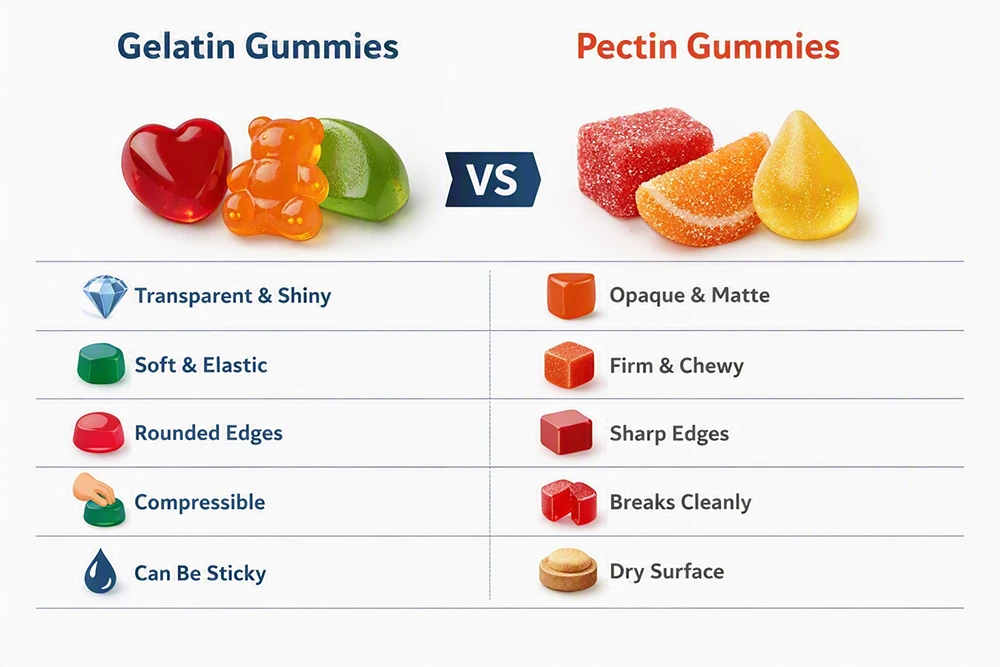
| Key Gelling Agents | Pectin (vegan), gelatin, carrageenan; glucose syrup, sucrose or sugar-free alternatives |
| Active Ingredient Categories | Vitamins (A, B-complex, C, D, E, K), minerals (calcium, zinc, selenium), botanicals (ashwagandha, elderberry), probiotics, melatonin, creatine, collagen |
| Manufacturing Process | Formulation → blending → cooking → molding → cooling/drying → coating (optional) → inspection → packaging |
| Regulatory Standards | FDA cGMP (21 CFR Part 111), ISO9001, ISO22000, HACCP; HALAL / KOSHER / Vegan certification available |
| Third-Party Testing | Certificate of Analysis (CoA) per batch; potency, heavy metals, microbial limits, allergen screening |
| Packaging Options | Bottles (HDPE/PET), pouches, blister packs, bulk bags; private label printing supported |
| Production Scalability | Small trial runs (flexible MOQ) to full-scale commercial volumes; annual capacity up to thousands of tons |
| Cleanroom Classification | 100,000-class manufacturing cleanroom; 10,000-class R&D laboratory |
| Shelf Life & Storage | Typically 18–24 months; stored at controlled temperature and humidity; moisture-barrier packaging recommended |
| Labeling Compliance | Supplement Facts panel per FDA 21 CFR 101; structure/function claim review; no disease claims permitted |
| Export Documentation | CoA, MSDS, Certificate of Free Sale, HACCP records, customs-compliant labeling |
Practical Insights (B2B-Focused)
Manufacturing Quality and Process Control Gummy production involves multiple heat-sensitive stages where active ingredient integrity can be compromised. A qualified manufacturer should demonstrate validated processes for each step, with in-process quality checks and documented deviation management. Look for manufacturers with pharmaceutical-standard cleanrooms, not just food-grade facilities.
Raw Material Sourcing Transparency FDA cGMP requirements mandate that dietary supplement manufacturers verify the identity of every incoming ingredient. Compliance with food supplement regulations opens doors to broader markets and partnerships, and many large retailers require GMP certification for dietary supplement suppliers. Ask suppliers for raw material CoAs, supplier qualification records, and traceability documentation.
Production Scalability and Lead Time For brands testing a new formula, flexible MOQ is critical. For established brands scaling up, confirmed annual production capacity and lead time commitments should be contractually secured. Confirm that the manufacturer can handle volume increases without quality deterioration.
Compliance and Documentation Readiness Before a single unit ships, ensure the manufacturer can provide batch production records, CoAs, and the documentation required by U.S. Customs, Amazon, or major retail chains. Missing documentation is one of the most common causes of import holds and retailer delistings.
Cost Structure Considerations Gummy supplement unit costs are influenced by gelling agent type (pectin vs. gelatin), active ingredient complexity, shape mold costs, packaging format, and order volume. Transparent cost breakdowns allow brands to make informed decisions about formulation trade-offs without sacrificing regulatory compliance.
How to Evaluate a Reliable Supplier Request a facility audit or third-party audit report. Verify GMP certification scope, review recent CoAs, check references from existing clients in the same target market, and assess the supplier’s familiarity with your regulatory destination — whether that’s the United States, EU, or elsewhere.
B2B Decision Guide
How Brands Choose the Right Manufacturer Prioritize manufacturers who hold current, verifiable GMP certifications aligned with your target market (FDA 21 CFR Part 111 for the U.S., EU GMP for Europe). Evaluate their formulation development track record, not just their production capacity.
What Matters in OEM/ODM Projects A custom gummy manufacturer should offer full formulation ownership transfer or proprietary formula security clauses. Confirm intellectual property protections, minimum run commitments, and whether the manufacturer supports label compliance review as part of the service.
How to Assess Production Capability Request facility documentation including cleanroom certification, equipment calibration records, and production throughput data. Ask specifically about gummy-format experience, including how they handle active ingredient degradation during the cooking phase.
Key Criteria for Long-Term Supply Partnerships Consistent batch-to-batch quality, on-time delivery rate, responsive technical support, and the ability to scale formulations as your brand grows are the most important long-term factors. A supplier who cannot demonstrate these is a supply chain risk regardless of price.
Risk Control and Quality Assurance Checkpoints
- Pre-production: ingredient identity verification, formula sign-off
- In-production: in-process weight checks, moisture control
- Pre-shipment: full CoA, organoleptic testing, label review
- Post-shipment: retain samples for lot traceability
For private label gummy projects, insist on a defined quality agreement that specifies acceptable quality limits (AQLs) and corrective action timelines.
Conclusion
Gummy vitamins occupy a well-defined but nuanced regulatory position in the United States — categorized as dietary supplements under food law, subject to cGMP requirements under 21 CFR Part 111, and monitored post-market by the FDA. For supplement brands, distributors, and OEM/ODM buyers, this framework does not reduce the compliance burden; it shifts it to manufacturers. Selecting a manufacturer with proven GMP credentials, robust documentation systems, and transparent quality processes is the most effective risk-mitigation strategy available. As the global gummy supplement market continues to expand, the ability to make vitamin gummies at scale with full regulatory traceability will remain a core competitive differentiator for any serious supplement brand.
FAQ
1. Are gummy vitamins regulated by the FDA? Dietary supplements are regulated by the FDA as food, not as drugs. This means gummy vitamins are not subject to pre-market approval, but manufacturers must comply with cGMP requirements under 21 CFR Part 111.
2. What is 21 CFR Part 111 and why does it matter for gummy manufacturers? 21 CFR Part 111 requires persons who manufacture, package, label, or hold a dietary supplement to establish and follow current good manufacturing practices to ensure the quality of the dietary supplement. Non-compliance can result in warning letters, facility shutdowns, or import refusals.
3. Does the FDA test gummy vitamins before they are sold? Since companies can often introduce a dietary supplement to the market without notifying the FDA, the agency’s role in regulating supplements primarily begins after the product enters the marketplace. Pre-market testing is not required, which is why third-party CoAs are a critical quality standard.
4. What certifications should a gummy supplement manufacturer hold? At minimum, manufacturers supplying the U.S. market should hold FDA-compliant GMP certification. Additional certifications such as ISO9001, ISO22000, HACCP, HALAL, KOSHER, and Vegan provide further assurance of quality system depth and market access breadth.
5. How does gummy format compare to capsules or tablets from a compliance standpoint? All formats are governed by the same dietary supplement regulatory framework. However, gummy manufacturing involves additional complexity around active ingredient stability, sugar content disclosure, and shelf life — making formulation-specific quality documentation especially important.
6. What should B2B buyers verify before placing a bulk gummy supplement order? Buyers should verify GMP certification scope, review batch CoAs from recent production runs, confirm label compliance capability for their target market, and secure a quality agreement with defined acceptance criteria and corrective action procedures.
About the Manufacturer
Shenzhen Gothink Biotech Co., Ltd. is a large-scale contract dietary supplement manufacturer based in China, offering OEM, ODM, private label, and CDMO services across gummy, capsule, tablet, powder, liquid, and drop formats. The company operates a GMP-certified production facility with a 100,000-class cleanroom and a 10,000-class pharmaceutical-grade R&D laboratory, with a daily output of 16 tons and an annual production capacity of 5,000 tons. Gothink’s R&D team includes researchers with postdoctoral experience at leading U.S. institutions, supporting custom formulation development across a broad range of functional supplement categories. The company holds ISO9001, ISO22000, HACCP, HALAL, KOSHER, GMP, and Vegan certifications, and provides complete export documentation to support regulatory compliance in international markets. Gothink supports brands, distributors, and B2B buyers at all stages of product development, from initial formulation through to final packaged goods, with flexible MOQ options designed to accommodate both early-stage trial runs and high-volume commercial production.