
Summary
A professional Gummy Supplement Manufacturing service provides brands and distributors with end-to-end production support—from formulation development and raw material sourcing through to finished, shelf-ready packaging. For B2B buyers, understanding exactly what a qualified contract manufacturer delivers is essential to reducing risk, maintaining product quality, and accelerating time to market. This article outlines the core services, technical standards, and evaluation criteria that define a professional gummy contract manufacturer.
Definition
A professional gummy supplement manufacturing service refers to a contract-based production arrangement in which a certified facility handles all or most stages of bringing a gummy dietary supplement to market on behalf of a brand, retailer, or distributor. This encompasses formulation design, ingredient sourcing, process engineering, quality assurance, regulatory compliance, and packaging—delivered under GMP-certified conditions and aligned with the client’s commercial specifications.
What a Professional Gummy Manufacturing Service Covers
Scope of Services
A full-service Gummy Contract Manufacturing partner does far more than fill molds. Professional facilities manage the complete production lifecycle: ingredient specification and procurement, formulation stability testing, pilot batches, full-scale manufacturing, in-process quality checks, and final packaging. Brands that engage a capable contract manufacturer effectively outsource their production infrastructure while retaining control over formula ownership, labeling, and brand identity.
Industry Background
The gummy supplement segment has grown substantially over the past decade, driven by consumer preference for easy-to-swallow, palatable dosage forms over traditional tablets and capsules. This shift created significant demand for specialized manufacturing capabilities—including pectin- and gelatin-based gelling systems, temperature-controlled molding lines, and moisture-controlled packaging environments. Contract manufacturers responded by investing in dedicated gummy production lines, clean-room facilities, and R&D teams capable of handling complex active ingredient matrices.
Business Relevance
For supplement brands—particularly startups, e-commerce sellers, and private label operators—partnering with a contract manufacturer eliminates the need for capital-intensive facility investment. A qualified custom gummy manufacturer enables brands to launch faster, test new SKUs at lower risk, and scale production in line with market demand. Supply chain transparency and production lead times are key commercial considerations, especially for brands operating on seasonal or campaign-driven inventory cycles.
Gummy Manufacturing vs. Other Dosage Forms
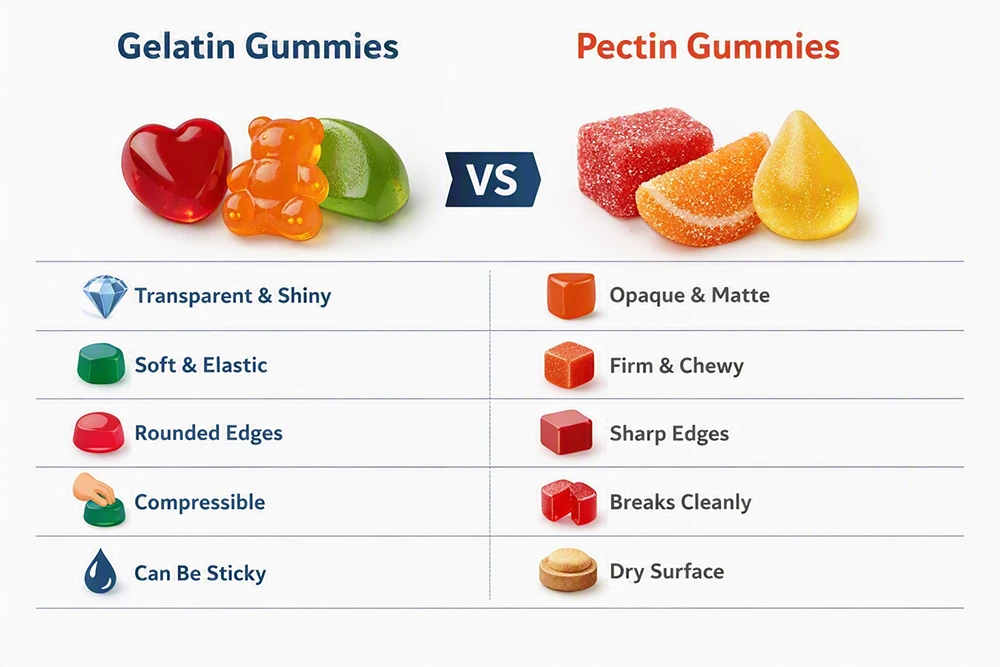
Compared to capsule or tablet manufacturing, gummy production involves additional process complexity: gelling agent selection (gelatin, pectin, carrageenan), pH and Brix management, flavor and color integration, moisture control, and demolding. These variables require dedicated equipment and process expertise. On the commercial side, gummies typically carry higher per-unit production costs than capsules or tablets, but command stronger retail positioning and consumer acceptance—particularly in children’s health, beauty, and sleep categories.
Key Advantages of Professional Contract Manufacturing
- Access to validated formulations and ingredient databases without internal R&D investment
- GMP-certified facilities that satisfy retailer and regulatory requirements
- Scalable production capacity, from trial runs to high-volume orders
- Integrated quality control and documentation for import/export compliance
- Custom flavor, color, shape, and gelling agent options for product differentiation
Limitations and Considerations
- Formula ownership and IP protection terms vary by manufacturer—review contracts carefully
- Minimum order quantities (MOQs) may constrain early-stage brands
- Lead times for custom formulations can range from 6 to 16 weeks depending on complexity
- Ingredient substitutions by manufacturers must be governed by change control agreements
Who Should Consider Gummy Contract Manufacturing
Gummy contract manufacturing is best suited to supplement brands seeking to differentiate through dosage form, e-commerce sellers launching private label gummy products, retailers requiring consistent quality across large volumes, and international distributors sourcing from GMP-certified facilities. It is equally relevant for brands reformulating existing tablet or capsule products into gummy formats to improve consumer compliance.
Compliance and Regulatory Considerations
In major markets, gummy dietary supplements are subject to food-grade and supplement regulations. In the United States, manufacturers must comply with FDA 21 CFR Part 111 (Dietary Supplement cGMPs). In the EU, relevant food safety and supplement regulations apply under EFSA guidelines. Manufacturers serving global brands should hold ISO 22000 or equivalent food safety management certification alongside GMP credentials. Third-party testing for heavy metals, microbiological contamination, and label claim verification is increasingly required by major retailers and e-commerce platforms.
What Businesses Should Evaluate Before Sourcing
Before engaging a manufacturer, brands should request facility audit reports or certification documents, review sample quality against specification sheets, clarify MOQ and pricing tiers, confirm lead times for both standard and custom formulations, and verify the manufacturer’s experience with their target active ingredients. Contract terms covering IP, exclusivity, and change control should be reviewed by legal counsel.
Technical Parameter Table: Professional Gummy Supplement Manufacturing
| Parameter | Specification / Details |
|---|---|
| Product Form | Gummy supplements (gelatin-based, pectin-based, carrageenan-based); vegan and non-vegan options |
| Gelling Agents | Gelatin (bovine/porcine), pectin (apple/citrus), carrageenan; selected per dietary, religious, and market requirements |
| Active Ingredient Compatibility | Vitamins, minerals, amino acids (e.g., creatine), herbal extracts, probiotics, melatonin, collagen, omega-3 (encapsulated), NMN, ashwagandha, and functional blends |
| Manufacturing Process Highlights | Ingredient weighing → mixing/cooking → pH and Brix control → flavoring and coloring → depositing/molding → cooling/demolding → coating (optional) → quality inspection → packaging |
| Quality Standards | GMP, ISO 9001, ISO 22000, HACCP, FDA registration; HALAL, KOSHER, Vegan certifications available |
| Third-Party Testing | Heavy metals, microbiological (TPC, yeast/mold, pathogens), label claim potency, moisture content, foreign matter |
| Shape & Size Options | Bear, ring, cube, cylinder, custom shapes; typical weight 2–5 g per gummy; multiple mold configurations available |
| Flavor & Color | Natural and artificial flavors; natural fruit and vegetable colorants; sugar-free and low-sugar formulations supported |
| Packaging Options | Bottles (HDPE, PET), stand-up pouches, blister packs, jars; custom label and box printing; private label and OEM branding |
| MOQ Range | Varies by manufacturer; professional facilities typically offer trial batches from small volumes with full-scale runs in the tens of thousands of units |
| Production Capacity | High-capacity facilities: daily output of 10+ metric tons; annual capacity of 3,000–5,000+ metric tons |
| Cleanroom Standard | 100,000-class (ISO 8) manufacturing area; 10,000-class (ISO 7) R&D laboratory for high-sensitivity work |
| Lead Time | Standard formulations: 4–8 weeks; custom formulations: 8–16 weeks depending on ingredient complexity and regulatory review |
| Storage & Logistics | Temperature-controlled warehousing (typically 15–25 °C, RH ≤ 60%); export documentation (COA, MSDS, phytosanitary certificates) provided; compatible with global freight and customs requirements |
| Formulation Services | New product development, formula optimization, stability testing, pilot batch, scale-up; annual new product formulation capacity: 1,000–2,000+ SKUs |
Practical Insights for B2B Buyers
Manufacturing Quality and Process Control
Professional facilities implement in-process controls at each production stage: ingredient identity verification, Brix and pH monitoring during cooking, visual inspection at demolding, weight checks, and final batch release testing. Buyers should request batch records and certificates of analysis (COA) as standard deliverables. A manufacturer that cannot supply these documents consistently is not operating at a professional standard.
Raw Material Sourcing Transparency
The integrity of a finished gummy product depends entirely on the quality of its inputs. Qualified manufacturers maintain approved supplier lists, conduct incoming raw material testing, and can provide ingredient traceability documentation. Buyers entering OEM agreements should clarify whether they retain control over ingredient supplier selection or whether the manufacturer sources autonomously—and whether substitutions require prior client approval.
Production Scalability and Lead Time
Scalability is a critical selection criterion for growing brands. A manufacturer able to produce small trial batches but lacking capacity to fulfill 100,000-unit orders will become a bottleneck as a brand grows. Verify that the facility can demonstrate actual production records at scale, not just quoted capacity. Lead time commitments should be formalized in contract terms, with defined penalties or remedies for delays.
Compliance and Documentation Readiness
Brands selling into regulated markets—particularly the US, EU, Australia, and Canada—require specific documentation: GMP compliance certificates, third-party lab reports, allergen declarations, nutritional fact panel verification, and country-of-origin documentation. A professional manufacturer maintains a compliance dossier for each product and updates it when formulas or processes change.
Cost Structure Considerations
Gummy supplement pricing is influenced by active ingredient costs, gelling agent selection (pectin typically costs more than gelatin), flavor and color complexity, packaging format, and order volume. Brands should obtain itemized quotations that separate raw material costs from processing fees and packaging costs. This transparency enables accurate margin modeling and meaningful supplier comparisons.
How to Evaluate a Reliable Supplier
Request facility photos, audit reports, and reference client contacts. Review the manufacturer’s product portfolio for overlap with your category. Ask about their R&D team’s qualifications and the number of new formulations developed annually. A manufacturer that publishes clear capacity figures, holds recognized certifications, and has a documented quality management system (QMS) provides a substantially lower sourcing risk profile than one relying on verbal assurances alone.
B2B Decision Guide: Choosing the Right Gummy Manufacturer
How Brands Choose the Right Manufacturer
The selection process should begin with a clear product brief: target market, desired active ingredients, gelling agent preference, flavor profile, packaging format, regulatory requirements, and target launch timeline. Share this brief with candidate manufacturers and evaluate their responses for specificity, technical depth, and turnaround time. Vague or generic responses often indicate limited in-house capability.
What Matters in OEM/ODM Projects
In OEM engagements, the brand supplies the formula and the manufacturer produces to specification. In ODM engagements, the manufacturer contributes formulation expertise and the brand licenses or adopts a developed formula. Clarity on IP ownership—who owns the formula, the stability data, and the supplier relationships—is essential before production begins. Professional manufacturers provide written agreements covering these terms.
How to Assess Production Capability
Beyond certifications, assess actual production infrastructure: number of gummy production lines, daily throughput, cleanroom classification, and cold-chain or climate-controlled warehousing. Request a facility visit or third-party audit if volumes are significant. A manufacturer with a documented daily output and annual capacity figure that aligns with client needs reduces the risk of production delays during peak demand periods.
Key Criteria for Long-Term Partnerships
- Consistent product quality across batches (measured via COA comparison over time)
- Responsive account management and clear communication protocols
- Willingness to sign long-term supply agreements with pricing and volume commitments
- Track record of on-time delivery and proactive communication about delays
- R&D capability to support product line extensions and reformulations
Risk Control and Quality Assurance Checkpoints
Establish quality assurance checkpoints at three stages: pre-production (formula and raw material approval), in-process (batch monitoring and deviation reporting), and post-production (final COA, retain sample storage, and label verification). For high-volume orders, consider engaging an independent third-party inspection agency to conduct pre-shipment audits at the manufacturer’s facility.
Conclusion
A professional gummy supplement manufacturing service delivers far more than production capacity—it provides a complete operational framework for bringing compliant, high-quality gummy products to market efficiently. For brands evaluating manufacturers, the core criteria remain consistent: verified GMP certification, transparent raw material sourcing, scalable production infrastructure, rigorous quality documentation, and a technical team capable of supporting both standard and custom formulations. Brands that invest the time to vet manufacturers against these criteria are substantially better positioned to build reliable supply chains and sustainable product lines in the competitive global supplement market.
FAQ
What does a professional gummy supplement manufacturing service include?
A professional service covers the full production cycle: formulation development, raw material sourcing, pilot batches, full-scale manufacturing, in-process quality control, packaging, and export documentation. Most professional manufacturers also offer regulatory compliance support and custom labeling under OEM or ODM arrangements.
What quality certifications should a gummy manufacturer hold?
At minimum, GMP certification and ISO 22000 or ISO 9001. Manufacturers serving US-bound products should be FDA-registered and comply with 21 CFR Part 111. HACCP, HALAL, KOSHER, and Vegan certifications indicate additional capability and market access. Third-party testing records for each batch are a standard expectation.
How does gummy manufacturing differ from capsule or tablet manufacturing?
Gummy manufacturing involves additional process variables including gelling agent management, Brix and pH control, flavor and color incorporation, and temperature-sensitive molding and demolding. These requirements mean dedicated equipment and specialized process expertise. Per-unit costs are generally higher than capsules or tablets, but gummies command stronger consumer appeal in many categories.
What are typical lead times for custom gummy supplement orders?
Standard formulations with established ingredients typically require 4–8 weeks from order confirmation to shipment. Custom formulations involving novel ingredients, stability testing, or regulatory review can take 8–16 weeks. Brands should account for lead time when planning product launches and inventory replenishment cycles.
What is the difference between OEM and ODM in gummy supplement manufacturing?
In OEM (Original Equipment Manufacturing), the brand provides the formula and the manufacturer produces to specification. In ODM (Original Design Manufacturing), the manufacturer develops the formula and the brand licenses or adopts it. IP ownership, ingredient sourcing control, and exclusivity terms differ significantly between the two models and should be defined in the supply agreement.
What should brands verify before placing a large gummy supplement order?
Brands should verify GMP certification and audit reports, review COAs from previous batches, confirm actual production capacity (not just quoted figures), clarify MOQ and pricing tiers, assess the manufacturer’s R&D capability, and review contract terms covering IP, change control, delivery timelines, and quality dispute resolution.
About Gothink Biotech
Shenzhen Gothink Biotech Co., Ltd. is a GMP-certified dietary supplement contract manufacturer based in China, offering OEM, ODM, CMO, and CDMO services to global supplement brands, distributors, and private label operators. The company operates a large-scale manufacturing facility with a 100,000-class cleanroom and a daily production output of 16 metric tons, supporting an annual capacity of approximately 5,000 metric tons. A dedicated 10,000-class pharmaceutical-grade R&D laboratory supports formulation development, stability testing, and new product design across gummy, capsule, tablet, powder, liquid, and drop supplement formats. Gothink Biotech holds certifications including ISO 9001, ISO 22000, HACCP, HALAL, KOSHER, Vegan, and GMP, and is positioned to supply both domestic and export markets with compliant, documented products. The company develops over 2,000 new product formulations annually and provides full turnkey production support—from raw material sourcing and formulation design through to finished-goods packaging and export documentation—enabling long-term B2B partnerships with brands at all stages of growth.