
What Is Gummy Contract Manufacturing?
Gummy contract manufacturing refers to the outsourced production of gummy-format dietary supplements or functional foods by a specialized third-party facility, typically under OEM (Original Equipment Manufacturer), ODM (Original Design Manufacturer), CMO (Contract Manufacturing Organization), or CDMO (Contract Development and Manufacturing Organization) arrangements. The brand owner supplies — or collaborates on — the product concept, formula, and branding, while the manufacturer handles raw material sourcing, formulation development, production, quality control, and packaging.
In the dietary supplement industry, Gummy Contract Manufacturing has grown into a distinct, technically demanding segment. Gummies require precise gelling agent ratios, controlled pH, careful temperature management, and flavor stability — differentiating this process from standard capsule or tablet manufacturing.
Industry Background
The global gummy supplement market has expanded significantly over the past decade, driven by consumer preference for palatable delivery formats over traditional pills and capsules. Gummies now represent one of the fastest-growing segments within the broader dietary supplement industry, spanning vitamins, minerals, adaptogens, sleep aids, probiotics, and sports nutrition.
Most gummy production is concentrated in a handful of manufacturing regions — the United States, China, Germany, and India — each with different cost profiles, regulatory environments, and production capabilities. Chinese manufacturers, in particular, have invested heavily in pharmaceutical-grade GMP infrastructure to serve global markets, including North America, Europe, and Southeast Asia.
Why the “Top” Manufacturer May Not Be Right for You
Brands new to the supplement space often default to seeking the largest or most well-known manufacturers. However, scale alone does not equal fit. The largest Top Gummy Manufacturers typically operate with high minimum order quantities (MOQ), longer lead times due to production scheduling, premium pricing that reflects their certifications and capacity, and more rigid formulation requirements designed for high-volume runs.
A startup brand launching its first SKU has fundamentally different needs from an established retailer placing quarterly orders of 500,000 units. Matching manufacturer scale to your current business stage — with room to grow — is a more practical approach than chasing prestige.
Key Variables to Consider by Brand Stage
- Early-stage / startup: Prioritize flexible MOQ, willingness to support small trial batches, responsive communication, and reasonable formulation development fees.
- Growth-stage brand: Focus on capacity reserves, lead time reliability, documentation readiness for retail buyers, and co-manufacturing transparency.
- Established brand: Evaluate long-term pricing structures, supply chain redundancy, proprietary formula protection, and audit readiness for third-party or retailer compliance programs.
Business Relevance: Market Demand and Supply Chain Considerations
Consumer demand for gummy supplements continues to outpace category averages. New entrants face a supply chain that rewards planning: gummy production involves more complex equipment than capsules, and premium raw materials — such as pectin for vegan gummies, high-quality botanical extracts, or patented active ingredients — require advance procurement.
For brands sourcing from overseas manufacturers, lead times of 45–90 days are common once formulation is finalized, with additional time for customs clearance and freight. Brands targeting U.S. retail accounts will also need to meet specific documentation requirements, including Certificates of Analysis (CoA), allergen statements, and in some cases third-party testing reports from accredited labs.
OEM vs. ODM vs. Private Label Gummy Manufacturing
Understanding the differences between these service models is essential before approaching any manufacturer:
- OEM (Original Equipment Manufacturer): The brand provides the formula; the manufacturer produces to those specifications. Best for brands with proprietary formulations.
- ODM (Original Design Manufacturer): The manufacturer develops the product (formula, design) and the brand applies its own label. Faster to market, lower development cost.
- Private label gummy manufacturer: A subset of ODM in which the manufacturer offers pre-developed, shelf-ready formulas. The brand selects a formula, applies its branding, and goes to market. Lowest barrier to entry.
- CDMO: Full-service model covering development through delivery — preferred by brands that want end-to-end management with a single partner.
Key Advantages and Limitations of Gummy Format Manufacturing
Advantages
- High consumer palatability improves adherence and repeat purchase
- Wide format flexibility: shapes, colors, flavors, and functional stacking
- Strong retail shelf appeal and DTC photography value
- Vegan options (pectin-based) addressable through most modern manufacturers
Limitations
- Higher per-unit manufacturing cost than capsules or tablets at equivalent volumes
- Active ingredient loading limits due to gummy matrix constraints
- Sensitivity to humidity and temperature during storage and transit
- More complex formulation for high-dose actives (e.g., creatine, certain minerals)
Compliance and Regulatory Considerations
For brands selling into the U.S. market, manufacturers should comply with FDA 21 CFR Part 111 (cGMP for dietary supplements). EU-bound products require compliance with relevant EU food supplement regulations. Key certifications to look for include GMP, ISO 22000, HACCP, and where relevant, HALAL, KOSHER, or Vegan certification. Third-party lab testing (heavy metals, microbiology, identity verification) is increasingly expected by retailers and is considered baseline for DTC brands with consumer trust goals.
Technical Parameter Overview: Gummy Supplement Manufacturing
| Parameter | Details |
|---|---|
| Product Forms | Standard gummy, gummy bears, chewable gummy, dual-layer gummy, sugar-free gummy, center-filled gummy |
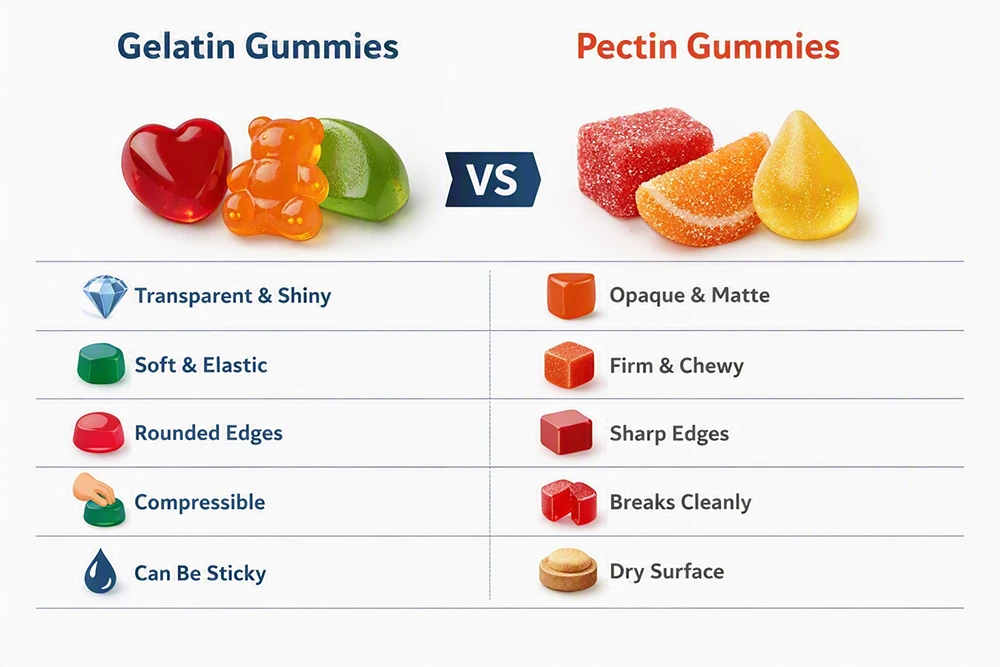
| Gelling Agents | Gelatin (bovine, porcine), Pectin (vegan), Carrageenan (vegan), Agar |
| Active Ingredient Categories | Vitamins (A, B-complex, C, D3, K2), Minerals (Zinc, Magnesium, Selenium, Calcium), Botanicals (Ashwagandha, Elderberry), Amino acids (Creatine), Probiotics, Melatonin, Omega-3 |
| Manufacturing Process | Dissolution → Mixing → pH adjustment → Casting / Depositing → Cooling/Demolding → Drying → Coating (optional) → Inspection → Packaging |
| Quality Standards | GMP (cGMP 21 CFR Part 111), ISO 9001, ISO 22000, HACCP, FDA facility registration, third-party COA testing |
| Optional Certifications | HALAL, KOSHER, Vegan, NSF, Informed Sport |
| Shapes & Customization | Bears, rings, worms, fruits, custom branded shapes; 20–30+ mold options typically available at established manufacturers |
| Packaging Options | PET jars, stand-up pouches, blister packs, stick packs; custom label and carton design support varies by manufacturer |
| MOQ Range | Varies widely: small manufacturers may accept 1,000–5,000 units; large-scale facilities often require 10,000–50,000+ units per SKU |
| Lead Time (post-formula approval) | 30–90 days typical; longer for novel formulations or custom molds |
| Storage & Logistics | Cool, dry conditions recommended (15–25°C, <60% RH); desiccant inclusion and moisture-barrier packaging for international shipping |
| Production Scalability | Larger facilities: 10–20+ tons/day; mid-sized: 2–8 tons/day; capacity reservation and scheduling advance notice typically required |
Practical Insights for B2B Buyers
Manufacturing Quality and Process Control
Request a facility audit or virtual walkthrough before committing to production. Cleanroom classification matters: pharmaceutical-grade facilities often operate 100,000-class (ISO 8) or cleaner environments for supplement production. Ask specifically about in-process quality checks — moisture content, weight uniformity, active ingredient testing at multiple production stages.
Raw Material Sourcing Transparency
A reputable custom gummy manufacturer should be able to provide documentation on raw material origins, including supplier COAs, identity testing, and traceability. For botanical ingredients in particular, country of origin and standardization levels (e.g., extract ratios, active compound percentages) affect both efficacy and regulatory compliance.
Production Scalability and Lead Time
Confirm whether the manufacturer can accommodate your projected growth. A facility capable of supporting your first order may not have the capacity for a 10× scale-up 18 months later. Discuss capacity planning explicitly, and understand how their production scheduling works — some manufacturers operate on a queue basis where peak season demand can extend lead times significantly.
Compliance and Documentation Readiness
For brands targeting retail, Amazon, or international markets, documentation is not optional. Manufacturers should be prepared to provide: batch-specific COAs, MSDS/SDS sheets, allergen declarations, country of origin documentation, and, for U.S. imports, the ability to support FDA Prior Notice and Customs entry requirements.
Cost Structure Considerations
Gummy manufacturing pricing typically includes formulation development fees (often one-time), raw material costs, production costs (per unit or per kilogram), packaging materials, and logistics. For offshore manufacturers, import duties, freight, and third-party testing costs should be factored into landed cost calculations. Lower per-unit pricing at high MOQ does not always represent better value when all-in costs are considered.
B2B Decision Guide: Choosing the Right Gummy Manufacturer
1. Define Your Requirements Before Outreach
Before contacting any manufacturer, document your target formula type (vegan vs. gelatin), desired MOQ, budget range, packaging format, target market and its regulatory requirements, and timeline to first shipment. Manufacturers will qualify you as a buyer based on these answers — arriving prepared signals professionalism and accelerates the quoting process.
2. Evaluate OEM/ODM Capability Depth
Not all manufacturers that offer OEM/ODM have genuine in-house formulation teams. Ask for examples of previous custom developments, inquire about their R&D laboratory specifications, and understand whether formulation work is done in-house or subcontracted. A manufacturer with a dedicated R&D team can troubleshoot stability issues, optimize active loading, and adapt formulas for different regulatory markets.
3. Assess Production Capability with Specifics
Request documented production capacity figures — daily output, annual capacity, and current utilization rate. Inquire about their equipment base (depositor lines, drying tunnels, coating drums) and whether they can produce specialty formats (dual-layer, center-filled, sugar-free) if relevant to your product roadmap.
4. Long-Term Supply Partnership Criteria
A manufacturer should be evaluated not only on their ability to fulfill the first order but on their stability as a business partner. Indicators include: years in operation, export market experience, staff retention, quality management system maturity, and willingness to enter formal supply agreements. Request references from existing clients if possible.
5. Risk Control and Quality Assurance Checkpoints
Establish clear quality agreements that define: acceptable limits for weight variation, active ingredient content, microbial contamination, and appearance; batch documentation requirements; hold-and-release protocols; and the process for addressing non-conforming batches. If sourcing internationally, consider engaging a third-party inspection service for pre-shipment audits on high-value orders.
Conclusion
The gummy supplement segment offers meaningful opportunities for brands willing to invest in quality manufacturing partnerships. The decision of which manufacturer to work with should be driven by fit — your current scale, regulatory market, formulation complexity, and growth trajectory — rather than the manufacturer’s overall size or name recognition.
The most effective approach is to identify two or three candidate manufacturers, request formulation samples, and evaluate them against a consistent set of criteria covering quality, capability, compliance, and communication. A manufacturer who is responsive, transparent about limitations, and capable of growing with your brand is more valuable than the largest facility that treats your account as low priority.
Whether you are looking to make gummies under your own brand for the first time or scaling an existing line with a more capable partner, the framework above provides a reliable foundation for making that decision with confidence.
Frequently Asked Questions
What is gummy contract manufacturing?
Gummy contract manufacturing is the outsourced production of gummy-format supplements or functional foods by a third-party facility. The brand owner defines the product concept and branding; the manufacturer handles formulation, production, quality control, and packaging under OEM, ODM, or private label arrangements.
What is the typical MOQ for gummy supplement production?
Minimum order quantities vary considerably. Smaller or mid-sized manufacturers may accept orders starting at 1,000–5,000 units per SKU. Large-scale facilities typically require 10,000–50,000 units or more. MOQ requirements often decrease as order frequency and brand volume increase over time.
What is the difference between a private label gummy manufacturer and a custom OEM manufacturer?
A private label gummy manufacturer offers pre-developed, ready-to-brand formulas — the brand selects an existing product and applies its own label. An OEM manufacturer produces to a formula provided by the brand. ODM sits in between: the manufacturer develops the formula, but it may be customized for the buyer. Custom OEM offers the highest degree of differentiation but requires more development time and investment.
What quality certifications should a gummy manufacturer hold?
At minimum, look for GMP certification (cGMP 21 CFR Part 111 for U.S.-market products), ISO 22000 or ISO 9001, and HACCP. HALAL, KOSHER, Vegan, and NSF certifications are relevant depending on your target consumer. Third-party batch testing with documented COAs is considered standard practice for any serious supplier.
How long does it take to produce a custom gummy supplement?
Once a formula is finalized and approved, production lead times typically range from 30 to 90 days. Novel formulations, custom mold development, or specialty ingredient sourcing can extend this timeline. Brands should plan for an additional 2–4 weeks for international freight and customs clearance when sourcing from overseas manufacturers.
Can gummy supplements be produced in vegan format?
Yes. Vegan gummies substitute animal-derived gelatin with plant-based gelling agents such as pectin (derived from citrus or apple) or carrageenan (from seaweed). Pectin-based gummies have become the industry standard for vegan-positioned products. Confirm that the manufacturer’s facility and raw material supply chain support certified vegan production if that claim is important to your brand.
About Gothink Biotech
Shenzhen Gothink Biotech Co., Ltd. is a China-based dietary supplement manufacturer offering end-to-end OEM, ODM, CMO, and CDMO services across gummy, capsule, tablet, powder, liquid, and drop supplement formats. The company operates a GMP-certified manufacturing facility with a 100,000-class cleanroom, a daily output capacity of 16 tons, and an annual production capacity of 5,000 tons. A dedicated 10,000-class pharmaceutical-grade R&D laboratory supports custom formulation development across a wide range of functional supplement categories.
Gothink Biotech holds certifications including ISO 9001, ISO 22000, HACCP, FDA facility registration, HALAL, KOSHER, and Vegan, and conducts formulation research on approximately 2,000 new products annually. The company provides full-service support covering product consultation, raw material sourcing, formulation development, custom packaging design, regulatory documentation, and export logistics — serving global supplement brands, distributors, online sellers, and startups across North America, Europe, and Asia-Pacific markets.