
Definition
Pre-workout gummies refer to chewable dietary supplement products formulated with performance-enhancing ingredients such as caffeine, beta-alanine, branched-chain amino acids (BCAAs), citrulline malate, and other active compounds designed to boost energy, muscular endurance, blood flow, and mental focus before physical training or athletic activity. Unlike powder or capsule formats, pre-workout gummies offer convenience, ease of consumption, and improved palatability, making them increasingly popular in the sports nutrition market.
Market Overview & Industry Relevance
The global sports nutrition market continues to expand, with gummy supplements representing one of the fastest-growing categories. Pre-workout gummies specifically address consumer demand for convenient, portable alternatives to traditional powder and capsule formats. The segment appeals to fitness enthusiasts, gym-goers, athletes, and casual exercisers seeking quick energy without mixing or water requirements.
For brands and distributors, pre-workout gummies represent a significant revenue opportunity due to:
- Higher retail margins compared to powder formulations
- Increased consumer convenience driving repeat purchases
- Growing awareness among younger demographics favoring gummy supplements
- Market differentiation through flavor innovation and functional claims
- Scalability from small batch runs to large-scale production
However, manufacturing pre-workout gummies involves complex technical, regulatory, and logistical considerations that directly impact product success and profitability.
Key Differences: Pre-Workout Gummies vs. Alternative Formats
Pre-Workout Gummies vs. Powders
Gummies advantages: Pre-workout gummies require no mixing, provide portion-controlled dosing, offer superior taste masking, and are convenient for on-the-go consumption. They eliminate the need for water or shaker bottles, making them ideal for gym environments or outdoor activities.
Powder advantages: Powders allow greater flexibility in serving size adjustment, lower production costs per unit, and easier scaling of large batches. They appeal to serious athletes seeking customizable dosing.
Pre-Workout Gummies vs. Capsules
Gummies advantages: Gummies offer superior taste and palatability, faster onset due to chewing and sublingual absorption, and higher consumer appeal for taste-conscious buyers. They command higher retail prices.
Capsule advantages: Capsules provide cost-effective manufacturing, simpler ingredient handling for heat-sensitive compounds, and neutral taste for consumers avoiding flavored products.
Core Manufacturing Considerations for Pre-Workout Gummies
Formulation Complexity
Pre-workout gummy formulations require careful ingredient selection and compatibility management. Key active ingredients include:
- Caffeine: Typically 50–150 mg per gummy; requires precise dosing and even distribution
- Beta-Alanine: 1000–2000 mg per serving; contributes to muscular endurance
- Citrulline Malate: 3000–6000 mg per serving; supports vasodilation and blood flow
- BCAAs (Leucine, Isoleucine, Valine): 3000–5000 mg combined; aids muscle recovery
- Taurine, L-Arginine, Niacin: Supporting ingredients for energy and circulation
The challenge lies in achieving uniform ingredient distribution across thousands of gummies while maintaining ingredient stability and bioavailability. Some ingredients are hygroscopic (absorb moisture), heat-sensitive, or prone to chemical degradation, requiring specialized manufacturing protocols.
Gelling Agent Selection
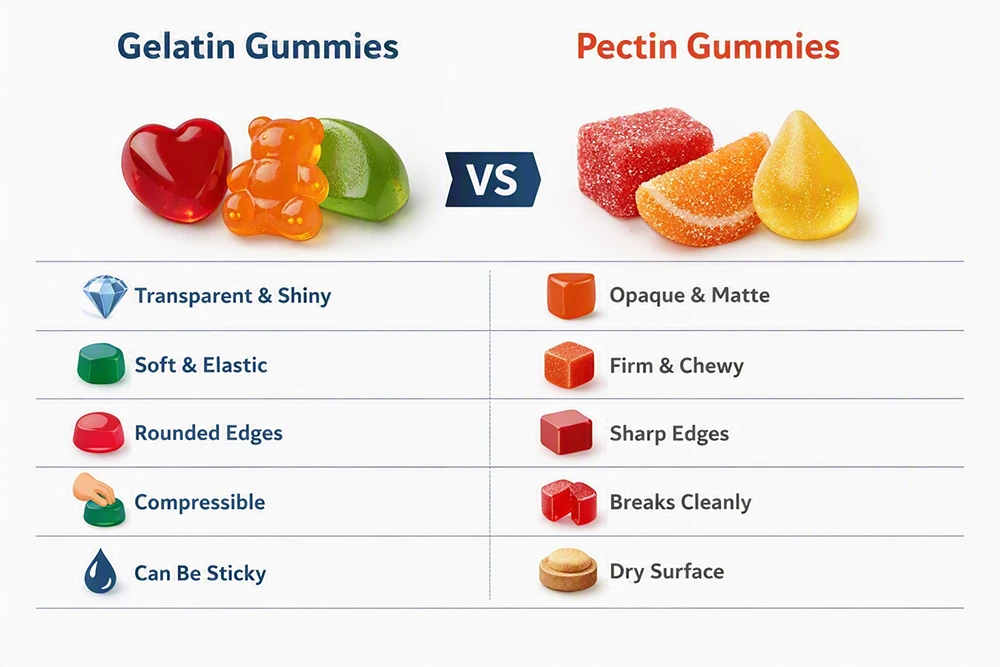
Pre-workout gummy production relies on natural gelling agents such as pectin, carrageenan, or gelatin. Each choice impacts:
- Pectin: Vegan-friendly, clean label appeal; requires precise pH and sugar balance
- Gelatin: Cost-effective, established performance; not suitable for vegan formulations
- Carrageenan: Vegan alternative; sensitive to ingredient interactions
Manufacturers must select gelling agents compatible with active ingredients while maintaining texture, shelf stability, and taste.
Ingredient Solubility & Bioavailability
Unlike powders or capsules, gummy matrices require complete or partial dissolution of active ingredients during manufacturing. Some pre-workout compounds (beta-alanine, citrulline) are highly soluble in water, simplifying processing. Others require solubilization techniques such as spray drying, micronization, or microencapsulation to ensure uniform distribution and prevent settling or clumping during production.
Technical Parameter Table: Pre-Workout Gummy Manufacturing Specifications
| Manufacturing Aspect | Standard Parameters & Considerations |
|---|---|
| Product Form & Format | Chewable gummy; standard shapes include cubes, bears, worms, rings; typical weight 2–5 grams per gummy; 20–40 gummies per serving container |
| Core Active Ingredients | Caffeine (50–150 mg), Beta-Alanine (500–1000 mg), Citrulline Malate (1500–3000 mg), BCAAs (1500–2500 mg), Taurine (500–1000 mg), L-Arginine (500–1000 mg), plus supporting vitamins (B-complex) |
| Gelling Agents | Pectin (6–8% w/w), Gelatin (4–6% w/w), or Carrageenan (3–5% w/w); natural gelling agents with no artificial thickeners |
| Sweeteners & Flavor | Glucose syrup, sugar, or sugar-free alternatives (stevia, erythritol, sorbitol); natural or artificial flavorings; typical formulation 40–55% sugars |
| Manufacturing Process | Wet granulation or dry blending → liquid syrup preparation → active ingredient addition → mold injection/depositing → cooling/setting (6–24 hours) → demolding → coating application (optional) → packaging |
| Production Capacity | Small-scale: 100–500 kg/batch; Medium-scale: 1–5 tons/batch; Large-scale: 10–50+ tons/month; Lead time typically 15–30 days post-order confirmation |
| Quality Standards & Certifications | GMP (Good Manufacturing Practice), ISO 9001 (Quality Management), ISO 22000 (Food Safety), HACCP (Hazard Analysis), FDA compliance (U.S.), Health Canada compliance (Canada), FSMA (Food Safety Modernization Act) |
| Third-Party Testing | Microbial testing (aerobic plate count, pathogens), heavy metals analysis (lead, cadmium, arsenic), pesticide residue screening, ingredient identity verification, potency assays (HPLC), stability testing (shelf life) |
| Packaging Options | HDPE bottles (60–150 count), PET bottles, aluminum-foil pouches, blister packs, doypack/resealable pouches; child-resistant caps where required; moisture-barrier packaging essential for stability |
| Coating & Protection | Optional wax or gum-arabic coating to prevent sticking; dust coating with maltodextrin or tapioca starch; UV-protective packaging for sensitive ingredients like caffeine |
| Shelf Life & Storage | Typical shelf life 18–24 months at room temperature (20–25°C, <60% RH); stability dependent on active ingredient choice and packaging barrier properties; refrigeration not required but cool/dry environment recommended |
| Regulatory Documentation | Certificate of Analysis (CoA), Safety Data Sheets (SDS) for raw materials, finished product batch records, stability test reports, third-party testing documentation, label compliance verification per region |
| Scalability & Customization | Flexible MOQ (Minimum Order Quantity) from 10–100 kg trial batches to full container loads (20+ tons); custom formulations, shapes, colors, and flavors available; private label & white-label options |
| Logistics & Lead Time | Sample development: 2–4 weeks; First production run: 4–8 weeks; Repeat orders: 3–4 weeks; Shipping: Ocean freight (20–40 days), air freight (5–7 days); ESL (Express Service Lead) available for urgent orders |
Step-by-Step Pre-Workout Gummy Manufacturing Process
Stage 1: Formulation & Sample Development
Manufacturers begin by formulating the gummy matrix based on your target active ingredient levels and taste preferences. This stage involves:
- Ingredient compatibility testing to ensure no chemical reactions or degradation
- Stability trials to predict shelf life under accelerated conditions
- Taste panel testing and flavor optimization
- Texture and firmness adjustment to match consumer preferences
Stage 2: Active Ingredient Preparation
Pre-workout actives (caffeine, beta-alanine, BCAAs) must be pre-processed to ensure uniform distribution across thousands of gummies. Depending on the ingredient:
- Soluble ingredients are dissolved directly into the syrup phase
- Poorly soluble ingredients undergo spray drying, micronization, or emulsification
- Heat-sensitive compounds (certain vitamins) are added post-cooking at lower temperatures
- Precise weighing and batch calculation ensures accurate dosing
Stage 3: Syrup Preparation
The gelling agent, sweeteners, and soluble actives are combined in large mixing vessels at controlled temperatures (typically 60–75°C). This stage requires:
- Careful heating to dissolve pectin or gelatin while preserving heat-sensitive nutrients
- Precise pH adjustment to ensure proper gel formation
- Removal of air bubbles through vacuum degassing to prevent defects
Stage 4: Mold Casting or Depositing
Gummy Casting (Traditional Method): Heated syrup is poured into starch molds. Molds are left to set for 12–24 hours at controlled humidity before demolding. This method allows custom shapes and is suitable for smaller batches.
Continuous Depositing (Industrial Method): Automated machines deposit controlled portions of syrup onto conveyor belts in rows. This method enables high-speed production (thousands per hour) and is standard in large-scale facilities.
Stage 5: Cooling & Setting
Gummies must cure at controlled temperature and humidity. Inadequate cooling results in sticky gummies; excessive cooling can cause brittleness. Typical conditions: 18–22°C, 50–65% relative humidity.
Stage 6: Demolding & Drying
Cured gummies are removed from molds and briefly air-dried or tumble-dried to remove surface moisture and prevent sticking. Drying time typically 2–6 hours depending on facility conditions.
Stage 7: Coating & Finishing
Optional dust coating (maltodextrin, tapioca starch) prevents gummies from sticking and provides a dry mouthfeel. Wax or gum-arabic coating may be applied for extended shelf life.
Stage 8: Packaging & Quality Control
Finished gummies are counted, weighed, and packaged in moisture-barrier containers. Final quality checks include:
- Visual inspection for color uniformity, size consistency, defects
- Weight verification per container
- Microbial and chemical testing per regulatory requirements
- Label accuracy and regulatory compliance verification
B2B Practical Insights: Manufacturing Quality & Supply Chain Considerations
Quality Consistency & Process Control
Gummy manufacturing demands strict process controls to ensure batch-to-batch consistency. Variables that impact quality include:
- Raw material variability: Natural gelling agents (pectin) vary by source. Suppliers must specify botanical origin and standardize extract potency.
- Temperature control: ±2°C variance in cooking temperature can affect gel strength and set time. Reliable equipment and trained operators are critical.
- Humidity management: Gummy texture is highly sensitive to ambient humidity. Facilities must maintain precise climate control (±5% RH tolerance).
- Active ingredient distribution: Uneven ingredient distribution creates “hot spots” (excessive caffeine in some gummies) and “weak spots” (insufficient dosage in others), damaging brand reputation and regulatory compliance.
Raw Material Sourcing & Transparency
Pre-workout gummies require high-purity, tested active ingredients. When evaluating manufacturers, assess:
- Supplier certifications: Do raw material suppliers hold ISO, GMP, or FSSC certifications?
- Ingredient traceability: Can the manufacturer trace each raw material batch to its botanical or chemical origin?
- Third-party testing: Are incoming materials tested for identity, purity, and contaminant levels?
- Documentation: Request Certificates of Analysis (CoA) for all active ingredients and excipients.
Production Scalability & Lead Time Management
Brands must understand how quickly manufacturers can scale production and adjust capacity for demand fluctuations:
- Minimum Order Quantity (MOQ): Reliable manufacturers offer flexible MOQs, from trial batches (10–50 kg) to full production runs (5–50 tons). Avoid manufacturers with excessively rigid MOQ requirements.
- Lead time predictability: Established manufacturers maintain consistent lead times (3–4 weeks for repeat orders). Delays indicate capacity constraints or operational inefficiencies.
- Capacity reserves: Does the manufacturer maintain production headroom to accommodate rush orders without compromising quality?
Regulatory Compliance & Documentation Readiness
Pre-workout gummies fall under dietary supplement regulations in most markets. Manufacturers must provide:
- FDA compliance: Finished product meets 21 CFR Part 111 (GMP for dietary supplements). Facility registered with FDA. Structures/function claims substantiated per FDASIA.
- Health Canada compliance: Products meet Natural and Non-prescription Health Products Directorate (NNHPD) requirements. License obtained or notification of preparation sent.
- EU compliance: Products comply with EC Regulation 1925/2006 (fortified foods). Food labeling per EC Regulation 1169/2011.
- Stability testing: Manufacturers must conduct real-time and accelerated stability studies to substantiate shelf life claims (typically 18–24 months).
Cost Structure & Pricing Transparency
Pre-workout gummy pricing typically ranges from $2–6 per unit for bulk orders (per individual gummy), depending on:
- Active ingredient cost: Caffeine and beta-alanine are relatively inexpensive; proprietary complexes or branded ingredients (e.g., Nitrosigine) increase costs significantly.
- Gelling agent choice: Pectin and carrageenan are costlier than gelatin but offer vegan appeal and market differentiation.
- Order volume: Larger orders (20+ tons) command 15–30% volume discounts.
- Customization: Custom flavors, colors, or shapes incur tooling fees ($500–2,000 per design).
- Packaging: Premium packaging (blister packs, resealable pouches) adds $0.20–0.50 per unit vs. standard bottles.
Request detailed cost breakdowns: raw materials, labor, packaging, testing, and overhead. Transparent pricing indicates a reliable supplier.
B2B Decision Guide: How to Select a Pre-Workout Gummy Manufacturer
1. Assess Manufacturing Capacity & Infrastructure
- Facility size: GMP-certified manufacturing floor with cleanroom standards (100,000-class or better). Visit the facility or request virtual tours before committing.
- Equipment: Modern depositing or casting equipment, climate-controlled setting rooms, quality control lab with testing capability (HPLC, microbial analysis).
- Batch capacity: Daily or monthly output should match your projected demand. Request production calendars to ensure no bottlenecks.
2. Evaluate Formulation & R&D Capabilities
- Scientific team: Manufacturers with PhD-level chemists or food scientists offer superior formulation expertise. Request proof of published research or patents.
- Formulation flexibility: Can they develop custom ingredient blends, adjust dosages, accommodate vegan or allergen-free requirements?
- Stability support: Do they conduct in-house stability testing or outsource to third-party labs? Request sample reports.
3. Verify Quality Assurance & Testing Protocols
- Certifications: ISO 9001, ISO 22000, HACCP, GMP, FDA registration. Confirm certificates are current (not expired).
- Testing scope: Request their testing menu: microbial (E. coli, Listeria, Salmonella), heavy metals, potency assays, stability studies, allergen screening.
- Third-party audits: Have they undergone independent FDA, FSSC, or NSF audits? Request audit reports (non-confidential sections).
4. Confirm Regulatory Expertise & Documentation
- Market knowledge: Do they understand your target market’s regulations (U.S., Canada, EU, Australia)? Request examples of compliance documentation for similar products.
- Label support: Can they review ingredient lists, supplement facts labels, and marketing claims for regulatory compliance?
- Registration assistance: For regulated markets (Health Canada, EU), do they guide you through registration or notification processes?
5. Assess Cost Competitiveness & Transparency
- Quotation detail: Request itemized quotes including raw materials, labor, packaging, testing, overhead, and profit margin. Red flag: vague pricing with no breakdown.
- Volume-based pricing: Confirm discounts for larger orders (5 tons, 10 tons, 20+ tons).
- Hidden costs: Clarify whether samples, stability testing, regulatory consulting, or expedited shipping incur additional fees.
6. Evaluate Supply Chain Resilience
- Raw material suppliers: Do they source from multiple certified suppliers? What happens if a supplier faces disruption?
- Backup capacity: Can they ramp production in competitor facilities if their primary line experiences downtime?
- Lead time predictability: Request historical data on on-time delivery rates for past projects.
7. Assess Long-Term Partnership Viability
- Reference checks: Request contact information for 3–5 existing clients (preferably similar product types). Ask about quality consistency, responsiveness, problem-solving.
- Communication: Are they responsive to inquiries? Do they provide regular batch updates and quality reports?
- Innovation support: Are they willing to collaborate on product improvements, new formulations, or market-specific adaptations?
8. Establish Clear Contractual Terms
- Quality standards: Define specifications (weight tolerance ±5%, moisture <3%, potency ±10%).
- Batch records: Require complete batch documentation, CoA, and SDS for all materials.
- Liability & recall procedures: Clarify manufacturer responsibility for defects, contamination, or regulatory violations.
- Intellectual property: Confirm that custom formulations remain your proprietary information.
Risk Control & Quality Assurance Checkpoints
Pre-Production
- Ingredient pre-approval: Provide approved raw material suppliers. Request split batches or secondary sourcing if available.
- Sample approval: Thoroughly test pilot batches (taste, texture, potency, stability) before committing to full production.
- Specifications document: Create a detailed technical specification sheet covering weight, moisture, potency, microbial limits, and defect tolerance.
During Production
- In-process audits: Request photos or videos of gummy casting, cooling, and packaging stages.
- Batch sampling: Require in-process checks at key stages (after cooking, post-cooling, pre-packaging).
- Process deviations: Establish a protocol for handling unexpected issues (temperature excursions, humidity spikes) with manufacturer accountability.
Post-Production
- Certificate of Analysis: Request complete CoA covering microbial testing, potency assays (HPLC), heavy metals, and moisture.
- Stability reports: Request 3-month, 6-month, and 9-month stability data if shelf life claims exceed 18 months.
- Retained samples: Request manufacturer retain reference samples for 2+ years to enable traceability if issues arise post-launch.
Key Regulatory & Compliance Considerations
Ingredient-Specific Concerns
Caffeine: Limits vary by market. U.S. dietary supplements typically cap at 100 mg per serving; Canada allows up to 200 mg with specific labeling. High-caffeine products require consumer warnings regarding safety in sensitive populations.
Beta-Alanine: Generally recognized as safe (GRAS) in the U.S. but may trigger paresthesia (tingling sensation) at high doses. Labeling should disclose this side effect transparently.
Citrulline Malate: Not a GRAS ingredient in all regulatory frameworks. Verify approval status in your target market before incorporating.
Proprietary Blends vs. Transparent Labels: The U.S. industry trend is shifting from proprietary blends (non-disclosed ingredient ratios) toward transparent labels listing each ingredient and dose. Transparent labeling builds consumer trust and simplifies regulatory compliance.
Prohibited or Restricted Ingredients
Avoid ingredients that are banned or restricted in your target markets. Examples:
- DMAA (Dimethylamylamine) – Banned by FDA (2013)
- Ephedrine alkaloids – Banned by FDA
- Certain synthetic stimulants (e.g., synephrine isolated from Citrus aurantium in high doses) – Restricted in some markets
Label Compliance Requirements
Pre-workout gummy labels must include:
- Supplement Facts panel (U.S.) with serving size, ingredient list, amounts per serving
- Warning statements for allergens, sensitivity risks, or contraindicated populations
- Structures/function claims only (no disease claims). Example: “supports muscle endurance” (compliant) vs. “treats muscle fatigue” (non-compliant)
- Manufacturer name, address, and lot/batch code for traceability
Pre-Workout Gummies: Comparison with Competing Formats
Cost Per Serving
| Format | Approximate Cost Per Serving (Bulk Production) | Retail Price Range |
|---|---|---|
| Pre-Workout Powder | $0.40–$0.80 | $0.80–$1.50/serving |
| Pre-Workout Capsules | $0.60–$1.20 | $1.00–$2.00/serving |
| Pre-Workout Gummies | $0.80–$1.50 | $1.50–$3.00/serving |
| Ready-to-Drink Beverages | $1.00–$2.00 | $2.00–$4.00 |
Key insight: Pre-workout gummies command the highest retail markup among solid formats (2–3x manufacturing cost), making them attractive for brands seeking higher margins. However, higher manufacturing complexity and ingredient costs offset cost advantages vs. powders.
Marketing & Consumer Positioning Considerations
When launching pre-workout gummies, brands should position them for:
- Convenience-focused consumers: Emphasize no-mixing, portable, quick-consuming benefits
- Taste-averse audiences: Highlight flavor options and taste superiority over powders
- Younger demographics: Leverage social media to highlight trendy formulations, flavors, and easy consumption
- Busy athletes/fitness enthusiasts: Market as “grab-and-go” pre-workout solution for gym, work, or travel
Important compliance reminder: All marketing claims must be substantiated and comply with FTC guidelines. Avoid unsubstantiated performance claims or comparisons to pharmaceutical products.
Conclusion
Pre-workout gummies represent a rapidly growing, high-margin segment within the sports nutrition market. However, manufacturing them successfully requires careful attention to formulation science, ingredient sourcing, process control, regulatory compliance, and supply chain management. Brands and distributors evaluating gummy contract manufacturing options must assess manufacturers based on GMP certification, R&D capabilities, quality testing protocols, regulatory expertise, and long-term partnership viability.
The right custom gummy manufacturer provides more than production capacity—they offer formulation innovation, regulatory guidance, scalability, and quality assurance that directly impact product success. By understanding the technical, regulatory, and commercial considerations outlined in this guide, brands can make informed decisions when sourcing or producing pre-workout gummies that meet market demand while maintaining profitability and compliance.
Success in the pre-workout gummy category depends on three core factors: (1) differentiated, effective formulations; (2) consistent, high-quality manufacturing; and (3) transparent, compliant marketing. Manufacturers who excel across all three dimensions become trusted long-term partners that drive brand growth and market leadership.
Frequently Asked Questions (FAQ)
Q: What is pre-workout gummies and why are they different from other supplement formats?A: Pre-workout gummies are chewable dietary supplements formulated with energy-boosting and endurance-enhancing ingredients (caffeine, beta-alanine, BCAAs, citrulline malate). Unlike powders requiring mixing or capsules requiring water, gummies offer convenience, no mixing, precise portion control, improved taste, and faster sublingual absorption due to chewing. They appeal to fitness enthusiasts seeking quick, portable energy before training.
Q: Why should manufacturers focus on pre-workout gummies for their supplement business?A: Pre-workout gummies command 2–3x higher retail prices compared to powders due to convenience and palatability, enabling brands to achieve 40–60% gross margins. Market demand is growing rapidly, particularly among younger consumers (Gen Z, millennials) favoring gummy supplements. The category offers differentiation through custom flavors, shapes, and formulations, supporting premium positioning and repeat purchases.
Q: How do pre-workout gummies compare to pre-workout powders in terms of cost and effectiveness?A: Pre-workout powders cost 40–60% less to manufacture per serving ($0.40–$0.80 vs. $0.80–$1.50 for gummies) and offer maximum flexibility in serving size adjustment. However, gummies retail at 2–3x the powder price, justifying the premium through convenience and taste. Efficacy is equivalent if formulated with identical active ingredient doses; gummy format may provide slightly faster absorption due to chewing and sublingual contact.
Q: What quality standards and certifications should brands verify before choosing a pre-workout gummy manufacturer?A: Essential certifications include GMP (Good Manufacturing Practice), ISO 9001 (Quality Management), ISO 22000 (Food Safety), HACCP, and FDA facility registration (U.S.). Manufacturers should provide third-party testing capabilities covering microbial analysis, heavy metals, potency assays (HPLC), and stability studies. Request audits from NSF, FSSC, or independent FDA inspections as evidence of compliance rigor.
Q: What lead time and minimum order quantities should brands expect when sourcing pre-workout gummies?A: Reliable manufacturers offer flexible MOQs starting from 10–50 kg for trial batches up to full-scale production runs (20+ tons). Sample development typically requires 2–4 weeks; first production runs 4–8 weeks; repeat orders 3–4 weeks. Lead times depend on customization complexity, ingredient sourcing, and testing requirements. Request historical on-time delivery data before committing.
Q: What regulatory compliance considerations are critical for pre-workout gummies in different markets?A: U.S. products must comply with 21 CFR Part 111 (GMP), FDA dietary supplement regulations, and FTC labeling standards. Canada requires Health Canada notification/licensing and compliance with Natural and Non-prescription Health Products Directorate (NNHPD) standards. EU products must meet EC Regulation 1925/2006 and 1169/2011. Caffeine limits, ingredient restrictions (e.g., DMAA banned), and label claims vary significantly by region. Always consult regulatory experts for your target market.
About Shenzhen Gothink Biotech Co., Ltd.
Shenzhen Gothink Biotech is a leading gummy contract manufacturing partner and private label gummy manufacturer specializing in custom gummy manufacturing for the global nutrition and dietary supplement industry. With a GMP-certified facility featuring a 100,000-class cleanroom, advanced formulation laboratory, and annual production capacity of 5,000+ tons, Gothink Biotech provides end-to-end services including custom formulation development, raw material sourcing, multi-format manufacturing (gummies, capsules, tablets, powders, liquids), packaging, and regulatory support.
Led by a scientific team with postdoctoral research experience from prestigious U.S. institutions (California Institute of Technology, Emory University, Ohio State University), Gothink Biotech combines world-class R&D capabilities with manufacturing scale. The company holds ISO 9001, ISO 22000, HACCP, FDA, GMP, KOSHER, and HALAL certifications, ensuring world-class quality and compliance across multiple global markets. Whether brands require small-batch trials, private label gummy solutions, or large-scale bulk manufacturing, Gothink Biotech delivers reliable, scalable, and innovative supplement solutions that drive long-term brand growth and market success.