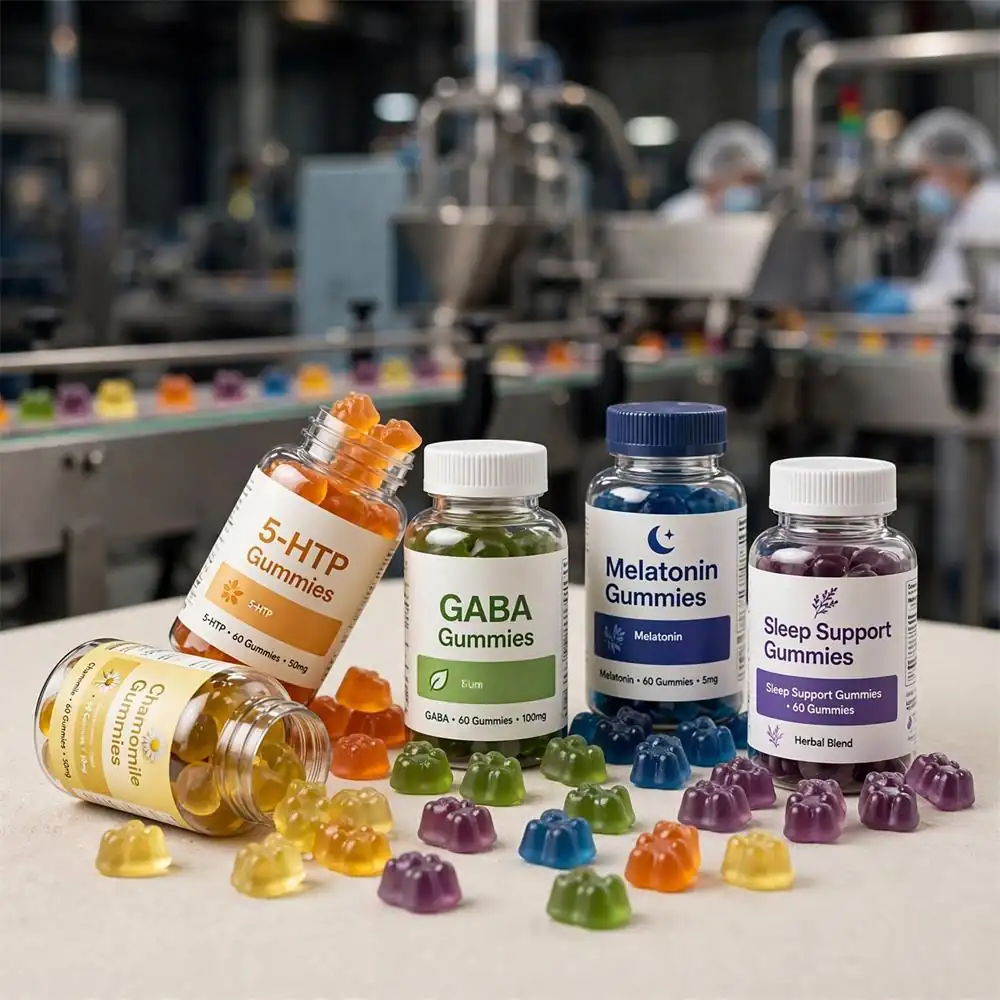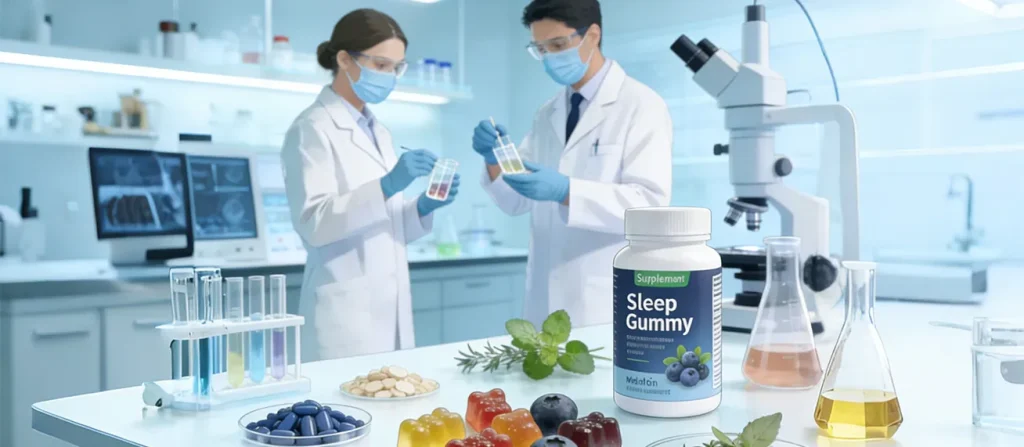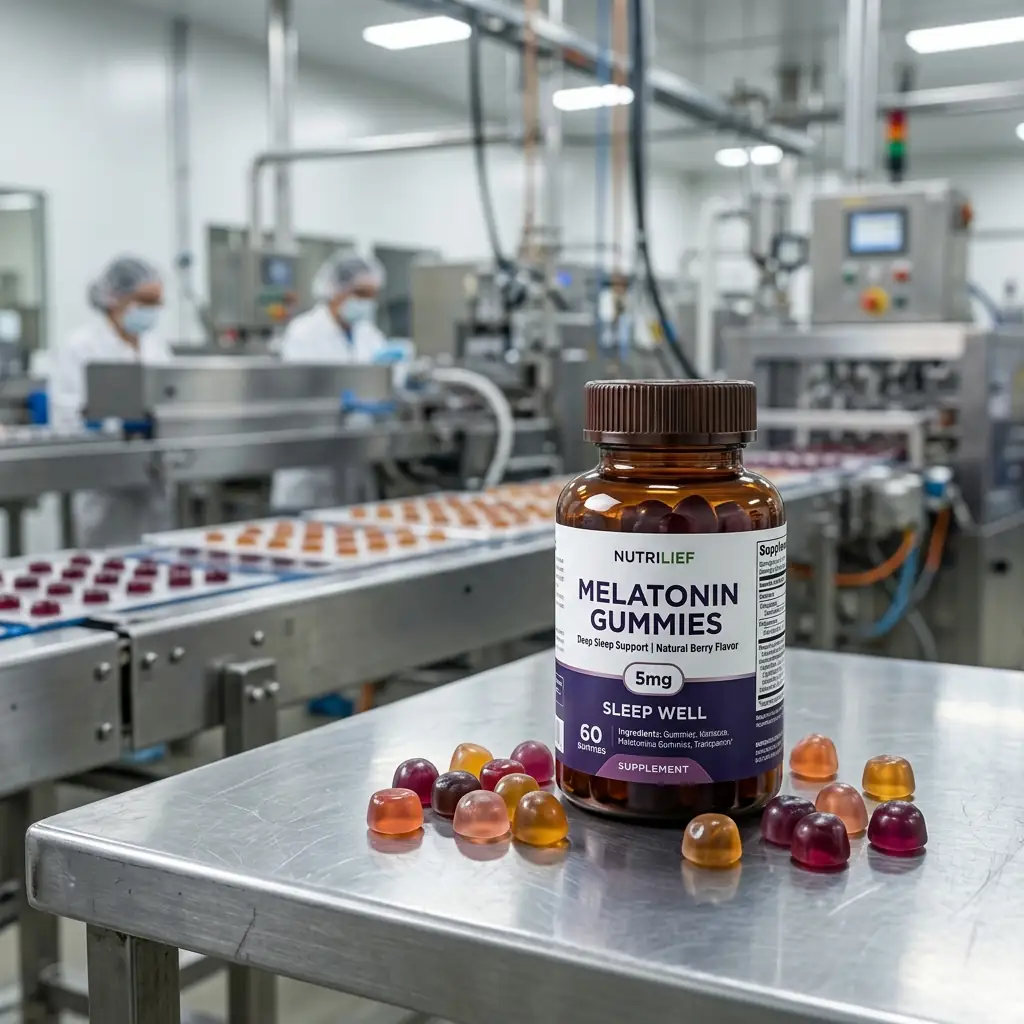

Understanding the science and process behind gummy supplement production, from formulation to finished product
What Gummy Candies Are: Definition and Core Characteristics
Gummy products have evolved significantly since their introduction in the early 20th century. What began as simple confectionery items has transformed into a sophisticated delivery system for nutritional and pharmaceutical compounds. Today’s gummy supplements represent a convergence of food science, nutrition, and manufacturing innovation.
Why Gummies Dominate the Supplement Market
Gummies offer multiple advantages over traditional supplement forms:
- Ease of consumption: No water required; pleasant taste masks medicinal flavors
- Better compliance: Consumer preference increases repeat usage and brand loyalty</
- Flexible active ingredients: Can incorporate vitamins, minerals, herbal extracts, probiotics, and functional compounds
- Extended shelf life: Proper formulation and packaging enable 2-3 year stability
- Premium positioning: Allows higher price points compared to tablets or powders
The Gummy Manufacturing Process: Step-by-Step Overview
Manufacturing gummy supplements or candies involves a complex series of precisely controlled steps. The entire process—from raw material preparation to final packaging—typically takes 3-5 weeks for custom gummy manufacturers developing new formulations.
Stage 1: Formulation Development and Raw Material Selection
Professional custom gummy manufacturers begin with comprehensive formulation design. This involves selecting the precise combination of gelling agents, sweeteners, flavoring compounds, and active ingredients that will deliver the desired nutritional or functional benefits.
Gelling Agents: The foundation of any gummy formulation. The most common options include:
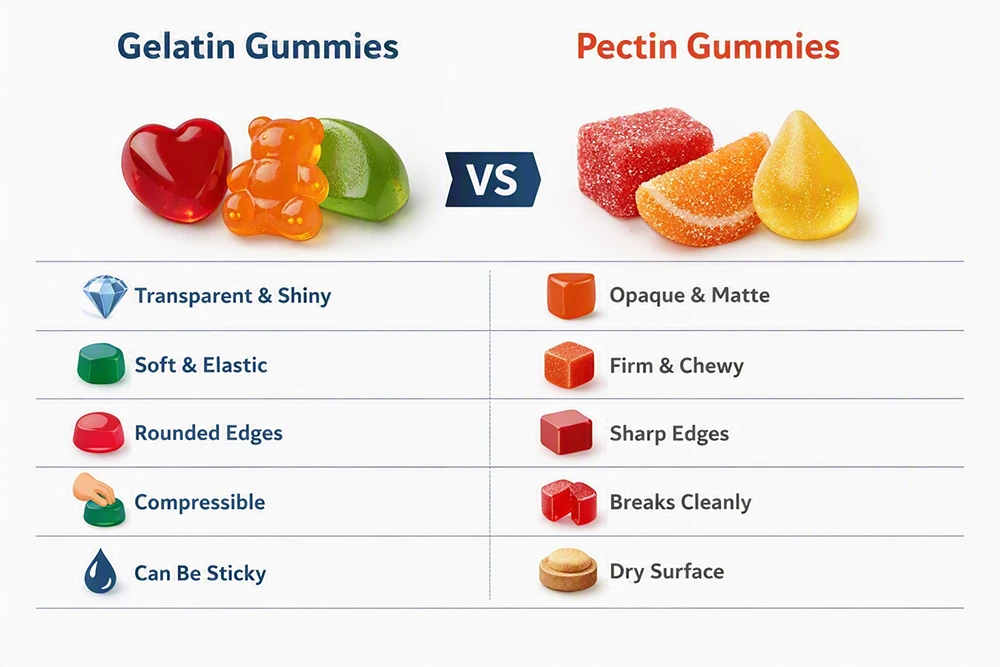
- Gelatin (traditional): Animal-derived protein providing firm texture; not suitable for vegan/vegetarian products
- Pectin (plant-based): Extracted from fruit; creates gummies with different mouthfeel; often preferred for vegetarian formulations
- Carrageenan: Marine polysaccharide offering excellent stability and gel strength
- Starch (modified): Cost-effective option for texture variation; often used in hybrid formulations
- Agar-agar: Premium vegan option derived from seaweed; requires precise temperature control
Sweetening System: Modern formulations balance taste with health-conscious consumer expectations. High-quality manufacturers use:
- Sugar (for traditional taste profiles)
- Sugar alcohols (sorbitol, maltitol, xylitol) for reduced-calorie products
- Stevia or monk fruit extract for zero-calorie alternatives
- Isomaltulose for lower glycemic index formulations
Active Ingredients: The functional components that define the product’s health benefits. Selection depends on product category:
- Vitamins and minerals (B-complex, Vitamin D, calcium, zinc)
- Herbal extracts (ashwagandha, echinacea, turmeric)
- Probiotics and prebiotics
- Amino acids and peptides
- Specialized compounds (collagen, CoQ10, omega-3 derivatives)
Stage 2: Cooking and Syrup Preparation
During this critical phase, the mixture must reach specific viscosity targets—measured in centipoise (cp)—to ensure optimal molding. Most gummy manufacturing operations maintain syrup viscosity between 400-600 cp at processing temperature. Too thin, and the mixture won’t hold shape; too thick, and it won’t fill molds properly.
Stage 3: Molding and Shaping
Starch Mold Process: The traditional and still widely-used method for high-volume production:
- Food-grade starch in shallow trays receives precise impressions from mold rollers
- Hot syrup is injected into cavities at exact doses (measured to ±5% variance)
- Molds are left undisturbed for 12-24 hours to allow gelling
- Demolding removes finished gummies; remaining starch is sieved for reuse
Silicone/Hard Mold Process: Gaining popularity for premium and specialty products:
- Reusable molds eliminate starch residue—critical for certain active ingredients
- Faster cycle times (4-8 hours vs. 12-24 hours)
- Superior shape consistency and sharper details
- Higher equipment costs but lower consumable expenses
Stage 4: Drying and Moisture Removal
Improper drying causes blooming (sugar crystallization on surface), microbial growth, or structural degradation. Professional gummy manufacturers employ hygrometer-controlled drying chambers that adjust humidity dynamically to achieve final moisture content of 8-12%—the optimal range for shelf stability and consumer experience.
Stage 5: Coating and Surface Treatment
- Sugar coating: Traditional approach; adds approximately 5-10% weight
- Wax coating: Reduces tackiness; extends shelf life
- Sour coating: Citric acid and sugar for tart flavor profile
- Vitamin coating: Additional micronutrients (vitamin C, B-complex) applied to surface
- No coating: Clean-label products gaining market share
Stage 6: Quality Control Testing
Physical Testing:
- Weight variance (USP standard: ±7.5%)
- Hardness and texture analysis using texture analyzers
- Shape and dimensional consistency
- Color uniformity and appearance
Chemical Analysis:
- Active ingredient potency verification via HPLC
- Moisture content (Karl Fischer titration)
- pH measurement
- Dissolution testing (in vitro bioavailability)
Microbiological Testing:
- Total aerobic bacterial count
- Yeast and mold presence
- Pathogenic organism screening (E. coli, Salmonella)
Stage 7: Packaging and Distribution
Technical Parameters and Production Specifications
The following table details critical technical parameters that professional custom gummy manufacturers monitor and control during production:
| Production Parameter | Typical Range | Impact on Quality | Measurement Method |
|---|---|---|---|
| Cooking Temperature | 50-70°C | Affects gel formation rate and ingredient stability | Digital thermometer/RTD probe |
| Syrup Viscosity | 400-600 cP | Controls molding precision and cavity fill rate | Rotational viscometer |
| Final Moisture Content | 8-12% | Directly impacts shelf-life and texture | Karl Fischer titration / Moisture analyzer |
| Drying Temperature | 18-22°C | Prevents ingredient degradation and blooming | Digital climate control system |
| Drying Humidity | 40-55% RH | Prevents blooming and microbial growth | Hygrometer / Environmental monitor |
| Individual Gummy Weight | ±7.5% variance | Ensures consistent dosage per unit | Precision scale (±0.1g accuracy) |
| Gummy Hardness | 20-60 Shore A | Affects consumer experience and texture | Texture analyzer / Durometer |
| Active Ingredient Potency | 95-105% label claim | Regulatory compliance and consumer efficacy | HPLC analysis |
Quality Assurance and Regulatory Compliance
Global Quality Standards in Gummy Manufacturing
Professional gummy supplement manufacturers operate under multiple quality frameworks:
GMP (Good Manufacturing Practice): The foundational requirement for all dietary supplement manufacturers. GMP standards mandate:
- Documented procedures for every production step
- Validated equipment and analytical methods
- Environmental monitoring (cleanroom classification 100,000 or higher)
- Comprehensive traceability from raw material to finished product
- Regular auditing and deviation investigation protocols
ISO 22000 (Food Safety Management): Increasingly required for supplement manufacturers, ensuring:
- Hazard analysis at each production stage
- Preventive controls for biological, chemical, and physical contaminants
- Supplier qualification and verification
- Traceability and recall procedures
Third-Party Testing: Many gummy manufacturers employ independent laboratories for verification of:
- Heavy metal content (lead, cadmium, arsenic, mercury)
- Microbial contamination
- Pesticide residues
- Allergen cross-contamination
Considerations for Scaling Production: From Prototype to Mass Production
Minimum Order Quantities (MOQ) and Production Economics
Understanding production economics is critical for anyone considering private label gummy development. The relationship between volume and per-unit costs is significant:
Small Batch Production (1,000-10,000 units): Ideal for market testing and brand validation. Cost per unit typically ranges from $0.35-$0.60, with longer production timelines (6-8 weeks including setup).
Medium Volume (50,000-250,000 units): Optimal for established brands and emerging retailers. Cost per unit drops to $0.15-$0.35, with production timelines of 3-4 weeks.
High Volume (1,000,000+ units): Required for major retail partnerships. Cost per unit reaches $0.08-$0.18, with dedicated production runs and 2-3 week timelines.
Customization Considerations for Private Label Production
Working with a private label gummy manufacturer offers flexibility but requires strategic planning:
- Formulation complexity: Custom active ingredient combinations may require additional R&D investment ($5,000-$30,000)
- Mold investment: Custom shapes require dedicated molds costing $3,000-$15,000 per mold design
- Packaging customization: Branded bottles, labels, and inserts add 8-12 weeks to timeline
- Regulatory pre-approval: Structure-function claims must be substantiated before production launch
Cost Structure Analysis for Gummy Manufacturing
The economics of gummy manufacturing break down across several cost categories:
Raw Materials (typically 20-30% of total cost):
- Gelling agents: $2-8 per kilogram (gelatin) to $8-15 per kilogram (premium pectin)
- Active ingredients: Highly variable ($10-200+ per kilogram) depending on sourcing and purity
- Sweeteners and flavorings: $3-12 per kilogram
Manufacturing and Processing (typically 30-40% of total cost):
- Direct labor
- Equipment depreciation and maintenance
- Utilities (temperature control is energy-intensive)
- Quality control testing
Packaging (typically 15-25% of total cost):
- Bottles or pouches
- Labels and printing
- Inserts and literature
- Shipping containers
Overhead and Compliance (typically 15-20% of total cost):
- Regulatory compliance and documentation
- Quality assurance and testing
- Administrative costs
B2B Decision Framework: Selecting a Gummy Manufacturer
For brands, retailers, or entrepreneurs considering gummy contract manufacturing, the selection process involves evaluating multiple criteria:
Critical Evaluation Checklist
- GMP Certification and Facility Audit: Verify current FDA inspection history and facility compliance scores. Request recent audit reports or conduct facility tours.
- Formulation Expertise: Assess R&D team qualifications, published research, and ability to work with specialized ingredients (probiotics, protein, delicate botanicals).
- Technical Capacity: Confirm equipment specifications, production volume capabilities, and facility scalability for future growth.
- Quality System Maturity: Review SOP documentation, testing protocols, and deviation investigation procedures. Modern manufacturers should employ HPLC, dissolution testing, and environmental monitoring.
- Supply Chain Stability: Evaluate raw material sourcing, supplier relationships, and contingency plans for supply disruptions.
- Regulatory Knowledge: Confirm manufacturer understands FDA structure-function claim substantiation, labeling requirements, and international compliance (EU, Canada, Australia).
- Customization Flexibility: Assess ability to modify formulations, create custom molds, and accommodate smaller MOQs for testing.
- Timeline and Delivery Performance: Request references and verify on-time delivery rates. Production delays cascade through supply chains.
- Cost Transparency: Ensure pricing is clearly itemized (raw materials, processing, quality testing, packaging) rather than bundled figures that hide inefficiencies.
- Post-Launch Support: Confirm availability of technical support, stability data generation, and troubleshooting assistance after product launch.
Questions to Ask Potential Manufacturers
Technical Depth: “Walk me through your process for validating a new formulation. What documentation do you provide?”
Quality Commitment: “What are your typical pass rates on first-batch quality tests? What percentage of batches require rework?”
Scalability: “If I launch with 100,000 units and need 500,000 units within 12 months, can you accommodate that growth without quality degradation?”
Regulatory Risk: “Have you ever received FDA warning letters? What was the issue and how did you address it?”
Reference Verification: “Can you provide contact information for 3-5 comparable brand partners? I’d like to understand their experience with you.”
Industry Trends and Innovation in Gummy Manufacturing
Emerging Technologies and Formulation Innovations
The gummy supplement industry continues to evolve with technological advancement:
Microencapsulation Technology: Advanced delivery systems that protect sensitive ingredients (probiotics, omega-3s, certain vitamins) from degradation during manufacturing and storage. Increases cost by 15-25% but enables inclusion of previously impossible active compounds.
Precision Nutrition and Personalization: Some manufacturers now offer customized formulations based on individual health data, opening premium market segments.
Sustainable and Alternative Gelling Agents: Movement toward plant-based gelling solutions (pea protein-based, algae-derived) responding to clean-label and vegan consumer preferences.
Advanced Form Factors: Beyond traditional bears and circles—hexagons, liquids in gummy format, and compressed-powder gummies expand market appeal.
Functional Optimization: Manufacturers increasingly partner with nutrition scientists to validate bioavailability, optimize dosing, and create products with clinically-supported efficacy claims.
Frequently Asked Questions About Gummy Manufacturing
OEM (Original Equipment Manufacturing): You provide the formulation; the manufacturer produces it under your specification and brand.
ODM (Original Design Manufacturing): The manufacturer develops the formulation, handles all design, and you affix your label—minimal customization required.
Private Label: The manufacturer uses an existing, off-the-shelf formulation and applies your branding. Most cost-effective and fastest to market, but limited differentiation.
Most brands use hybrid approaches: ODM formulation (faster market entry) transitioning to OEM customization (differentiation) as volumes grow.
Partner with a Leading Gummy Supplement Manufacturer
Bringing your supplement vision to market requires more than manufacturing capability—it demands deep expertise, uncompromising quality standards, and partnership-oriented service.
World-Class Gummy Contract Manufacturing Services
Our facility represents the pinnacle of gummy manufacturing technology and expertise. With over a decade of combined experience from postdoctoral researchers trained at leading U.S. institutions, we combine rigorous scientific methodology with production excellence.
Comprehensive Manufacturing Capabilities
✓ Advanced OEM/ODM ServicesFrom concept formulation through production scale-up, we handle every aspect of custom gummy manufacturing with precision and expertise.
✓ Private Label Gummy SolutionsRapidly market-ready private label gummy products with customized branding, minimal MOQs, and complete compliance support.
✓ Premium Formulation DevelopmentOur 10,000-class pharmaceutical-grade R&D laboratory develops innovative formulations incorporating specialized ingredients—probiotics, botanicals, proteins, and functional compounds.
✓ High-Volume ProductionOur GMP-certified facility operates with 100,000-class cleanroom standards, producing 16 tons daily with annual capacity of 5,000 tons—supporting brands from startup to enterprise scale.
✓ Flexible Form Factor SupportManufacturing expertise across gummies, capsules, tablets, powders, liquids, and drops—enabling multi-product portfolio development from a single partner.
✓ End-to-End Turnkey SolutionsComplete ecosystem support including raw material sourcing, process optimization, quality assurance, regulatory guidance, and packaging customization.
Quality Assurance and Regulatory Excellence
We hold certifications across ISO 9001, ISO 22000, HACCP, FDA compliance, HALAL, GMP, KOSHER, and Vegan standards. Every batch undergoes rigorous testing—potency verification via HPLC, microbial analysis, heavy metal screening, and stability validation—ensuring products that exceed regulatory requirements and consumer expectations.
Strategic Partnership Approach
We don’t view clients as transactions—we’re your manufacturing partner committed to your success. Our approach includes:
- · Dedicated formulation scientists working on your specifications
- · Transparent communication with regular progress updates
- · Flexible MOQs accommodating brands at all growth stages
- · Technical support extending well beyond product delivery
- · Collaborative problem-solving on production challenges
Whether you’re launching a private label gummy to test market viability, developing a proprietary OEM formulation for differentiation, or scaling production to meet explosive growth—we provide the expertise, capacity, and partnership your brand deserves.
Transform your supplement vision into market-ready products with manufacturing excellence and scientific rigor.