
Summary: Gummy bear production is a sophisticated multi-stage process combining formulation science, precision equipment, and strict quality control. From ingredient preparation and cooking to molding, cooling, and packaging, modern gummy manufacturing requires expertise in polymer chemistry, food safety standards, and manufacturing scalability. This guide covers the complete production workflow, technical requirements, and best practices for successful gummy supplement manufacturing.
Definition: Gummy bear production refers to the industrial process of manufacturing gel-based confectionery products infused with vitamins, minerals, functional ingredients, or active pharmaceutical compounds. The process combines gelatin or pectin-based matrices with specific flavorings, colorants, and active ingredients, shaped into standardized forms through molding technology. Modern gummy supplements and gummy contract manufacturing operations transform bulk ingredients into consumer-ready products through controlled cooking, setting, coating, and packaging stages—each critical for product stability, bioavailability, and regulatory compliance.
Understanding the Gummy Manufacturing Landscape
The global gummy market has experienced exponential growth, driven by consumer preference for convenient, palatable supplement delivery. Unlike traditional tablets or capsules, gummies offer superior taste masking, improved absorption for certain nutrients, and significantly higher consumer compliance rates. Custom gummy manufacturer operations today serve diverse markets: from pediatric multivitamins and sports nutrition to specialized herbal formulations and pharmaceutical-grade nutraceuticals.
Modern gummy production demands expertise spanning polymer chemistry, process engineering, regulatory compliance, and supply chain management. Whether operating as an OEM partner or a private label gummy manufacturer, successful producers must balance cost efficiency with quality consistency across multi-ton batch runs.
The Complete Gummy Bear Production Process
Stage 1: Raw Material Selection and Preparation
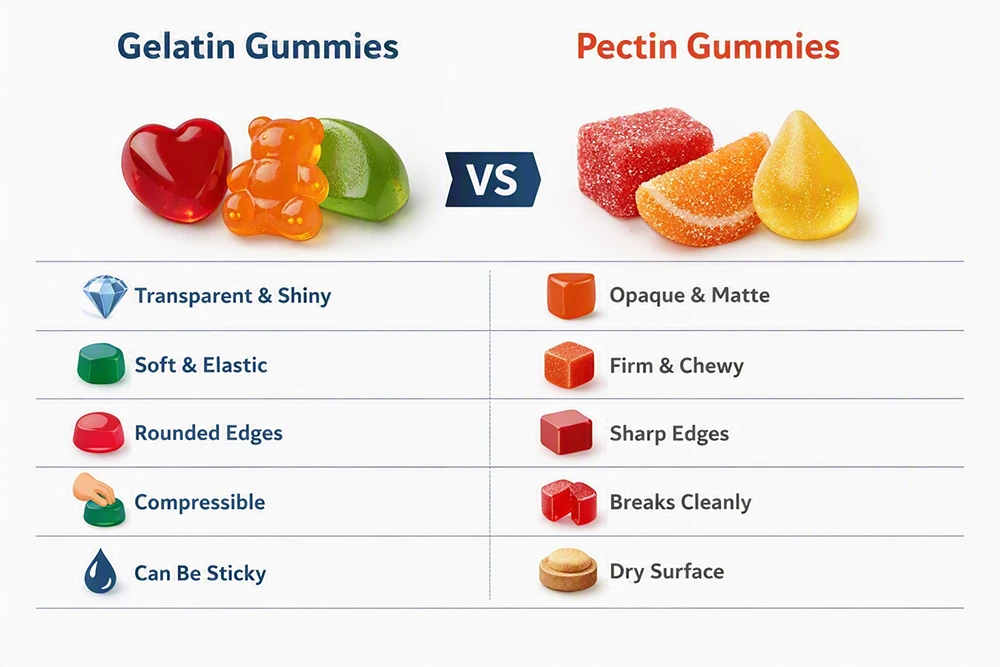
The foundation of quality gummies begins with rigorous raw material sourcing. Gelatin quality directly impacts gel structure, while alternative gelling agents—such as pectin (fruit-based), carrageenan (seaweed-derived), or modified starches—determine texture and shelf stability. Each base matrix carries distinct advantages:
- Gelatin: Superior gel clarity, proven bioavailability, cost-effective, but unsuitable for vegan formulations
- Pectin: Plant-based alternative, excellent for functional health segments, requires careful moisture management
- Carrageenan: Superior water retention, extended shelf life, ideal for humid climates
- Modified Starch: Budget-conscious option, excellent texture variation, common in children’s formulations
Raw materials undergo laboratory verification for moisture content, microbial load, particle size, and heavy metal contamination. This pre-manufacturing stage is critical—any variance in incoming material composition cascades downstream, affecting viscosity, set time, and final product consistency.
Stage 2: Formulation Development and Cooking
The cooking phase is where raw components transform into a homogeneous gel matrix. This stage requires precise temperature control and sequential ingredient addition:
| Process Parameter | Typical Range | Critical Control Point |
|---|---|---|
| Cooking Temperature | 65-85°C | Prevents ingredient degradation while ensuring gel matrix formation |
| Mixing Duration | 15-30 minutes | Ensures uniform distribution of active ingredients and prevents stratification |
| Gel Viscosity | 3,000-6,000 cPoise | Affects molding accuracy and final product texture consistency |
| Moisture Content | 14-18% | Controls shelf stability and prevents crystallization or spoilage |
| Vacuum Degassing | 0.6-0.8 bar for 5-15 min | Eliminates air bubbles that compromise product aesthetics and bioavailability |
During cooking, gelatin (or alternative gelling agent) is hydrated in water or juice concentrate, then gently heated while maintaining agitation. As temperatures rise, ingredients dissolve and homogenize. Flavoring agents, sweeteners (sorbitol, maltitol, or stevia), colorants, and active pharmaceutical ingredients are added in sequence—always respecting thermal stability thresholds. Heat-sensitive ingredients like vitamins or probiotics are typically added during the cooling stage to preserve bioactivity.
Stage 3: Molding and Shaping
Once the gel mixture reaches target viscosity (typically 3,000-6,000 cPoise), it flows into precision molding equipment. Modern gummy production employs two primary technologies:
Starch Molding: A traditional yet still widely-used method where hot gel is deposited onto starch beds. The starch absorbs surface moisture, creating a skin that facilitates demolding. Operators harvest gummies after 8-24 hours of setting, shake off starch residues, and conduct inline inspection. This method offers exceptional flexibility—operators can introduce 30+ different shapes, colors, and sizes from a single production run by changing starch bed configurations.
Mogul Depositing: High-capacity systems that use precision-engineered molds rotating through heated chambers. Gel deposits directly into cavities, the conveyor passes through cooling chambers (reducing temperature from 65°C to 25°C), and finished gummies exit via automated demolding. This approach delivers 3-5x higher throughput (12-16 tons daily capacity) compared to starch molding, with superior dimensional consistency and reduced labor intensity.
Stage 4: Cooling, Setting, and Demold
Temperature management during setting is non-negotiable. Rapid cooling creates internal stresses and brittleness, while slow cooling results in gummies that stick together or lose shape. Industrial facilities employ multi-chamber cooling zones with graduated temperature profiles:
- Zone 1 (65°C → 50°C): Controlled gel solidification begins; 2-4 hours
- Zone 2 (50°C → 35°C): Secondary gel matrix hardening; 4-8 hours
- Zone 3 (35°C → 20°C): Final moisture equilibration and structural stability; 8-12 hours
Once set, gummies enter the demold phase. In starch systems, mechanical shakers and air blowers remove residual powder; in mogul systems, the mold cavity’s geometry and ejector pins facilitate clean release. At this stage, gummies are typically fragile and require gentle handling to prevent chipping or deformation.
Stage 5: Drying and Moisture Adjustment
Post-demold gummies contain 18-22% moisture. Excessive moisture invites microbial growth and crystallization; insufficient moisture causes brittleness. Industrial drying tunnels reduce moisture to 14-16% over 12-48 hours, depending on gummy size and composition. Temperature is maintained at 45-60°C to prevent ingredient degradation while efficiently removing water vapor.
During this phase, gummies often undergo a final quality check: weight verification, hardness testing (via durometer), and visual inspection for color consistency, surface defects, or sticking.
Stage 6: Coating and Finishing
Many premium gummy formulations receive a polishing or coating layer. This serves multiple purposes:
- Wax Coating: Enhances gloss, reduces stickiness, extends shelf life by creating moisture barrier
- Sugar Coating: Improves mouthfeel, masks unpleasant tastes, adds visual appeal
- Sour Coating (Citric Acid): Stimulates saliva, improves flavor perception, particularly effective for children’s formulations
- Functional Coatings: Vitamin-enriched or probiotic coatings applied post-production for specific health claims
Coating equipment typically uses tumbler drums or fluid bed technologies, rotating gummies at precise speeds while applying coating agents. Time in the coating chamber averages 15-45 minutes, with final moisture checks confirming adequate adhesion.
Stage 7: Quality Control and Testing
Comprehensive quality assurance runs throughout production, with intensified testing at critical milestones:
| Test Parameter | Methodology | Compliance Standard |
|---|---|---|
| Weight Uniformity | Precision scale sampling; ±5% variance threshold | USP <905>, EP 2.9.5 |
| Hardness Testing | Durometer or texture analyzer; compression force measurement | Custom specification per formulation |
| Moisture Content | Karl Fischer titration or loss on drying | 14-16% target range |
| Microbial Analysis | Total plate count, pathogen screening (E. coli, Salmonella, Listeria) | FDA/EU food safety standards |
| Dissolution Testing | USP apparatus; time to 80% ingredient release | 15-45 minutes typical for optimized bioavailability |
| Active Ingredient Assay | HPLC or UV-Vis spectrophotometry | ±10% of label claim |
| Heavy Metals Screening | ICP-MS (inductively coupled plasma mass spectrometry) | FDA limits: Lead <0.1 ppm, Cadmium <0.1 ppm |
Leading manufacturers maintain in-house analytical laboratories with pharmaceutical-grade equipment. Regular batch-to-batch testing, stability studies (accelerated and long-term at 40°C/75% RH), and retained sample protocols ensure consistent quality across production runs.
Stage 8: Packaging and Distribution
Final packaging must balance product protection with consumer convenience. Private label gummy manufacturers typically offer multiple packaging tiers:
- Bulk/Industrial: 20-25kg bags for B2B suppliers and formulators
- Wholesale: 500g or 1kg containers for retailers and direct-to-consumer brands
- Retail Consumer: 100-250g bottles or pouches with child-resistant closures and desiccant packs
- Single-Serve Sachets: 10-30g packets for sampling, subscription boxes, or pharmaceutical applications
All final packaging includes moisture barriers (foil laminates, nitrogen flushing in some cases), UV-protective materials, and tamper-evident seals. Labeling compliance with nutritional facts, allergen declarations, usage instructions, and batch/expiration information is verified before shipment.
Practical Insights: Production, Quality & Scalability
Production Efficiency and Capacity Planning
Industrial gummy contract manufacturing facilities typically operate with daily outputs of 12-16 tons, depending on gummy size and coating complexity. A 100,000-class cleanroom (meeting pharmaceutical standards) with dual mogul lines enables flexible batch scheduling, allowing manufacturers to transition between formulations within 2-4 hours. Batch sizes typically range from 500kg (trial/pilot runs) to 5,000kg (commercial scale), with annual facility capacity reaching 5,000+ tons.
Raw Material Management and Scalability
Consistent quality demands strategic supplier partnerships. Leading manufacturers maintain relationships with 3-5 gelatin or pectin suppliers, reducing single-source dependency. Bulk ingredient procurement (500kg+ orders) offers 15-20% cost advantages over smaller volumes, crucial for competitive pricing in the private label gummy manufacturer segment. Inventory turnover—particularly for heat-sensitive ingredients like vitamins—requires sophisticated inventory management systems and temperature-controlled storage.
Formula Optimization and Regulatory Compliance
Modern gummy formulations balance multiple constraints: taste masking of active ingredients, texture preferences (softer gummies for seniors, firmer for fitness segments), color stability across shelf life, and bioavailability enhancement. Regulatory compliance extends beyond ingredient safety to label claims substantiation. Any functional or health claim requires clinical evidence or documented structure-function relationships. FDA’s CFR Part 111 (dietary supplement GMP), EU Directive 2002/67/EC, and China’s registration requirements for imported supplements introduce complexity requiring specialized regulatory expertise.
Quality Assurance Beyond Basic Testing
Premium custom gummy manufacturer operations implement stability testing protocols spanning 24-36 months at multiple environmental conditions (room temperature, accelerated 40°C/75% RH, and extreme storage scenarios). Bioavailability studies, conducted in clinical settings, validate that gummy formulation doesn’t impair ingredient absorption. Shelf-life extension—achieved through optimal moisture management, antioxidant inclusion, and packaging innovation—adds premium positioning and reduces retailer returns from expired stock.
Cost Structure and Margin Optimization
Gummy manufacturing economics are volume-dependent. Raw material costs (gelatin, active ingredients, flavoring) typically comprise 40-50% of COGS. Manufacturing labor and overhead (facility, equipment, quality assurance) account for 25-35%. Packaging, logistics, and regulatory compliance represent 15-25%. Success in make gummies at scale requires optimizing each component: bulk purchasing agreements with suppliers, energy-efficient equipment, automation investment, and waste minimization strategies. Break-even analysis typically occurs at 200-300 tons annual production; profitability accelerates significantly beyond 1,000 tons.
B2B Decision Framework: Selecting a Gummy Manufacturing Partner
Capability Assessment
OEM/ODM Manufacturing vs. Private Label: OEM partners handle complete product development—from formulation through branded packaging and distribution. ODM relationships typically provide custom formulations within your brand specifications. Private label manufacturers offer pre-formulated products under your brand. Evaluate which model aligns with your R&D investment capacity and time-to-market urgency.
Facility Standards and Certifications
Verify ISO 9001 (quality management), ISO 22000 (food safety), HACCP certification, FDA facility registration, GMP compliance, HALAL, KOSHER, and vegan certifications as applicable. Request facility tours to inspect cleanroom standards (100,000-class minimum for premium products), R&D laboratory capabilities (10,000-class pharmaceutical standard preferred), equipment age and maintenance records, and environmental controls (temperature/humidity logging systems).
Technical Expertise and Innovation Capacity
Leading manufacturers employ postdoctoral researchers and Ph.D.-level scientists in biochemistry, polymer chemistry, and materials science. Request evidence of formulation innovation: How many novel formulations has the manufacturer developed annually? What’s their success rate in achieving specific active ingredient bioavailability targets? Can they scale limited-edition or seasonal formulations without supply chain disruption?
Regulatory and Compliance Partnership
Beyond basic GMP compliance, assess the manufacturer’s expertise in navigating market-specific regulations. Do they maintain relationships with regulatory consultants? Have they successfully navigated FDA warning letters or product recalls? Can they support international expansion (EU, Canada, Australia market-specific requirements)? Quality manufacturers provide regulatory gap analysis and compliance roadmaps before production begins.
Quality Assurance and Traceability
Request copies of recent batch test reports, COAs (Certificates of Analysis), and stability study data. Verify that the manufacturer maintains traceability from raw material receipt through final packaging—critical for rapid response if recalls occur. Advanced manufacturers use blockchain or similar technologies for ingredient tracking, enhancing supply chain transparency.
Scalability and Flexibility
Confirm minimum order quantities (MOQ) and assess flexibility in batch scheduling. Can the manufacturer accommodate seasonal demand spikes or market testing at reduced volumes? What’s the lead time from formulation finalization to first commercial batch? Manufacturers with redundant equipment lines and diverse production capacity offer superior flexibility for growing brands.
Cost Transparency and Long-Term Partnerships
Request detailed cost breakdowns: raw materials, labor, overhead, QA, packaging, logistics. Transparent pricing with volume-based discounts incentivizes long-term partnerships. Beware of manufacturers quoting below-market prices—this often indicates corner-cutting on quality or ingredient sourcing. Negotiate framework agreements that protect both parties while allowing cost adjustments for commodity ingredient fluctuations.
Conclusion
Gummy bear production is a sophisticated blend of food science, manufacturing precision, and regulatory expertise. Success requires mastery of multiple disciplines: chemistry (formulation design), engineering (equipment operation and process control), biology (bioavailability and microbial safety), and business (cost optimization and supply chain management). Whether launching a startup brand or scaling enterprise volumes, partnering with experienced custom gummy manufacturers that combine technical depth with operational excellence ensures products that meet consumer expectations, regulatory requirements, and profitability targets. The market continues expanding—success belongs to manufacturers and brands that prioritize innovation, transparency, and unwavering commitment to quality across every production stage.
Frequently Asked Questions
Complete production cycles average 2-4 weeks from approved formulation to packaged inventory. This includes: pilot formulation testing (3-7 days), scale-up to commercial batch (5-10 days), quality assurance and stability sampling (5-10 days), and packaging/labeling (3-7 days). Expedited timelines are possible for established formulations with pre-approved protocols, reducing total time to 10-14 days.
Premium manufacturers employ HPLC (high-performance liquid chromatography) testing to verify active ingredient concentration post-manufacturing, and dissolution testing (USP apparatus) to measure ingredient release rates in simulated gastric conditions. Many conduct clinical bioavailability studies comparing gummy formulations to standard supplements, quantifying absorption efficiency. Formulation optimization—including pH adjustment, particle size reduction, and surfactant addition—can enhance bioavailability by 20-40% versus poorly formulated alternatives.
Minimum standards include ISO 9001 (quality management), ISO 22000 (food safety), and HACCP certification. FDA facility registration and GMP compliance are non-negotiable for U.S. market distribution. International operations require HALAL and KOSHER certifications for specific market segments. Vegan certifications are increasingly expected for plant-based gelling agents. Reputable manufacturers maintain current third-party audit certificates from NSF, USP, or equivalent bodies, demonstrating independent verification of claimed certifications.
Yes, modern gummy contract manufacturing facilities offer flexible formulations using pectin, carrageenan, or other plant-based gelling agents instead of gelatin. Allergen-free production requires dedicated equipment lines or rigorous cleaning protocols to eliminate cross-contamination risks. Manufacturers should maintain separate inventory systems and production schedules for allergen-sensitive formulations. Always request allergen control documentation and facility sanitation procedures before committing to sensitive formulations.
MOQs vary significantly. Pilot/trial batches can be as small as 50-100kg, suitable for market testing or small-scale brand launches. Standard commercial MOQs range from 500kg to 2,000kg, depending on formulation complexity and equipment setup costs. Bulk orders (5,000+ kg) unlock maximum cost efficiency and faster per-unit pricing. Many manufacturers offer MOQ flexibility for established clients or high-volume commitments, allowing smaller initial orders with volume-tiered pricing for scaling.
Well-formulated gummies typically achieve 24-36 months shelf life under standard storage conditions (room temperature, <60% humidity). Shelf life is influenced by: moisture content (14-16% optimal range), oxygen exposure (nitrogen-flushed packaging extends stability), light exposure (amber or opaque packaging prevents photodegradation of sensitive ingredients), storage temperature (each 10°C increase accelerates degradation by ~2x), and ingredient sensitivity (probiotics, vitamins C and D degrade faster than minerals). Accelerated stability testing at 40°C/75% RH for 6 months typically correlates to 24-month real-time shelf life, enabling faster product launches.
Transform Your Vision Into Market-Ready Gummies
Our expertise in gummy contract manufacturing and private label gummy manufacturer services positions us as a trusted partner for brands worldwide. Whether you’re developing a startup wellness brand, scaling enterprise volumes, or launching specialized formulations, we deliver comprehensive solutions across manufacturing, OEM/ODM development, and custom brand deployment.
Why Partner With Us for Gummy Manufacturing?
- Advanced Manufacturing Capacity: GMP-certified facility with 100,000-class cleanroom, 16-ton daily output capacity, and 5,000-ton annual production capability. Dual mogul lines enable rapid formulation transitions and flexible batch scheduling.
- Scientific Excellence: Postdoctoral researchers from leading U.S. institutions (Caltech, Emory, Ohio State) lead our R&D team. 10,000-class pharmaceutical-grade laboratory enables cutting-edge formulation innovation, bioavailability optimization, and stability research.
- Comprehensive OEM/ODM Services: From initial concept through commercial launch—complete formulation development, regulatory consultation, custom packaging design, and labeling compliance. We manage every detail so you focus on brand growth.
- Quality Assurance & Compliance: ISO 9001, ISO 22000, HACCP, FDA, GMP, HALAL, KOSHER, and Vegan certifications. Rigorous testing protocols, stability studies, and third-party audits ensure products meeting the highest international standards.
- Flexible Scalability: From 50kg pilot batches to 5,000+ ton annual volumes. Transparent pricing, volume-tiered discounts, and partnership-focused economics support your growth trajectory.
- Global Expertise: Regulatory navigation for U.S., EU, Canada, Australia, and Asian markets. International logistics support and customs documentation streamline distribution to your target regions.
Ready to Make Gummies That Stand Out? Whether you need custom gummy manufacturer expertise, private label solutions, or full OEM development—contact us today to discuss your project and discover how we transform supplement concepts into category-leading products.