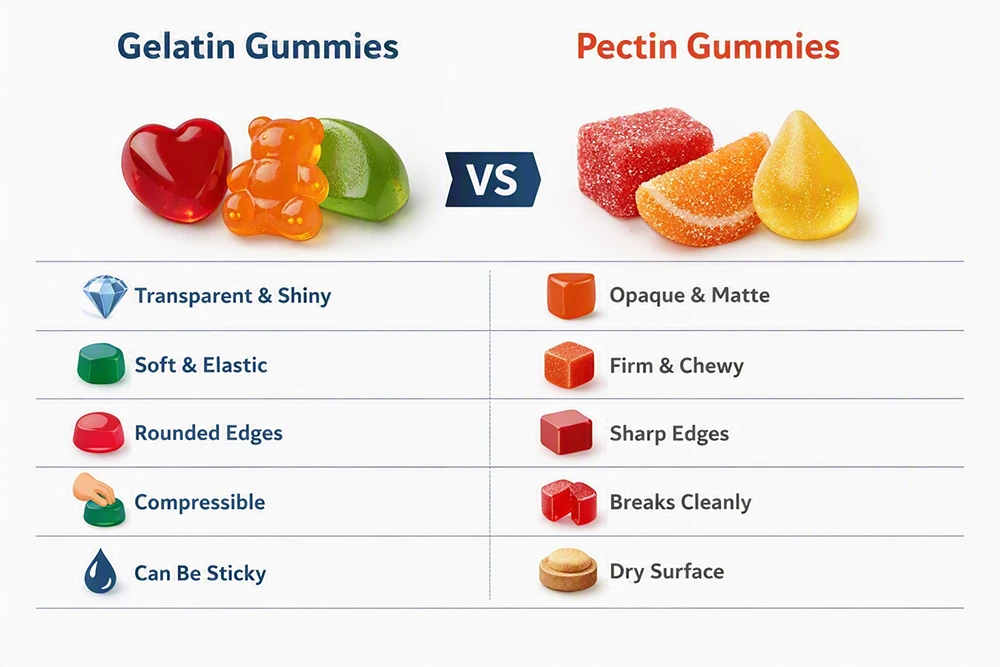

Executive Summary
The production of gummies involves precise formulation, carefully controlled mixing, molding, and drying stages to create consistent, shelf-stable products. Understanding how they make gummies requires knowledge of ingredient chemistry, equipment specifications, quality control mechanisms, and regulatory compliance—critical factors that distinguish industrial-scale manufacturing from small-batch operations. This guide explores the comprehensive methodology behind gummy supplements and custom formulations in modern production facilities.
Definition
Gummy manufacturing refers to the industrial-scale process of producing gelatin or pectin-based confectionery products infused with active ingredients such as vitamins, minerals, herbal extracts, or pharmaceuticals. The process encompasses formulation design, batch preparation, molding, setting, coating, packaging, and quality assurance—transforming raw materials into finished consumer products. Modern facilities employ automated systems to make gummies at scales ranging from thousands to millions of units daily while maintaining strict quality, potency, and safety standards.
The Gummy Manufacturing Process: Step-by-Step Breakdown
1. Raw Material Sourcing and Specification
Gummy manufacturing begins with material selection. Core ingredients include:
|
|---|
Each ingredient must meet pharmaceutical-grade specifications, with suppliers providing Certificates of Analysis (CoA) documenting potency, purity, and microbial content.
2. Formulation Development and Testing
Before scaling to production, formulation teams conduct:
- Stability Testing: Temperature and humidity cycling (ICH guidelines) to verify ingredient compatibility and shelf-life claims
- Dissolution Studies: Confirming active ingredient bioavailability and release profile
- Texture Optimization: Balancing hardness, chewability, and mouthfeel through gelling agent ratios
- Flavor Masking: Encapsulating bitter compounds (e.g., iron, mineral supplements) to improve palatability
- Color Fastness: Ensuring FD&C dyes remain stable under light and thermal stress
This phase typically requires 2–8 weeks depending on complexity and regulatory requirements.
3. Batch Preparation: Mixing and Cooking
Once formulation is finalized, production begins in industrial kettles (capacity: 100–2,000 liters):
Sequence of Operations:
- Dry Ingredient Blending (5–10 minutes)
- Gelatin/pectin, sugar, and active ingredients combined in ribbon blenders
- Ensures uniform distribution before heat exposure
- Wet Ingredient Incorporation (10–15 minutes)
- Glucose syrup, glycerin, and water added
- Temperature controlled at 60–80°C to prevent gelatin denaturation
- Active Ingredient Dispersion (15–25 minutes)
- Vitamins and botanicals added in controlled increments
- Continuous agitation prevents settling and ensures homogeneous distribution
- Final Cooking Stage (30–45 minutes)
- Temperature raised to 70–85°C
- Vacuum is applied to remove air bubbles (critical for texture and appearance)
- Viscosity monitored to reach optimal flow state for molding
Key Control Parameters:
- Temperature tolerance: ±2°C (excessive heat denatures gelatin; insufficient heat prevents molding)
- Vacuum pressure: 50–90 mbar (removes gas while maintaining ingredient stability)
- Batch uniformity: Sampling at 3, 5, and 10-minute intervals for pH, viscosity, and potency verification
4. Molding: From Batch to Individual Units
Industrial gummy production employs two primary molding technologies:
Starch Molding (Traditional, 60% of market)
- Pre-shaped starch impression trays create individual cavity molds
- Batch mixture deposited via nozzle into starch beds
- Gummies set in starch for 12–24 hours at controlled humidity (60–70% RH)
- Advantages: Flexibility for custom shapes, lower equipment cost
- Limitations: Starch residue requires thorough cleaning; slower throughput (2,000–5,000 units/hour)
Depositing Machine Molding (Modern, 40% of market)
- Automated rotary depositors or belt-fed systems
- Mixture injected into silicone or PTFE molds at precise volumes (±2% accuracy)
- Cooling belt or water-spray cools gummies to 15–20°C in 3–5 minutes
- Advantages: High-speed production (15,000–40,000 units/hour), consistent dosing, minimal waste
- Limitations: Higher capital investment ($300K–$2M per line); limited shape complexity
Critical Parameters During Molding:
- Mix temperature at deposition: 65–75°C (prevents premature gelation; ensures flow)
- Mold temperature: 10–25°C (rapid cooling = faster production; too cold = cracking)
- Fill weight consistency: ±3% tolerance required for pharmaceutical compliance
5. Setting and Curing Phase
After initial molding, gummies undergo a controlled setting process:
Duration: 12–48 hours (depending on size, gelling agent type, and humidity)
Environmental Control:
- Temperature: 18–25°C (constant; fluctuations cause cracking and separation)
- Humidity: 55–65% RH (below 50% = shrinkage and hardening; above 70% = stickiness)
- Air circulation: 2–4 air changes per hour (prevents microbial growth, ensures uniform setting)
This phase allows gelatin/pectin chains to fully cross-link and stabilize the gummy structure.
6. De-Molding and Cleaning
Once set:
- Starch-molded gummies: Sifted or washed in 35–40°C water jets to remove starch residue; final rinse in 15°C water to chill
- Machine-molded gummies: Released directly onto conveyor; no cleaning needed
- Drying: Tumbled in dedicated dryers at 25–35°C for 2–4 hours to remove residual moisture and achieve target water content (2–5% by weight)
7. Coating and Finishing (Optional)
Many custom gummy manufacturers add surface treatments:
- Wax Coating: Carnauba or beeswax applied to reduce stickiness and extend shelf-life by 3–6 months
- Sugar/Sanding: Colored sugar applied for visual appeal and flavor enhancement
- Sour Coating: Citric acid or malic acid mixture sprayed for tartness (common in private label gummy products)
Coating thickness: 1–5 mg per unit; controlled via tumbling duration and coating viscosity.
8. Final Quality Control and Testing
Before packaging, samples undergo:
|
|---|
Samples tested at: start of batch, mid-batch, and end of batch (minimum n=5 per point).
9. Packaging and Storage
Gummies are packaged in:
- Bulk bags: HDPE or Kraft paper-lined for wholesale distribution
- Consumer bottles: PET or HDPE with child-resistant caps (pharmaceutical standard)
- Blister packs: PVC/PVDC for extended shelf-life and moisture barrier
Storage Requirements:
- Temperature: 15–25°C (room temperature)
- Humidity: 30–60% RH (prevents moisture absorption or loss)
- Light protection: Opaque or amber containers (light degrades vitamins, especially A, D, E)
- Shelf-life: Typically 24–36 months under optimal conditions
Advanced Manufacturing Considerations for Gummy Contract Manufacturing
Scalability and Capacity Planning
1. Batch Size Optimization
- Micro-batches: <100 kg (for R&D or ultra-premium products)
- Standard batches: 500–1,000 kg (typical commercial production)
- Mega-batches: 2,000–5,000 kg (cost-efficient for private label gummy manufacturer operations)
Scaling increases throughput but requires recalibration of mixing times, cooling rates, and QC sampling.
2. Equipment Utilization
- Single kettle + single molding line: 3–5 metric tons/day capacity
- Dual kettle + dual molding line: 10–15 metric tons/day
- Automated facilities with continuous cooling: 20–40 metric tons/day
3. Production Scheduling
- Changeover time between formulations: 2–4 hours (cleaning, equipment recalibration)
- Planning must account for shift patterns, maintenance windows, and ingredient lead times
Quality Control and Regulatory Compliance
Gummy supplements manufacturing is governed by:
- FDA (Food & Drug Administration): cGMP (Current Good Manufacturing Practices) for dietary supplements (21 CFR Part 111)
- European Standards: GMP Annex 1 for pharmaceuticals; European Food Safety Authority guidelines for nutraceuticals
- USP/NF Standards: If claiming USP-grade potency or purity
- Third-Party Audits: NSF, USP, or SQF certification for retail credibility
Critical Compliance Areas:
- Documentation: Batch records, deviation logs, corrective/preventive actions (CAPA)
- Change Management: Any formulation modification requires stability testing and regulatory assessment
- Supplier Qualification: Vendor audits, CoA review, ongoing relationship management
- Traceability: Ingredient lot tracking from raw material through finished product
- Recall Procedures: Documented protocols for swift product removal if safety issue identified
Practical Implementation: Production Workflow Timeline
For a typical private label gummy project (5,000 unit minimum):
|
|---|
B2B Decision Framework: Selecting a Gummy Contract Manufacturing Partner
Key Evaluation Criteria
1. Technical Capability Matrix
|
|---|
2. Supply Chain Transparency
- Can the manufacturer provide full traceability from raw material to finished product?
- Are suppliers audited annually?
- What is the backup plan if a critical ingredient becomes unavailable?
3. Quality System Maturity
- SOP (Standard Operating Procedures) documentation completeness
- Stability testing data availability (at minimum: initial, 3-month, 6-month, 12-month)
- Out-of-specification (OOS) procedure and trend analysis
- Corrective action effectiveness (how quickly issues are resolved)
4. Cost Structure Transparency
|
|---|
5. Customer Support and Flexibility
- Does the manufacturer offer formulation consultation or recommend standard formulas?
- Can they accommodate mid-batch adjustments (ingredient sourcing changes, potency adjustments)?
- What is the process for handling complaints or product recalls?
- Availability of technical documentation (formulations, manufacturing specs, stability data) for regulatory submissions?
Industry Insights: Emerging Trends in Gummy Manufacturing
1. Functional Innovations
- Probiotic Gummies: Requires special stabilization to maintain viability; shelf-life typically 12–18 months vs. 24–36 for standard vitamins
- Slow-Release Formulations: Coating with time-release polymers; requires specialized equipment and increases cost 15–25%
- Sports Nutrition Gummies: Higher potencies (2–5 g carbohydrates; 5–10 g protein), modified texture; appeals to fitness-focused consumers
- Mushroom & Adaptogen Gummies: Extract standardization (% beta-glucans, polysaccharides) is critical; requires specialized assay methods
2. Ingredient Sustainability
- Plant-Based Gelatin: Pectin, agar, or carrageenan replacing porcine/bovine gelatin (8–12% cost premium; growing consumer demand)
- Natural Colorants: Anthocyanins, beta-carotene replacing FD&C dyes (5–8% cost increase; regulatory complexity due to stability concerns)
- Organic & Non-GMO Certification: Adds 10–15% to raw material cost; requires dedicated production lines to prevent cross-contamination
3. Manufacturing Automation
- AI-Driven Quality Monitoring: Computer vision systems inspecting gummies for color, shape, defects in real-time (reduces manual QC by 60%)
- Blockchain Traceability: End-to-end supply chain tracking for B2B transparency and recall management
- IoT Sensors: Temperature, humidity, and viscosity monitoring during mixing and curing phases; automated alerts for deviations
4. Regulatory Evolution
- Stricter Potency Tolerance: Many jurisdictions moving from ±10% to ±5% acceptable variance (impacts manufacturing precision requirements)
- Microplastic Concerns: Increased scrutiny on synthetic colorants and coating materials; shift toward plant-based alternatives
- Serialization Requirements: Some markets (EU, select Asian markets) mandating unique identifiers on packaging for anti-counterfeiting and traceability
Frequently Asked Questions (FAQ)
1. How long does it take to make gummies from concept to market?
Answer: For an established formula with standard ingredients, the timeline is typically 3–5 weeks. This includes 2–4 weeks pre-production (formulation finalization and trial batch) and 1–2 weeks for production, QC testing, and packaging. Novel formulations with specialized ingredients or stability requirements can extend this to 8–12 weeks. Rush services are available at 20–40% premium pricing.
2. What is the minimum order quantity for private label gummy products?
Answer: Most custom gummy manufacturers require a minimum of 5,000–10,000 units for a single SKU (Stock Keeping Unit). However, facilities with lower minimums (1,000–3,000 units) exist at a cost premium of 15–25% per unit. Bulk orders (50,000+ units) typically reduce per-unit costs by 20–30%, making them attractive for established brands scaling into new markets.
3. How do I verify the potency of gummy supplements after manufacturing?
Answer: Potency verification requires HPLC (High-Performance Liquid Chromatography) testing on representative samples from each batch. The manufacturer should provide a Certificate of Analysis (CoA) confirming that >90% of units meet the label claim (typically ±10% acceptable range). For regulated products (prescription or pharmaceutical-grade), USP (United States Pharmacopeia) or Ph.Eur. (European Pharmacopoeia) standards apply, allowing only ±5% variance. Third-party testing labs provide independent verification if needed (cost: $500–$2,000 per batch).
4. Can a gummy contract manufacturer handle allergen-free or allergen-certified production?
Answer: Yes, but it requires dedicated production lines and validated cleaning procedures. Cross-contamination risk increases in multi-product facilities. Allergen-certified facilities typically charge 10–20% premium and require minimum batch sizes of 20,000–50,000 units to justify line dedication. Look for manufacturers with SQF or NSF certification and documented allergen control plans (HACCP procedures). Request a written statement of allergen controls before committing to the partnership.
5. What shelf-life can I expect from private label gummy products?
Answer: Standard gummies formulated with gelatin, sugar, and common vitamins typically have a shelf-life of 24–36 months under room temperature storage (15–25°C, 30–60% RH). Delicate actives (probiotics, omega-3s, adaptogens) reduce this to 12–18 months. Wax coating extends shelf-life by 3–6 months. Moisture content (target: 2–5% by weight) is the primary degradation driver; packaging integrity (airtight, light-blocking) is critical. Request accelerated stability data (3-month, 6-month results) from the manufacturer before full production.
6. How does gummy manufacturing compare to tablet production?
Answer: Gummies are 20–40% more expensive per unit than tablets due to ingredient complexity (gelling agents, humectants, flavorings) and longer production timelines (curing phase adds 2–5 days). However, gummies offer 3–5x faster time-to-market because formulation flexibility allows rapid prototyping, whereas tablets require extensive compression and die-tooling setup. Gummies appeal to consumers with swallowing difficulties and offer superior taste masking. For premium products, the higher cost is justified by improved compliance and perceived value; tablets remain cost-optimal for simple, high-volume commodity supplements.
Manufacturing Excellence: Our Comprehensive Gummy Manufacturing Capabilities
Why Partner With Us for Custom Gummy Manufacturing
We are an industry-leading gummy contract manufacturer and private label gummy manufacturer specializing in delivering end-to-end solutions for brands seeking to launch or scale gummy supplements at commercial scale.
Our Core Competencies
1. Advanced Manufacturing Infrastructure
- State-of-the-art gummy production facilities with dual-line capacity: 15–25 metric tons/day output
- Equipment: Industrial vacuum kettles (500–2,000L), automated depositing systems (25,000–40,000 units/hour), precision coating lines
- Climate-controlled curing chambers with ±1°C temperature tolerance and real-time humidity monitoring
- Dedicated QC laboratories with HPLC, ICP-MS, and microbiological testing capabilities
2. Formulation Innovation
- In-house R&D team specializing in how they make gummies across 20+ active ingredient categories
- Rapid prototyping: From concept to trial batch in 5–10 business days
- Expertise in: gummy supplements with probiotics, adaptogens, botanicals, and nutraceutical actives
- Stability testing and shelf-life validation (ICH-compliant; 3–12 month data available)
3. Regulatory & Quality Excellence
- FDA cGMP registered; SQF and NSF certified
- Full traceability: Blockchain-enabled supply chain documentation
- Complete batch record generation with deviation tracking and CAPA procedures
- Support for nutraceutical, pharmaceutical, and OTC product classifications
4. Customization at Scale
- Minimum order quantity: 5,000 units (lower minimums available; premium pricing applies)
- Shape, size, and color: Custom molds created in 2–3 weeks; no setup fees on repeat orders
- Formulation flexibility: Ingredient substitution (gelatin → pectin; sugar → allulose) within production timeline
- Packaging options: Bulk, retail bottles, blister packs, and branded custom packaging
5. Cost-Transparent Partnership
- Per-unit cost range: $0.18–$0.45 (depending on active ingredients, potency, volume)
- Setup/NRE: $1,500–$3,500 (includes trial batch and mold creation)
- Volume discounts: 20–30% reduction at 100,000+ unit orders
- No hidden fees: Upfront quotation with binding cost structure
B2B Service Offerings
| Capability | Baseline | Advanced | Premium |
|---|---|---|---|
| Active Ingredient Range | Vitamins, minerals | + Botanicals, amino acids | + Probiotics, enzymes, peptides |
| Potency per Unit | 10–500 mg | 500 mg–2 g | 2–10 g (requires tech innovation) |
| Batch Flexibility | Minimum 10,000 units | Minimum 5,000 units | Custom down to 1,000 units (premium price) |
| Production Speed | 4–6 weeks lead time | 2–3 weeks lead time | 1–2 weeks (rush fees apply) |
| Certifications | cGMP + FDA registered | + USP, SQF, NSF certified | + Organic, Kosher, Halal, vegan verification |
Quality Assurance & Compliance
- Batch testing: Every production run tested for potency (HPLC), microbial safety (USP methods), and physical specifications
- Certificate of Analysis (CoA): Provided within 10 business days; includes all regulatory data
- Stability data: 12–36 month accelerated and real-time data available for all products
- Recall procedures: ISO 13485-compliant documentation; rapid response protocols
Scalability Without Compromise
Whether launching a private label gummy brand with 5,000-unit trial batches or scaling a successful custom gummy manufacturer partnership to 500,000+ units annually, we provide:
- Flexible batch scheduling to accommodate growth without lengthy lead times
- Predictable costs with volume-based discounts transparent and binding
- Consistent quality maintained across all batch sizes via identical processes and QC standards
- Supply chain resilience: Multi-source supplier relationships and 6-month ingredient buffer stock
Conclusion
Gummy manufacturing is a sophisticated process combining chemistry, precision engineering, and rigorous quality control. Understanding how they make gummies—from formulation optimization through multi-stage production and comprehensive testing—is essential for brands seeking reliable manufacturing partners. Whether you are developing a proprietary gummy supplements line or scaling an established brand through gummy contract manufacturing, selecting the right custom gummy manufacturer determines product quality, time-to-market, and profitability.
The industry’s evolution toward functional, sustainable, and innovative gummy products demands manufacturers with deep technical expertise, regulatory mastery, and flexible production capacity. By partnering with a certified private label gummy manufacturer offering transparent costing, proven scalability, and unwavering quality standards, brands can confidently launch products that meet consumer expectations and regulatory requirements—positioning themselves for sustainable growth in the rapidly expanding gummy market.