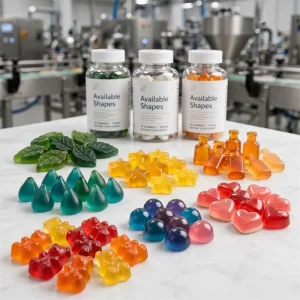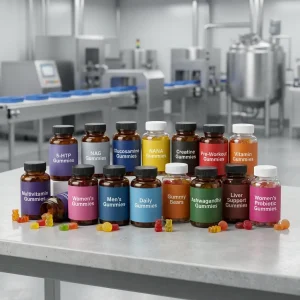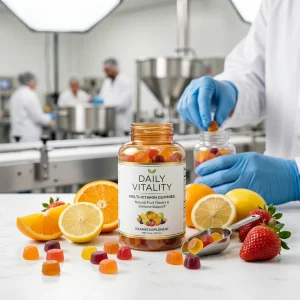

Most gummy process guides describe a factory floor. This one starts earlier, with the specification a brand must lock before a manufacturer can 製作軟糖 that are stable, label-accurate, and shippable. If you are briefing a 軟糖製造商, the process is really a sequence of decisions about your active profile, dose, claims, and destination market. To make those decisions concrete, this guide walks one realistic product from brief to release: a vegan pectin immune gummy delivering 90 mg vitamin C, 5 mg zinc, and elderberry extract per two-gummy serving.
Why the brief comes before the recipe
A recipe is the last thing a manufacturer writes, not the first. The first output is a specification sheet that fixes the variables a process must respect. For our example, the brief dictates a vegan claim (so pectin, not gelatin), an acidic active (vitamin C) that both helps and stresses a pectin set, a mineral (zinc) that needs taste masking, and a botanical (elderberry) that brings color and microbial-load risk. Every later step is judged against these constraints.
| 簡要要素 | Process consequence |
|---|---|
| Vegan claim | Pectin or other plant gelling system; no gelatin, no animal-derived coating |
| 90 mg vitamin C per serving | Heat-sensitive; added post-cook with overage; acidic, aids pectin set |
| 5 mg zinc | Metallic taste; requires flavor masking and even distribution |
| Elderberry botanical | Identity and residue testing; color stability under light and heat |
| Humid export market | Low water-activity target and high-barrier packaging required |
Step 1: Lock the Gel System From the Claim, Not the Trend
Gel selection is the first irreversible process decision because it sets pH, acid, and drying requirements. Our vegan claim forces a plant system. Pectin is the standard choice: high-methoxyl pectin sets only with sufficient sugar and a low pH, so the acid from vitamin C is useful, but the final pH must land in the pectin’s working window or the batch will not set.
| If your brief requires | 選擇 | 過程意義 |
|---|---|---|
| Vegan or halal/kosher plant claim | Pectin, agar, or starch blend | Tight pH and soluble-solids control; longer dry time than gelatin |
| Classic chew, animal-derived acceptable | 明膠 | Thermoreversible set; weaker below pH 3.5; melts in transit heat |
| Sugar-free vegan claim | Low-methoxyl amidated pectin (calcium-set) | Calcium timing critical; mineral calcium can pre-gel |
Step 2: Size the Gummy From the Active Load
Active dose sets physical size. A standard gummy weighs 2.5 to 4.0 grams; our 90 mg vitamin C plus 5 mg zinc over a two-gummy serving fits comfortably inside that range, so we target 3.0 g per piece. Had the brief specified 500 mg calcium carbonate, the mass would not fit a 3 g piece without a sandy texture, forcing either a larger gummy, a two-per-serving increase, or a different format.
The arithmetic matters commercially: gummy weight multiplied by units per bottle determines raw-material use and bottle count per batch. Fixing 3.0 g early prevents a late redesign that changes mold, packaging, and cost.
Step 3: Qualify Raw Materials Against the Active Profile
Before cooking, each incoming material is identified and assayed. For this product, vitamin C needs a certificate of analysis showing potency and a stated degradation rate, zinc a heavy-metal screen, and elderberry a botanical identity test plus pesticide-residue panel. Pectin is checked for esterification degree because that determines the exact acid and solids needed to set.
A manufacturer with on-site testing can release a lot before it enters the cook. For botanicals and minerals, ask which residue and contaminant panels are standard versus on request, because that decides export eligibility.
Step 4: Cook the Gel Base Within the System’s Window
The base cook dissolves pectin, sweeteners, and acids into a uniform slurry, then heats to activate the gel. For pectin, the cook must reach the soluble-solids level the set requires and hold the pH in window; overheating drives off water and shifts texture, undercooking leaves the gel unhydrated. Temperature here is read through its effect on the gel, not as a number to hit blindly.
Step 5: Add Actives After the Cook, by Stability
This is where a generic recipe and a brand-grade process diverge. Heat-sensitive actives are held out of the cook. Vitamin C is added after the mass cools below the temperature that accelerates its loss, with an overage built in so the label claim still holds at end of shelf life. Zinc and elderberry follow in a homogeneous blend. A probiotic or enzyme variant of this product would instead require post-cool addition of a protected culture and a separate low-moisture, low-temperature handling path.
The addition point is a control point, not a step. Document the temperature and the overage, because both feed the stability claim and the release specification.
Step 6: Mix and Homogenize for Uniform Dose
Once actives are in, the mass is mixed to even distribution. In a 3 g gummy, a 10 percent deposit variation means some pieces fall under labeled potency. Homogenization also controls entrained air and oil dispersion. At pilot scale this is trivial; at commercial volume the same formula can show tailing or soft centers if mix energy and viscosity are not held, which is why scale-up validation matters.
Step 7: Deposit Against the Weight Specification
A depositor meters a fixed volume into each mold. Our 3.0 g target drives the deposit volume and the mold cavity. Automated lines typically hold piece weight within a small tolerance; that tolerance is what protects the label claim during third-party audit, so the manufacturer should be able to show piece-weight control data for the actual formula, not a generic line spec.
Step 8: Cool and Set the Gel Structure
For pectin, set is locked by the acid-sugar balance established earlier, then fixed as the mass cools. Cooling rate affects crystal structure and chew. Too fast skins the surface; too slow loses throughput and lets texture drift between the front and back of a large batch. The brief’s claim (vegan, stable in transit) is what makes cooling uniformity a quality gate rather than a convenience.
Step 9: Dry to a Water-Activity Target, Not a Moisture Percentage
Fresh gummies carry moisture too high for stable shelf life. Conditioning lowers it toward a target water activity, typically kept low enough to block microbial growth without hardening the piece. For our humid-market product we target the lower end of the commercial range. Water activity, not percent moisture, predicts safety and texture, so the specification must state the aw number and how it is verified.
Step 10: Engineer the Package as a Stability Component
Packaging is where many gummy projects lose shelf life. Our product carries three stability stressors: vitamin C oxidizes, elderberry color fades under light, and the piece is moisture-sensitive. That combination rules out a simple PET bottle in a humid market and points to either a bottle with desiccant plus oxygen scavenger or a high-barrier foil format.
| 格式 | 防潮層 | 氧氣屏障 | 當它合適的時候 |
|---|---|---|---|
| PET bottle + desiccant | 中度 | Low unless induction-sealed | Stable actives, dry climate, low cost |
| HDPE bottle + desiccant | 固德 | 低 | Moisture-sensitive, light-stable actives |
| Aluminum blister | 高 | 高 | Per-piece protection, premium positioning |
| Foil stick / sachet | 很高 | 很高 | Humid export, light-sensitive botanicals |
Changing package format after stability data exists usually means re-running the study. Choose the barrier against the harshest market in your launch plan, not the easiest one.
Step 11: Test and Release Against the Brief
Before release, the line passes gummies through metal detection and inspection, then the batch is tested for active assay, microbial limits, heavy metals, moisture, and aw. For this product, the vitamin C assay at release must include the overage margin, and the elderberry identity must be confirmed. A robust program tests every batch for safety and key-actives identity; deeper panels may be reserved for periodic or stability verification.
Step 12: Validate Shelf Life Before You Print the Date
Shelf life is not borrowed from a similar recipe. For a new formula it is established through a stability plan: an accelerated condition (elevated temperature and humidity) for early read, plus real-time confirmation at the sellable climate. Typical timepoints test active assay, aw, texture, color, and microbial status at set intervals. Our vitamin C and elderberry product is tested for assay retention and color shift specifically, because those are its failure modes.
A manufacturer should return a stability protocol and, for new formulas, pilot data rather than a copied expiration. The printed date is only as good as the worst-performing attribute in the study.
Step 13: Bridge Pilot to Commercial Volume
The riskiest move is the jump from pilot to full run. A formula validated at 20 kg can behave differently at 500 kg because heat-transfer time, deposit consistency, and drying uniformity all shift with batch size. For our product, the pectin set and vitamin C overage are exactly the attributes to re-check at scale. Expect a pilot or scale-up batch before committing a full commercial order, especially with heat-sensitive or live actives.
What Drives Cost and MOQ for This Product
| 成本驅動因素 | Effect on this product |
|---|---|
| Pectin vs gelatin | Pectin base and longer dry time raise unit cost versus a gelatin equivalent |
| Vitamin C overage | Stability margin adds active input beyond label dose |
| Botanical testing | Elderberry identity and residue panels add per-batch cost |
| Foil packaging | High-barrier format costs more than a standard bottle but protects shelf life |
| MOQ | Below the line’s efficient batch size, setup and cleaning spread over fewer units |
How to Evaluate a Gummies Manufacturer for a Spec Like This
Generic assurances do not qualify a partner for a vegan, heat-sensitive, botanically-loaded gummy. Verify measurable capability: GMP-certified facility with controlled cleanroom production; in-house formulators who have run pectin and heat-sensitive actives; on-site identity, microbial, and contaminant testing; documented pilot-to-commercial scale-up; and export documentation support. A facility operating a GMP-certified environment with a 10,000-class R&D laboratory and daily gummy capacity in the tons range can typically support this profile from concept through commercial run. Ask for evidence of formulas it has scaled, not just produced.
Common Mistakes in Briefing a Gummy Project
- Choosing a gel system for appearance before checking the vegan or religious-diet claim it enables or blocks.
- Under-specifying active form and stability, forcing late reformulation and a new stability study.
- Treating packaging as decoration rather than a stability control, then losing shelf life in humid markets.
- Skipping a pilot batch for a heat-sensitive or botanical-heavy formula and discovering scale-up variation only after a full run.
- Requesting a quote without fixed gummy weight, dose, and serving size, which makes any price meaningless.
Practical Briefing Checklist
Before you ask a supplier to make gummies for this type of product, assemble:
- Target active ingredient(s), dose per serving, and serving count (our example: 90 mg vitamin C, 5 mg zinc, elderberry; 2 gummies).
- Claim constraints: vegan, halal, kosher, allergen-free.
- Gummy weight and shape (3.0 g, standard mold for first run).
- Flavor direction and masking needs (zinc metallic note).
- Target markets and their residue or labeling limits.
- Packaging format and harshest climate in the launch plan.
- Required shelf life and any stability claims.
常見問題
How do I calculate gummy size from my active dose?
Start from a standard 2.5 to 4.0 gram piece and sum your actives plus the gel, sweetener, and flavor mass. If a single high-dose mineral exceeds what fits at 3 g without a sandy texture, increase piece weight, raise servings per dose, or move the active to another format. The brief’s dose and the piece weight are solved together, not separately.
Why does vitamin C need an overage in gummy manufacturing?
Vitamin C loses potency with heat and over time. Manufacturers add an intentional margin above the label dose so the finished gummy still meets claim at the end of shelf life. The overage size depends on the stability study, not a fixed rule, which is why the addition step and the study are linked.
What packaging do I need for a light- and moisture-sensitive gummy shipped to humid markets?
Match the barrier to the harshest market. A PET bottle is usually insufficient for a vitamin C plus botanical product in humidity; an HDPE bottle with desiccant, an aluminum blister, or a foil stick pack provides the needed moisture and oxygen barrier. Changing format after stability data usually requires re-testing.
How is shelf life actually determined for a new gummy formula?
Through a stability plan using accelerated conditions for an early read and real-time confirmation at the sellable climate, with assays at set timepoints for potency, water activity, texture, color, and microbes. The printed expiration reflects the worst-performing attribute. A new formula needs its own study, not a borrowed date.
Do I need a pilot batch for a standard vitamin gummy?
For a familiar vitamin in a proven gel system, a small pilot may be light, but it is still advisable when the active is heat-sensitive, the dose is high, or the market is humid. The pilot confirms the set, the overage, and the scale-up behavior before a full commercial commitment.
Can a pectin gummy carry the same claims as a gelatin one?
Pectin enables vegan, halal, and kosher plant claims that gelatin cannot, but it demands tighter pH and soluble-solids control and typically a longer dry time. The claim you want should select the gel, because switching later changes the process and the stability data.
Move From Brief to Production Sample
If your brand is defining a gummy, start from the specification rather than a recipe. Prepare the briefing checklist above, decide the gel system from your claims, and discuss dose, gummy weight, and packaging barrier with the manufacturer before requesting a quotation. A technical partner should return a feasibility assessment and a pilot plan from your specification, not a generic price. Review the relevant gummy manufacturing capability page and request a custom formulation proposal once your brief is fixed.
Jack Luo|資深技術顧問,營養研究中心代表 Gothink Biology,一家總部位於中國深圳的 GMP 認證膳食補充劑製造商。