
The difference between a sleep gummy that holds its label claim for twenty-four months and one that degrades into a sticky, sub-potent mess is almost never the formula on paper. It is the process: how temperature is staged, how water activity is controlled, which quality gates sit between raw material and shipment, and whether the feasibility work was done before tooling rather than after.
This article sets out the production sequence with the parameters that matter, the validation a brand should require, and the quality control checkpoints that separate a manufacturing partner from a supplier. It forms part of our complete sleep gummies manufacturing guide.
The Seven Stages, With the Parameters That Matter
| Stage | What happens | Critical parameters | What can go wrong |
|---|---|---|---|
| 1. Formula and compatibility assessment | Base, sweetener system and actives selected; compatibility tested | Regulatory maximums per market; thermal and pH sensitivity of each active | Actives specified that cannot survive the process |
| 2. Ingredient sourcing and verification | Raw materials qualified; identity verified | Supplier CoAs; traceability; botanical standardisation specs | Contaminated or inconsistent input; failed release testing |
| 3. Mixing and cooking | Base and sweeteners blended and heated into homogeneous syrup | 70–90°C; often under vacuum; staged addition of heat-sensitive actives | Overcooking destroys actives; undercooking causes poor gelling |
| 4. Deposition and moulding | Warm mass dispensed into starch or silicone moulds | Depositing temperature and line speed by gelling system; vision-based fill weight verification | Weight variation; dose inconsistency |
| 5. Drying and curing | Climate-controlled cure to target moisture | 12–72 hours; target water activity Aw 0.60–0.65 | Clumping and mould if too wet; brittle product if too dry |
| 6. Coating and packaging | Anti-stick coating; moisture-barrier packing | Carnauba wax or coconut oil; induction seals, desiccants, foil or amber for light-sensitive actives | Moisture and light ingress shortening shelf life |
| 7. Quality assurance | Release testing and third-party confirmation | HPLC potency; microbials; heavy metals; stability | Sub-potent or non-compliant product reaching market |
For sleep products specifically, stage 3 and stage 5 are where most value is won or lost. Staged addition protects actives like melatonin from thermal degradation, and water activity control determines whether the product survives transit and shelf life. The formulation-side reasoning is set out in our formulation guide.
In-Process Quality Gates
A manufacturer should be able to describe, document by document, what is checked at each of four points.
Pre-production
- Ingredient identity verification for every incoming lot
- Formula sign-off against the master manufacturing record
- Supplier qualification records and raw material CoAs
In-production
- In-process weight checks and fill-weight vision inspection
- Moisture and water activity monitoring
- Thermal processing logs showing staged addition temperatures
- Documented deviation management
Pre-shipment
- Full Certificate of Analysis per batch
- Organoleptic testing — appearance, texture, flavour
- Label review against target market requirements
- Potency confirmation by HPLC
Post-shipment
- Retain samples retained for lot traceability
- Ongoing real-time stability programme
For private label projects, insist on a written quality agreement specifying acceptable quality limits and corrective action timelines. Without it, disputes about out-of-specification batches resolve in the supplier’s favour by default.
Feasibility Validation: The Step That Prevents Dead Stock
Skipping prototyping is the most expensive shortcut available in this category. Gummies rely on delicate hydrocolloid systems, and small variations in humidity, temperature or mixing speed during scale-up can change the finished product materially. Without sample testing, the common failure modes are texture instability, inconsistent active distribution, flavour or colour degradation in storage, and non-compliance with labelling rules.
Proper feasibility validation evaluates three dimensions:
- Technical feasibility — can the target shape, texture, active dose and shelf life be achieved consistently with the available process?
- Regulatory feasibility — do the ingredients, claims and labelling comply with the target market’s framework, whether that is DSHEA in the US, EU novel food rules, or Health Canada’s requirements?
- Commercial feasibility — does the projected cost per unit support the target retail price, distribution model and margin expectation?
A professional sample testing protocol includes base matrix development, active ingredient compatibility testing, sensory and organoleptic analysis, accelerated stability testing (commonly 40°C / 75% RH for three months to predict 12–24 months real time), and packaging interaction studies. Pilot batch sizes of roughly 5–20 kg support iterative testing without committing to production volumes.
Worked example: a sleep stack that initially failed
A wellness brand developed a sleep gummy containing melatonin, magnesium and L-theanine. Initial pilot samples showed inconsistent dissolution and a lingering bitter note. Structured validation identified three fixes: switching to microencapsulated melatonin to improve stability and mask bitterness; optimising the acidulant balance to improve flavour without adding sugar; and selecting UV-protective amber packaging to preserve light-sensitive actives. The revised sample passed 18-month real-time stability testing and supported a successful direct-to-consumer launch. Every one of those problems would have surfaced after commercialisation without the validation step — at a cost orders of magnitude higher.
Stability Testing: What to Require
- Accelerated: 40°C / 75% RH for three months, as an early predictor
- Real-time: an ongoing programme to 18–24 months to substantiate the declared shelf life
- Packaging interaction: confirming the chosen format prevents moisture absorption, oxidation and adhesion
- Third-party confirmation: ISO 17025-accredited laboratory results, not only in-house data
A product that passes release testing can still degrade within weeks if stability was never validated. This is the specific failure that produces the “great sample, terrible repeat order” pattern brands complain about. Melatonin in particular has degradation pathways — thermal, oxidative, photolytic — that require specific control levers beyond generic process discipline; these are set out in our melatonin stability guide.
Heavy Metals: A Category-Specific Risk
An investigation by the Florida Department of Health found that 28 of 46 candy products tested carried arsenic levels posing a safety risk with long-term consumption. That finding is a direct warning for the gummy supplement category, and it is worse for sleep products specifically — because sleep gummies frequently co-formulate mineral ingredients such as magnesium and zinc, and mineral-derived inputs are a common contamination pathway.
What to require:
- Arsenic, lead, cadmium and mercury testing on every batch, not spot checks
- Raw material screening before ingredients enter the facility
- Third-party laboratory confirmation alongside internal testing
- Production in a controlled cleanroom environment — 100,000-class for supplement gummies, with 10,000-class pharmaceutical-grade R&D support
Heavy metal contamination is one of the few failure modes that can end a brand rather than just a batch. Treat testing protocol as a primary supplier qualification criterion. Note also that mineral actives bring their own formulation difficulties — dose volume, mineral taste and syneresis risk — which we cover in our non-melatonin actives guide.
Palatability Versus Pharmaceutical Precision
The gummy format exists because consumers reject pills. But medical professionals have raised legitimate concerns about the category: dosage accuracy, ingredient stability, and the risk of overconsumption when a supplement tastes like confectionery.
Those concerns are answerable, but only with pharmaceutical-grade discipline:
- Uniform distribution — validated mixing and automated deposition to ensure each piece carries the intended dose
- Stability research — confirming actives remain bioavailable through the heating process and across shelf life
- Controlled environment — 100,000-class cleanroom production under GMP to prevent contamination and ensure consistent mixing
- Objective validation — certifications including FDA registration, ISO 22000, HACCP, HALAL, KOSHER and Vegan
The relevant question to ask a prospective manufacturer is not whether their gummies taste good. It is whether they can show batch uniformity data and thermal processing logs.
Certifications to Verify
| Certification | Why it matters |
|---|---|
| GMP / FDA cGMP (21 CFR Part 111) | Non-negotiable baseline for US, EU and Australian markets; covers documented quality processes and traceability |
| ISO 9001 | Quality management system maturity |
| ISO 22000 / HACCP | Food safety management and systematic hazard control; essential for EU compliance documentation |
| HALAL / KOSHER | Required for specific consumer segments; affects gelling agent sourcing |
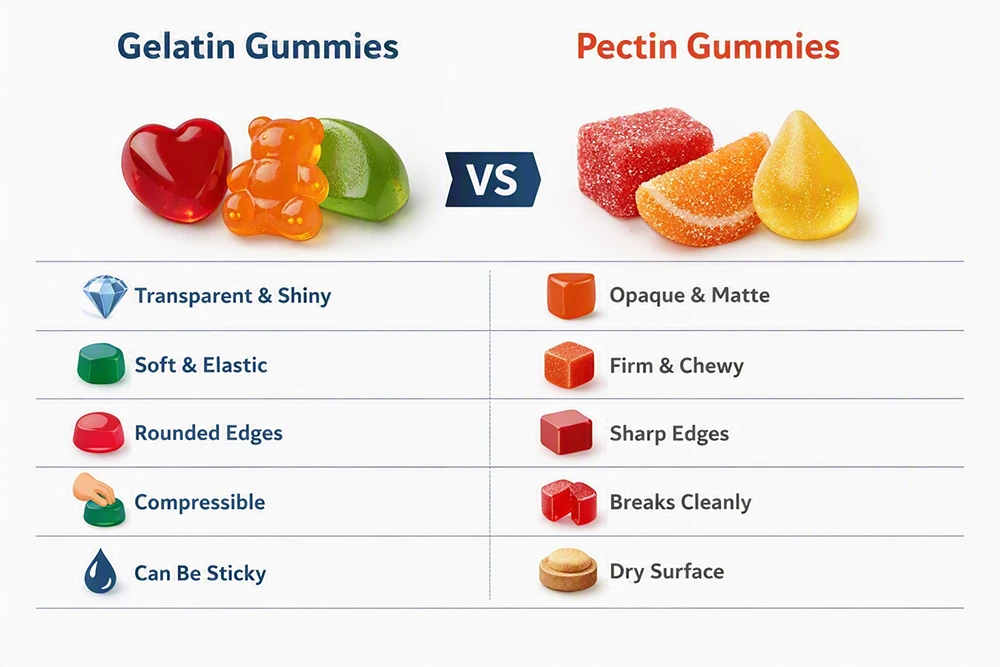
| Vegan | Required for plant-based positioning; requires non-gelatin gelling system |
| Third-party lab testing | ISO 17025-accredited potency, purity, heavy metal and microbial verification |
Also verify cleanroom classification (100,000-class production, 10,000-class R&D), equipment calibration records, and the manufacturer’s track record with your specific gelling system at commercial scale.
Manufacturer Audit Checklist
- Is gummy supplement manufacturing their specialism, or a sideline from confectionery?
- Can they produce full cGMP documentation — batch records, SOPs, audit readiness?
- Do they offer formulation support, or only contract production?
- What are the MOQ and lead time for both trial and commercial runs?
- Do they understand the regulatory requirements of your target markets?
- Can they show third-party stability data, not just in-house CoAs?
- Will they support a facility audit or provide a recent third-party audit report?
- Do they offer pilot runs and post-launch reformulation support?
Frequently Asked Questions
How long does the manufacturing process take?
Sample batches typically take 2–4 weeks, extending to 4–6 weeks with stability trials or iterative refinement. Commercial lead times run 6–12 weeks including formulation, sampling, production, testing and packaging.
What water activity should a finished gummy target?
Typically Aw 0.60–0.65, equivalent to roughly 10–12% moisture. Above that invites microbial growth and clumping; below it the product becomes brittle.
Can multiple variants be tested at once?
Yes. Comparative sample batches — two or three formulation options evaluated side by side — are standard practice in gummy R&D.
Are sample fees credited against production orders?
Many OEM and ODM manufacturers credit sample costs when the client proceeds to full-scale production, though policies vary. Confirm in writing before starting.
Does sample testing guarantee regulatory compliance?
No. Sample testing validates technical and sensory performance. Regulatory compliance depends on accurate labelling, substantiated claims and adherence to regional law, and requires a separate formal review before launch.
Is a finished formula required to begin sampling?
Not necessarily. Experienced manufacturers support co-development, advising on ingredient selection, solubility and compatibility during ideation.
How should gummies be packaged for humid climates?
High moisture-barrier packaging — PET jars with induction seals or foil pouches — plus a desiccant canister. For light-sensitive actives such as melatonin, amber or opaque packaging is required.
What is the single most common cause of a failed gummy launch?
Compressing the validation stage. Skipping pilot runs and stability work to hit a launch date is what produces sub-potent, unstable or non-compliant product at commercial scale.
About Gothink Biotech
Shenzhen Gothink Biotech Co., Ltd. is a dietary supplement and gummy manufacturer providing OEM, ODM, CMO and CDMO services worldwide. Our 100,000-class GMP-certified cleanroom supports daily output of 16 tons and annual capacity of 5,000 tons, with a 10,000-class pharmaceutical-grade R&D laboratory conducting more than 2,000 new formulation projects annually. We hold ISO 9001, ISO 22000, HACCP, FDA, GMP, HALAL, KOSHER and Vegan certifications, apply batch-level heavy metal testing including arsenic, and support flexible MOQs from pilot batches to full-scale production. To review production formats, see our sleep support gummies collection.