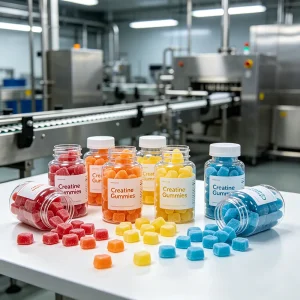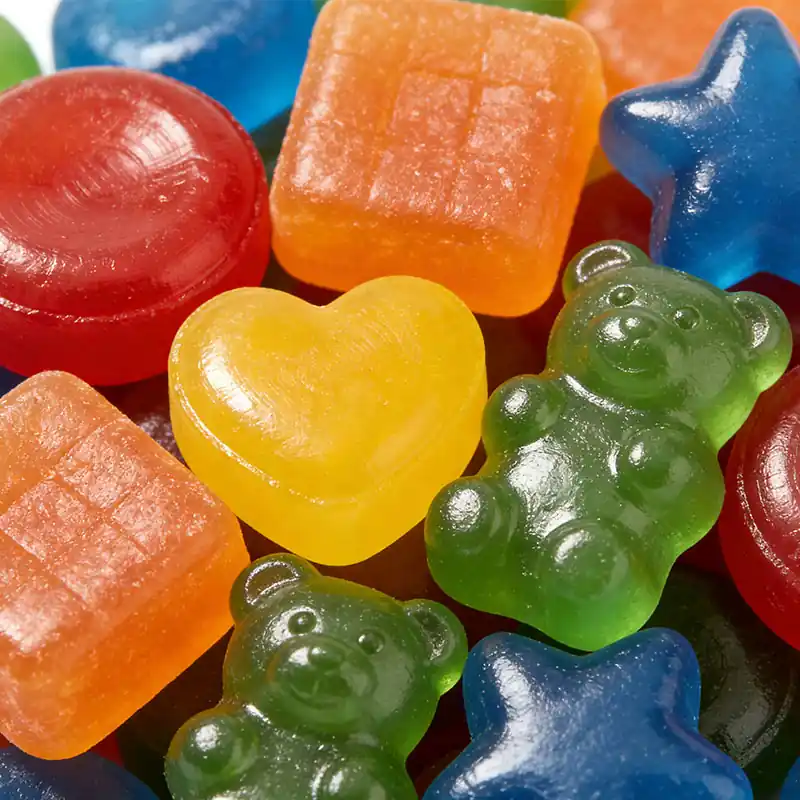

短い答え: Gummies are made by cooking a gel and sweetener base to a target Brix, adding heat-sensitive actives in a controlled cooling window, depositing the mass into molds, then cooling, drying to a target water activity, coating, testing and packaging — all under GMP conditions. At commercial scale, every stage is tied to a measurable parameter (Brix, pH, temperature, time, Aw) that decides texture, potency and shelf life.
Many brands treat グミ製造 as a scaled-up candy recipe. It is not. A formula that pours perfectly on a lab bench can fail on a line depositing thousands of pieces per minute because heat exposure is longer, water activity drifts, and active ingredients degrade. This guide walks through the commercial process used in GMP-certified facilities, the parameters that control it, and what buyers should verify before placing an OEM, ODM or private label order.
For the ingredient side of the same product, see グミは何でできているのか. For the gel-system decision specifically, see グミ製造におけるペクチンとゼラチンの比較.
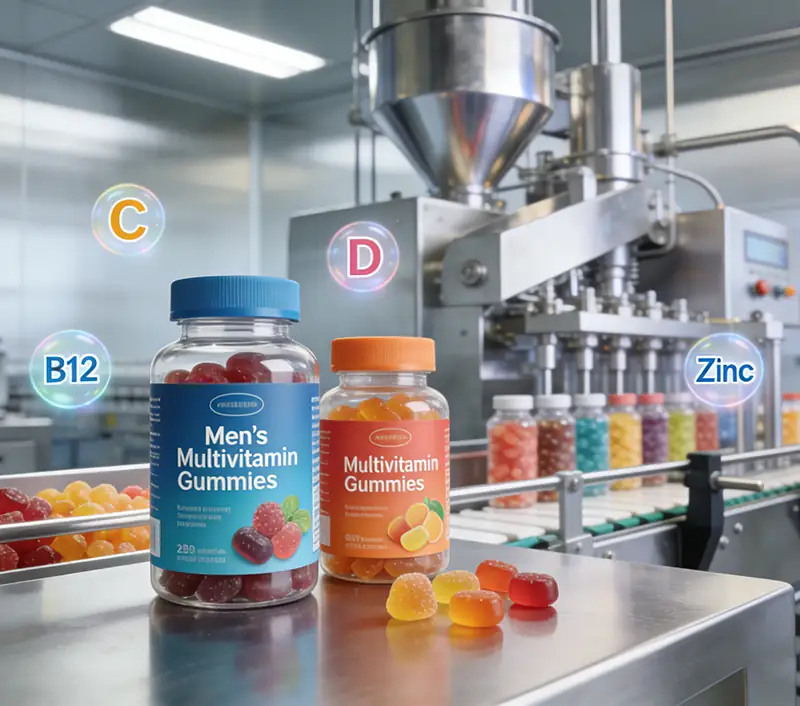
Why the Process Matters More Than the Recipe
Texture, water activity, active degradation and batch consistency are decided during manufacturing, not in the formula document alone. Four differences separate commercial production from kitchen-scale work:
- Longer heat exposure. Vitamins, probiotics and botanicals degrade faster when the mass stays hot; actives must be added at the lowest viable temperature.
- Water activity control. Most supplement gummies target Aw below 0.75 to block yeast and mold without hardening the piece.
- 投与量の正確性。 Precision depositing and weight verification are required to hold the label claim piece after piece.
- ドキュメンテーション。 GMP lines require batch records, in-process checks and traceability from raw material lot to finished goods.
The Commercial Gummy Manufacturing Process, Step by Step
Most GMP facilities follow the same core flow. A standard production runs 12 controlled stages, each with a parameter that must be hit before the batch moves on.
1. コンセプトおよび仕様のレビュー
The manufacturer evaluates target actives, dose per serving, gummy weight, gel system, flavor, claims, target market and packaging before any lab work. This is where feasibility is decided. A 500 mg calcium carbonate dose, for example, will not fit in a 2.5 g pectin gummy without texture and taste problems, so serving count or gummy weight must change early — before tooling and artwork are committed. A standard commercial gummy weighs 2.5–4.0 g.
2. Formulation Development and Compatibility Check
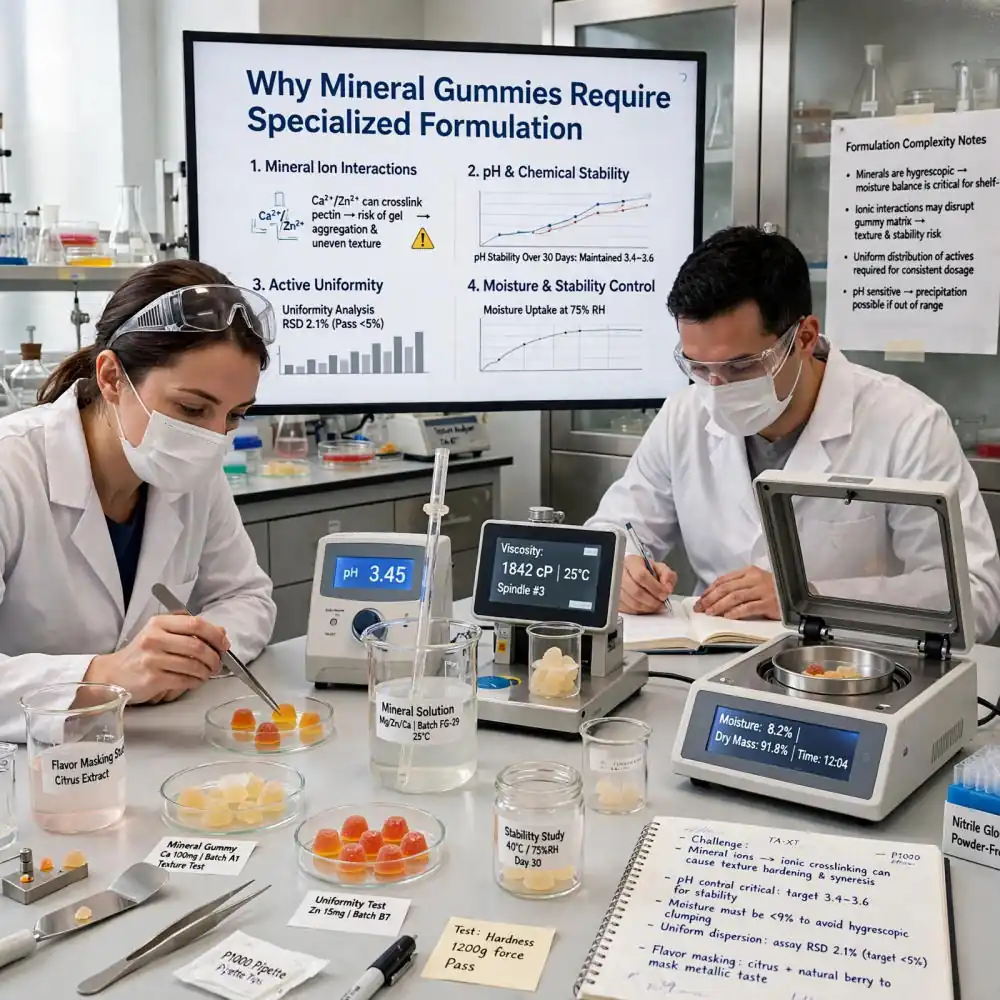
The gel system, sweetener architecture and active loading are locked here. Acidic actives such as vitamin C can hydrolyze gelatin under prolonged heat; excess acid can break a pectin gel if pH falls below 3.2 before depositing. Mineral salts add bitterness and can interact with other components. When actives exceed roughly 20–25% of gummy weight, mouthfeel and dose uniformity become difficult. Sugar-free systems replace sucrose and glucose syrup with polyols such as maltitol, often blended with erythritol or allulose, which shifts cooking targets and drying behavior.
3. Raw Material Testing, Dispensing and Pre-Weigh
Every incoming lot is tested for identity, potency and microbiology before release. Gelatin bloom strength, pectin grade, sweetener Brix and active assay are confirmed; color and flavor are matched to standards because natural colors shift with pH and heat. Pre-weighed materials are staged for the batch under documented control — no exceptions on a GMP line.
4. ゲルの調製と砂糖の調理
The gel is hydrated separately while sugar, glucose syrup (or polyol) and water are cooked in jacketed or vacuum vessels to target soluble solids. Typical endings: 76–80 Brix for pectin systems, 75–78 Brix for gelatin; some formulas cook the syrup to 110–130°C before blending. Overheating degrades pectin gel strength and drives excess moisture loss; undercooking leaves too much water and raises water activity. For gelatin, the sugar base is cooked first and gel added after the mass cools.
5. Active Ingredient Addition — The Critical Control Point
Most vitamins, minerals and botanicals are heat-sensitive and can degrade above 100°C. The mass is cooled into a defined window before actives, acids, flavors and colors are added — commonly 70–85°C for gelatin systems and 80–95°C for pectin, with delicate actives added as low as 60–75°C. This single step is where potency is won or lost; adding too early destroys vitamin C, B vitamins, vitamin A and probiotics.
6. Mixing, Vacuum Deaeration and Homogenization
High-shear mixing and vacuum deaeration remove trapped air and distribute the active uniformly, which is what makes the dose consistent across the batch. Uniform dispersion matters more than overage for potent actives such as vitamin D3, zinc or melatonin.
7. 金型への充填
The cooked mass moves to depositors that fill starch or silicone molds to a target piece weight. Starch moguls suit high-volume runs because starch absorbs excess moisture; silicone molds are reusable and release easily. Depositing accuracy against the weight specification is the primary dosing control.
8. 冷却と硬化
Trays pass through cooling tunnels where the gel matrix sets. Gelatin typically needs 30–60 minutes at 10–18°C; pectin can set faster but requires tight pH control. Gelatin is more forgiving; pectin is sensitive to calcium, acid timing and soluble solids.
9. Demolding and Cleaning
Set pieces are demolded and screened to remove starch residue or excess oil before conditioning.
10.乾燥とコンディショニング
Gummies are held in humidity- and temperature-controlled rooms, usually 12–48 hours depending on size, gel type and humidity, to reach target water activity and moisture. Target Aw is commonly 0.60–0.75. Hygroscopic ingredients such as magnesium, potassium chloride, honey or glycerin pull water back in and require tighter control. Drying too far creates a hard texture and weight loss.
11.コーティングと研磨
Optional oil or wax coating improves shine, reduces sticking and supports shelf stability. Coating thickness is typically 1–5 mg per unit, controlled by tumbling time and coating viscosity.
12. Inspection, Testing, Packaging and Release
Batches pass metal detection and visual inspection, then finished-product testing for active assay, water activity, texture, microbiology, heavy metals and moisture. potency verification uses HPLC on representative samples, with a Certificate of Analysis confirming units meet the label claim. Batch traceability is maintained from raw material lot to finished goods lot before release.
Key Process Parameters at a Glance
| Typical commercial target | 重要性 | |
|---|---|---|
| Syrup solids, pectin | 76–80 Brix | Gel strength and final texture |
| Syrup solids, gelatin | 75–78 Brix | Moisture and depositing performance |
| Syrup cooking temperature | 110–130°C (formula dependent) | Sets final moisture; too high degrades actives |
| Active addition window | 60–95°C by gel and active stability | 熱劣化を防ぐ |
| Gelatin setting | 30~60℃で10~18分 | Proper gel structure before demolding |
| 水分活性(Aw) | 0.60–0.75 (below 0.75) | Microbial stability and non-sticky texture |
| Drying / conditioning | 12-48時間 | Locks texture and shelf life |
| Standard gummy weight | 2.5〜4.0 g | Caps how much active dose can be carried |
| Active loading limit | roughly 20–25% of gummy weight | Above this, texture and mouthfeel fail |
Complete ingredient categories and formulation strategy are covered in グミは何でできているのか.
How the Gel System Changes the Process
Gel choice determines cooking window, depositing temperature, setting time and claim — not just mouthfeel. Gelatin gives an elastic chew, lower depositing temperature (about 80–90°C), good clarity and faster, more forgiving setting, but it is not vegan and can melt in high ambient heat. Pectin gives a shorter, tender bite, higher heat resistance and vegan/halal/kosher eligibility, but needs precise pH and Brix control and more careful drying. Hybrid starch–pectin or pectin–gelatin systems are used to balance texture and cost. A full head-to-head comparison is in pectin vs gelatin for gummy brands.
Scale-Up: From Pilot to Commercial Volume
Scale-up is the highest-risk transition. A formula that behaves at bench scale can drift in Brix, pH or depositing weight at volume. The process should be bridged deliberately: lock the specification, run a pilot batch, then validate at commercial depositing speed with weight checks and stability data. In a large facility such as Shenzhen Gothink Biotech Co., Ltd., production runs in a GMP-certified plant with a 100,000-class cleanroom, a 10,000-class R&D laboratory, roughly 16 tons of daily capacity and about 5,000 tons of annual capacity. Scale-up there focuses on depositing accuracy, controlled drying and release testing rather than simply enlarging a recipe.
Quality, Compliance and Certifications
Commercial gummy production should take place in facilities certified to GMP, with ISO 9001, ISO 22000 and HACCP systems and FDA facility registration for the U.S. market. Depending on target markets, HALAL, KOSHER and Vegan certification may be required. For export production, third-party testing for potency, microbiology and heavy metals adds credibility. Buyers should verify:
- In-process checks at cooking (Brix, temperature, pH) and after drying (Aw, moisture)
- Finished-product assay by HPLC and a matching Certificate of Analysis
- Batch records and full lot traceability
- Allergen controls and validated cleaning procedures for shared lines
Cost, MOQ and Lead Time Drivers
For an established formula with standard ingredients, a typical timeline is 3–5 weeks: 2–4 weeks of pre-production (formulation finalization and trial batch) plus 1–2 weeks for production, QC and packaging. Novel formulations take longer. Most トップメーカーが require 5,000–10,000 units per SKU; lower minimums of 1,000–3,000 units exist at a 15–25% per-unit premium, while orders above 50,000 units earn volume discounts. Gummies cost roughly 20–40% more per unit than tablets because of ingredient complexity and the curing phase, but they reach market 3–5× faster on formulation and consumer acceptance. Standard gelatin/sugar gummies hold 24–36 months shelf life at 15–25°C; delicate actives such as probiotics, omega-3s and adaptogens reduce this to 12–18 months.
How to Evaluate a Gummy Manufacturer
Generic assurances do not qualify a partner for a heat-sensitive, botanically loaded or vegan gummy. Verify measurable capability instead:
- GMP-certified facility with controlled cleanroom production and an in-house analytical lab
- Formulators with direct experience in your target gel system and actives
- Transparent documentation: CoA, spec sheets and stability data, not just ingredient certificates
- A documented stability plan — accelerated conditions for an early read, real-time confirmation at the sellable climate, with assays for potency, Aw, texture, color and microbes at set timepoints
- Capacity to scale from pilot to commercial volume without losing depositing accuracy
グミプロジェクトのブリーフィングにおけるよくある間違い
- Specifying a dose that cannot physically fit the intended gummy weight
- Choosing a gel system from a trend rather than from the claim and stability requirement
- Drying to a moisture percentage instead of a water-activity target
- Assuming shelf life can be borrowed from a similar recipe instead of running a stability plan
- Committing to artwork and MOQ before a pilot batch confirms texture and assay
よくある質問
How long does commercial gummy manufacturing take?
For an established formula, typically 3–5 weeks including trial batch, production, QC and packaging. Novel formulations with new actives require additional formulation and stability time.
最低注文数量はどれくらいですか?
Commonly 5,000–10,000 units per SKU. Trial batches of 1,000–3,000 units are available at a premium; volume discounts begin around 25,000–50,000 units.
How is dosage accuracy verified?
Through precise weighing, automated depositing with in-line weight checks, and finished-product HPLC assay with a CoA confirming units meet the label claim.
What certifications should a gummy manufacturer hold?
At minimum GMP and FDA facility registration for the U.S. market; ISO 9001, ISO 22000 and HACCP for quality and food-safety systems; HALAL, KOSHER and Vegan as required by target markets.
Why do my gummies get sticky or clump?
Usually excessive water activity, inadequate drying or insufficient coating. Ask for the Aw target and shelf-life stability data rather than a generic assurance.
Are gummies more expensive than tablets?
Yes — roughly 20–40% more per unit due to gelling agents, humectants, flavorings and a longer production cycle — but they typically reach market faster and score higher on consumer adherence.