
A Manufacturer’s Guide for Supplement Brands, Private Label Buyers & Wholesale Buyers
Abstract
| Creatine gummies have gained significant traction in the sports nutrition and functional supplement markets. Yet one question consistently arises — both from end consumers and from supplement brand owners, private label buyers, and gummy wholesale purchasers: how much creatine is actually in a creatine gummy, and is it enough to be effective?
This article examines standard dosing across the industry, the formulation science behind gummy manufacturing for creatine, bioavailability considerations, and what supplement brands or private label gummy buyers should evaluate when choosing a creatine gummy manufacturer or sourcing gummy bulk and wholesale. The goal is to provide clear, evidence-informed answers — not marketing claims. |
1. Why Creatine Gummies Are Growing in the Supplement Market
Creatine monohydrate is one of the most extensively studied ergogenic aids in sports science. Traditionally delivered as a powder or capsule, creatine has seen a format shift in recent years toward gummies — driven by consumer demand for convenient, palatable, and easy-to-dose supplement formats.
For supplement brands, this shift represents a real commercial opportunity. Gummy manufacturing now accounts for one of the fastest-growing segments of the dietary supplement industry, and creatine gummies are among the most searched functional gummy SKUs on retail and DTC platforms.
However, the format shift brings a legitimate formulation challenge: creatine monohydrate has a relatively high effective dose (3–5g per day for maintenance), and packing that dose into a small, shelf-stable, consumer-friendly gummy requires either a multi-gummy serving structure or very high creatine concentration per piece.
2. How Much Creatine Is Typically in One Gummy?
The honest answer is: it varies considerably by product design and manufacturer capability. However, the industry has converged around a few common structures:
| Product Type | Creatine per Gummy | Typical Daily Serving |
| Entry-level / budget gummies | 500 mg – 750 mg | 6–10 gummies/day |
| Standard market gummies | 1,000 mg (1g) | 3–5 gummies/day |
| High-dose gummies | 1,500 mg – 2,000 mg | 2–3 gummies/day |
| Premium / clinical-grade gummies | 2,500 mg – 3,000 mg | 1–2 gummies/day |
The most common commercially viable format for mid-to-premium supplement brands is the 1,000 mg (1g) per gummy structure, with a serving size of 3–5 gummies to deliver 3–5g of creatine monohydrate — which aligns with established clinical maintenance dosing.
3. What Does the Science Say About Effective Creatine Dosing?
Before evaluating a creatine gummy product — whether you are a brand owner, a private label gummy buyer, or a bulk buyer — it is important to understand the established dosing context from published research:
- Maintenance dose: 3–5g of creatine monohydrate per day is the widely accepted maintenance protocol supported by research, including position papers from the International Society of Sports Nutrition (ISSN).
- Loading phase: Some protocols use a short-term loading phase of approximately 20g/day (split into four 5g doses) for 5–7 days, followed by the maintenance dose. Not all consumers or products use a loading protocol.
- Saturation model: Creatine works by saturating muscle phosphocreatine stores over time. Daily consistency matters more than timing or precise method of delivery.
This means that for a creatine gummy product to be considered functionally dosed, each serving must deliver a minimum of 3g of creatine — regardless of how many individual gummies that requires. Products delivering significantly less than 3g per serving are underdosed by research standards and should be clearly disclosed as such.
| Key Point | Check the supplement facts panel, not just the label marketing. Look for the total creatine per serving, not per gummy. This is where the real formulation transparency lies. |
4. Formulation Challenges in Creatine Gummy Manufacturing
From a gummy manufacturing perspective, creatine monohydrate is a demanding active ingredient. Understanding these challenges helps brand owners and private label buyers make informed sourcing decisions when selecting a creatine gummy manufacturer or evaluating gummy bulk options.
4.1 High Required Dose vs. Gummy Format Constraints
The primary formulation challenge is density. A standard gummy weighs approximately 2–5g total. Packing 1–3g of creatine monohydrate into a single gummy means the active ingredient can constitute 30–60% of the total gummy mass. This places significant constraints on texture, flavor profile, mouthfeel, and structural integrity.
Manufacturers must balance active ingredient load against the functional roles of gelling agents (such as pectin or gelatin), humectants, sweeteners, flavoring agents, and acidulants. At very high creatine concentrations, maintaining gummy texture without grittiness becomes technically demanding.
4.2 Creatine Stability in Gummy Matrices
Creatine monohydrate can degrade to creatinine — its inactive metabolite — under acidic pH conditions and elevated temperatures. Gummy manufacturing inherently involves heat and moisture, and finished gummies are mildly acidic due to the presence of citric or malic acid flavor systems.
Quality creatine gummy manufacturers address this through:
- Precise pH management during the cooking and molding process
- Controlled moisture activity (Aw) in the finished product
- Appropriate packaging — typically with desiccants and moisture-barrier laminates
- Shelf-life stability testing using HPLC to verify creatine content vs. creatinine levels at the end of shelf life
4.3 Gelling Agent Selection
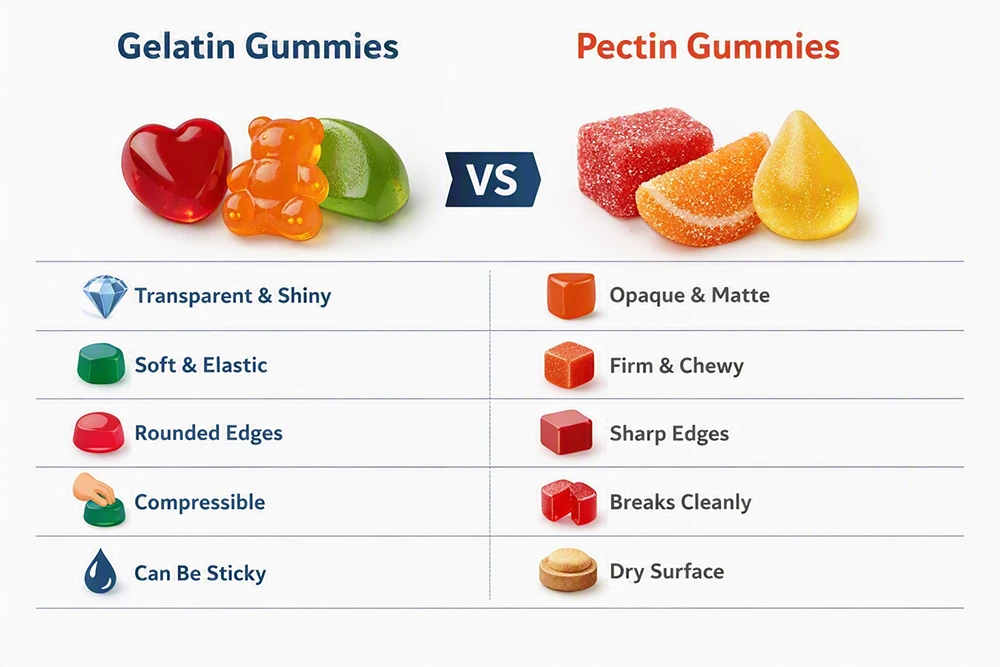
The choice of gelling agent affects both the texture and the dosing density achievable. Gelatin-based gummies offer high elasticity and can support dense active ingredient loads, but are unsuitable for vegan or halal consumers. Pectin-based vegan gummies are increasingly popular but require tighter processing controls at high active concentrations. Some manufacturers use hybrid systems or modified starch blends to achieve specific textural targets.
For private label gummy buyers and brands sourcing gummy wholesale, it is worth specifying whether your target market requires vegan, halal, or kosher certification — as this directly affects the gelling system and, consequently, the achievable creatine load per piece.
5. What to Look for When Sourcing a Creatine Gummy Manufacturer
For supplement brands, online sellers, or wholesale buyers looking to launch or expand a creatine gummy SKU, the following criteria are meaningful indicators of a capable and compliant creatine gummy manufacturer:
5.1 GMP Certification and Cleanroom Production Standards
Good Manufacturing Practice (GMP) certification is a baseline requirement for any reputable gummy manufacturing facility. Look for facilities that operate ISO-certified cleanrooms — typically 100,000-class environments for dietary supplement gummy production. Pharmaceutical-grade R&D laboratories (10,000-class) within the same facility indicate a higher level of formulation capability.
5.2 In-House R&D and Formulation Support
Creatine gummies are not a plug-and-play formulation. A manufacturer with an in-house R&D team, ideally with scientific advisors experienced in nutraceutical formulation, is better positioned to:
- Optimize creatine load while maintaining texture and palatability
- Develop stable formulations with demonstrated shelf-life data
- Customize flavor, shape, and color for brand differentiation
- Conduct ingredient compatibility studies if combining creatine with co-ingredients
5.3 Transparent Certificate of Analysis (CoA) Practices
Every batch of creatine gummies should be accompanied by a CoA that includes active ingredient assay (creatine monohydrate content), creatinine levels (stability marker), microbial testing, heavy metals, and moisture/Aw data. Brands should request third-party verified CoA data from prospective manufacturers rather than relying solely on self-reported data.
5.4 Flexible MOQ and Gummy Bulk / Wholesale Capabilities
Many supplement brands — particularly startups, online sellers, and emerging labels — need a manufacturer that supports flexible minimum order quantities (MOQ) for initial market trials, alongside full-scale gummy bulk and gummy wholesale capacity for growth-stage production. This flexibility is a meaningful operational advantage when validating a new SKU.
5.5 End-to-End OEM/ODM Support
For brands that do not have in-house formulation or regulatory teams, a manufacturer offering full OEM (Original Equipment Manufacturing) and ODM (Original Design Manufacturing) services covers the entire production chain: formulation development, sourcing of raw materials, manufacturing, packaging design, compliance documentation, and export logistics.
| Buyer Tip | When evaluating a private label gummy or gummy wholesale supplier, request a sample batch with a full CoA before committing to production. Verify the declared creatine content using an independent third-party lab. |
6. Creatine Gummies vs. Creatine Powder: Is the Format Worth It?
This is a question supplement brand owners frequently ask when deciding whether to invest in a creatine gummy SKU vs. maintaining a traditional powder or capsule product.
| Factor | Creatine Gummy | Creatine Powder/Capsule |
| Consumer compliance | High — no mixing, portable | Moderate — requires preparation |
| Dosing precision | Moderate — per-gummy units | High — freely adjustable |
| Manufacturing complexity | High — active formulation required | Low to moderate |
| Cost per serving | Higher due to manufacturing complexity | Lower |
| Retail differentiation | Strong — premium perception | Competitive, commoditized |
| Target demographic | General consumers, lifestyle users | Athletes, experienced users |
The conclusion is not that one format is superior — rather, they serve different market segments and purchase motivations. For brands targeting lifestyle-oriented consumers, gym newcomers, or e-commerce channels where packaging differentiation drives conversion, creatine gummies present a compelling SKU. For brands serving performance-focused, experienced athletes, powder remains the cost-efficient staple.
7. Labeling and Regulatory Considerations for Creatine Gummies
For supplement brand owners and private label gummy buyers, regulatory compliance in labeling is non-negotiable. Below are the key considerations:
- Supplement Facts Panel: Must declare creatine monohydrate content per serving size (in grams), with serving size stated in number of gummies. Per-gummy content must be calculable from this data.
- FDA Dietary Supplement Regulations (21 CFR Part 111): Manufacturing facilities selling into the U.S. market must comply with Current Good Manufacturing Practice (cGMP) regulations. Verify that your creatine gummy manufacturer holds FDA registration and follows cGMP standards.
- Third-Party Testing & Claims: If making structure/function claims (e.g., “supports muscle strength”), these must be substantiated and a notification filed with FDA. Creatine monohydrate has a well-established safety and efficacy profile, making such claims generally defensible with citation of peer-reviewed literature.
- International Markets: Export requirements for creatine gummy products vary significantly. Brands targeting EU, UK, Canada, or Asian markets should confirm that their gummy manufacturer can provide the relevant compliance documentation (e.g., EFSA dossiers for the EU, Health Canada NPN for Canada).
8. How to Evaluate a Creatine Gummy Sample Before Bulk or Wholesale Purchase
If you are a supplement brand, distributor, or wholesale buyer sourcing creatine gummies in gummy bulk or through a white label gummy supplier, evaluating samples systematically before committing to a production run is essential. Here is a practical evaluation framework:
Step 1 — Sensory Evaluation
Assess texture (not gritty or excessively hard), flavor (no strong chemical aftertaste from creatine), color uniformity, and dimensional consistency across the sample batch.
Step 2 — Label vs. CoA Verification
Request a batch Certificate of Analysis and verify that the declared creatine content per gummy matches what is stated on the label. Cross-check creatinine levels as a stability and quality indicator.
Step 3 — Third-Party Lab Testing
For significant gummy bulk purchases or ongoing private label gummy programs, commission an independent third-party laboratory analysis (HPLC for creatine assay) from at least one sample batch before establishing the supplier relationship.
Step 4 — Shelf-Life Data
Ask for accelerated shelf-life stability data or real-time stability reports. At minimum, request data at the 12-month mark to confirm creatine retention under standard storage conditions (25°C / 60% RH).
Step 5 — Manufacturing Audit or Certification Review
Request copies of GMP certificates, FDA registration, ISO certifications, and any relevant quality certifications (HACCP, HALAL, KOSHER, Vegan) applicable to your target market. For larger volume gummy wholesale programs, consider requesting a facility audit or third-party audit report.
Article Summary
| Key Takeaways
• Most creatine gummies contain 500 mg to 3,000 mg of creatine monohydrate per gummy, with 1,000 mg per gummy being the most common commercial standard. • An effective creatine serving requires 3–5g of creatine monohydrate per day, consistent with established sports nutrition research. Products should deliver this within a reasonable serving size. • Gummy manufacturing with high-dose creatine is technically demanding — stability, texture, and active ingredient concentration must be carefully balanced through professional formulation. • Brand owners, private label gummy buyers, and gummy wholesale purchasers should evaluate creatine gummy suppliers based on GMP certification, R&D capability, CoA transparency, and shelf-life data — not solely on price. • Creatine gummies serve a different market segment than powders — primarily lifestyle and convenience-oriented consumers — and can command premium retail positioning when properly formulated and branded. |
Frequently Asked Questions (FAQ)
Q: How much creatine should be in a creatine gummy for it to be effective?
A: The entire daily serving — typically 3–5 gummies — should deliver a combined 3g to 5g of creatine monohydrate. This aligns with the maintenance dose supported by the International Society of Sports Nutrition (ISSN) and other sports science organizations. A single gummy containing only 500 mg and taken in isolation would be significantly underdosed.
Q: Is creatine stable in gummy form?
A: Creatine monohydrate can degrade to creatinine under acidic or high-temperature conditions. Professionally manufactured creatine gummies from reputable gummy manufacturing facilities address this through pH control, moisture management, appropriate packaging, and stability testing. Always request a CoA that includes creatinine levels as a quality indicator.
Q: Can I launch a private label creatine gummy without my own formulation?
A: Yes. Many creatine gummy manufacturers offer ODM (Original Design Manufacturing) services where the manufacturer provides a tested, ready-to-brand formulation. This reduces development time and cost. Alternatively, OEM services allow you to bring your own formula and have it produced under contract. Both options are widely available in the gummy contract manufacturing industry.
Q: What certifications should I look for in a creatine gummy manufacturer?
A: At minimum, look for GMP certification and FDA registration for products sold in the U.S. market. Additional certifications such as ISO9001, ISO22000, HACCP, HALAL, KOSHER, and Vegan are relevant depending on your target market. These certifications signal production environment quality, quality management systems, and food safety practices.
Q: What is a reasonable MOQ for a creatine gummy private label program?
A: MOQ varies significantly by manufacturer and product complexity. Entry-level or startup-focused creatine gummy manufacturers may offer trial runs at lower MOQs, while full-scale gummy bulk and wholesale programs typically start at higher quantities. Clarify MOQ requirements, lead times, and pricing tiers before committing to a production partnership.
Q: Are vegan creatine gummies possible, and does the gelling agent affect creatine content?
A: Yes — pectin-based vegan creatine gummies are commercially viable. The gelling agent affects texture, processing conditions, and the achievable active ingredient density per piece. Vegan gummies using pectin may require slightly adjusted formulations to achieve the same creatine load as gelatin-based gummies, but this is manageable with experienced gummy manufacturing partners.
Q: How do I verify the creatine content in gummies I purchase in gummy bulk?
A: Request a batch Certificate of Analysis (CoA) with HPLC-based creatine assay data. For significant purchasing commitments, commission an independent third-party laboratory test from a sample of the bulk batch before accepting the full order. This is standard practice in responsible supplement sourcing.
About Gothink Biotech — Gummy Manufacturing & Dietary Supplement Manufacturer
| Shenzhen Gothink Biotech Co., Ltd.
Gothink Biotech is a GMP-certified gummy manufacturing and dietary supplement manufacturer based in Shenzhen, China, offering comprehensive OEM, ODM, CMO, and CDMO services to supplement brands, private label buyers, online sellers, retailers, and startups worldwide. Our production capabilities span the full range of supplement formats — including gummy, capsule, tablet, powder, liquid, and drop — with a daily output of 16 tons and an annual manufacturing capacity of 5,000 tons. Our GMP-certified facility operates a 100,000-class cleanroom, and our R&D laboratory meets 10,000-class pharmaceutical-grade standards. For gummy-specific production, we support private label gummy programs, white label gummy products, gummy bulk production, gummy wholesale supply, and fully custom OEM/ODM development. We formulate and manufacture across more than 30 gummy shapes and a wide range of functional categories — including creatine gummies, multivitamin gummies, probiotic gummies, sleep gummies, and more. Our scientific team is led by advisors with postdoctoral research backgrounds from Cold Spring Harbor Laboratory, Emory University, and The Ohio State University. We hold certifications including ISO9001, ISO22000, HACCP, FDA, HALAL, GMP, KOSHER, and Vegan — ensuring regulatory alignment for global market access. From initial formulation consultation and raw material sourcing through to manufacturing, quality control, packaging, and export — we provide end-to-end turnkey solutions designed to help your brand reach market efficiently, compliantly, and at scale. Website: gttbio.com | Creatine Gummies: gttbio.com/creatine-gummies-manufacturer/ |