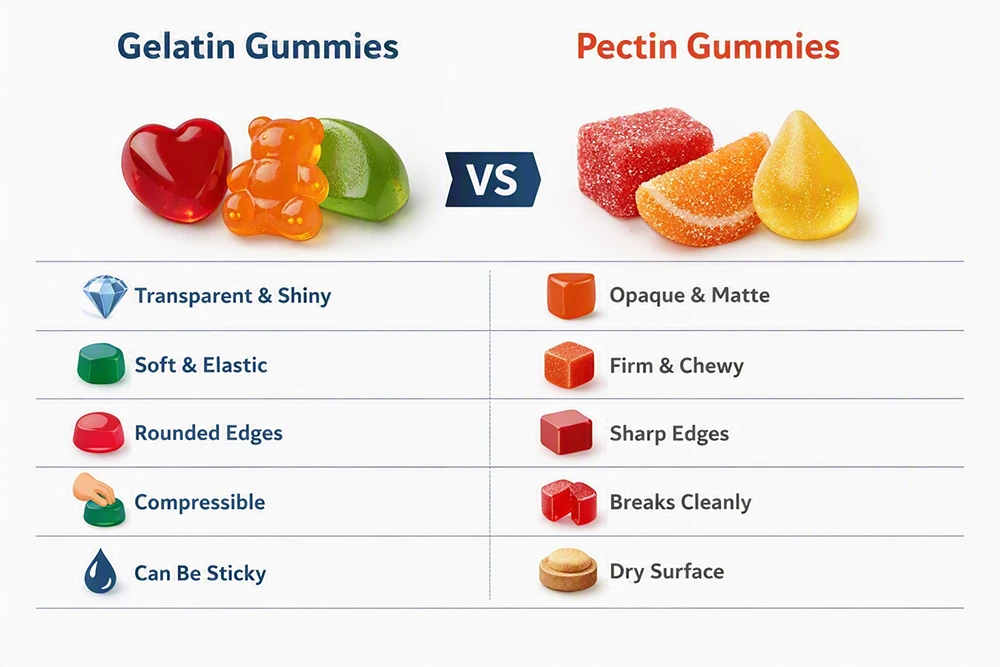

Executive Summary:As the “snackification” of the supplement industry accelerates, Creatine Gummies have emerged as a high-growth category. However, the market is currently plagued by quality inconsistencies—specifically the degradation of active creatine into creatinine. This article provides an authoritative comparison between traditional powders and modern gummies, exposing the technical challenges of manufacturing and offering strategic insights for brands looking to source high-efficacy dietary supplements.
1. The Convenience Revolution: Why Creatine is Moving Beyond the Shaker
For decades, Creatine Monohydrate powder has been the gold standard for muscle recovery and performance. Yet, despite its efficacy, the “powder fatigue”—clumpy textures, the need for shaker bottles, and the lack of portability—has created a massive market opening.
Consumers today demand “frictionless” health. Creatine gummies transform a chore into a treat, significantly increasing user compliance and subscription retention. For supplement brands, this shift represents a premium positioning opportunity with higher margins than the increasingly commoditized powder market.
2. The Technical Paradox: Creatine vs. Creatinine
The primary hurdle in producing a high-quality creatine gummy is molecular stability. Creatine is highly sensitive to heat and moisture—the two core elements of traditional gummy manufacturing.
When exposed to high temperatures during the boiling process, creatine undergoes a cyclization reaction, converting into Creatinine. Creatinine is a metabolic waste product with zero performance benefits. Many manufacturers fail to address this, resulting in products that are delicious but functionally “hollow.”
Our Manufacturing Edge:
As a specialized creatine gummy manufacturer, we utilize a proprietary Low-Temperature Cold-Press Process. By controlling the water activity (aW) and pH levels, we prevent the degradation cycle, ensuring that what is listed on the label is what reaches the consumer’s muscles.

3. Head-to-Head: Creatine Gummies vs. Creatine Powder
The following table highlights why “Active Ingredient Integrity” is the most critical factor for modern brands.
| Feature | Creatine Gummies (Premium) | Traditional Creatine Powder |
| Active Ingredient Integrity | Variable/Critical. Many brands show 30-50% under-dosing in lab tests due to degradation. Our process guarantees 95%+ retention. | High. Generally stable as a dry anhydrous powder. |
| User Compliance | Extremely high; “Grab-and-go” convenience. | Moderate; requires water, bottle, and cleanup. |
| Bioavailability | Enhanced when paired with the gummy’s glucose base (insulin spike aids uptake). | Standard; requires separate carbohydrate intake for optimal uptake. |
| Manufacturing Complexity | Very High. Requires specialized equipment to prevent heat-induced spoilage. | Low. Basic dry-blending and filling. |
| Market Potential | Massive premium/lifestyle appeal. | Saturated; driven by price wars. |
Industry Warning: Industry-wide lab audits have revealed that “budget” creatine gummies often contain high levels of creatinine. As a brand, sourcing based on price alone is a significant risk to your E-E-A-T standing with consumers.
4. How to Vet a Supplement Manufacturer: A Sourcing Checklist
To ensure your brand delivers a product that actually works, look for these three pillars of manufacturing excellence:
-
HPLC Verification: Do not settle for “Input Labels” (which only show what was added at the start). Demand High-Performance Liquid Chromatography (HPLC) testing on the finished product to prove the creatine remained stable through the cooking process.
-
Moisture Control Technology: High water content in gummies is the enemy of creatine. Ask your manufacturer about their “Water Activity” specs. A shelf-stable gummy must have a precisely calibrated moisture barrier.
-
Clean Label Matrices: Avoid “sugar-bombs.” Look for manufacturers who can balance the flavor profile using functional sweeteners that don’t interfere with the creatine’s chemical bond.
Conclusion
Creatine gummies are not just a trend; they are a technological evolution of the most researched supplement in history. While the technical challenge of preventing Creatinine conversion is real, it serves as a barrier to entry that rewards quality-focused brands. By choosing a manufacturer that prioritizes chemical stability over cheap production, you ensure your customers see the results they pay for, building long-term brand equity in the competitive dietary supplement space.

FAQ (Frequently Asked Questions)
Q: Why do some lab tests show creatine gummies have “zero” active creatine?
A: This usually happens when a manufacturer uses standard “high-heat” pectin or gelatin processes. The heat effectively converts the creatine into creatinine before the gummy even cools down. Our cold-press method eliminates this risk.
Q: Are gummies as effective as powder for muscle gain?
A: Yes, provided the dosage is correct. In fact, the small amount of sugar in a gummy can trigger an insulin response that actually helps transport the creatine into the muscle cells more efficiently than plain powder mixed with water.
Q: What is the ideal dosage per gummy for a brand to launch?
A: We recommend 1g to 1.5g of Creatine Monohydrate per gummy. This allows consumers to easily customize their dose (e.g., 3-5 gummies a day) without feeling overwhelmed by “candy” consumption.