
Creatine gummies are an emerging supplement format that delivers creatine monohydrate — one of the most widely researched performance ingredients — in a chewable, consumer-friendly form. For supplement brands, understanding whether creatine gummies are a viable product depends on evaluating ingredient stability, formulation feasibility, consumer demand trends, and manufacturing considerations. This guide examines the practical value of creatine gummies from both a product and B2B sourcing perspective.
1. Definition
Creatine gummies refers to chewable gummy supplements formulated with creatine monohydrate (or alternative creatine salts) as the primary active ingredient, combined with gelling agents such as pectin or gelatin, sweeteners, flavorings, and stabilizers. Unlike traditional creatine powders or capsules, creatine gummies deliver the ingredient in a palatable, ready-to-consume format without mixing or swallowing large tablets.
2. What Are Creatine Gummies?
Overview and Format
Creatine is one of the most extensively studied ergogenic aids in sports nutrition, primarily used to support high-intensity exercise performance and muscle energy metabolism. Creatine gummies adapt this well-established ingredient into a confectionery-style delivery system, targeting consumers who prefer alternatives to powders and pills.
A standard serving typically contains 3–5 grams of creatine monohydrate spread across multiple gummies. Because creatine dosing requirements are relatively high compared to vitamins or botanical extracts, gummy formulations must carefully manage serving size, gummy weight, and active ingredient loading per piece.
Industry Background and Market Context
The global creatine supplement market has seen steady growth driven by sports nutrition, fitness, and emerging wellness segments. Simultaneously, the broader gummy supplement category has expanded rapidly across demographics — from children’s vitamins to adult health and performance products. The convergence of these two trends has made creatine gummies manufacturer services increasingly sought after by brands looking to differentiate in a competitive market.
Consumer research indicates that taste, convenience, and format preference are major purchasing drivers, particularly among younger demographics and fitness newcomers who may find powders inconvenient or off-putting. Creatine gummies directly address these adoption barriers.
Business Relevance and Market Demand
For supplement brands, private label creatine gummies represent a product expansion opportunity with strong consumer appeal. The format enables brands to enter the performance nutrition space without relying on the commodity powder segment, where price competition is intense. Gummy differentiation allows for higher retail price points, branded flavors, and cross-selling opportunities within existing gummy product lines.
Demand is particularly visible in e-commerce channels, where consumer reviews and repeat purchase data consistently favor taste-forward supplement formats. Retailers and direct-to-consumer (DTC) brands have both identified creatine gummies as a viable SKU for broadening their sports and active nutrition assortment.
Differences vs. Alternative Formats
Compared to creatine powders, gummies offer superior palatability and portability but present formulation challenges around ingredient loading — each gummy can typically hold 500–750 mg of active ingredient, requiring 4–8 gummies per serving to achieve a 3–5 g dose. Compared to capsules, gummies require no water and offer a more appealing sensory experience, though the manufacturing process is more complex and moisture-sensitive. Compared to chewable tablets, gummies deliver a softer texture and are generally perceived as more premium by consumers.
Key Advantages
The primary advantages of creatine gummies for brands include: strong consumer acceptance due to flavor and texture, reduced friction for daily compliance (users are more likely to maintain consistent dosing), compatibility with mainstream retail environments, and alignment with the broader functional confectionery trend. The format also enables flavor customization and co-branding flexibility that powders and capsules do not readily support.
Key Limitations
Manufacturers must address several limitations when choosing to make creatine gummies. First, creatine monohydrate has limited solubility and can affect gummy texture if not properly handled during formulation. Second, the relatively high serving dose means either larger gummies, more gummies per serving, or the use of concentrated creatine forms (such as buffered creatine or creatine HCl, which offer higher solubility but higher raw material cost). Third, moisture management during production and packaging is critical, as creatine gummies are more susceptible to clumping and stickiness than many other gummy types. Fourth, per-gram active ingredient cost is higher in gummies than in bulk powder formats, which must be reflected in retail pricing strategy.
Who Should Consider This Format
Creatine gummies are a strong fit for brands targeting the fitness, active lifestyle, or sports nutrition categories — particularly those already operating in the gummy supplement space and seeking to expand their SKU portfolio. They are also appropriate for brands launching new lines with a consumer-friendly positioning. OEM and ODM buyers looking for differentiated products with strong retail shelf presence will find creatine gummies a viable addition to their development pipeline.
Regulatory and Quality Considerations
In the United States, creatine supplements are regulated as dietary supplements under DSHEA. Manufacturers must ensure current Good Manufacturing Practices (cGMP) compliance, accurate label claims, and appropriate third-party testing for identity, purity, and label accuracy. In the EU and other markets, applicable food supplement regulations govern labeling, permitted ingredients, and maximum levels. Brands sourcing from contract manufacturers should verify that the manufacturing facility holds GMP certification and can supply full documentation including Certificate of Analysis (COA) for each production batch.
What Businesses Should Evaluate Before Sourcing
Before entering production, brands should evaluate: the manufacturer’s experience with high-dose active ingredient gummies, available creatine input forms (monohydrate vs. HCl vs. buffered), moisture and stability testing protocols, shelf-life data, minimum order quantities, lead times, and the level of formulation development support offered. Businesses should also assess packaging compatibility — creatine gummies typically require moisture-barrier packaging such as aluminum foil pouches or sealed bottles with desiccant.
3. Technical Parameter Table
| Parameter | Details |
|---|---|
| Product Form | Chewable gummy; available in bear, round, cube, or custom shapes |
| Primary Active Ingredient | Creatine monohydrate (most common); also creatine HCl, buffered creatine (Kre-Alkalyn) |
| Typical Serving Dose | 3–5 g creatine per serving (4–8 gummies depending on gummy weight and active load) |
| Active Ingredient Load per Gummy | Typically 500–750 mg per piece |
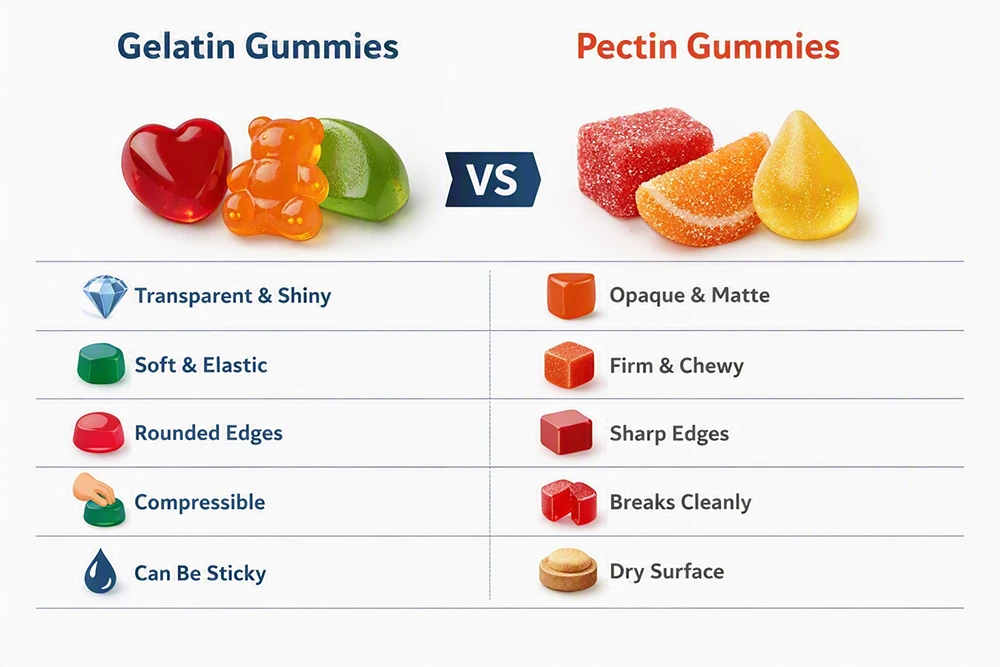
| Gelling Agents | Pectin (vegan), gelatin (non-vegan), or carrageenan; choice affects texture and target market |
| Additional Ingredients | Sweeteners (sugar, glucose syrup, or sugar-free alternatives), citric acid, natural flavors, colors |
| Manufacturing Process | Ingredient weighing → solution preparation → active ingredient blending → molding → cooling/setting → de-molding → coating (optional) → quality inspection → packaging |
| Key Process Considerations | Creatine must be added at controlled temperatures to preserve stability; moisture management critical throughout |
| Quality Standards | GMP, ISO 9001, ISO 22000, HACCP; third-party testing for identity, potency, heavy metals, and microbiology |
| Certifications (Optional) | Halal, Kosher, Vegan (pectin-based); NSF or Informed Sport for sports market |
| Packaging Options | HDPE bottles with desiccant; resealable aluminum foil pouches; blister packs; child-resistant closures available |
| Moisture Barrier Requirement | High — creatine gummies require packaging with moisture vapor transmission rate (MVTR) protection |
| Shelf Life | Typically 18–24 months from production date under appropriate storage conditions (cool, dry, away from direct light) |
| Minimum Order Quantity (MOQ) | Varies by manufacturer; typically 1,000–5,000 units for trial runs; flexible MOQ available with some CMO partners |
| Production Scalability | Capable of scaling from sample/trial batches to full commercial production runs |
| Lead Time | Formulation development: 4–8 weeks; production lead time: 4–6 weeks depending on order volume and packaging |
| Storage Conditions | Cool, dry conditions (below 25°C, relative humidity below 60%); avoid exposure to heat and direct sunlight |
| Export Compliance | COA, SGS/third-party test reports, manufacturing license, GMP certificate; market-specific documentation available |
4. Practical Insights for B2B Buyers
Manufacturing Quality and Process Control
The quality of a creatine gummy is determined at multiple stages of production. Active ingredient incorporation must occur at temperatures that do not degrade creatine stability, and gelling agents must be selected to maintain texture under the mechanical stress of high ingredient loading. Reliable Gummy Manufacturing partners invest in controlled-environment production rooms, validated mixing equipment, and in-process quality checks to ensure batch-to-batch consistency. Buyers should request process validation data and representative COAs from recent commercial batches.
Raw Material Sourcing Transparency
Creatine monohydrate quality varies significantly by source. Buyers should confirm that their manufacturing partner sources creatine from traceable, pharmaceutical-grade or food-grade suppliers with available heavy metal testing and purity documentation. Some manufacturers can provide supply chain traceability documentation as part of a formal quality agreement. This is particularly important for brands selling into sports nutrition markets where consumers and regulatory bodies are sensitive to contamination risk.
Production Scalability and Lead Time
Brands should clearly communicate anticipated volume requirements from the outset. Gummy manufacturing involves more capital-intensive setup than capsule or powder filling, so manufacturers structure pricing around batch size. A facility capable of scaling from small trial batches to commercial volumes offers the most flexibility for brands at different stages of market development. Confirm that the manufacturing partner has documented capacity data and can provide production scheduling commitments in writing.
Compliance and Documentation Readiness
For export markets, documentation requirements go beyond a basic COA. Depending on the destination market, brands may need GMP certificates, manufacturing licenses, SGS or equivalent third-party inspection reports, and Declaration of Conformity documentation. Manufacturers that routinely serve global markets typically have standardized documentation packages that can be adapted to specific market requirements on request.
Cost Structure Considerations
Creatine gummies have a higher unit cost than equivalent creatine powder SKUs due to gummy manufacturing complexity, packaging requirements, and moisture-barrier materials. Buyers should model landed cost carefully, accounting for ingredient costs, manufacturing fees, packaging, inbound freight, duties, and any third-party testing costs. The higher manufacturing cost is generally supportable at retail given that gummy format commands premium positioning, but margin planning should be conducted rigorously before committing to production volumes.
How to Evaluate a Reliable Supplier
Key supplier evaluation criteria include: GMP certification status and audit history, gummy-specific production experience (years of operation, client references), available certifications relevant to target markets (Halal, Kosher, Vegan, NSF), in-house testing capabilities and third-party lab relationships, flexibility on MOQ and formulation customization, responsiveness and technical communication quality, and ability to provide stability testing data for creatine gummy products specifically.
5. B2B Decision Guide
How Brands Choose the Right Manufacturer
Selecting a creatine gummy manufacturer is a multi-factor decision. The most critical factors are demonstrated experience with active ingredient-loaded gummies, GMP compliance verification, and documented quality systems. Brands should avoid manufacturers that cannot supply third-party test data or that lack a formal quality management system, regardless of price competitiveness.
What Matters in OEM/ODM Projects
For OEM projects, where the brand provides the formulation, the manufacturer’s role is precision execution. For ODM projects, where the manufacturer provides formulation development, the key value-add is in formulation expertise — specifically the ability to achieve target creatine dose per serving while maintaining acceptable taste, texture, and stability. Brands should evaluate whether a manufacturer’s R&D team has direct experience with high-dose active ingredient gummies before committing to an ODM engagement. To create creatine gummies that perform well in the market, formulation collaboration between brand and manufacturer is essential.
How to Assess Production Capability
Request a factory audit or video facility tour if an in-person visit is not feasible. Confirm GMP certification is current and issued by a recognized body. Ask for production capacity documentation — daily output, cleanroom classification, and available equipment types. Review a sample COA from a recent creatine or high-potency gummy batch to assess testing depth and internal quality standards.
Key Criteria for Long-Term Partnerships
Long-term manufacturing partnerships succeed when both parties have aligned expectations on quality standards, communication protocols, and supply security. Brands should assess whether a manufacturer can support their growth trajectory — a partner appropriate for a 5,000-unit pilot may not be able to handle a 100,000-unit quarterly replenishment efficiently. Confirm scalability commitments in a written supply agreement.
Risk Control and Quality Assurance Checkpoints
Key quality checkpoints in a creatine gummy program include: incoming raw material testing (identity and purity of creatine input), in-process checks during blending and molding, finished product testing (potency, moisture content, microbiology, heavy metals), and pre-shipment inspection. Brands sourcing internationally should additionally arrange third-party pre-shipment inspection to independently verify product specifications before goods leave the facility.
6. Conclusion
Creatine gummies represent a commercially sound product opportunity for supplement brands that understand the formulation requirements and manufacturing considerations involved. The format effectively addresses consumer adoption barriers associated with traditional creatine supplements while enabling premium positioning and strong retail differentiation. For B2B buyers, the decision to develop and launch creatine gummies should be grounded in thorough supplier evaluation, realistic cost modeling, and a clear understanding of target market regulatory requirements. When produced by an experienced gummy contract manufacturer with robust quality systems, creatine gummies can serve as a durable, high-value product line addition for brands operating in sports nutrition and active wellness.
7. Frequently Asked Questions
Q: What are creatine gummies?Creatine gummies are chewable dietary supplements that deliver creatine monohydrate (or alternative creatine forms) in a gummy format. Each serving typically provides 3–5 grams of creatine across multiple gummies, offering a convenient alternative to powders and capsules.
Q: Are creatine gummies as effective as creatine powder?Creatine bioavailability is determined by the form of creatine used, not the delivery format. When formulated with pharmaceutical-grade creatine monohydrate at effective serving doses, creatine gummies deliver the same active ingredient as powder forms. The key variable for brands is ensuring sufficient creatine per serving is achievable within a practical gummy count.
Q: What quality standards apply to creatine gummy manufacturing?Creatine gummies are subject to applicable dietary supplement or food supplement regulations in each market. Manufacturers should hold GMP certification and conduct third-party testing for potency, heavy metals, and microbiological safety. In the US, DSHEA compliance and cGMP manufacturing are required. ISO 9001, ISO 22000, and HACCP certifications are additional indicators of quality system maturity.
Q: What is the typical MOQ for private label creatine gummies?Minimum order quantities vary by manufacturer. Trial or pilot runs commonly start at 1,000–5,000 units. Brands should confirm MOQ, pricing tiers, and scale-up pricing with their manufacturing partner before entering a formal development agreement.
Q: What businesses should consider before sourcing creatine gummies?Brands should evaluate manufacturer GMP certification, creatine-specific gummy formulation experience, raw material sourcing transparency, available certifications (Vegan, Halal, Kosher), packaging options suitable for moisture-sensitive products, lead times, MOQ, and full documentation support for their target export markets.
Q: How do creatine gummies compare to creatine capsules for B2B sourcing?Creatine capsules are simpler to manufacture and have lower per-unit production costs, but gummies offer significantly stronger consumer preference and retail shelf differentiation. For brands with a premium or DTC positioning, gummies typically justify the higher manufacturing cost through better repeat purchase rates and consumer loyalty.
About Shenzhen Gothink Biotech Co., Ltd.
Shenzhen Gothink Biotech Co., Ltd. is a GMP-certified dietary supplement contract manufacturer based in Shenzhen, China, offering OEM, ODM, CMO, and CDMO services to supplement brands and distributors worldwide. The company operates a 100,000-class cleanroom manufacturing facility with a daily output capacity of 16 tons and an annual production capacity of 5,000 tons, supporting both small-volume trial runs and large-scale commercial production.
Gothink Biotech specializes in gummy, capsule, tablet, powder, liquid, and drop supplement manufacturing, with in-house formulation development capability supported by a 10,000-class pharmaceutical-grade R&D laboratory. The company holds certifications including ISO 9001, ISO 22000, HACCP, GMP, Halal, Kosher, and Vegan, and conducts formulation research on approximately 2,000 new products annually.
The company provides end-to-end turnkey solutions covering ingredient sourcing, formulation development, custom packaging design, production, quality control, and export documentation support. Gothink Biotech is structured to support long-term B2B partnerships, with the flexibility to accommodate diverse market requirements and regulatory standards across global markets. Further information is available at gttbio.com.