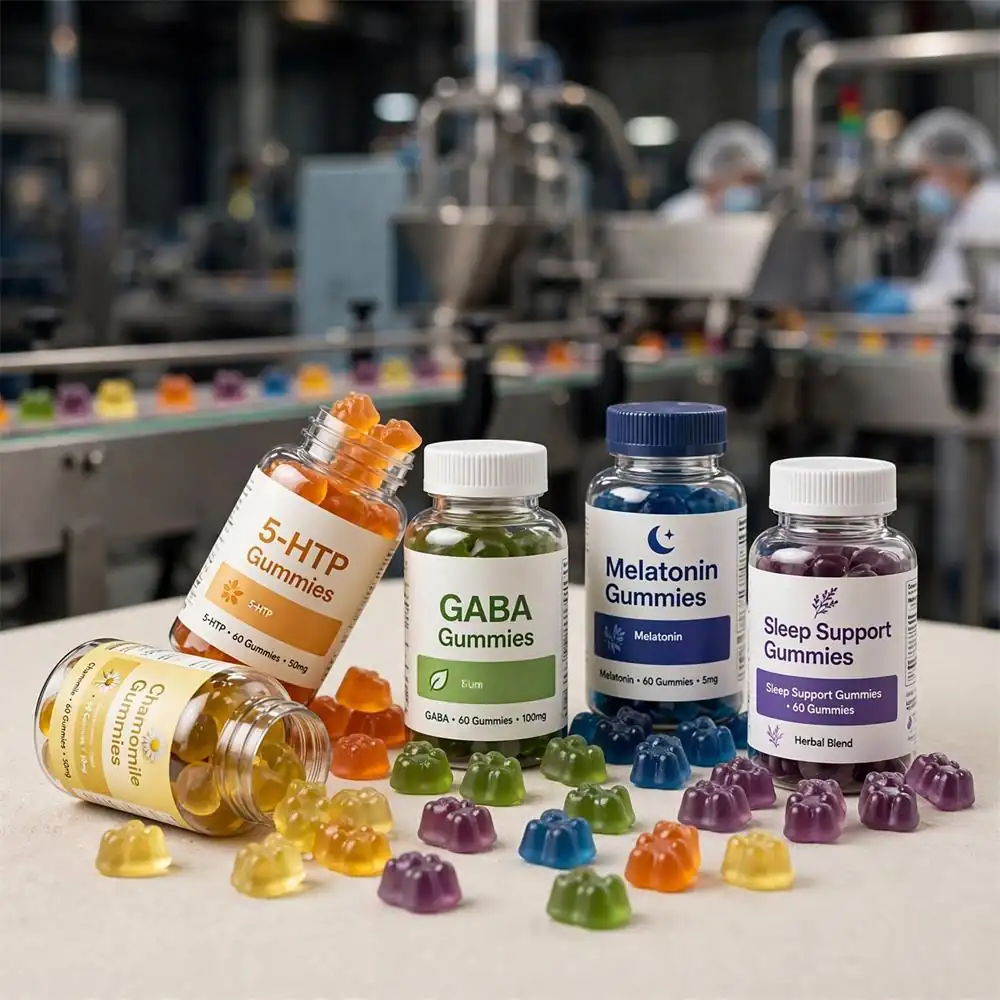

A sleep gummy that tastes good in a benchtop sample and fails in commercial production is one of the most common — and most expensive — outcomes in this category. The gap is almost never the flavour. It is the engineering: whether the actives survive the cooking phase, whether the matrix holds its structure through transit, and whether the dose is uniform across a two-ton batch.
This article walks through how a sleep gummy formulation is actually built, from the brief through to a validated pilot, and where brands most often lose money. It is one part of our complete sleep gummies manufacturing guide, which covers the category end to end.

Before You Formulate: Four Things to Lock Down
Approaching a manufacturer without these settled guarantees expensive reformulation once the kettles are already running.
- Target consumer profile. Shift worker, frequent traveller, menopausal woman, student, older adult — each implies a different active hierarchy and dosage band.
- Ingredient hierarchy and dosages. Which actives are non-negotiable, at what daily dose, and what the regulatory maximums are in your target market.
- Dietary and certification constraints. Vegan, halal, kosher and sugar-free requirements dictate your gelling system, which in turn changes cooking temperature, drying time, pH control and final texture.
- Realistic budget including tooling. Custom moulds and specialised ingredient sourcing carry costs that do not appear in unit pricing.
A formula designed around gelatin cannot simply swap in pectin later without a structural overhaul and a fresh round of stability work. Decide the gelling system early.
Step 1: Select the Gelling System First
The gelling agent is the structural matrix that suspends your actives. It determines batching chemistry, cooking parameters, depositing line speed, drying profile, active stability, certification eligibility and cost per unit. This is a manufacturing strategy decision, not a texture preference.
| Dimension | Pectin | Gelatin |
|---|---|---|
| Source | Plant-derived (citrus peel, apple pomace) | Animal collagen (bovine or porcine) |
| Vegan / Halal / Kosher | Suitable with proper line control | Not vegan; halal/kosher possible with certified source |
| Gelling mechanism | Acid plus soluble solids, or calcium cross-linking | Thermal reversible gelation |
| Texture | Firm, short bite, heat-stable | Soft, elastic, melts in mouth |
| pH requirement | Acidic, typically pH 3.0–3.8 | Neutral to mildly acidic |
| Setting speed | Slower; controlled cooling | Fast; supports high-speed lines |
| Heat tolerance (finished) | High; resists melting in transit | Low; may soften above 35°C |
| Active compatibility | Stresses acid-sensitive actives | Stresses moisture-sensitive actives |
| Raw material cost | Generally higher per kg | Generally lower per kg |
| Processing complexity | Higher — pH, buffering, staging | Lower — hydration, temperature |
| Sugar reduction | Possible with LM pectin and polyols | Easier; less dependent on solids |
For sleep products specifically, pectin is usually the default for three reasons: it tolerates the higher transit temperatures that matter in Middle Eastern and Southeast Asian distribution, it unlocks vegan and halal positioning, and it is often the more stable matrix for sensitive actives. Note that pectin is not a single ingredient — high methoxyl (HM) pectin relies on sugar solids and acidity, while low methoxyl (LM) pectin gels with calcium and is preferred for reduced-sugar formulas. Ask which grade is being recommended and why.
Step 2: Integrating Actives — Staged Addition Is Everything
Not every active belongs in a gummy, and almost none of them should be added at the same moment.
- Heat-sensitive actives require staged addition. Melatonin, certain botanical extracts and especially probiotics cannot be added to a cooking slurry at 85°C. Heat-sensitive compounds are introduced at a controlled lower temperature, or delivered in a microencapsulated or post-cooking dusted format.
- Micro-doses require homogeneity engineering. Melatonin at 1 mg in a 3 g gummy is a 0.03% inclusion. Achieving uniform distribution across a commercial batch requires validated mixing protocols and automated dosing — not a scoop.
- Fat-soluble actives require emulsification. Without it they separate, producing inconsistent dosing and oily surface defects.
- Some actives simply do not fit. High-dose ingredients — 3 g of creatine, or therapeutic magnesium doses — are physically impossible to deliver in a standard 3 g gummy. Highly reactive minerals such as iron oxidise the matrix, causing browning and off-flavours. These belong in capsules or powders.
The specific degradation pathways and control levers for melatonin, including overage practice and analytical verification, are covered in detail in our melatonin stability and dosage guide. For the wider active palette — GABA, L-theanine, chamomile, magnesium, ashwagandha — see the non-melatonin actives guide.
Step 3: Taste Masking
Taste is where sleep formulations most often fail commercially, because the actives are genuinely unpleasant.
- Melatonin carries a lingering bitter note, which is why microencapsulation is frequently specified — it solves stability and taste at once.
- Magnesium leaves a mineral, chalky aftertaste. The temptation is to increase acid to mask it — which is precisely what causes syneresis later (see below).
- Botanical extracts such as valerian are earthy and persistent, requiring a properly developed flavour system rather than a higher sugar load.
Buffering agents, not more acid, are the correct tool for balancing taste against structural integrity. A qualified flavour house working alongside the formulation team is worth the cost.
Step 4: Cooking, Depositing and Curing
- Cooking: base ingredients are mixed and heated, typically 70–90°C, often under vacuum to remove air and concentrate solids. Overcooking destroys heat-sensitive actives; undercooking causes poor gelling.
- Depositing: the warm mass is dispensed into starch or silicone moulds. Pectin and gelatin require different depositing temperatures, line speeds and mould types. Vision systems verify fill weight in real time.
- Drying and curing: gummies cure in climate-controlled rooms for 12–72 hours to reach a target water activity, typically Aw 0.60–0.65 (roughly 10–12% moisture). Too much moisture invites microbial growth and clumping; too little produces brittle, rubbery product. This step is where most outsourcing failures occur, because impatient brands compress the schedule to hit a launch date.
- Finishing: demoulding, de-starching, and a light coating of carnauba wax or coconut oil to prevent sticking, followed by moisture-barrier packaging.
Step 5: The Failure Modes That Cost Real Money
Thermal degradation
One documented case involved a private label gummy combining collagen, vitamin C and live probiotics. The contract manufacturer added every active to the slurry at 85°C to save line time. The heat destroyed the probiotics, oxidised the vitamin C and broke the pectin base into unsellable syrup. The brand absorbed roughly USD 40,000 in dead stock and six months of lost momentum. The root cause was ignoring thermal degradation curves and failing to stage addition against specific temperature thresholds.
Syneresis
Syneresis is the slow leakage of liquid from a gummy over weeks. It is frequently self-inflicted: formulators add excess acid to mask the taste of minerals like zinc or magnesium, the low pH progressively breaks down pectin chains, and the consumer opens a bottle of soggy, leaking product. Buffering agents, not acid loading, are the fix.
Clumping in the bottle
Almost always a moisture problem. Dry to Aw below 0.65, apply an anti-sticking coating, use high-barrier packaging, and add a desiccant for humid markets.
Step 6: What to Demand Before Full Production
- A pilot run proving the formula survives scale-up from 10 litres to a 500-litre commercial kettle without burning or separating.
- A facility audit verifying 100,000-class cleanroom controls, or a recent third-party audit report.
- CoAs for every raw material batch and a finished-product CoA confirming potency retention after heat processing.
- Accelerated stability data — typically 40°C / 75% RH for three months — plus a real-time programme to support your claimed shelf life.
- Documented staged addition protocols and thermal processing logs, not assurances.
The full production sequence, in-process quality gates and validation framework are set out in our sleep gummy manufacturing process and QC guide.
Frequently Asked Questions
Can any active ingredient be put into a gummy?
No. Ingredients requiring large doses are physically impossible to fit into a standard 3 g gummy, and highly reactive minerals cause oxidation and off-flavours. Feasibility assessment should happen before you commit to a formula, not after.
What is the typical lead time for a new sleep gummy formula?
From concept to finished pilot batch, expect 6–10 weeks: 2–3 weeks bench formulation, 1–2 weeks flavour and texture adjustment, 2–4 weeks pilot production and stability testing. Full commercial production adds a further 3–5 weeks.
Gelatin or pectin — which should I choose?
It depends on your target demographic and distribution geography. Gelatin is cheaper and easier to process and suits mainstream positioning without dietary constraints. Pectin is necessary for vegan, halal or clean-label positioning, and for markets with high ambient temperatures where gelatin softens in transit. See the comparison table above, and the fuller treatment in our process guide.
How do I stop gummies sticking together?
Ensure drying to Aw below 0.65, apply a carnauba wax or equivalent coating, specify high moisture-barrier packaging, and consider a desiccant canister for humid climates.
Should I start with a stock formula or develop a custom one?
For most brands, the lower-risk sequence is to launch with a validated standard formula to establish demand, then commission a custom formulation for the second generation using real sales data. You can review the formulations we currently produce at scale on our sleep support gummies collection.
What does a proper feasibility validation include?
Three dimensions: technical (can the shape, texture, dose and shelf life be consistently achieved?), regulatory (do ingredients, claims and labelling comply with your target market?) and commercial (does the projected unit cost support your target retail price and margin?). Our process and QC guide breaks this down further.
About Gothink Biotech
Shenzhen Gothink Biotech Co., Ltd. is a China-based nutrition supplement manufacturer offering OEM, ODM, CMO and CDMO services. Our GMP-certified facility features a 100,000-class cleanroom with daily output of 16 tons and annual capacity of 5,000 tons, supported by a 10,000-class pharmaceutical-grade R&D laboratory. Our team evaluates more than 2,000 new formulations annually across gummy, capsule, tablet, powder, liquid and drop formats. Certifications include ISO 9001, ISO 22000, HACCP, FDA, HALAL, GMP, KOSHER, BRC, FSSC 22000 and Vegan. Visit gttbio.com to discuss your formulation.