
Summary
Scaling the production of creatine gummies requires precise formulation, specialized depositing equipment, and strict quality control to ensure dosage accuracy and product stability. For B2B buyers, transitioning from concept to mass production involves navigating raw material solubility challenges and regulatory compliance. Partnering with an experienced contract manufacturer is essential to achieving cost efficiency and market-ready products.
Definition
How to Make Creatine Gummies at Scale refers to the industrial processes, formulation strategies, and manufacturing infrastructure required to produce creatine-infused gummy supplements in large commercial volumes. It encompasses raw material preparation, mixing, depositing, cooling, and packaging while maintaining consistent dosing and texture.
Main Content
What It Is
Producing creatine gummies at an industrial level involves transforming creatine monohydrate powder into a stable, palatable gummy matrix. Because creatine has low solubility and a gritty texture, the manufacturing process must overcome these physical limitations to produce a smooth final product.
Industry Background
The dietary supplement industry has seen a significant shift from traditional powders and capsules to gummy formats. This transition is driven by consumer preference for convenient, chewable dosage forms. Creatine, traditionally a gritty powder, is now being adapted into this format to capture the fitness and lifestyle markets.
Business Relevance
Understanding how to make creatine gummies at scale allows brands to enter a high-growth segment with better margins than standard powders. However, the production requires specialized depositing machines and climate-controlled environments to prevent sticking and deformation.
Differences vs. Alternative Formats
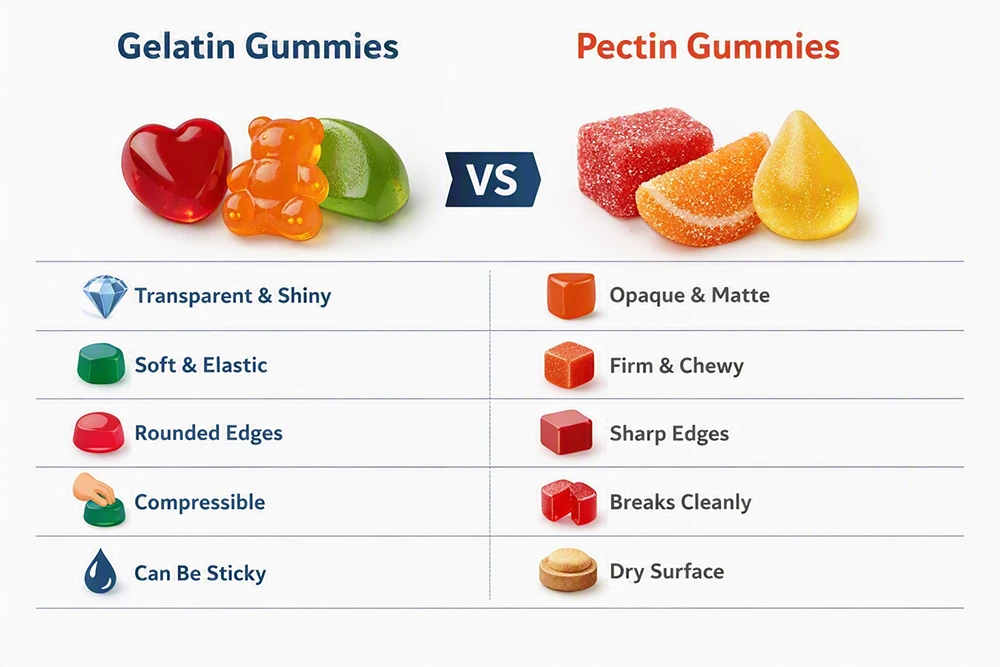
Unlike capsules or powders, gummies require gelling agents (pectin or gelatin), sweeteners, and flavorings. While powders offer high raw material density, gummies limit the amount of creatine per serving due to the physical space required by the gummy base and the solubility limits of creatine.
Key Advantages and Limitations
Advantages include higher consumer compliance, premium pricing potential, and strong shelf appeal. Limitations involve lower active ingredient loading per gummy, higher production costs, and the need for rigorous stability testing to prevent moisture absorption and ingredient degradation.
Target Audience for Production
This production method is ideal for supplement brands, fitness companies, and distributors looking to diversify their product lines. OEM and ODM buyers particularly benefit from this model, as they can leverage a qualified creatine gummies manufacturer to bypass the high capital expenditure of setting up their own gummy production lines.
Compliance and Quality Considerations
Facilities must operate under strict cGMP guidelines. Dosage uniformity is a critical regulatory focus; each gummy must contain the exact declared amount of creatine. Third-party testing for heavy metals, microbes, and active ingredient potency is standard industry practice.
Evaluating Production Readiness
Before a business decides to create creatine gummies, they must evaluate formulation stability, the cost of high-quality pectin or gelatin, and the logistics of climate-controlled warehousing to prevent product melting or fusing during storage and transit.
Technical Parameter Table
| Parameter | Details |
|---|---|
| Product Form | Chewable gummies (pectin-based or gelatin-based) |
| Key Materials / Ingredients | Creatine monohydrate, pectin/gelatin, glucose syrup, sucrose, natural flavors, citric acid, colors |
| Manufacturing Process Highlights | Dissolving, vacuum cooking, creatine dispersion, starch molding or silicon molding, drying, de-molding |
| Quality Standards | cGMP, ISO22000, HACCP, FDA registered, third-party COA testing |
| Packaging Options | PET bottles with desiccants, stand-up pouches, blister packs |
| Scalability & Production Capacity | Capable of scaling from pilot runs (5,000 units) to commercial batches (millions of units) depending on facility size |
| Storage & Logistics | Store below 25°C, low humidity environment; requires climate-controlled shipping to prevent sticking |
Practical Insights
Manufacturing Quality and Process Control
Uniform dispersion of creatine is the primary challenge. If the powder settles during cooking or depositing, some gummies will be under-dosed while others will have a gritty texture. Continuous mixing and controlled cooling rates are essential to maintain homogeneity.
Raw Material Sourcing Transparency
B2B buyers must ensure the creatine monohydrate is Creapure-grade or equivalent to guarantee purity and absence of impurities like dicyandiamide. Sourcing transparency for gelling agents is equally important for texture consistency.
Production Scalability and Lead Time
Scaling from a lab sample to a full production run requires stability testing at batch level. Lead times typically range from 30 to 60 days, accounting for raw material procurement, production, drying time, and quality clearance.
Compliance and Documentation Readiness
Manufacturers must provide complete documentation, including Certificates of Analysis (COA), Allergen statements, and Manufacturing Records. For international distribution, customs documentation and destination country-specific dossiers must be prepared.
Cost Structure Considerations
The cost to make creatine gummies is higher than powders due to excipients, longer drying times, and lower active ingredient yield per batch. Packaging also adds cost, as gummies require specialized moisture barriers.
Evaluating a Reliable Supplier
Site audits are critical. A reliable facility will have cleanroom environments, validated depositing equipment, and a robust quarantine system for raw and finished goods to prevent cross-contamination.
B2B Decision Guide
Choosing the Right Manufacturer
Brands should prioritize facilities with proven experience in functional gummies, not just standard vitamin gummies. Handling creatine requires specific dispersion technology that standard gummy lines may not possess.
OEM/ODM Project Essentials
For ODM projects, verify if the manufacturer holds the intellectual property for the formulation. For OEM projects, ensure the facility can accurately replicate your specific recipe and adjust for batch-size variations without altering the texture or dosage.
Assessing Production Capability
Review the factory’s daily and annual output capacities. High-capacity facilities ensure that as your brand grows, the manufacturer can scale production without extended lead times or compromised quality.
Criteria for Long-Term Partnerships
Look for financial stability, transparent communication, and a willingness to invest in R&D for formulation optimization. A strong partner will proactively suggest cost-saving measures or texture improvements as raw material markets fluctuate.
Risk Control and Quality Assurance
Implement strict incoming material inspections and in-process checks (weight, hardness, and moisture content). Establish clear protocols for handling non-conforming batches to prevent them from entering the supply chain.
Conclusion
Transitioning creatine into a gummy format at scale presents distinct manufacturing challenges but offers significant market advantages in consumer compliance and brand differentiation. Success depends on partnering with a contract manufacturer that possesses the technical capability to ensure uniform dosing, texture stability, and regulatory compliance. For B2B buyers, mastering the sourcing and production parameters of this category is a strategic move to capture value in the evolving sports nutrition market.
FAQ
Q: What is How to Make Creatine Gummies at Scale?
A: It refers to the industrial processes and commercial infrastructure required to produce large volumes of creatine-infused chewable supplements while ensuring dosage accuracy and product stability.
Q: Why does large-scale creatine gummy production matter for manufacturers?
A: It allows supplement brands to enter the high-margin, fast-growing gummy market segment, moving away from commodity powder products to differentiated, consumer-friendly formats.
Q: How does this production process compare to alternative formats?
A: Unlike capsules or powders that simply enclose or mix raw powder, gummy production requires complex thermal processing, gelling agents, and precise dispersion techniques to prevent the creatine from settling or ruining the texture.
Q: What should businesses consider before sourcing?
A: Businesses must evaluate the manufacturer’s experience with low-solubility active ingredients, their drying and de-molding capabilities, packaging solutions to prevent moisture ingress, and their ability to provide consistent third-party potency testing.
Q: What quality standards apply to scaled creatine gummy production?
A: Facilities must comply with cGMP, ISO22000, and HACCP standards. Products require third-party testing for heavy metals, microbial limits, and precise active ingredient dosage verification.
About Shenzhen Gothink Biotech Co., Ltd.
Shenzhen Gothink Biotech Co., Ltd. is a dietary supplement manufacturer providing comprehensive OEM, ODM, CMO, and CDMO services. The company operates a GMP-certified facility featuring a 100,000-class cleanroom with a daily output of 16 tons and an annual production capacity of 5,000 tons. R&D capabilities are supported by a 10,000-class pharmaceutical-grade laboratory, led by a chief scientific advisor and co-founder with postdoctoral experience from institutions such as the California Institute of Technology, Emory University, and Ohio State University. The facility holds multiple certifications, including ISO9001, ISO22000, HACCP, FDA, HALAL, GMP, KOSHER, BRC, FSSC 22000, PJPH, and Vegan. Gothink Biotech offers turnkey solutions to make creatine gummies and other supplement formats, covering formulation development, custom design, manufacturing, and packaging for global health brands. The company conducts formulation research on approximately 2,000 new products annually, providing flexible minimum order quantities and strict quality control for long-term B2B partnerships.