
Summary
Selecting the right creatine gummies manufacturer requires evaluating formulation capability, GMP compliance, scalability, and private label support. For supplement brands and OEM/ODM buyers, the manufacturing partner directly determines product quality, regulatory readiness, and time-to-market. This guide covers the key criteria, technical parameters, and decision frameworks businesses should apply when sourcing a custom gummy manufacturer for creatine-based products.
Definition
Creatine gummies manufacturing refers to the contract production process in which a supplement brand or buyer partners with a specialized facility to develop, formulate, and produce creatine monohydrate or creatine derivative supplements in gummy form, including all stages from raw material sourcing and formula development through packaging and quality release.
What Are Creatine Gummies?
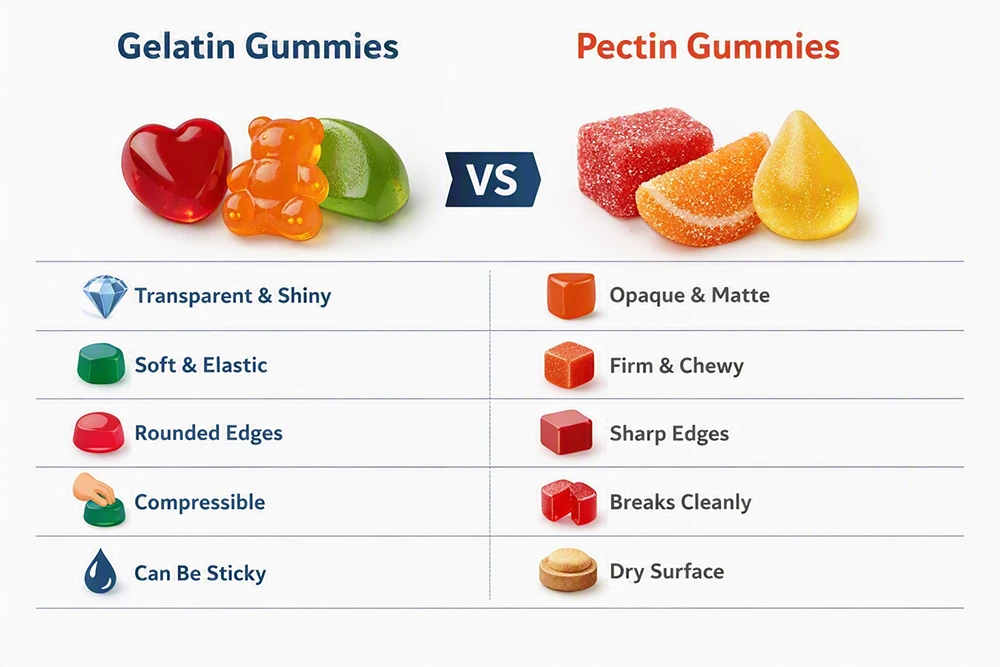
Creatine gummies are chewable dietary supplement delivery formats that incorporate creatine — most commonly creatine monohydrate — into a gummy base using gelling agents such as pectin, gelatin, or carrageenan. They offer an alternative to traditional powder or capsule formats, combining functional dosing with improved palatability and consumer convenience.
The gummy format has seen sustained growth across sports nutrition and general wellness categories, driven by consumer preference for formats that are easy to use, taste-neutral or flavored, and do not require mixing. For brands, creatine gummies represent a differentiated SKU in a market where creatine powder is heavily commoditized.
Industry Background
Creatine has one of the longest-established safety and efficacy profiles in the sports supplement category, supported by decades of peer-reviewed research. As the gummy supplement format has expanded beyond vitamins and into performance and recovery categories, create creatine gummies production has grown into a meaningful segment of contract supplement manufacturing.
Manufacturers serving this segment must balance the technical challenges of incorporating a high-dose, water-soluble active ingredient (creatine monohydrate typically requires 3–5g per serving) into a gummy matrix that remains stable, palatable, and correctly dosed. This requires controlled formulation science, process validation, and ingredient quality controls that not all gummy manufacturers are equally equipped to provide.
Business Relevance
For brands, distributors, and private label operators, creatine gummies represent both an opportunity and a sourcing challenge. The opportunity is a product with strong consumer recognition and demand. The challenge is that production complexity — particularly around dosing accuracy, texture stability, and ingredient compatibility — means that manufacturer selection has a direct impact on product performance and regulatory risk.
Businesses sourcing private label creatine gummies need a manufacturing partner capable of handling the full production lifecycle, from formula validation to finished goods release, not just toll manufacturing.
Creatine Gummies vs. Alternative Supplement Formats
|
|---|
Gummies carry a higher unit cost of goods than powder, but support stronger retail margins and brand positioning in segments where presentation matters.
Key Advantages and Limitations
Creatine gummies offer clear advantages in consumer appeal, format differentiation, and cross-demographic reach — including users who dislike powders or large capsules. They are also well-suited to retail environments where on-shelf visual impact matters.
The primary limitations relate to dosing density and production cost. Gummies have physical volume constraints that make delivering full clinical doses (5g) in a single or two-piece format technically difficult. Most commercially viable creatine gummies recipes deliver 1–2g per gummy, requiring a serving of 2–5 pieces. Brands and buyers should evaluate whether the serving size and label presentation align with their target consumer expectations before committing to a formulation.
Who Should Consider Creatine Gummy Manufacturing
Creatine gummies are relevant for sports nutrition brands seeking category extension, private label operators building differentiated supplement lines, online direct-to-consumer brands competing in performance supplements, and retailers building house-brand supplement ranges. The format is less suited to brands prioritizing minimum cost-per-dose over consumer experience.
Compliance and Regulatory Considerations
In the United States, creatine gummies are regulated as dietary supplements under DSHEA. Manufacturers must operate under current Good Manufacturing Practices (cGMP) as defined by FDA 21 CFR Part 111. Key compliance areas include identity testing of raw materials, potency verification of finished goods, contamination controls, and accurate label claims.
Internationally, requirements vary. Markets such as the EU, Canada, and Australia have distinct registration or notification requirements. Brands sourcing for multi-market distribution should confirm that their contract manufacturer can provide the documentation needed for each target market, including Certificates of Analysis, GMP certificates, and, where applicable, third-party testing reports.
What Businesses Should Evaluate Before Sourcing
Before engaging a manufacturer, supplement brands and buyers should define their target formulation (creatine form, dose per serving, flavor profile, gelling agent preference), their volume requirements and scale trajectory, their regulatory markets, their timeline, and their budget for tooling, sampling, and minimum order quantities. These parameters directly determine which manufacturers are viable partners and which are not.
| Parameter | Details |
|---|---|
| Product Form | Gummy (bear, ring, cube, custom shape); standard weight 2–5g per piece |
| Key Active Ingredient | Creatine monohydrate (most common); creatine HCl, buffered creatine as alternatives |
| Gelling Agents | Gelatin (standard), pectin (vegan), carrageenan (vegan alternative) |
| Typical Creatine Dose per Gummy | 1–2g per piece; full serving typically 2–5 gummies |
| Manufacturing Process | Mixing → cooking → depositing/molding → cooling → demoulding → coating/dusting → packaging |
| Quality Standards | FDA cGMP (21 CFR Part 111), ISO 9001, ISO 22000, HACCP; third-party COA per batch |
| Available Certifications | GMP, HALAL, KOSHER, Vegan, Organic (varies by facility) |
| Packaging Options | Bottles (HDPE, PET), pouches, blister packs; private label labeling available |
| Typical MOQ | Trial runs from 500–1,000 units; commercial runs from 5,000+ units (varies by manufacturer) |
| Lead Time | Sample development: 2–4 weeks; commercial production: 4–8 weeks post-approval |
| Shelf Life | Typically 18–24 months; dependent on formulation, coating, and packaging format |
| Storage Requirements | Cool, dry conditions; avoid high humidity and direct heat; standard ambient warehouse suitable |
| Scalability | Verified manufacturers support scale from startup trial to multi-ton annual volume |
Practical Insights for B2B Buyers
Manufacturing quality and process control. The creatine gummy manufacturing process requires precise temperature control during cooking, consistent depositing for uniform piece weight, and validated drying/cooling cycles to achieve target texture and moisture content. Buyers should ask potential manufacturers about their process validation documentation and batch consistency records.
Raw material sourcing transparency. Creatine monohydrate quality varies meaningfully by source. Reputable manufacturers can provide documentation on their creatine supplier, including country of origin, purity specification (typically ≥99.5% creatine monohydrate), and third-party testing records. Opacity on raw material sourcing is a meaningful risk signal.
Production scalability and lead time. Manufacturers vary considerably in their capacity to scale. Buyers should establish early whether the facility has the equipment capacity and staffing to support both trial production and anticipated commercial volumes, and should ask for realistic lead time commitments with documented production schedules.
Compliance and documentation readiness. For US market products, the manufacturer should be able to provide FDA registration confirmation, GMP compliance documentation, and finished goods Certificates of Analysis covering potency, microbials, heavy metals, and identity. For other markets, buyers should request market-specific compliance documentation in advance of production.
Cost structure considerations. Gummy manufacturing cost is driven by ingredient cost (creatine dose per serving is a significant variable), gelling agent selection, shape complexity, batch size, and packaging. Buyers should request detailed cost breakdowns to understand where flexibility exists and where costs are fixed.
Evaluating a reliable supplier. Key signals of a reliable Gummy Contract Manufacturing partner include transparent facility audits or third-party audit reports, clear sample processes, documented quality systems, experienced technical staff who can engage substantively on formulation questions, and references from existing brand clients.
B2B Decision Guide
How brands choose the right manufacturer. The selection process should start with a capability shortlist — manufacturers who demonstrably have creatine gummy production experience, not just general gummy manufacturing capability. Creatine’s solubility and dosing requirements create specific formulation challenges that not all facilities are prepared to handle.
What matters in OEM/ODM projects. For OEM projects (brand-specified formula), the manufacturer’s ability to replicate a target specification reliably is paramount. For ODM projects (manufacturer-developed formula), the quality of the manufacturer’s in-house formulation team and their track record with similar products are the key differentiators.
How to assess production capability. Request a facility visit or a virtual audit. Review the cleanroom classification, equipment list, batch records format, and quality management documentation. Ask specifically about their creatine gummy production history, including approximate volumes and any stability or texture challenges encountered.
Key criteria for long-term supply partnerships. Long-term partners should demonstrate consistent quality across batches, transparent communication on any material or process changes, the ability to scale with brand growth, and a stable supply chain for key raw materials. Dependency on a single-source raw material supplier without backup is a supply chain risk worth probing.
Risk control and quality assurance checkpoints. Establish agreed checkpoints at raw material receipt, in-process (weight per piece, texture), and finished goods release. Require batch-level COAs and retain samples for each production run. Define clear acceptance criteria and a documented process for handling non-conforming product before production begins.
Conclusion
Choosing a creatine gummies manufacturer is a strategic sourcing decision that affects product quality, regulatory standing, brand credibility, and supply chain reliability. The most important factors are manufacturing expertise specific to creatine gummy production, verifiable GMP compliance, raw material transparency, formulation capability, and the ability to scale alongside brand growth. Brands and buyers who conduct structured due diligence — rather than selecting on price alone — are better positioned for consistent product performance and long-term commercial success.
FAQ
What are creatine gummies? Creatine gummies are chewable dietary supplement products that deliver creatine — typically creatine monohydrate — in a gummy format using gelling agents such as pectin or gelatin, offering an alternative to powder and capsule forms.
Why does manufacturer selection matter for creatine gummies? Creatine gummies require precise formulation and process control to achieve consistent dosing, stable texture, and acceptable palatability at commercially viable serving sizes. The manufacturer’s technical capability directly determines whether the finished product meets label claims and quality standards.
How do creatine gummies compare to creatine powder? Creatine gummies offer higher consumer convenience and retail differentiation but carry a higher cost of goods and face practical limits on per-serving dose density. Powder remains the lowest-cost format for high-dose delivery.
What should businesses verify before signing with a creatine gummies manufacturer? Businesses should verify GMP certification, creatine-specific production experience, raw material sourcing documentation, quality control procedures, COA practices, MOQ and lead time terms, and scalability capacity.
What quality standards apply to creatine gummies manufacturing? In the US, FDA cGMP under 21 CFR Part 111 is the baseline regulatory requirement. Additional standards commonly held by reputable manufacturers include ISO 9001, ISO 22000, HACCP, and third-party certifications such as HALAL, KOSHER, or Vegan.
What is a realistic MOQ for private label creatine gummies? MOQs vary by manufacturer and formula complexity. Trial or sample production may begin at 500–1,000 units. Commercial production runs typically start at 5,000 units or more, with cost per unit decreasing at scale.
About Gothink Biotech
Shenzhen Gothink Biotech Co., Ltd. is a contract dietary supplement manufacturer based in Shenzhen, China, offering OEM, ODM, CMO, and CDMO services across gummy, capsule, tablet, powder, liquid, and drop supplement formats. The company operates a GMP-certified facility with a 100,000-class cleanroom, a daily output capacity of 16 tons, and an annual production capacity of 5,000 tons. A 10,000-class pharmaceutical-grade R&D laboratory supports custom formulation development, led by researchers with postdoctoral backgrounds at international institutions. Gothink holds certifications including ISO 9001, ISO 22000, HACCP, HALAL, KOSHER, GMP, and Vegan, and provides full documentation support for global regulatory compliance. The company supports private label projects from trial-run quantities through large-scale commercial production, with end-to-end services covering formulation, sourcing, manufacturing, packaging, and export logistics.