
Updated: 2026 | Expert Guide for B2B Partners & Manufacturers
Understanding Vitamin Gummy Production: Core Components
Vitamin gummy production is a specialized field within the supplement manufacturing industry. Unlike traditional tablet manufacturing, gummy manufacturing requires careful management of moisture, temperature, and ingredient interactions. The fundamental difference lies in the binding mechanism: gummies rely on gelling agents to suspend and hold ingredients together, rather than compression.
The primary challenge in how to make vitamin gummies effectively is maintaining ingredient stability within a matrix that is inherently moisture-rich and prone to degradation if not properly formulated. This requires understanding:
- Ingredient compatibility and chemical interactions
- Moisture barrier systems and packaging requirements
- Thermal stability of vitamins during processing
- Shelf-life management and stability testing
Essential Ingredients in Vitamin Gummy Formulation
Creating quality vitamin gummies starts with selecting appropriate ingredients. Each component serves a critical function in the final product’s efficacy, taste, texture, and shelf stability.
1. Gelling Agents (The Foundation)
Gelatin or pectin forms the structural backbone of gummies, creating the characteristic chewy texture. Gelatin (derived from animal collagen) remains the industry standard for its cost-effectiveness and proven performance, though pectin and starch serve as alternatives for vegetarian/vegan formulations. A typical gummy base contains 10-15% gelling agent by weight.
2. Active Ingredients (Vitamins & Minerals)
Vitamin and mineral actives are incorporated at precise levels determined by label claims and bioavailability requirements. Common inclusions are:
- Vitamin A (palmitate or beta-carotene) – 5,000-10,000 IU per serving
- Vitamin D3 (cholecalciferol) – 400-2,000 IU per serving
- Vitamin C (ascorbic acid) – 30-500 mg per serving
- Vitamin B Complex (various forms) – 1-100 mcg per serving
- Minerals (zinc glucinate, magnesium citrate) – 5-30 mg per serving
3. Sweeteners
Sugar or sugar alcohols (sorbitol, xylitol, maltitol) comprise 30-50% of gummy formulation. The choice affects taste profile, texture, and shelf stability. Sugar offers superior stability but carries caloric content; sugar alcohols provide calorie reduction but may cause digestive effects.
4. Bulking Agents
Glucose syrup or corn syrup (40-50% by weight) provides body, texture, and serves as a humectant that controls moisture absorption. These ingredients are essential for achieving the desired gummy consistency.
5. Additional Excipients
Other critical components include:
- Citric acid/malic acid: pH adjustment and flavor enhancement (1-2%)
- Lecithin: Anti-sticking agent and emulsifier (0.5-1%)
- Modified cornstarch: Dusting agent and anti-caking (0.5-1%)
- Natural/artificial flavors: Taste profile development (0.5-1.5%)
- Food coloring: Visual appeal (approved colors only)
- Carnauba wax or beeswax: Gloss and moisture barrier (minimal amount)
Vitamin Gummy Production Parameters Reference Table
| Parameter | Specification | Impact on Quality |
|---|---|---|
| Cook Temperature | 65-80°C (150-176°F) | Too high damages vitamins; too low prevents proper gelation |
| Cook Duration | 20-40 minutes | Proper hydration of gelling agents without nutrient degradation |
| Cooling Temperature | 15-20°C (59-68°F) | Ensures proper gel set; rapid cooling prevents separation |
| Gel Setting Time | 4-8 hours (room temp) or 30-60 min (cold room) | Complete gelation prevents mold defects and deformation |
| Moisture Content | 10-15% | Balanced texture; higher moisture increases microbial risk |
| pH Level | 2.5-4.5 | Prevents microbial growth; affects vitamin stability |
| Storage Humidity | 40-50% RH | Prevents moisture uptake and texture degradation |
| Storage Temperature | 15-25°C (59-77°F) | Maintains stability; heat accelerates degradation |
Step-by-Step Manufacturing Process
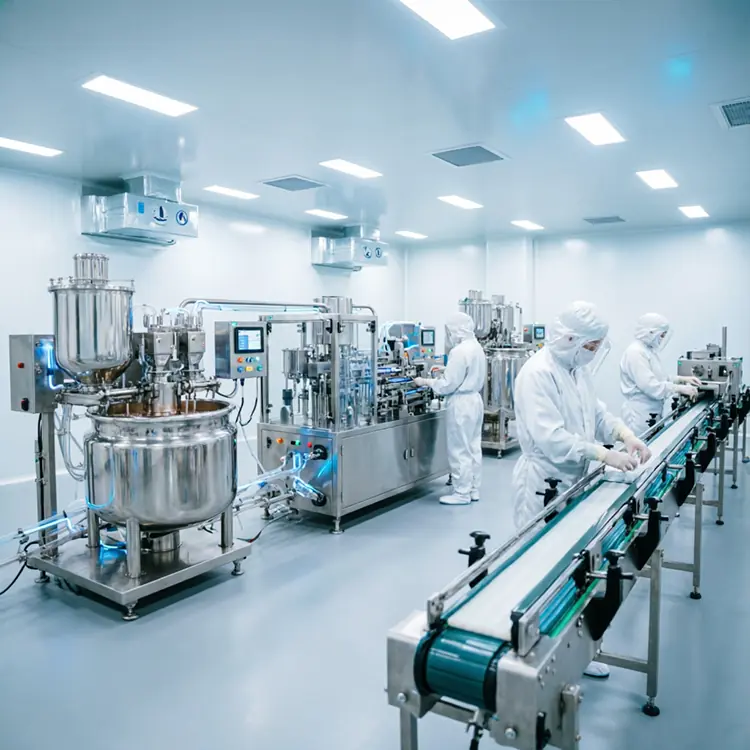
The complete production cycle for vitamin gummies involves multiple stages, each critical to final product quality. Understanding this process is essential for anyone engaged in custom gummy manufacturer operations or quality assurance.
Phase 1: Formulation & Pre-Production
Step 1: Recipe DevelopmentBegin with precise weight calculations for all ingredients based on target serving size and label claims. Create a master formula document specifying exact percentages and gram quantities. This step involves stability testing of the vitamin combination to ensure compatibility within the gummy matrix.
Step 2: Ingredient PreparationSource all ingredients from qualified suppliers with certificate of analysis (CoA). Pre-dry heat-sensitive vitamins if required and verify that all actives meet USP/BP standards. Sift and measure all dry ingredients precisely to ensure batch consistency.
Step 3: Equipment CalibrationCalibrate all production equipment including thermometers, scales, humidity monitors, and molds. Clean all surfaces with food-grade sanitizer and verify temperature control systems are functioning within specifications.
Phase 2: Gummy Preparation (Cooking & Mixing)
Step 4: Hydrating Gelling AgentIf using gelatin, bloom it in cold water (1:5 ratio) for 5-10 minutes. This allows the gelatin to absorb water and break down uniformly. Meanwhile, combine glucose syrup and sugar in the jacketed kettle, heating to 60-65°C while stirring constantly.
Step 5: Melting & CombiningAdd the bloomed gelatin to the heated sugar solution gradually while stirring. Increase temperature to 70-75°C and maintain for 15-20 minutes, allowing full hydration. The mixture should become clear and uniform with consistent viscosity.
Step 6: Adding Vitamins & ActivesCool the base mixture to 60-65°C before adding vitamins and heat-sensitive ingredients. High temperatures damage vitamin efficacy, particularly vitamin C, B vitamins, and probiotics. Add actives slowly while stirring to ensure even distribution.
Step 7: Flavoring & ColoringIntroduce natural or artificial flavors and approved food colorings at 55-60°C. Stir thoroughly for 2-3 minutes to achieve uniform color and flavor distribution. Avoid over-mixing, which can introduce air bubbles.
Phase 3: Molding & Setting
Step 8: DegassingBefore molding, allow the mixture to rest for 10-15 minutes in a warm environment or use a vacuum pump to remove air bubbles. Air pockets create defects and weak structural points in finished gummies.
Step 9: Pouring into MoldsUsing a depositor machine or manual pouring with measured cups, fill silicone or starch molds at 45-55°C. Maintain consistent temperature and pouring rate to ensure uniform gummy size and weight. Each gummy should be 1.5-3g depending on serving size.
Step 10: Cooling & GelationTransfer filled molds to a cooling chamber at 15-20°C for 4-8 hours (or use blast freezing for 30-60 minutes). Proper cooling prevents separation of ingredients and ensures the gel sets to the correct texture. Humidity should be maintained at 40-50% RH.
Phase 4: Demolding & Finishing
Step 11: Demolding ProcessOnce fully set, gummies are demolded using specialized equipment that inverts silicone molds or uses air pressure for starch molds. Demold at room temperature to avoid thermal shock that could crack gummies.
Step 12: Drying & ConditioningSpread gummies on screens in a low-temperature drying room (18-22°C, 40-50% RH) for 24-48 hours. This reduces surface moisture without over-drying the interior. Proper conditioning prevents moisture uptake and improves shelf stability.
Step 13: Coating (Optional)For sugar-coated varieties, tumble gummies with fine granulated sugar or sour sugar coating. For wax coating, apply food-grade carnauba or beeswax suspension (0.5-1% applied). Coating reduces sticking and extends shelf life.
Phase 5: Quality Control & Packaging
Step 14: Quality InspectionConduct visual inspection of all gummies for color uniformity, proper shape, absence of defects, and foreign particles. Perform weight variation testing (standard deviation should not exceed ±7.5%). Test moisture content (10-15%), hardness, and appearance.
Step 15: Finished Product TestingSend samples to qualified testing laboratories for: active ingredient assay (HPLC verification), microbial testing (bacteria, yeast, mold count), heavy metal screening, and allergen verification. This ensures compliance with USP/FCC standards.
Step 16: Packaging & LabelingPackage gummies in moisture-barrier containers (amber glass bottles or high-barrier plastic with desiccant packets). Apply labels with ingredient list, supplement facts panel, warnings, lot number, and expiration date. All labeling must comply with FDA/FTC regulations.
Quality Control Standards & Testing Protocols
Manufacturing premium vitamin gummies requires comprehensive quality assurance at every stage:
Raw Material Verification
- Supplier audits: Verify third-party certifications (ISO 9001, cGMP, organic certifications)
- Certificate of Analysis review: Confirm identity, purity, potency, and microbial status
- Incoming testing: Random sampling for identity confirmation via FTIR or color testing
In-Process Testing
- Temperature monitoring: Continuous verification of cooking and cooling temperatures
- pH testing: Confirm acidity remains within acceptable range (2.5-4.5)
- Viscosity assessment: Manual texture evaluation to ensure proper consistency
- Weight checks: Verify each gummy meets target weight ±7.5%
Finished Product Testing
- Potency assay (HPLC): Verify vitamin content matches label claims (±10% acceptable variance)
- Microbiological testing: Total aerobic count, E. coli, Salmonella, Listeria screening
- Stability testing: Accelerated studies (40°C/75% RH) and real-time shelf-life data
- Moisture analysis: Karl Fischer titration to confirm 10-15% range
- Heavy metal screening: Lead, cadmium, mercury analysis per USP limits
Regulatory Compliance & Industry Standards
Manufacturing vitamin gummies requires strict adherence to multiple regulatory frameworks depending on target market:
United States (FDA)
- cGMP Compliance: Current Good Manufacturing Practices (21 CFR Part 111) for dietary supplements
- Labeling Requirements: Supplement Facts panel format, structure-function claims limitations
- Quality Standards: Verification of identity, purity, quality, and strength per USP/FCC monographs
- Adverse Event Reporting: Mandatory reporting of serious adverse events
European Union (EFSA)
- Novel Foods Assessment: Pre-market approval required for new ingredients
- Health Claims Regulation: Strict substantiation requirements for any health claims
- Food Standards: Compliance with food additive regulations (E-numbers)
Key Compliance Checkpoints
- Ingredient status verification (food vs. drug classification)
- Allergen declaration accuracy
- Manufacturing facility GMP certification
- Stability testing completion (minimum 2 years recommended)
- Third-party laboratory testing documentation
Scaling for Commercial Production
Moving from small-batch to commercial-scale gummy manufacturing requires significant operational changes:
Equipment & Facility Requirements
| Production Scale | Batch Size | Key Equipment |
|---|---|---|
| Pilot/Small (R&D) | 1-10 kg batches | Jacketed kettle, silicone molds, cooling chamber |
| Medium Scale | 50-200 kg batches | Double-jacketed kettle, automated depositor, conveyor cooling |
| Commercial (Production) | 500+ kg batches | Continuous cooker, automatic depositor system, starch mold lines |
| Large-Scale (OEM/ODM) | 1000+ kg batches | Fully automated line, continuous cooker, belt cooling, robotic packaging |
Facility Infrastructure
- Climate-controlled production areas: 18-22°C, 40-50% RH maintained year-round
- Raw material storage: Temperature and humidity-controlled with pest control measures
- Quality control lab: Equipment for moisture analysis, weight checking, appearance inspection
- Finished product storage: Segregated by product type with proper expiration date tracking
Production Efficiency Optimization
- Batch scheduling: Group similar formulations to minimize changeover time
- Yield management: Optimize ingredient quantities to reduce waste; target 95%+ yield
- Labor efficiency: Implement standard operating procedures (SOPs) and cross-training
- Cost reduction: Bulk ingredient purchasing with quality verification protocols
Common Manufacturing Challenges & Solutions
Challenge 1: Ingredient Separation
Problem: Vitamins and minerals settling at the bottom of the gummy during cooling, creating uneven distribution.
Solutions: Increase viscosity of the gel matrix using higher gelatin concentration; use suspending agents like xanthan gum; implement continuous gentle stirring during cooling; adjust density of vitamin premix to match gel base.
Challenge 2: Moisture Uptake During Storage
Problem: Gummies becoming sticky or soft due to environmental humidity or inadequate packaging.
Solutions: Use high-barrier containers with desiccant packets; apply moisture-resistant coatings; maintain storage at 40-50% RH; store in dark, cool conditions; verify seal integrity on all packaging.
Challenge 3: Vitamin Degradation
Problem: Loss of potency during manufacturing or storage, failing label claim verification.
Solutions: Reduce cooking temperatures to 70-75°C; use stabilized vitamin forms (ascorbyl palmitate vs. ascorbic acid); incorporate antioxidants (vitamin E, rosemary extract); conduct accelerated stability testing; limit processing time.
Challenge 4: Microbial Contamination
Problem: High microbial counts detected during testing, requiring batch rejection.
Solutions: Implement strict environmental monitoring (HVAC, surfaces, equipment); use microbially-tested ingredients; establish proper pH control (2.5-4.5); ensure adequate drying times; maintain detailed environmental testing logs.
Challenge 5: Inconsistent Gummy Weight/Size
Problem: Variation exceeding ±7.5%, causing potency variations per gummy.
Solutions: Invest in automated depositor equipment with weight control; calibrate equipment regularly; maintain consistent mix viscosity; train operators on proper filling techniques; implement in-process weight sampling.
B2B Manufacturing Partnerships & Options
Understanding Gummy Contract Manufacturing
For businesses lacking in-house manufacturing capability, Gummy Contract Manufacturing partnerships provide an efficient path to market. Contract manufacturers handle all production aspects while brands focus on product development and marketing.
Contract Manufacturing Benefits
- Eliminates capital investment in equipment and facilities
- Provides access to specialized expertise and equipment
- Ensures regulatory compliance and quality standards
- Scales production based on demand without fixed overhead
- Reduces time-to-market through established processes
- Provides stability testing and regulatory documentation
Selecting the Right Partner
When evaluating a custom gummy manufacturer, verify the following credentials:
- cGMP Certification: Current FDA approval for dietary supplement manufacturing
- Quality certifications: ISO 9001, ISO 22000, or equivalent
- Equipment capability: Capacity to produce your target batch size and product type
- Testing facilities: In-house or reliable third-party testing partnerships
- Regulatory experience: Track record with FDA submissions and international markets
- References: Established relationships with successful brands
- Capacity planning: Ability to scale with business growth
Private Label & White Label Manufacturing
Many supplement brands leverage private label vitamin gummy manufacturing to establish their own branded products. A private label gummy manufacturer produces products according to your formulation and branding specifications.
Private Label vs. White Label
Private Label: Products manufactured to your unique formulation with your branding and label design. Higher customization, 50-500 unit minimum orders typically. Cost per unit: $0.40-$1.20 depending on complexity.
White Label: Pre-formulated products from the manufacturer’s catalog, simply re-labeled with your brand. Lower cost and faster turnaround, but limited differentiation. Cost per unit: $0.15-$0.50.
Custom Formulation Development
Working with a manufacturer for formulation development typically involves:
- Initial consultation to define your target market and product positioning
- Formulation recommendation based on ingredient trends and efficacy data
- Prototype development and stability testing (60-90 days)
- Regulatory review and documentation preparation
- Final product approval and manufacturing setup
Cost Structure & Pricing Analysis
Understanding the cost breakdown helps in pricing strategy and profitability planning:
| Cost Category | Percentage of Total | Notes |
|---|---|---|
| Raw Materials | 35-45% | Vitamins, gelling agents, sweeteners, excipients |
| Labor | 10-15% | Manufacturing, QA, compliance personnel |
| Equipment & Depreciation | 5-10% | Cookers, depositors, molds, testing equipment |
| Packaging | 10-15% | Bottles, labels, desiccants, shipping materials |
| Testing & QA | 5-10% | Potency assay, microbial testing, stability |
| Overhead & Administration | 10-15% | Facility, utilities, regulatory compliance, training |
Example calculation for a 60-gummy bottle (120-count at 2 gummies per serving):
- Raw materials: $1.50-$2.00
- Labor: $0.40-$0.60
- Packaging: $0.50-$0.80
- Testing/QA: $0.25-$0.40
- Total manufacturing cost: $2.65-$3.80 per bottle
- Typical wholesale price (to retailers): $6.00-$8.00
- Retail price: $14.99-$24.99
Practical Insights: Production Best Practices
Achieving Consistency Across Batches
Batch-to-batch consistency is critical for customer satisfaction and regulatory compliance. Implement these practices:
- Detailed SOPs: Document every step with precise temperatures, times, and ingredient quantities
- Equipment validation: Perform IQ/OQ/PQ (Installation/Operational/Performance Qualification) on all critical equipment
- Raw material management: Use the same suppliers for ingredient consistency; track lot numbers
- Operator training: Comprehensive training and certification with periodic retraining
- Data tracking: Record all manufacturing parameters in batch records
- Statistical monitoring: Track batch records to identify trends before problems occur
Reducing Production Waste
Efficient manufacturing targets 95%+ yield per batch:
- Accurate pre-weighting of all ingredients to prevent over-formulation
- Proper mold maintenance and cleaning to prevent sticking and breakage
- Optimize demolding timing to prevent cracking or deformation
- Quality inspection to catch defective gummies early
- Proper storage to prevent moisture damage before packaging
Managing Shelf-Life & Stability
Vitamin gummies typically have 24-36 month shelf-life with proper management:
- Conduct accelerated stability studies (40°C/75% RH for 6 months) prior to launch
- Monitor real-time samples stored under normal conditions
- Use appropriate moisture barriers and desiccants in packaging
- Store finished products in cool, dry conditions (15-25°C, 40-50% RH)
- Implement FIFO (First In, First Out) inventory management
- Track expiration dates and manage product rotation
Practical Implementation: Starting Your Gummy Manufacturing
Path 1: In-House Manufacturing
Investment: $150K-$500K for complete facility and equipment setup
Timeline: 6-12 months from planning to first commercial production
Best for: Established brands with consistent demand and capital availability
- Secure cGMP-compliant facility (1,000+ sq ft)
- Install climate control and environmental monitoring systems
- Procure manufacturing equipment and validation tools
- Establish quality control laboratory
- Hire experienced operations and QA personnel
- Develop and validate manufacturing procedures
- Conduct environmental monitoring and equipment performance qualification
- Submit FDA notification if required
Path 2: Contract Manufacturing Partnership
Investment: $20K-$100K for development and initial orders
Timeline: 60-90 days from formulation to first production batch
Best for: Startups and brands prioritizing speed-to-market
- Identify suitable manufacturers through industry directories and referrals
- Evaluate capabilities, certifications, and track record
- Develop custom formulation through collaborative R&D
- Complete stability testing and regulatory documentation
- Execute manufacturing and supply agreements
- Place initial production order with quality agreements
Path 3: White Label/Pre-Formulated Products
Investment: $5K-$30K for initial inventory and labeling
Timeline: 30-45 days to first saleable inventory
Best for: Quick market entry with minimal product differentiation
- Review pre-formulated options from manufacturers
- Select formulation matching your target market needs
- Develop brand packaging and label design
- Place minimum viable order (typically 500-1000 units)
- Receive inventory and launch sales
B2B Decision Framework: Selecting Your Manufacturing Strategy
This framework helps decision-makers evaluate which approach aligns with business objectives:
| Decision Factor | In-House | Contract Mfg | White Label |
|---|---|---|---|
| Startup Capital | High (150K-500K) | Medium (20K-100K) | Low (5K-30K) |
| Time to Market | 12+ months | 60-90 days | 30-45 days |
| Product Customization | Complete | High | Minimal |
| Quality Control | Direct | Shared | Manufacturer |
| Unit Cost (500+ units) | $0.35-$0.50 | $0.40-$0.70 | $0.15-$0.35 |
| Risk Profile | High | Medium | Low |
Strategic Recommendations
For Startups: Begin with white label or contract manufacturing to validate market demand with minimal risk. Once sales reach 50,000+ units annually, consider transitioning to custom contract manufacturing for better margins.
For Established Brands: Use contract manufacturers for custom formulations that differentiate your brand. Invest in in-house manufacturing only when annual volume exceeds 500,000+ units and margins support capital investment.
For Multi-SKU Lines: Maintain 2-3 key SKUs with contract manufacturers for custom formulations (high differentiation), while leveraging white label products for broader portfolio coverage (quick cash flow).
Conclusion: Key Takeaways for Vitamin Gummy Manufacturing
Manufacturing vitamin gummies is a specialized process requiring precision, quality discipline, and regulatory knowledge. Success depends on understanding ingredient chemistry, process control, quality assurance, and scalability requirements. Whether you choose in-house manufacturing, contract manufacturing, or white label options, the fundamental principles remain constant: formulate responsibly, manufacture consistently, test rigorously, and document meticulously.
The vitamin gummy market continues to grow at 8-12% annually, driven by consumer preference for convenient supplementation. Businesses that prioritize product quality, regulatory compliance, and customer safety will sustain competitive advantages. For companies lacking manufacturing expertise, partnerships with experienced gummy manufacturers provide a pragmatic path to market entry while maintaining quality standards and reducing operational risk.
Next Steps: Clearly define your product positioning, target market, and production volume requirements. This information will guide the selection of the optimal manufacturing strategy—whether internal capability development or strategic partnership with established manufacturers.
Frequently Asked Questions About Vitamin Gummy Manufacturing
Minimum orders vary by manufacturer and formulation complexity. Typical ranges: White label products: 500-1,000 units. Custom formulations: 5,000-10,000 units. Some manufacturers accept smaller pilot batches (1,000-2,000 units) for new product development at premium pricing. Lower minimums allow market testing before major commitment.
Accelerated stability testing (40°C/75% humidity) requires 6 months of data before launch. However, many manufacturers will begin production while final months of accelerated testing complete, provided initial 3-month data shows stability. Full real-time shelf-life studies extend 24-36 months for comprehensive data. Many brands extend shelf-life claims based on accelerated data extrapolation following FDA guidelines.
Yes, but with significant technical challenges. Probiotics and enzymes are temperature-sensitive and require specialized stabilization techniques. Processing temperatures must stay below 55°C, and protective encapsulation (microencapsulation) is often necessary. Shelf-life becomes shortened (12-18 months typical vs. 24-36 months standard gummies). Viability testing is required at beginning and end of shelf-life. Cost per unit increases 30-50% due to complexity.
In the US, dietary supplements don’t require pre-market FDA approval but must comply with cGMP regulations and accurate labeling. Manufacturers must have proper documentation including ingredient approvals, stability data, and potency verification. For claims beyond basic structure-function, clinical evidence may be required. International markets (EU, Canada, Australia) have stricter pre-approval requirements. Most manufacturers handle compliance documentation as part of production services.
Standard vitamin gummies have 24-36 month shelf-life under proper storage (room temperature, 40-50% humidity, light protection). Shelf-life is affected by: vitamin type (fat-soluble vitamins more stable than water-soluble), packaging barrier (glass with desiccant best; plastic less effective), storage conditions (higher temperature/humidity reduces stability), and formulation (antioxidants extend life). Products with added probiotics or botanical extracts typically have 12-18 month shelf-life.
Multiple strategies ensure consistency: precise pre-weighting of all ingredients, mechanical mixing to ensure uniform distribution, continuous monitoring of texture and mixing time, validated mold systems that deposit identical weights, weight sorting of finished gummies to remove outliers, and finished product testing via HPLC to verify potency across samples from different parts of the batch. Statistical process control tracks manufacturing parameters to identify drift before quality issues occur.
Advanced Manufacturing Capabilities
Leading gummy manufacturers offer comprehensive services supporting the complete product lifecycle:
Our Core Manufacturing Services
Custom Formulation DevelopmentCollaborate with R&D specialists to create unique vitamin gummy formulations tailored to your brand positioning and target market demographics.
OEM/ODM ManufacturingComplete manufacturing solutions where we handle design, development, and production of vitamin gummies per your specifications and branding requirements.
Private Label Vitamin Gummy ProductionManufacture unique formulations exclusively for your brand with complete confidentiality, proprietary formulation protection, and quality assurance.
Batch Production & ScalingScale from pilot batches (5,000 units) to commercial production (100,000+ units monthly) with consistent quality and on-time delivery.
Compliance & DocumentationComplete regulatory documentation, stability testing coordination, potency verification, and FDA compliance support for market launches.
Quality Assurance & TestingComprehensive testing including potency assay (HPLC), microbial analysis, heavy metal screening, moisture testing, and stability studies.
Why Partner with Experienced Manufacturers
- Cost Efficiency: Eliminate capital expenditure for equipment and facilities; variable cost structure aligns with demand
- Quality Assurance: cGMP-certified facilities with rigorous quality control exceed typical in-house standards
- Regulatory Expertise: Experienced teams navigate FDA, FTC, and international regulatory requirements
- Time Efficiency: Established processes and infrastructure compress time-to-market from 12+ months to 60-90 days
- Scalability: Grow production with demand without facility constraints or equipment limitations
- Innovation Support: Access to latest ingredients, technologies, and industry trends through manufacturer connections
Partnership Models Available
| Partnership Type | Best For | Typical Volume |
|---|---|---|
| Custom Formulation + Manufacturing | Brands with unique positioning needs | 50,000-500,000 units/year |
| Private Label Manufacturing | Established brands with formulation ready | 100,000-1,000,000 units/year |
| White Label Products | Quick market entry with minimal differentiation | 10,000-100,000 units/year |
| Co-Manufacturing (Shared Batch) | Small brands with limited volume | 1,000-10,000 units per batch |