
A Comprehensive Guide to Gummy Bear Manufacturing, Leading Producers, and Custom Production Solutions
Who Makes Gummy Bears: Industry Overview
The gummy bear and gummy supplements industry comprises several categories of manufacturers, each serving different market segments and brand requirements.
1. Large-Scale Industrial Producers
Major multinational companies dominate the global confectionery market, producing billions of gummy units annually. These manufacturers operate facilities with output capacities exceeding 5,000 tons per year and maintain vertically integrated supply chains. They focus on economies of scale, efficiency, and consistent quality for mass-market distribution.
2. Specialized Supplement Manufacturers
Contract manufacturers specializing in dietary supplements operate under strict pharmaceutical GMP standards. These facilities focus on functionality, ingredient integrity, and regulatory compliance. Many offer custom gummy manufacturer services with formulation expertise and quality control tailored to supplement brands.
3. OEM/ODM Service Providers
Original Equipment Manufacturer (OEM) and Original Design Manufacturer (ODM) partners provide end-to-end solutions. OEM gummy manufacturing involves producing gummies based on client specifications, while ODM services include formulation design, flavor selection, and packaging customization. These partners enable brands to launch products without manufacturing infrastructure.
4. Private Label Manufacturers
Private label gummy manufacturer services allow retailers and smaller brands to distribute products under their own branding. These manufacturers manage production, quality control, and packaging while the brand handles marketing and distribution.
Gummy Bear Manufacturing: Production Capabilities & Process
Formulation Development
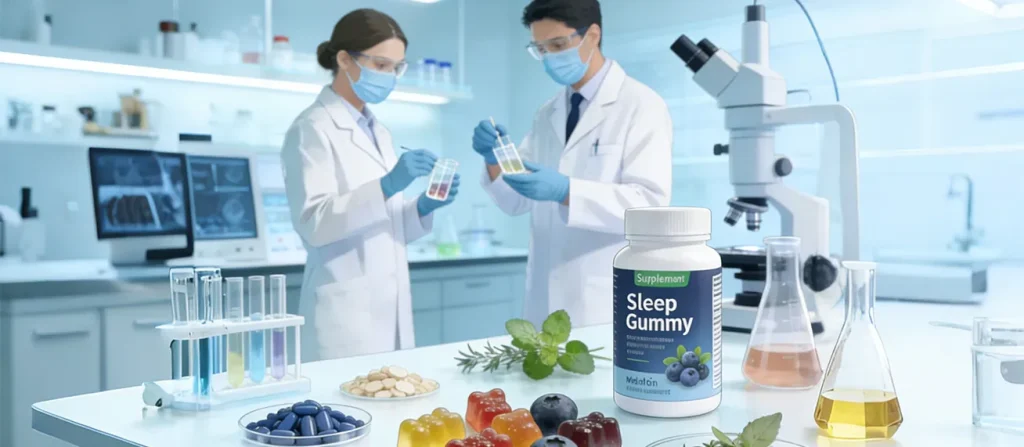
Professional gummy manufacturers maintain dedicated R&D laboratories staffed with food scientists, biochemists, and product development specialists. Advanced facilities feature pharmaceutical-grade laboratories (10,000-class cleanrooms) where formulations are optimized for stability, bioavailability, and consumer appeal. Leading manufacturers research 2,000+ new product formulations annually, enabling rapid innovation cycles for client brands.
Manufacturing Technologies
Gummy Contract Manufacturing utilizes multiple production methods depending on target product characteristics:
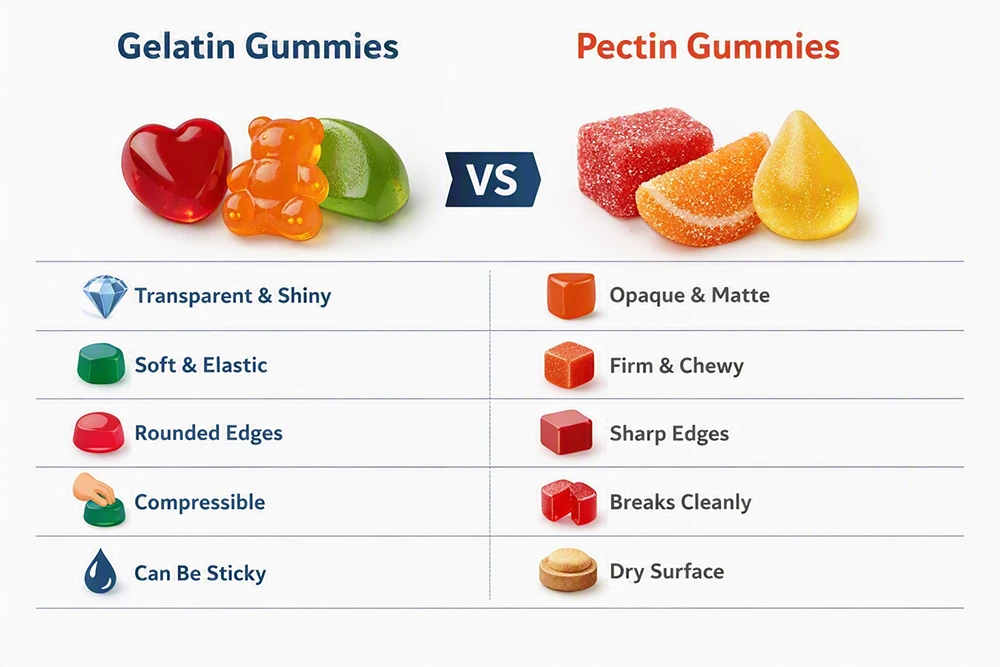
- Gelatin-Based Gummies: Traditional formulation using gelatin derived from animal sources, offering superior texture and longer shelf stability.
- Pectin-Based Gummies: Plant-derived alternative suitable for vegan and vegetarian consumers, increasingly preferred for premium supplement lines.
- Starch-Based Gummies: Cost-effective option with rapid texture development.
- Advanced Hybrid Formulas: Combinations of natural gelling agents optimized for specific functional ingredients.
Production Specifications
State-of-the-art facilities achieve production efficiency metrics that enable rapid scaling:
| Production Metric | Specification Range | Relevance to Brands |
|---|---|---|
| Daily Output Capacity | 10-16 tons per day | Supports rapid fulfillment and seasonal demand spikes |
| Annual Production Capacity | 3,000-5,000+ tons per year | Enables large-scale private label and OEM partnerships |
| Cleanroom Classification | 100,000-class (ISO Class 5-6 equivalent) | Pharmaceutical-grade purity standards for dietary supplement compliance |
| R&D Laboratory Grade | 10,000-class pharmaceutical standard | Precision formulation and stability testing for novel ingredients |
| Mold Variety | 30+ custom shape options | Distinctive product differentiation and brand recognition |
| Lead Time | 4-8 weeks for standard production | Efficient time-to-market for seasonal products and new launches |
Quality Control Standards
Professional gummy manufacturers implement multi-stage quality verification:
- Raw Material Testing: Ingredient authentication and potency verification before formulation
- In-Process Monitoring: Real-time batch monitoring during production with automated parameter tracking
- Final Product Testing: Dissolution testing, potency verification, moisture analysis, and microbiological screening
- Stability Testing: Accelerated and long-term stability studies ensuring product shelf-life claims
- Third-Party Verification: Independent laboratory testing for heavy metals, pesticide residues, and bacterial contaminants
Types of Gummy Products Manufactured
Vitamin & Mineral Gummies
Manufacturers produce comprehensive micronutrient formulations including multivitamins, individual vitamin gummies (vitamin C, D, B-complex), mineral supplements (calcium, magnesium, zinc), and specialized formulations for specific demographics—women’s multivitamins, men’s health gummies, and children’s supplement options.
Functional & Herbal Gummies
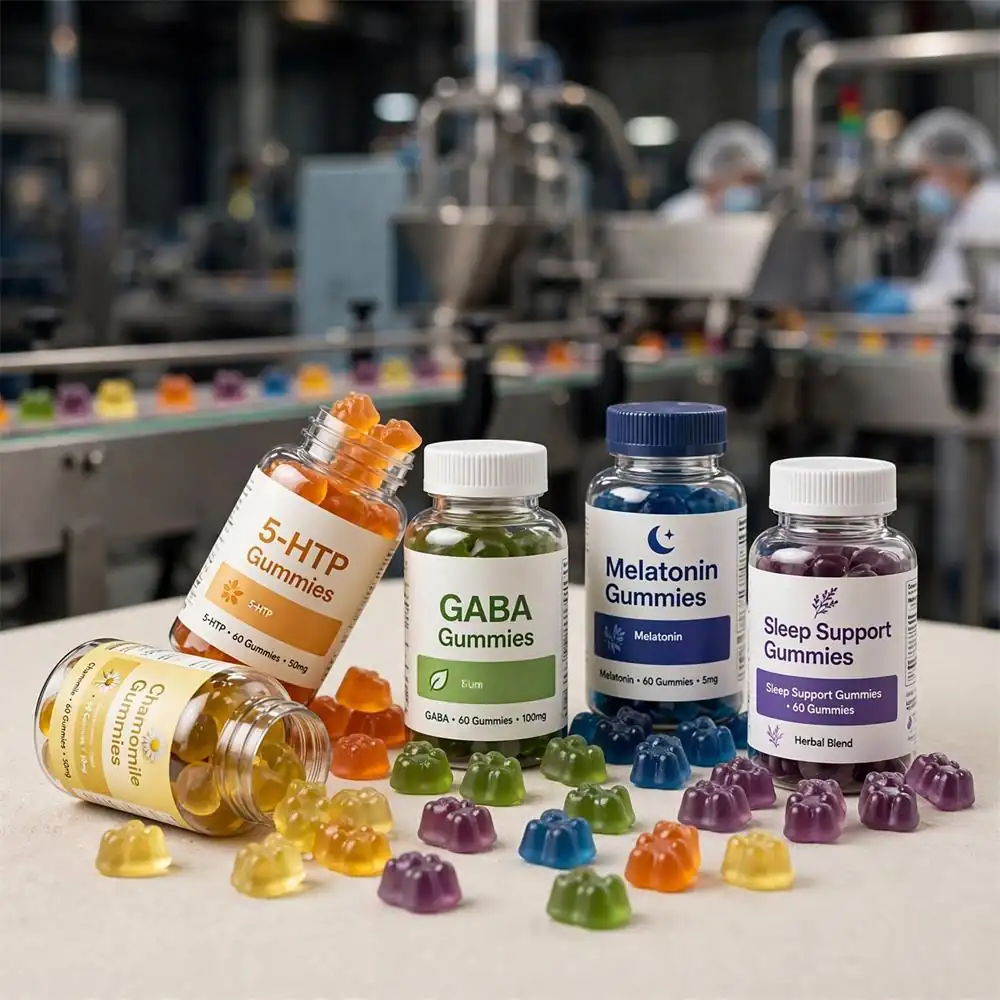
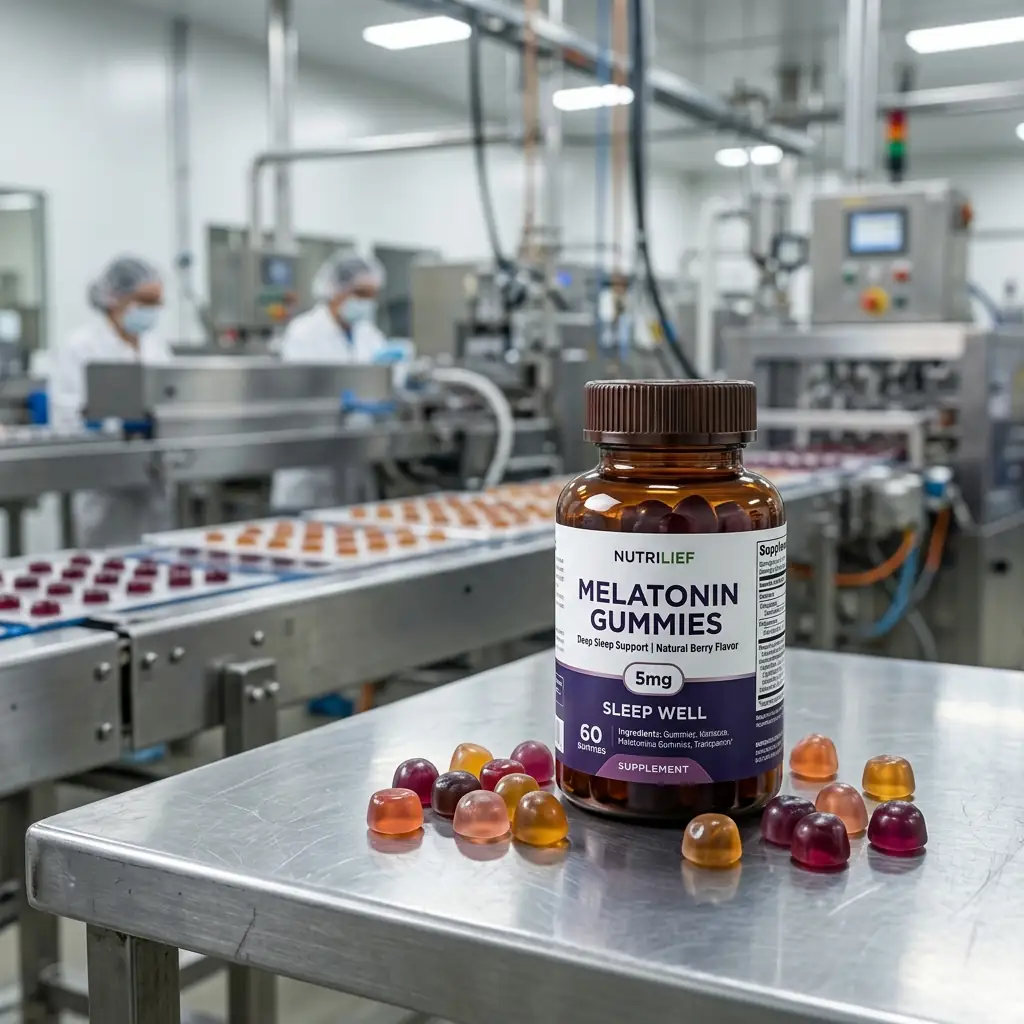
Advanced formulations incorporating plant extracts and phytochemicals: ashwagandha gummies for stress management, melatonin sleep gummies, probiotic gummies for digestive health, liver support formulas, and adaptogens. These represent high-margin products with growing consumer demand.
Sports & Performance Gummies
Specialized products designed for fitness-focused consumers: creatine gummies for muscle support, pre-workout gummies delivering caffeine and performance-enhancing ingredients, BCAAs, and recovery formulations. These segments show significant year-over-year growth.
Specialty & Dietary Formulations
Customized products addressing market niches: vegan gummies using pectin or agar gelling agents, sugar-free formulations for diabetic consumers, keto-compatible gummies, and allergen-free products. Custom gummy manufacturers excel at these specialized applications.
B2B Decision Framework: Selecting a Gummy Manufacturer
Critical Evaluation Criteria
1. Regulatory Compliance & Certifications
Verify manufacturer holds GMP certification (Good Manufacturing Practices), ISO 9001 (Quality Management), ISO 22000 (Food Safety), HACCP (Hazard Analysis), and FDA compliance for facilities located in regulated jurisdictions. International HALAL and KOSHER certifications expand market accessibility. Vegan certification requires pectin-based formulations.
2. Manufacturing Capacity & Scalability
Evaluate production capacity against current and projected demand. Facilities capable of 5,000+ tons annually support growth from initial 100-unit trial batches to national distribution. Flexible MOQ (Minimum Order Quantity) enables startups and smaller brands to launch economically.
3. R&D Capabilities & Formulation Expertise
Assess the manufacturer’s ability to translate ingredient trends into viable formulations. Leading manufacturers conduct 2,000+ formulation research studies annually and employ postdoctoral researchers with academic backgrounds from top institutions. Advanced laboratories enable rapid stability testing and innovation cycles.
4. Quality Control Infrastructure
Confirm manufacturers operate 100,000-class cleanroom facilities meeting pharmaceutical standards. Multi-stage testing protocols—raw material authentication, in-process monitoring, final product testing, and stability verification—ensure consistent batch quality and regulatory compliance.
5. Cost Competitiveness & Payment Terms
Compare unit costs, production overhead, and payment structures. OEM services often offer better unit economics than in-house manufacturing. Evaluate total cost of ownership including compliance costs, quality assurance, and regulatory support.
6. Service Scope & Market Support
Professional manufacturers provide end-to-end services: formulation design, raw material sourcing, production, packaging customization, labeling compliance, and marketing collateral. Private label gummy programs reduce brand management burden while maintaining quality control.
Turnkey Solutions & Integration Services
Leading gummy contract manufacturers offer comprehensive turnkey models handling every production stage from initial concept through final packaging. This integrated approach accelerates time-to-market, reduces operational complexity, and ensures regulatory consistency across product development and manufacturing.
Market Trends in Gummy Manufacturing
Rising Demand for Functional Gummies
Consumer preference shifts toward functional supplements delivered in convenient gummy formats. Melatonin sleep gummies, ashwagandha stress-relief products, and women’s probiotic formulations represent fastest-growing segments. Manufacturers respond with advanced delivery technologies improving ingredient stability and bioavailability.
Plant-Based & Clean Label Movement
Pectin-based, vegan gummies now command premium pricing as consumers prioritize plant-derived ingredients and clean labels. Manufacturers invest in natural flavor technology and allergen-free formulations to capture health-conscious demographics.
Private Label Expansion
Retail chains and e-commerce platforms increasingly develop private label gummy manufacturer partnerships to build owned brands with superior margins. OEM/ODM manufacturers benefit from increased order volumes and longer-term contracts.
Specialized Demographics & Life Stages
Customized formulations targeting specific populations—children’s gummies with reduced sugar, women’s multivitamin gummies with iron optimization, senior formulations with joint support—drive innovation in contract manufacturing.
Manufacturing Capacity Statistics
New formulations researched annually
Daily production capacity
Annual production volume
Cleanroom standard
R&D laboratory specification
Implementing Gummy Manufacturing Partnerships
Phase 1: Formulation & Design
Initiate partnership by defining target market, functional benefits, and consumer preferences. Professional manufacturers utilize R&D laboratories to develop custom formulations optimizing ingredient efficacy, taste, texture, and stability. Trial batches validate formulation performance before full-scale production.
Phase 2: Compliance & Regulatory Planning
Manufacturers guide brands through regulatory requirements specific to target markets (US FDA, EU regulations, China CFDA standards). Label compliance, ingredient documentation, and safety testing protocols are established before production commences.
Phase 3: Production Scaling
Initial production batches typically range from 100-1,000 units, scaling to 5,000+ ton annual volumes as market demand grows. Flexible manufacturing accommodates seasonal variations and promotional demands.
Phase 4: Quality Assurance & Ongoing Support
Continuous quality monitoring, batch testing, and stability verification ensure consistent product performance. Manufacturers provide technical support, regulatory updates, and market trend insights supporting brand success.
Frequently Asked Questions
Q: What is the difference between OEM and ODM gummy manufacturing?A: OEM (Original Equipment Manufacturing) produces gummies based on the brand’s specifications and formulation—the manufacturer implements the design. ODM (Original Design Manufacturing) encompasses complete design responsibility: the manufacturer develops the formulation, selects ingredients, designs packaging, and delivers the finished product ready for brand distribution. ODM services suit brands lacking in-house R&D resources.
Q: How do I ensure quality consistency across production batches?A: Professional manufacturers implement multi-stage quality control: raw material testing (ingredient authentication), in-process monitoring (automated batch tracking), final product testing (potency verification, dissolution, microbiological screening), and third-party validation. ISO 9001 and GMP certifications provide documented quality management systems. Request batch testing reports and third-party certificate-of-analysis documentation from manufacturers.
Q: What is the minimum order quantity for custom gummy manufacturing?A: Leading manufacturers support flexible MOQ ranging from 100-unit trial batches for testing to full-scale production runs. Trial batches enable market validation and consumer feedback collection before committing to larger volumes. Discuss MOQ flexibility during initial consultations—established manufacturers often accommodate startup requirements.
Q: How long does the development process take from concept to production?A: Typical timelines span 6-12 weeks: formulation development and trial batches (4 weeks), regulatory compliance and labeling (2-3 weeks), scaling and production setup (1-2 weeks), and initial batch manufacturing (1-2 weeks). Experienced manufacturers accelerate timelines through documented processes and established supplier networks. Standard production runs typically deliver within 4-8 weeks after order confirmation.
Q: Can manufacturers accommodate allergen-free and dietary-restricted formulations?A: Yes. Leading manufacturers manage multiple production lines with dedicated cleaning protocols preventing cross-contamination. Pectin-based gummies serve vegan consumers, gelatin-free formulations address vegetarian markets, and gluten-free protocols accommodate celiac requirements. HALAL and KOSHER certifications indicate commitment to specialized dietary compliance. Discuss specific requirements during formulation planning.
Q: What regulatory certifications are essential for dietary supplement gummies?A: Critical certifications include GMP (Good Manufacturing Practices), ISO 9001 (Quality Management), ISO 22000 (Food Safety Management), HACCP (Hazard Analysis), and FDA approval for facilities in North America. International markets require additional compliance: EU registration for European distribution, China CFDA standards for Asian markets. Reputable manufacturers maintain comprehensive certifications covering target market requirements.
Conclusion: Finding Your Gummy Manufacturing Partner
The gummy bear and dietary supplement manufacturing industry offers diverse partnership models enabling brands to launch innovative products without significant capital investment or manufacturing expertise. Leading manufacturers combine pharmaceutical-grade facilities (100,000-class cleanrooms, 10,000-class R&D laboratories), advanced formulation capabilities (2,000+ annual research studies), and comprehensive quality assurance systems ensuring product excellence.
Whether launching initial trial batches or scaling to national distribution, professional contract manufacturers provide flexible solutions from small-batch OEM services to full-scale private label operations. By evaluating regulatory compliance, production capacity, R&D capabilities, and quality infrastructure, brands can partner with manufacturers delivering consistent quality, regulatory compliance, and market-ready products. The future of supplement retail belongs to brands leveraging specialized manufacturing partnerships to rapidly innovate and scale.