
Abstract
As the sports nutrition market continues to expand, create creatine monohydrate gummies has become one of the most sought-after product development projects among supplement entrepreneurs, private label buyers, and wholesale distributors. Creatine monohydrate remains the most research-backed performance ingredient available today, and the gummy delivery format addresses one of its longstanding challenges: palatability. This guide walks through every critical stage of the manufacturing process — from ingredient selection and formulation science to compliance considerations and sourcing strategies — providing actionable insight for brands looking to launch or scale creatine gummy supplements efficiently and compliantly.
Why Creatine Monohydrate Is the Right Starting Ingredient
Not all creatine forms are created equal. Creatine monohydrate is by far the most studied variant, with decades of peer-reviewed clinical trials confirming its effectiveness in supporting muscular strength, power output, and recovery. Compared to alternatives like creatine HCl or buffered creatine, monohydrate offers a more favorable cost-to-efficacy ratio — which is critical for any brand scaling production.
From a manufacturing standpoint, creatine monohydrate presents specific challenges in gummy formats due to its relatively high dose requirement (typically 3–5g per serving) and its sensitivity to moisture and pH. These properties directly influence the formulation approach, gelling agent selection, and encapsulation strategy — all factors that a competent manufacturer must address before production begins.
Understanding these characteristics upfront is essential when you decide to create creatine gummies that are both shelf-stable and efficacious.
The Science Behind Gummy Supplement Formulation
Gummy supplements sit at the intersection of food science and nutraceutical manufacturing. The base matrix — typically composed of a gelling agent, humectant, sweetener, and flavoring system — must be carefully engineered to accommodate active ingredients without degrading their bioactivity.
Gelling Agents: Gelatin vs. Pectin vs. Carrageenan
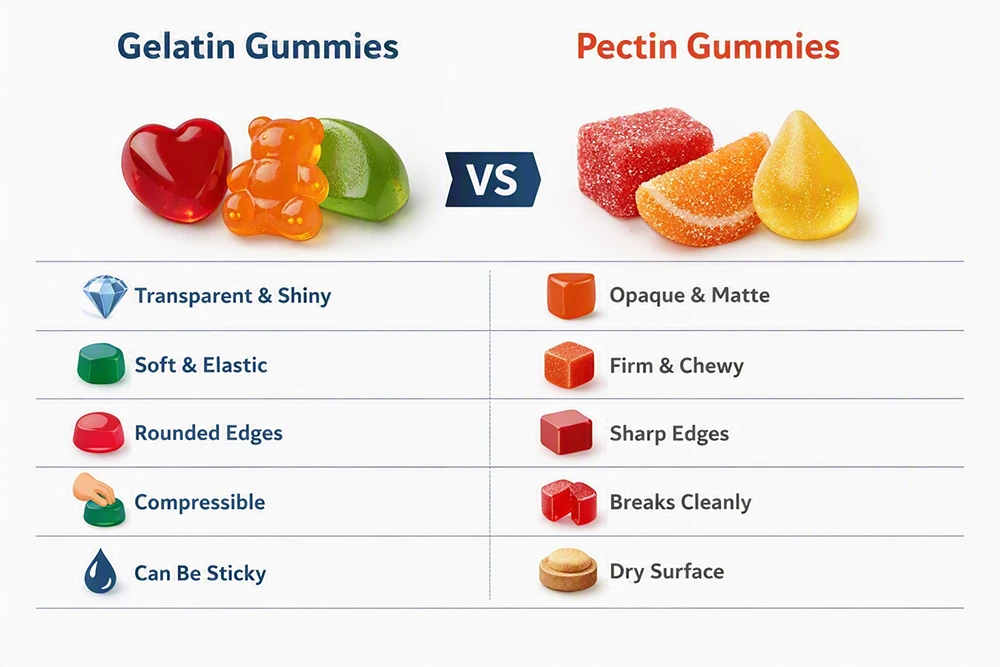
The most common gelling agent in traditional gummies is gelatin, derived from porcine or bovine collagen. However, vegan and halal markets increasingly demand plant-based alternatives. Pectin (derived from citrus peel or apple pomace) and carrageenan (a seaweed extract) are the primary options. Each has different gelling temperatures, textures, and moisture retention characteristics.
For creatine monohydrate specifically, the formulator must consider that lower pH environments (which can result from citric acid used in flavoring) may accelerate the conversion of creatine to creatinine — an inactive byproduct. Controlling the pH of the gummy matrix (ideally kept above 5.5) and limiting heat exposure during cooking are non-negotiable steps in maintaining ingredient integrity.
Dose Engineering in a Small Format
One of the more complex technical challenges when you create creatine monohydrate gummies is delivering a clinically relevant dose (3–5g) within a reasonable serving size. A standard gummy weighs between 3–6g, meaning either the dose per gummy must be carefully split across multiple pieces, or formulation density must be optimized to allow higher active loading.
Experienced contract manufacturers typically approach this through one of two strategies: increasing the number of gummies per serving (e.g., 4–5 gummies = one full dose), or using concentrated creatine monohydrate powder grades with finer particle size to improve dispersion within the matrix. Neither approach is inherently superior — the right choice depends on target consumer experience and label claims.
Step-by-Step: How the Manufacturing Process Works
Understanding gummy manufacturing at a process level helps brands make informed decisions when evaluating contract manufacturers, reviewing COAs, or auditing production facilities.
Step 1: Raw Material Sourcing and Testing
Quality begins before the first batch is made. Creatine monohydrate should meet established benchmarks for purity (≥99.9%), heavy metal limits, and microbial standards. Certificates of analysis (COAs), third-party testing reports, and HPLC verification are standard due diligence requirements. Reputable manufacturers source only from suppliers with traceable raw material chains.
Step 2: Formula Development and Stability Testing
The formulation phase involves iterative testing of the gummy base alongside the active ingredient. Variables include cook temperature, pH buffer selection, moisture content, and preservative system. Stability testing (typically 3–6 months accelerated or 12 months real-time) validates that creatine concentration remains within specification throughout shelf life.
Step 3: Pilot Batch and Sensory Evaluation
Before committing to full production, a pilot batch is produced to evaluate texture, mouthfeel, flavor profile, and visual consistency. Creatine monohydrate at higher concentrations can impart a slight powdery or chalky texture; skilled formulators balance this through modified starch additions or polyol humectants like maltitol or sorbitol.
Step 4: Large-Scale Production and Quality Control
Once the formula is locked, production scales up in GMP-certified facilities. Inline quality checks monitor cook temperature, fill weight per mold, moisture content, and active ingredient uniformity. Post-production testing includes dissolution testing, potency assay, and microbial screening before any batch is approved for packaging.
Step 5: Packaging and Label Compliance
Packaging selection impacts both product quality and consumer perception. Moisture-barrier pouches, PET jars with desiccant inserts, and nitrogen-flushed packaging all help extend shelf life for creatine gummies. From a regulatory standpoint, finished product labels must comply with FDA dietary supplement labeling requirements (21 CFR Part 101), including a Supplement Facts panel, serving size declaration, and appropriate structure/function claim disclaimers.
Regulatory and Compliance Considerations
Supplement brands operating in the U.S. market must ensure their creatine gummies comply with FDA cGMP regulations (21 CFR Part 111). This means that the manufacturer — not just the brand — carries responsibility for batch records, identity testing, and complaint handling procedures. Working with a manufacturer holding relevant certifications (GMP, ISO22000, HACCP) dramatically reduces compliance risk.
For brands targeting international markets — the EU, UK, Australia, or Southeast Asia — additional regulatory frameworks apply. The EU’s Food Supplements Directive, for example, sets specific maximum limits on certain ingredients, and label requirements differ significantly from the U.S. model. Engaging a manufacturer with international export experience is therefore not a luxury but a practical necessity.
Private Label vs. Custom Formula: Choosing the Right Development Path
There are two primary paths when bringing creatine gummies to market, each with distinct trade-offs.
Private label creatine gummies refer to pre-developed, ready-to-brand formulas maintained by the manufacturer. This path offers the fastest time-to-market (typically 4–8 weeks), lower MOQ requirements, and reduced development costs. The trade-off is limited differentiation — other brands may offer identical or similar products.
Custom OEM/ODM development, by contrast, allows complete formulation ownership. Brands can specify unique ingredient stacks (e.g., creatine monohydrate + HMB + electrolytes), exclusive flavor systems, and proprietary gummy textures. The development timeline is longer (12–20 weeks typically), and upfront R&D investment is required, but the resulting product can be genuinely differentiated in a competitive market.
For startups and early-stage brands, private label creatine gummies provide a lower-risk entry point. Established brands with an existing customer base may find the ROI on custom development more defensible.
Understanding MOQ, Bulk Orders, and Wholesale Pricing Structures
Cost modeling is a critical part of evaluating manufacturing viability. Creatine gummies bulk orders typically follow a tiered pricing model: the higher the volume, the lower the per-unit cost. Understanding where the major cost drivers lie helps brands negotiate intelligently.
The primary cost components in gummy manufacturing include raw material costs (creatine monohydrate, gelling agents, flavors, packaging), manufacturing labor, quality testing, and logistics. For creatine specifically, the ingredient cost tends to dominate — creatine monohydrate is generally commodity-priced, but quality variance between suppliers is meaningful.
For distributors and retailers exploring creatine gummies wholesale sourcing, it’s worth distinguishing between purchasing finished product in bulk versus entering a direct manufacturing relationship. Wholesale purchasing of pre-made product is faster and simpler; direct manufacturing relationships offer more margin leverage and product control over time.
Minimum order quantities in the gummy space typically start at 10,000–50,000 units depending on the manufacturer and format complexity. Some contract manufacturers offer trial or pilot runs at lower MOQs to allow brands to validate market demand before committing to large-scale production — a valuable option for new market entrants.
Selecting a Creatine Gummies Manufacturer: Key Evaluation Criteria
Choosing the right creatine gummies manufacturer is arguably the single most consequential decision in your product launch. The following criteria should guide the evaluation process:
Certifications and compliance infrastructure: At minimum, look for GMP certification and ISO food safety standards (ISO 22000 or equivalent). Halal, Kosher, and Vegan certifications matter depending on your target market.
R&D capability: A manufacturer with in-house formulation scientists — ideally with backgrounds in food science or pharmaceutical chemistry — will be better equipped to troubleshoot creatine-specific formulation challenges and iterate quickly.
Transparency and testing documentation: Ask for batch COAs, third-party testing reports, and stability data. A reputable manufacturer will provide these without hesitation.
Production capacity and lead times: Understand the facility’s daily output capacity and average production lead time. Misalignment between your sales velocity and production timelines can be costly.
Communication and project management: Especially for international sourcing, clear communication channels and dedicated account management are practical necessities, not differentiators.
Summary
Creating a creatine monohydrate gummy product that is both effective and commercially viable requires navigating a layered set of formulation, manufacturing, regulatory, and business considerations. Creatine monohydrate’s proven efficacy makes it an excellent anchor ingredient, but its physical and chemical properties demand experienced formulation management to translate into a high-quality gummy supplement. Whether a brand pursues a private label path for speed or custom OEM development for differentiation, the quality of the manufacturing partner ultimately determines the product’s integrity and the brand’s long-term credibility.
Frequently Asked Questions (FAQ)
Q1: What is the standard serving size for creatine monohydrate gummies? Most formulations deliver 3–5g of creatine monohydrate per serving, typically split across 3–5 individual gummies. The exact serving configuration depends on the gummy weight and active loading capacity determined during formulation development.
Q2: Can creatine monohydrate be formulated into vegan gummies? Yes. Pectin and carrageenan are the most common vegan gelling agents used as alternatives to gelatin. Both are compatible with creatine monohydrate, though formulation parameters (cook temperature, pH, texture) will differ from gelatin-based systems and require specific optimization.
Q3: How does moisture affect creatine gummy stability? Creatine monohydrate is hygroscopic and can absorb moisture from the gummy matrix over time, potentially affecting texture and active ingredient concentration. Moisture-barrier packaging (e.g., foil-laminate pouches or PET jars with desiccant) and controlled aw (water activity) in the formulation are the primary mitigation strategies.
Q4: What certifications should I look for in a creatine gummies manufacturer? At minimum: GMP certification and ISO 22000 (or HACCP). Depending on your target market, Halal, Kosher, Vegan, and FDA registration may also be relevant. For U.S.-bound products, ensure the manufacturer is registered with the FDA and follows 21 CFR Part 111 cGMP guidelines.
Q5: What is the typical MOQ for private label creatine gummies? MOQs vary by manufacturer but commonly range from 10,000 to 50,000 units for standard private label programs. Some manufacturers offer lower-MOQ pilot production runs for new brands. Custom OEM formulations generally carry higher MOQs due to dedicated tooling and batch setup costs.
Q6: How long does it take to go from concept to finished product? Private label creatine gummies can typically be ready in 4–8 weeks from order confirmation. Custom OEM/ODM development timelines range from 12–20 weeks, factoring in formulation development, stability testing, packaging design, and production scheduling.
Q7: Is creatine monohydrate safe to consume in gummy form? Creatine monohydrate has an extensive safety profile established over decades of clinical research. In a properly formulated gummy, the ingredient’s bioavailability and safety are maintained provided that pH control and stability parameters are correctly managed during manufacturing. As with any dietary supplement, consumers should follow label directions and consult a healthcare provider when appropriate.
About Gothink Biotech
Shenzhen Gothink Biotech Co., Ltd. is a professional gummy manufacturer and dietary supplement manufacturer based in China, offering end-to-end OEM and ODM services to brands, retailers, and distributors worldwide. Our GMP-certified facility — featuring a 100,000-class cleanroom and a 10,000-class pharmaceutical-grade R&D laboratory — supports gummy production at scale, with an annual output capacity of 5,000 tons.
We specialize in custom gummy formulation and production across a full range of formats and functional categories, including creatine, multivitamins, probiotics, sleep support, liver health, and more. Whether you are looking to launch your own brand through private label, develop a proprietary formula under white label or OEM/ODM arrangements, place a bulk manufacturing order, or source wholesale finished product, our team provides comprehensive support from formulation concept through export-ready packaging.
Our chief scientific advisor holds postdoctoral research credentials from Cold Spring Harbor Laboratory, Emory University, and The Ohio State University, with published research in leading scientific journals. This depth of scientific expertise underpins the quality and precision we bring to every production run.
To learn more or request a product consultation, visit gttbio.com.