Tillverkare av kosttillskott | Gummi,…




Developing a gummy supplement that works in the lab is not the same as developing one that runs reliably on a commercial line. Many promising concepts fail during scale-up due to texture breakdown, active ingredient degradation, or unstable water activity. A capable Tillverkare av gummi approaches formula development as an engineering problem that balances dosage, stability, sensory profile, and process capability from day one.
This article explains how commercial gummy formulas are actually developed for OEM and ODM production, what decisions affect cost and feasibility, and what information you should prepare before requesting a quotation.
Direct Answer: What Does Commercial Gummy Formula Development Involve?
Commercial gummy formula development starts with defining commercial specs, then selecting a gelling system and building a base that controls pH, solids, and water activity.
Actives are evaluated for heat sensitivity, pH sensitivity, hygroscopicity, flavor impact, and loading level. The base is adjusted so the process — cooking, addition point, depositing, drying, and coating — protects both texture and potency. Stability testing, microbiological control, and packaging compatibility are built in before commercial batch release.
For brand owners, this means a good formula is not just effective on paper. It must deposit cleanly, set consistently, maintain target water activity below critical thresholds, and remain stable through its declared shelf life.
Why Formula Development Determines Commercial Success
In tillverkning av gummi, formulation and process are inseparable. Gummy mass is a low-moisture, high-solids system where gelatin or pectin forms a continuous gel network. Small shifts in pH, cooking temperature, or brix change that network and affect chew, clarity, and moisture migration.
For buyers, a poorly designed formula shows up as sticky surface, syneresis, grainy texture, color fading, or active ingredient content below label claim after three months. These are manufacturing failures, not just R&D issues. Addressing them early reduces rework, shortens lead time, and protects unit economics.
The Commercial Gummy Formula Development Process
1. Define Product Concept and Commercial Specifications
Every commercial project starts with a spec sheet. This should include target actives and dosage per serving, serving size, gummy weight, flavor direction, color direction, dietary requirements, and target market.
Dietary claim affects gelling system selection. Gelatin is animal-derived and not suitable for vegan or vegetarian positioning. Pectin is plant-based but requires tighter pH control and is more sensitive to calcium and acid addition order. Sweetener choice also matters. Sugar-free systems using maltitol or erythritol behave differently during cooking and drying than sucrose-glucose systems.
2. Select the Gelling System: Gelatin vs Pectin vs Hybrid
The gelling system determines texture, process window, and compatibility. Gelatin gives an elastic, chewy texture and tolerates a wider pH range. It melts at body temperature, which helps flavor release but can be a disadvantage in hot climates.
Pectin forms a short, tender bite and is thermally stable after setting. It requires pH typically between 3.2 and 3.8 and high soluble solids to gel properly. Low-methoxyl pectin can gel with calcium, which is useful for reduced-sugar formats but adds another variable for mineral interaction.
| Parameter | Gelatin System | Pectin System |
|---|---|---|
| Struktur | Elastisk, seg, smälter i munnen | Short, tender, less elastic |
| pH-tolerans | 3.5 – 5.0, more flexible | 3.2 – 3.8, critical for gel formation |
| Värmestabilitet | Melts above ~35°C, needs controlled storage | Thermally stable after set, better for warm climates |
| Veganskt påstående | Inte lämplig | Suitable, supports Vegan, Halal, Kosher positioning |
| Process Risk | Foaming, prolonged drying if over-hydrated | Pre-gelation if acid added too early, sensitive to calcium |
3. Assess Active Ingredient Loading and Compatibility
Active loading directly affects gummy weight, serving count, and texture. Vitamins, minerals, botanicals, and specialty ingredients behave very differently in a gummy matrix.
High-dose water-soluble vitamins like vitamin C can increase sourness and lower pH, which impacts pectin gel strength. Minerals such as zinc citrate or iron can create metallic off-notes and may interact with pectin or colors. Hygroscopic ingredients like choline or certain B-vitamin salts absorb moisture and raise water activity.
Manufacturers calculate theoretical loading as mg active per gram of finished gummy. When loading exceeds about 15-20% of gummy weight, texture becomes crumbly and depositing becomes inconsistent. At that point, you must increase gummy size, reduce dosage, or split into two gummies per serving.
| Typ av ingrediens | Typisk utmaning | Manufacturing Adjustment |
|---|---|---|
| High-dose Vitamin C, B-complex | Lowers pH, sour, hygroscopic | Buffer pH, add after cooling, control drying |
| Minerals (zinc, magnesium, calcium) | Bitter, interacts with pectin | Encapsulated mineral forms, flavor masking, adjust calcium in pectin |
| Botaniska extrakt | Color variation, bitter, ethanol residue | Standardized extract spec, color compensation, deodorized grades |
| Heat-Sensitive (D3, probiotics, enzymes) | Degradation during cooking | Add at low-temp holding stage, reduce holding time, validate potency retention |
4. Build the Base Formula: Solids, pH, and Water Activity
A commercial gummy base typically targets 78-84 Brix before depositing. Solids control final texture and drying time. Too low and gummies will not set. Too high and mass becomes too viscous to deposit accurately.
pH and water activity are critical control points. pH controls gel formation for pectin and influences preservative efficacy. Most commercial gummies target pH 3.2-4.2 for flavor and microbial control. Water activity is usually controlled below 0.75 for gelatin and below 0.70 for pectin to limit microbial growth and stickiness.
Why this matters: water activity, not just moisture content, drives microbial risk and texture changes during storage. A manufacturer measures both during drying and after conditioning to set release specs.
5. Manage Heat-Sensitive and Reactive Ingredients
Cooking temperatures for gummy syrup often exceed 100°C to reach target solids. Many actives cannot survive that step. Vitamin D3, retinol, probiotics, and certain enzymes lose potency at high heat.
Commercial practice is to prepare a base syrup, cool it to a controlled holding temperature (often 70-80°C for gelatin, 90-95°C for pectin before acid addition), then add heat-sensitive actives, flavors, and colors under vacuum or low-shear mixing to minimize air incorporation and oxidation. Acid for pectin is added last, because early acid causes pre-gelation and lumpy depositing.
6. Flavor, Color, and Sweetener System
Flavor masking is often required for minerals, botanicals, and B-vitamins. Natural flavors can volatilize at depositing temperatures, so dosage is optimized after thermal loss validation. Sour sanding or acid coating can help mask bitterness but raises surface moisture if not dried properly.
Color stability depends on pH and light. Natural colors like anthocyanin fade at higher pH, while curcumin is sensitive to light. A manufacturer will match color system to pH target and packaging opacity.
7. Lab Trials, Pilot Batches, and Scale-Up
Formula development moves from bench beakers to pilot depositor to commercial line. Each scale introduces new variables. Mixing time, shear, holding time in the hopper, and cooling tunnel temperature all affect final texture and active uniformity.
On a large-scale line, a small variation in depositing nozzle temperature creates weight variation. That directly affects content uniformity. This is why experienced manufacturers validate mixing time, depositor settings, starch or silicone mold release, and cooling curve during pilot runs before committing to full production.
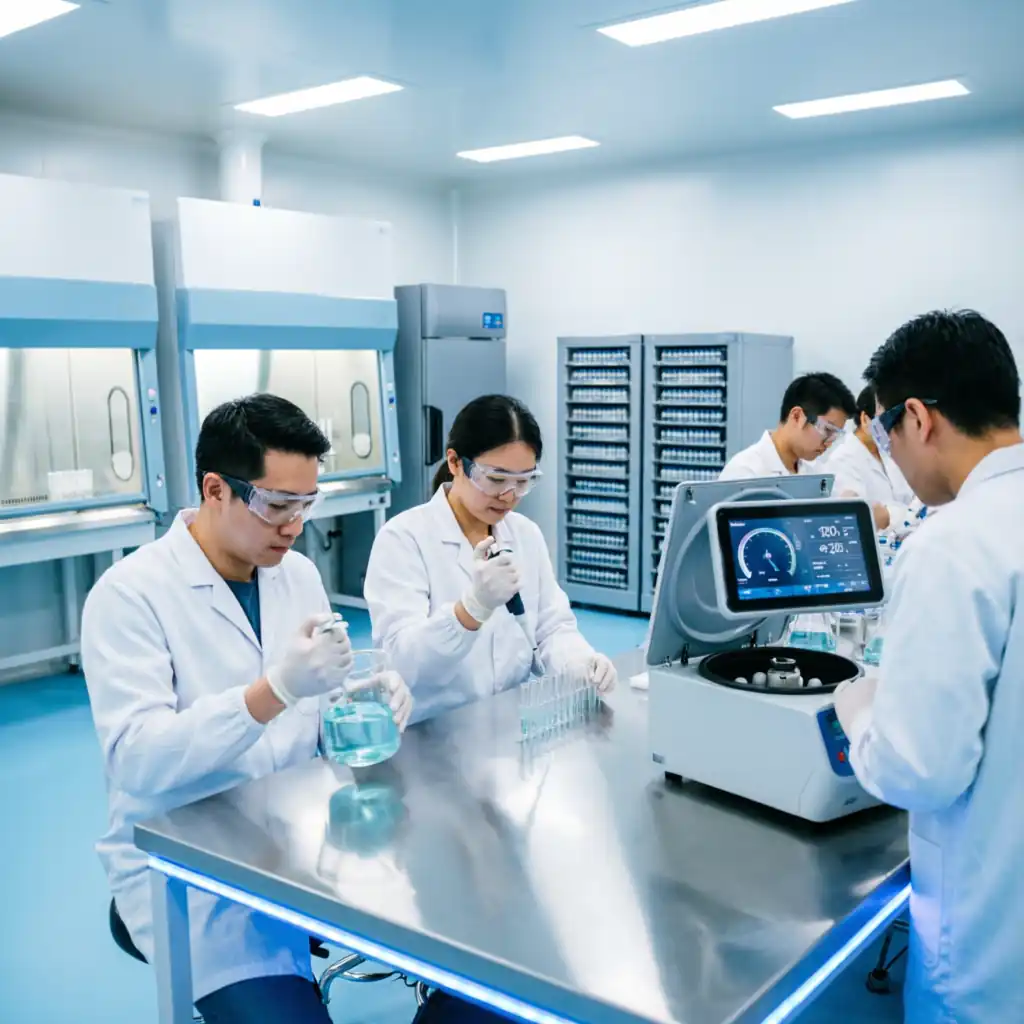
Shenzhen Gothink Biotech Co., Ltd. operates a 10,000-class R&D laboratory alongside a GMP-certified facility with 100,000-class cleanroom and approximately 16 tons of daily capacity, which allows parallel small-batch optimization and commercial-scale validation without changing material sources.
8. Stability and Shelf-Life Validation
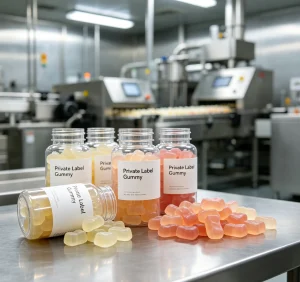
After pilot, samples are placed on accelerated and real-time stability. Key tests include active assay, water activity, texture profile, color change, and preservative efficacy where applicable. For Private Label Gummy projects using an existing base, stability data from similar formulas can shorten timelines. For new custom formulas, 3-6 months of accelerated data is typically needed to set a provisional shelf life.
Quality Control and Testing in Commercial Gummy Production
Commercial production requires in-process controls and finished-product testing that consumer brands rarely see in small kitchens.
- Råvarutestning: identity, potency, heavy metals, and microbiology for actives, gelatin/pectin, and flavors.
- Pågående: Brix, pH, temperature, viscosity, depositing weight checks, and water activity during drying.
- Färdig produkt: weight uniformity, active assay, water activity, pH, texture, microbiological testing including total plate count, yeast and mold, and metal detection.
- Packaging compatibility: seal integrity and moisture barrier testing, especially for pectin gummies in high-humidity markets.
Batch traceability from raw material lot to finished goods lot is required for GMP compliance and for export documentation. Buyers should ask how a manufacturer tracks and documents this.
Cost, Gummy Weight, and MOQ Considerations
For gummies, cost is driven by more than active ingredient price. Major factors include:
- Aktiv belastning och gummivikt: higher dosage often requires larger gummy size, which increases all material usage and reduces pieces per hour on the depositor.
- Gelling system: pectin generally costs more than gelatin and requires more precise process control, which affects line efficiency.
- Flavor and masking: complex masking systems for minerals or botanicals increase formula cost.
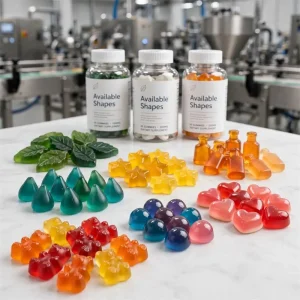
- Mold and shape: custom shapes require new molds and affect demolding efficiency.
- Beläggning: oil coating, wax coating, or sour sanding adds a process step.
- Förpackning: bottles with desiccant vs stand-up pouches affect stability and packaging line speed.
- Testning: heavy metals, potency assays for multiple actives, and stability programs add to lot cost.
MOQ becomes commercially important because gummy lines require minimum batch sizes to achieve thermal stability and depositing consistency. Changing formula during a run is not possible. A low MOQ may mean higher per-unit cost due to line clearance, cleaning, and testing overhead. For startups, a Privat etikettgummi built on an existing validated base can lower MOQ and shorten lead time compared to fully custom development.
How to Evaluate a Gummy Manufacturer for Custom Formula Development
When evaluating a supplier for custom formulation, focus on verifiable capabilities rather than marketing claims.
- Formulation experience: proven work with your ingredient category — high-dose, mineral, botanical, sugar-free, or vegan pectin.
- R&D to production transfer: pilot depositor, lab for pH, Brix, water activity, and texture analysis, and documented scale-up procedures.
- Kvalitetssystem: GMP-certified facility, HACCP, ISO22000, FSSC 22000, BRC, and FDA registration where relevant. These systems govern hygiene, traceability, and release.
- Testkapacitet: in-house or qualified third-party testing for potency, microbiology, and heavy metals.
- Ingredient sourcing control: ability to source standardized botanicals and encapsulated minerals with consistent specs.
- Dokumentationsstöd: COA, allergen statements, manufacturing process flow, and nutrition facts support for target markets.
- Export and packaging capability: bottle and pouch lines, desiccant application, and experience with climate-specific stability.
- Capacity and lead time transparency: daily output, changeover time, and realistic lead time for pilot, stability, and commercial lots.
For example, a manufacturer maintaining certifications including ISO9001, ISO22000, HACCP, FDA, HALAL, GMP, KOSHER, BRC, FSSC 22000, and Vegan demonstrates broad quality system coverage, but you should still ask which certifications apply to the specific production line that will run your product.
Checklist: What to Provide to Your Gummy Manufacturer
Providing complete information at RFQ stage prevents weeks of back-and-forth and inaccurate pricing.
- Target actives, dosage per serving, and servings per container
- Desired gummy weight range and pieces per serving
- Flavor, color, and sweetener preferences and dietary claims (vegan, sugar-free, halal)
- Target pH or sourness level if you have a reference product
- Packaging format, bottle size or pouch size, and target shelf life
- Target market and any regulatory limits for daily intake
- Budget range and estimated annual volume
- Reference samples or competitor benchmarks, if available
Common Mistakes That Delay Commercial Production
- Overloading actives into a single gummy: leads to poor texture and potency variation. Split dose or increase gummy size.
- Ignoring pH impact of actives: vitamin C or fruit powders lower pH and break pectin gels if not buffered and sequenced correctly.
- Adding acid too early in pectin: causes pre-gelation, nozzle clogging, and weight inconsistency.
- Choosing a flavor that fades at process temperature: results in repeated flavor adjustments during scale-up.
- Skipping water activity control: results in sticky, clumped gummies in bottles during summer shipment.
- Not validating packaging: a pouch with insufficient barrier raises water activity and microbial risk during distribution.
FAQ
How long does it take to develop a custom gummy formula for commercial production?
For a Private Label Gummy using an existing base, development can take 1-3 weeks. For a fully custom formula with new actives, expect 4-10 weeks for lab and pilot work, plus additional time for accelerated stability if a new claim or high-risk ingredient is involved.
What is the maximum active ingredient load in a gummy?
There is no fixed maximum, but practical commercial loading is typically below 20% of finished gummy weight. Beyond that, texture becomes crumbly and depositing accuracy drops. Minerals and botanicals often require larger gummy size or two gummies per serving to meet dosage.
Can probiotics be made into gummy supplements?
Probiotic gummies are technically challenging due to heat, moisture, and low pH. Most commercial formats use spore-forming strains or specialized low-water-activity pectin systems and require strict temperature control during depositing, drying, and storage. Stability validation is essential before commercial launch.
Why does my manufacturer recommend pectin instead of gelatin?
Pectin is recommended when you need vegan, vegetarian, halal, or kosher positioning, better heat stability for warm markets, or a short tender bite. It requires tighter pH control and more precise acid addition timing, which affects line efficiency and cost.
How does gummy size affect cost and MOQ?
Larger gummies use more raw material per piece and produce fewer pieces per hour, which raises per-piece cost but may allow you to meet dosage in one gummy. MOQ is set by minimum batch size needed for consistent cooking and depositing, typically measured in kg of finished mass, not piece count.
What tests should I request for commercial gummy batches?
At minimum: active assay, water activity, pH, weight uniformity, appearance and texture, total plate count, yeast and mold, and metal detection. Depending on markets, you may also need heavy metals, preservative challenge, and allergen testing.
What information does a Gummy Manufacturer need to give an accurate quotation?
Actives and dosage per serving, gummy weight, gelling system preference, flavor and color direction, dietary requirements, packaging format, target shelf life, target market, and projected volume. Without this, any quotation will be provisional and subject to reformulation.
Next Step: From Concept to Commercial Quotation
If you have a product concept, start by defining commercial specs and dosage strategy before locking flavor or shape. Discuss active compatibility, gelling system trade-offs, and stability expectations with your manufacturer early. A manufacturer with dedicated R&D and commercial-scale lines can advise whether your formula should be a custom development or adapted from a validated Private Label Gummy base to reduce cost and lead time.
To move forward, request a formulation review with your target actives, desired gummy weight, and packaging format. Compare formulation options based on water activity control, process feasibility, and testing requirements, then request an OEM/ODM quotation with pilot and commercial batch terms.
Utforska fler tekniska artiklar i vår Kunskapsnav covering gummy, capsule, tablet, powder, and liquid supplement manufacturing.
Jack Luo, senior teknisk rådgivare, Nutrition Research Center. Representerar Gothink Biology, en GMP-certifierad tillverkare av kosttillskott baserad i Shenzhen, Kina.