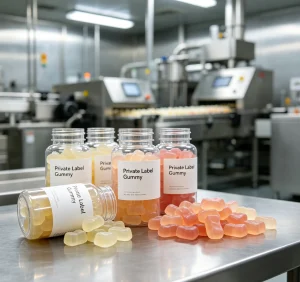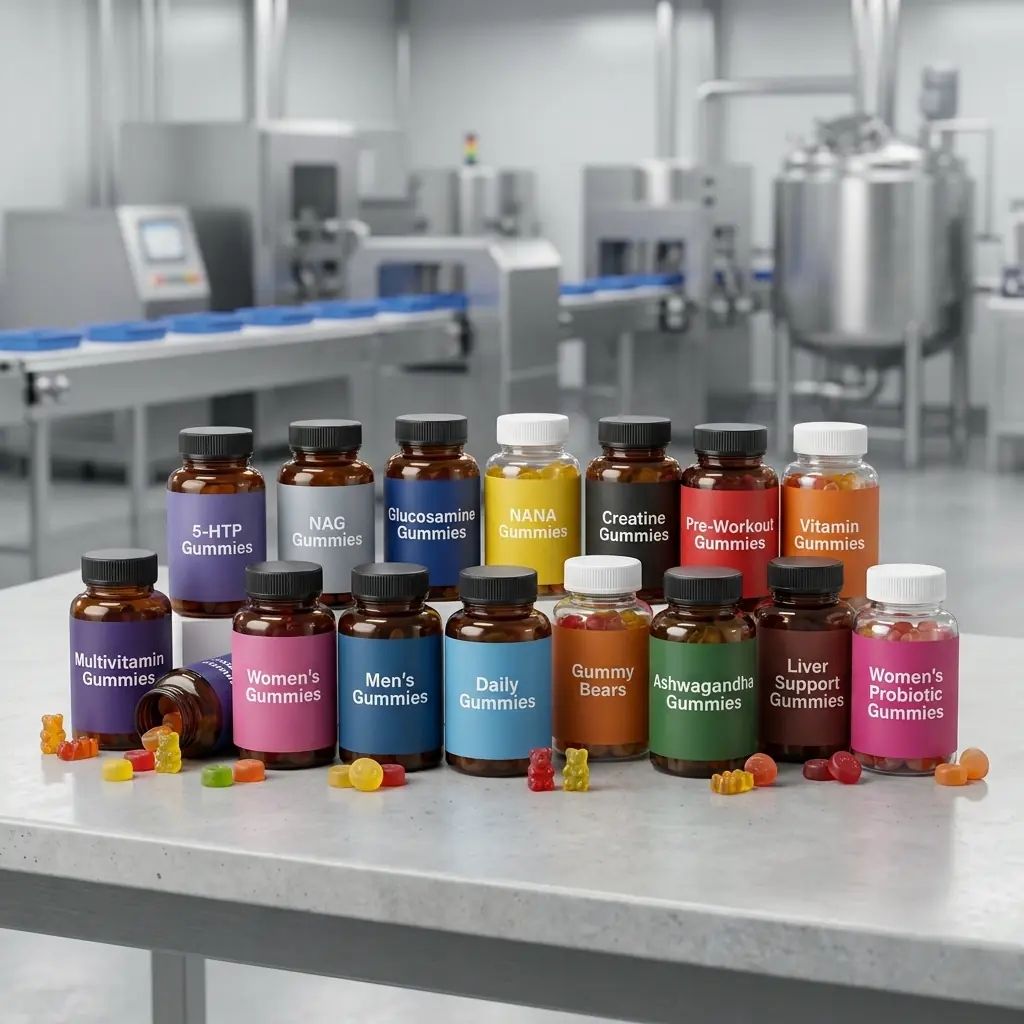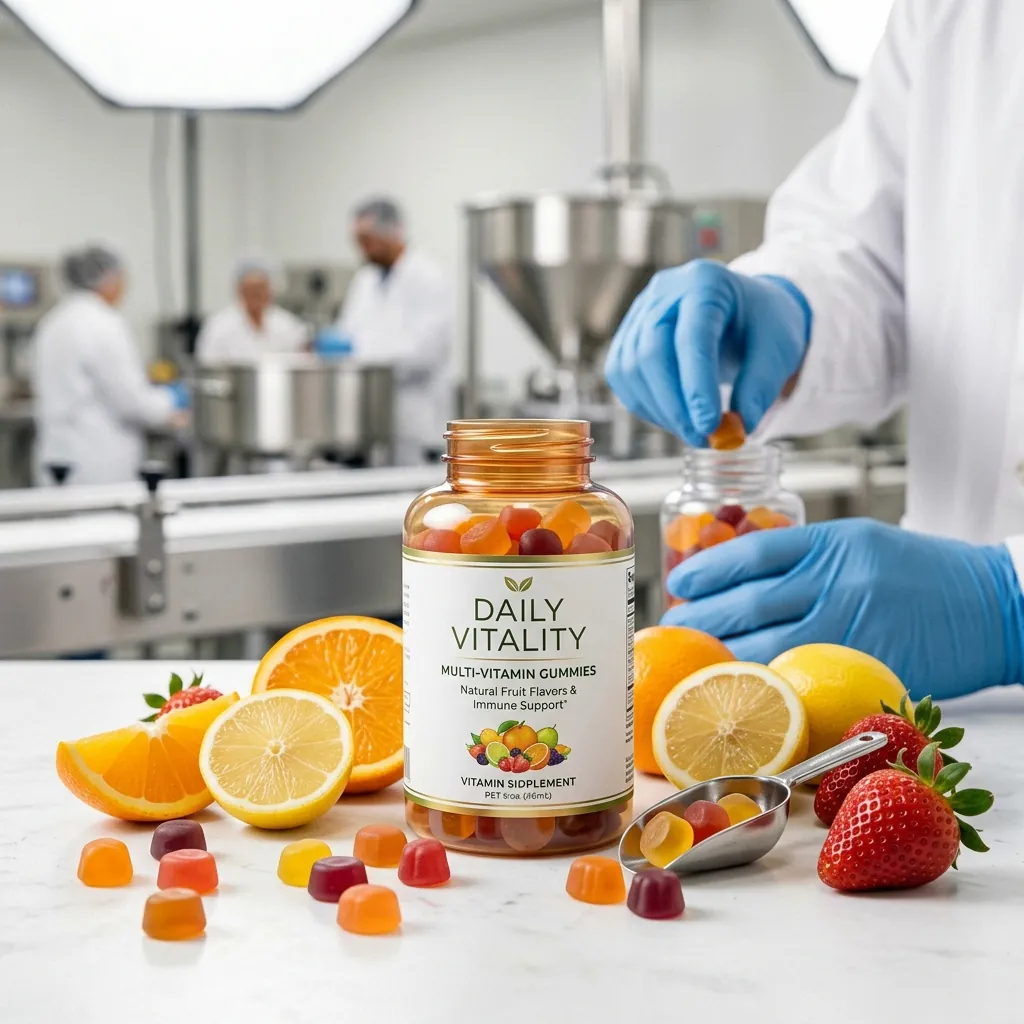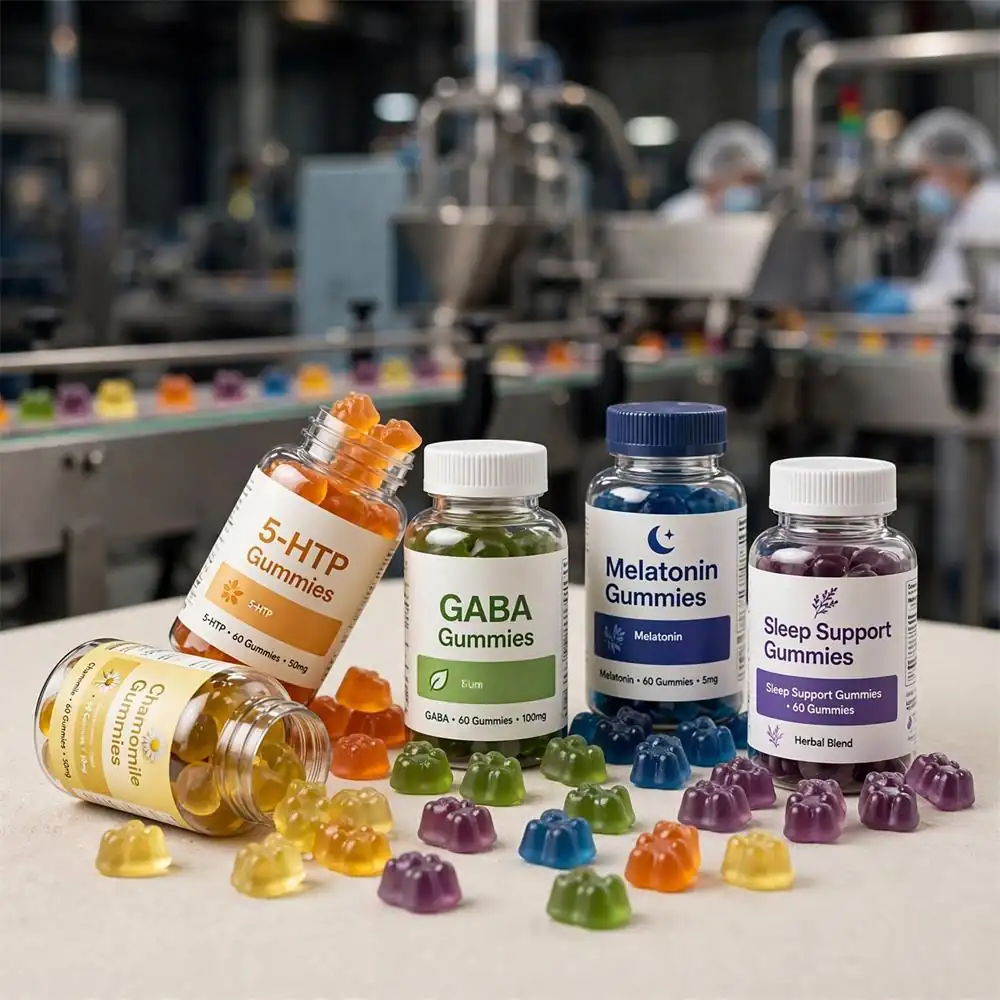

Komersial pembuatan bergetah turns a supplement concept into a stable, accurately dosed, shelf-ready product through controlled gel cooking, precision depositing, conditioning, and GMP packaging. The right pengeluar bergetah engineers the gel system, pH, water activity, and heat-exposure profile so that potency, texture, and label claims survive both the production line and the supply chain. For any brand or buyer planning a label peribadi bergetah launch, understanding how the process works is the fastest way to reduce risk, shorten development time, and ask suppliers the right qualification questions.
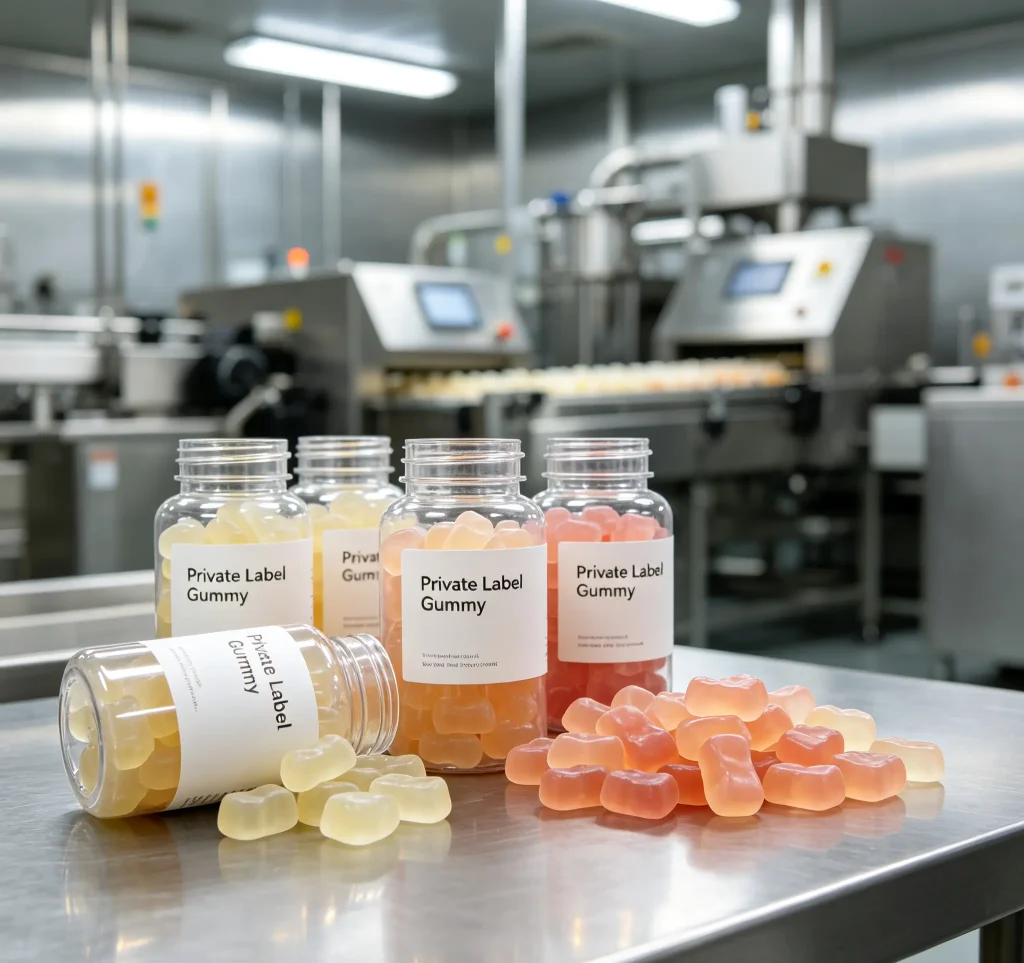
Direct Answer: How Are Gummies Manufactured at Commercial Scale?
Commercial gummy production is a controlled sequence of formulation, cooking, active addition, precision depositing, cooling, drying, and packaging under GMP conditions. A qualified contract manufacturer does not simply scale up a kitchen recipe — it engineers the gel system, pH, water activity, and heat exposure to protect actives, achieve target texture, and meet stability and microbiological requirements batch after batch.
In practice, most commercial lines follow this flow: specification review, formula lock, raw material QC, preparation of the gel-sugar mass in jacketed cookers, low-temperature addition of heat-sensitive actives, flavor and acid dosing, continuous depositing into molds, cooling tunnel set, demolding, conditioning to target water activity (aw), coating or sanding, metal detection, and final packaging with finished-product testing. Each stage is tied to a process parameter that directly affects texture, potency, and shelf life.
Why Scale-Up Changes Everything for Supplement Brands
Scale-up is the highest-risk transition in gummy product development: a formula that pours perfectly at lab bench can fail on a commercial line depositing thousands of pieces per minute. Small deviations in cooking temperature, Brix, or pH create batch inconsistency, sticking, blocked depositors, or active degradation — problems a hand-poured lab trial will never reveal.
Buyers research this topic because they need to understand risk before committing to tooling, MOQ, and stability testing. The manufacturing method determines dosage accuracy, shelf-life validation, packaging compatibility, and whether a concept is commercially viable at target cost.
If you understand the process, you can make sharper decisions on gummy weight, serving size, gel system, and flavor system — and you will know exactly what to ask a supplier to prove during qualification.
The Core Manufacturing Process at a Professional Gummy Manufacturer
Commercial gummy production runs through ten controlled stages, and every stage is tied to a process parameter — Brix, pH, temperature, time, or water activity — that directly determines texture, potency, and shelf life. The stages below reflect standard practice in a GMP-certified supplement facility.
1. Concept Review and Specification Alignment
Specification alignment is the first quality gate in gummy manufacturing: the manufacturer validates active loading, serving size, gel preference, and market claims against the physical limits of the gummy matrix before any formulation work begins. Every project starts with a target label — actives per serving, serving size, gummy weight, gel preference, flavor, color, sweetener system, and claims such as pectin-based, gelatin-free, vegan, or sugar-free.
This review prevents costly rework. A 500 mg calcium carbonate dose, for example, will not fit in a 2.5 g pectin gummy without serious texture and taste problems, so serving count or gummy weight must change early — before tooling or packaging are committed.
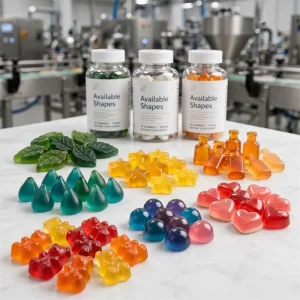
Brands with a signature shape in mind can request a 3D custom mold design feasibility review at this stage to confirm the concept deposits, sets, and demolds cleanly before tooling costs are incurred.
2. Formulation Development and Ingredient Selection
Gummy formulation is a three-way balance between stable gel structure, acceptable taste and texture, and potency retention through shelf life. Gelatin delivers an elastic chew and tolerates a wider pH range, while high-methoxyl and low-methoxyl pectin demand precise solids and pH control and behave differently with calcium-reactive actives.
Ingredient compatibility drives the choices. Acidic actives such as vitamin C can hydrolyze gelatin if exposed too long at high temperature, and excess acid can break pectin gel if pH drops below 3.2 before depositing. Mineral salts create bitterness and interfere with gelling. Hygroscopic powders such as choline bitartrate or certain botanical extracts raise water activity and demand dedicated moisture management.
Sweetener architecture is also decided here. Sugar-free systems replace glucose syrup and sucrose with polyols — typically maltitol syrup, often blended with erythritol or allulose — which shifts cooking targets, cooling behavior, and water activity control. Custom flavor development and color matching against brand standards (including natural, clean-label color systems) are locked at this stage; requesting a custom flavor sample kit here lets your team benchmark masking performance before committing to a full formula.
3. Raw Material QC and Pre-Weigh
Every raw material lot must pass identity, potency, and microbiological testing and be formally released before it can enter a batch — no exceptions on a GMP line. Sugars, glucose syrup or polyol base, gel agents, acids, flavors, colors, and actives are pre-weighed in a controlled environment to prevent cross-contamination and weighing errors.
For actives with potency variability, such as botanical extracts, input potency is calculated to hit label claim, with overages set from real process-loss data rather than assumptions. No proprietary loss factors are applied without development data behind them.
4. Gel Mass Cooking
Gel mass cooking is the most parameter-sensitive stage in the process: Brix, temperature, and pH at the cooker determine gel strength, final moisture, and depositing performance downstream. The mass is cooked in jacketed vessels or vacuum cookers to a target Brix of typically 75-82 depending on gel system and final moisture target, with conventional syrup boiling commonly running at 105-115°C before the mass is cooled for sensitive additions.
Temperature control is critical. Overheating degrades pectin gel strength and drives excessive moisture loss; undercooking leaves too much water and raises water activity. For gelatin systems, the sugar base is cooked first and gelatin is added after the mass cools to roughly 80-85°C to avoid hydrolysis. For pectin systems, pectin is hydrated separately, combined with the sugar solids, and cooked with pH held above 3.8 until depositing to prevent premature gelation in the hopper.
5. Active Ingredient Addition
Heat-sensitive actives are added downstream — after the cooked mass cools into a defined 60-75°C window — because this step is where potency is won or lost. Vitamins C, D, and B-complex, delicate flavors, and many botanical actives degrade with prolonged heat exposure, so residence time at temperature is minimized and validated.
Mixing must homogenize the batch without entraining air or shearing the gel network. High-shear mixing can break gel structure; poor mixing creates potency variation across the batch. Sequence matters: oil-soluble actives such as vitamin D3 or CoQ10 may need emulsification, minerals need pre-dispersion to avoid grit, and acids and buffers are dosed at the end to set final pH for pectin setting. With controlled addition temperature and short residence time, processing retention for common vitamins typically runs at 90% or higher, with the balance covered by a data-backed overage.
6. Meletakkan dan Mencetak
Precision depositing meters the conditioned mass into silicone or starchless molds at weight tolerances of ±2-3%, which is what makes label-claim accuracy and batch consistency possible at commercial scale. Depositor hopper temperature is actively controlled so viscosity — and therefore piece weight — stays constant across the entire run.
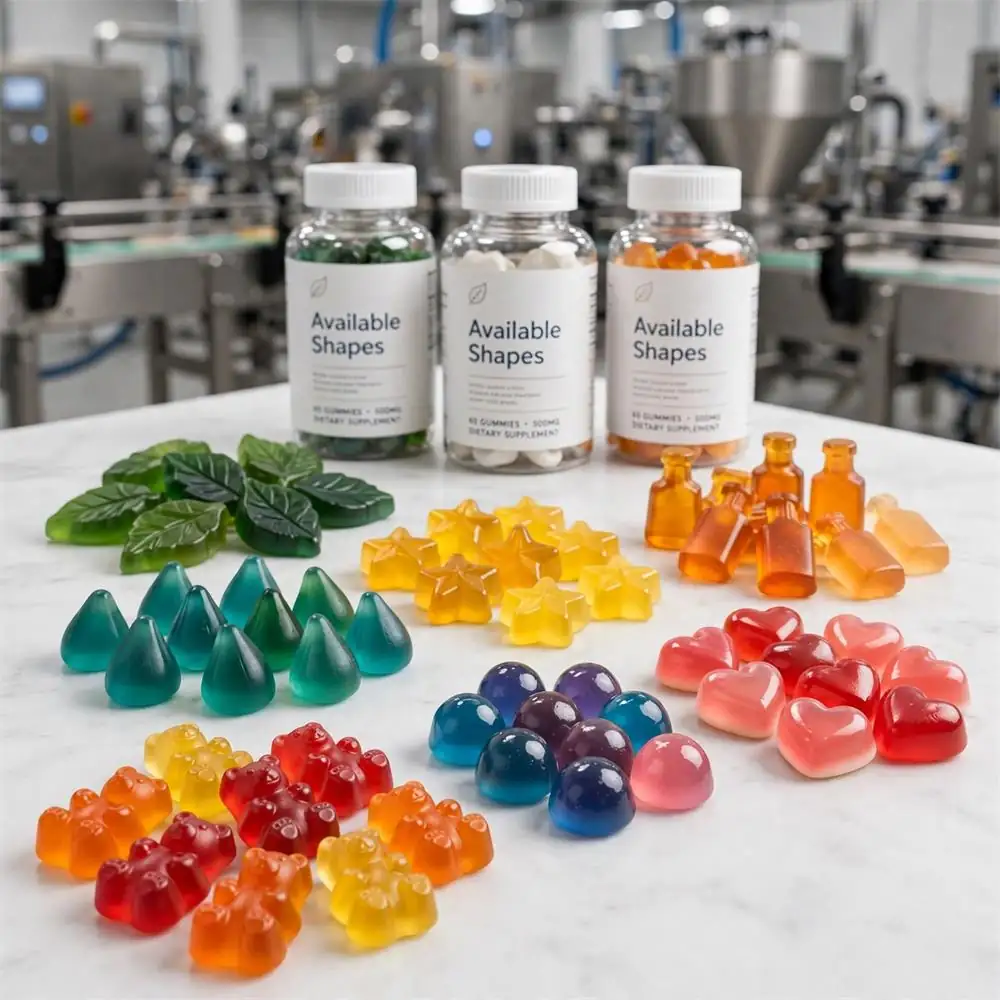
Mold design affects demolding and consumer experience. Sharp edges increase breakage, deep cavities slow setting, and heavier gummies reduce line speed. For private label gummy programs, using existing validated mold shapes lowers cost and lead time, while custom shapes require new depositing plates and tooling time — reviewing a supplier’s stock mold catalog early, or requesting 3D custom gummy mold design renders for a signature shape, shortens development on both paths.
7. Cooling, Setting and Demolding
Setting converts the deposited liquid into a solid that can be handled: gelatin requires chill setting at 0-5°C for 30-90 minutes depending on piece size, while pectin sets through a sugar-acid-gel mechanism under controlled cooling — never freezing, which would fracture the gel network.
Demolding too early causes deformation; demolding too late wastes line capacity on high-throughput equipment. Process validation locks the time-temperature profile so every batch releases cleanly with consistent shape and gloss.
8. Drying and Water Activity Control
Post-demolding conditioning dries gummies to a target water activity — commonly 0.55-0.65 for finished supplement gummies, and in all cases below the ~0.75 ceiling above which yeast and mold risk rises sharply. This stage is not about making the gummy hard; it stabilizes texture, sets the bite, and protects microbiological shelf life.
Drying parameters are product-specific. Over-drying toughens pectin gummies and triggers sugar crystallization; under-drying leaves sticky surfaces and water activity too high for shelf-life validation. Hygroscopic ingredients slow drying and extend conditioning time. Conditioning and coating decisions also drive melting resistance in transit: properly dried gummies in high-barrier packaging resist blocking, sweating, and deformation at the ambient temperatures encountered in export shipping.
9. Coating or Sanding
Coating is a functional process step, not decoration: a thin film of carnauba wax or MCT oil reduces sticking and slows moisture exchange during storage, while sugar sanding delivers a distinct sensory profile. Coating choice also influences shelf-life melting resistance and how the product behaves in a bottle or pouch over time.
For sugar-free or vegan positioning, coating agents must match label claims, and coating compatibility with specific colors and flavors is verified during development — some oil systems bleed natural colors or strip delicate flavors.
10. Inspection, Testing and Packaging
Finished-product release is the final quality gate: every batch must pass metal detection, visual inspection, weight checks, potency, pH, moisture, water activity, and microbiological testing — total plate count, yeast and mold, and absence of specified pathogens where required by specification — before it ships.
Packaging compatibility is part of quality, not an afterthought. High-barrier bottles with induction seals, or pouches with desiccants, maintain water activity and flavor through shelf life, and the packaging format must be included in stability studies because it controls oxygen and moisture ingress.
Gel Systems Compared at Commercial Scale
Gel system choice — gelatin, pectin, or starch/agar blends — dictates the entire process flow, from cooker settings and depositing behavior to texture, melting resistance, and which actives are technically feasible. The table below summarizes the trade-offs seen in commercial gummy manufacturing.
| atribut | Getah Gelatin | Pectin Gummy | Other Systems (Starch, Agar Blends) |
|---|---|---|---|
| tekstur | Elastik, kenyal, cair di mulut | Shorter bite, tender to firm depending on solids and pH | Variable; often used for vegan positioning or specific chew targets |
| Kepekaan Proses | Tolerates wider pH; sensitive to prolonged heat after gelatin addition | Highly sensitive to pH and Brix; acid is dosed at depositing | Requires precise hydration and cooking sequence |
| Pelepasan Rasa | Slower release; good masking for some minerals | Faster release; needs a robust flavor system for bitter actives | Depends on blend; generally faster than gelatin |
| Kedudukan Diet | Not suitable for vegan; halal/kosher only with certified gelatin source | Suitable for vegan, halal, kosher when certified inputs are used | Often vegan-friendly |
| Heat / Melting Resistance | Softens near body temperature (~35°C); needs climate-controlled logistics for hot markets | Holds shape at higher ambient temperatures; preferred for hot-climate export | Generally good heat stability depending on blend |
| Typical Active Challenges | Acidic actives can hydrolyze gelatin if mishandled | Calcium, high acid load, and high-dose minerals can disrupt the gel | High oil load and high mineral load can affect set |
For brands shipping to hot-climate markets, melting resistance is a commercial variable, not a footnote. Gelatin begins to soften near body temperature (~35°C), so summer transit and warehouse storage can deform pieces, while pectin and agar-blend systems retain shape at higher ambient temperatures — one reason pectin is the default choice for tropical export markets. If your distribution footprint includes hot-climate regions, ask for stability data at elevated storage temperatures, for example 40°C conditioning, as part of the shelf-life protocol.
Key Formulation Challenges That Drive Manufacturing Decisions
Technical feasibility in gummy formulation is decided by four interacting variables: active loading, heat sensitivity, pH compatibility, and water activity. The challenges below are the ones that most often reshape a formula, a serving size, or a launch timeline.
- Active loading and gummy weight: A typical commercial gummy weighs 2.5-4.0 g. High-dose ingredients such as magnesium, calcium, or fiber increase gummy size or force a 2-3 gummy serving. Overloading makes texture gritty and depositing accuracy fall.
- Kepekaan haba: Vitamins A, C, D, probiotics, and some botanicals degrade with prolonged heat. Commercial practice is to shorten heat exposure and add them downstream, with mixing validated for uniformity.
- pH and gel compatibility: Pectin needs a final pH of about 3.2-3.8 to set. Highly acidic actives or excess citric acid added early can cause pre-gelation in the hopper and block depositors.
- Moisture and water activity: Hygroscopic ingredients such as sodium ascorbate, choline bitartrate, or honey powders raise water activity and cause stickiness and microbial risk. Drying time and packaging barrier must be adjusted.
- Taste and flavor masking: Minerals like zinc and iron, botanicals like ashwagandha, and high-dose B vitamins create bitter or metallic notes. Oil coating alone does not mask them; flavor system, sweetener, acid balance, and encapsulation or pre-dispersion are needed.
- Color and stability: Natural colors are pH-sensitive and heat-sensitive. Anthocyanins fade at low pH and high heat, while curcumin is light-sensitive. Stability testing under intended packaging confirms color retention.
- Oil-soluble actives: Ingredients like CoQ10, vitamin D3, or CBD-type hemp extracts require emulsification. High oil load can soften texture and affect demolding if not properly bound.
Quality Control and Testing Buyers Should Verify
Professional gummy quality control operates at three checkpoints — incoming raw materials, in-process parameters, and finished-product release — and each checkpoint must be documented and auditable. Ask to see how each is evidenced.
- Incoming QC: Identity, potency, allergen status, and microbiology for actives and gel agents. Certificates of Analysis from suppliers are verified, not just filed.
- Kawalan dalam proses: Brix, pH, depositing weight, cooling tunnel temperature, drying time and temperature, and water activity trending. These drive batch consistency.
- Finished-product testing: Potency for labeled actives, moisture, water activity, texture assessment, and microbiological testing. Heavy metals and preservative testing where required by market or specification.
- Kebolehkesanan dan rekod kelompok: Lot numbers for each ingredient linked to finished batch, with retention samples stored under defined conditions.
- Packaging checks: Seal integrity, count accuracy, and label verification. For bottles, induction seal verification; for pouches, seal strength.
Microbiological control is not a final test alone; it is built into water activity management, drying, sanitation, and air handling in a 100,000-class cleanroom environment. When you request a COA and TDS package during supplier qualification, check that release testing covers all of the above — a manufacturer confident in its systems will share representative documents readily.
What Determines Cost, MOQ and Lead Time
In gummy contract manufacturing, unit cost is driven by formula complexity, process time, and packaging — not simply by the price of the active ingredient. Understanding these drivers helps you scope a viable project before requesting quotes.
| Faktor Kos | Why It Matters Commercially | What Buyers Can Provide to Improve Accuracy |
|---|---|---|
| Jenis dan dos bahan aktif | High-cost actives, high-dose minerals, and oil-soluble actives increase formula cost and may need extra processing | Exact form (e.g., magnesium citrate vs. bisglycinate), potency per serving, target overage policy |
| Gummy weight and serving count | Larger gummy weight reduces pieces per kg and increases packaging and freight cost | Target weight range, count per bottle, single vs. multi-gummy serving |
| Gel system and mold | Custom molds and vegan pectin systems can add tooling cost and longer development | Preference for gelatin or pectin, existing mold acceptance |
| Flavor, color, coating | Natural flavors, clean-label colors, and sugar sanding increase cost vs. artificial systems | Flavor profile, natural vs. artificial, sugar vs. sugar-free |
| Pengujian dan dokumentasi | Stability, extra microbiology, allergen, and market-specific documentation add time and cost | Target market, required documents (COA, allergen, nutrition facts support) |
| Format pembungkusan | Bottles, pouches, and child-resistant closures differ in material cost and line efficiency | Packaging preference, count per pack, barrier requirements |
MOQ exists because gummy lines have minimum efficient batch sizes for cooking and depositing. As a practical benchmark, custom formulations at gummy-focused contract manufacturers commonly carry first-run MOQs in the range of roughly 10,000-50,000 units per SKU, while stock private label formulas built on validated molds and flavors often start lower; fully custom tooling pushes economical batch sizes up. Always ask for MOQ per SKU, not just per formula, and confirm how it changes with flavor, color, or mold customization.
Lead time follows the same logic. Stock formulas typically reach first production around 4-8 weeks after sample approval, while fully custom formulations — new flavor development, color matching, custom molds, stability initiation — commonly require 12-20 weeks. The single biggest accelerator is a complete specification at kickoff: submitting the checklist below with your inquiry gets you an itemized OEM/ODM quotation faster and more accurately.
How to Evaluate a Gummy Manufacturer for OEM/ODM Projects
Credible supplier evaluation verifies documented capabilities — certification scope, capacity, QC depth, and scale-up logic — rather than marketing statements. The checklist below is what experienced procurement and product teams use.
- GMP dan sistem kualiti: Ask for current GMP certification scope, ISO9001, ISO22000, HACCP, and food safety systems such as BRC or FSSC 22000 where relevant. Verify that cleanroom classification and lab controls are documented, for example a 100,000-class cleanroom and 10,000-class R&D lab.
- Keupayaan R&D: Can the manufacturer show formulation experience with your active category, gel system, and dietary claim? Ask how they handle heat-sensitive addition and pH control during scale-up.
- Kapasiti pengeluaran dan peralatan: Daily and annual capacity, number of depositing lines, cooker type, cooling and drying capacity, and metal detection. For Shenzhen Gothink Biotech Co., Ltd., reference capacity is approximately 16 tons daily and approximately 5,000 tons annually across supplement formats, with gummy as a core format.
- Testing and QC depth: In-house vs. third-party testing, water activity meters, Brix refractometers, HPLC for potency, and microbiology capability.
- Ingredient sourcing and traceability: Supplier qualification, allergen control, and lot-level traceability from raw material to finished batch.
- Pilot-to-commercial scale-up: Does the manufacturer offer pilot batches that use the same depositing and cooking logic as commercial batches? This reduces texture surprises at scale.
- Keupayaan pembungkusan: Bottle filling, pouch packing, labeling, and secondary packaging under controlled conditions.
- Pengalaman dokumentasi dan eksport: Ability to provide COA, specification sheets, manufacturing process summaries, allergen statements, and regulatory support documents for your target markets without implying market approval.
- MOQ flexibility and supply chain: How MOQ changes with custom flavor, color, or mold, and how raw material lead times are managed.
For a closer look at custom gummy formulation and commercial production capabilities, request a capability overview and representative project case studies alongside your quotation — a transparent manufacturer will provide both.
Common Mistakes in Private Label Gummy Sourcing
Most private label gummy sourcing failures trace back to a short list of predictable — and avoidable — technical mistakes.
- Locking gummy weight before active loading is confirmed. High-dose actives may not fit the target weight, leading to poor texture or potency failure.
- Adding acid too early in pectin systems. This causes premature gelling and line stoppage, which a lab hand-pour will not reveal.
- Ignoring water activity. A formula that tastes good on day 1 can fail microbiology at month 3 if water activity is not controlled and the packaging barrier is too low.
- Choosing flavor and color without stability data. Natural colors and citrus flavors fade faster in high-moisture, low-pH gummies unless validated in final packaging.
- Underestimating flavor masking for minerals and botanicals. Zinc, iron, ashwagandha, and green tea extracts need dedicated masking strategies, not just more sweetener.
- Requesting probiotics in standard gummy processes. Probiotic gummies require additional stability and process considerations, including low-temperature processing, water activity control, and specialized packaging, and are not suitable for every line.
- Providing incomplete specifications to the manufacturer. Missing information on gel preference, serving size, sweetener system, or target market delays quotation and sample development.
Checklist: Information to Provide for an Accurate Quotation
A complete specification shortens quotation turnaround and directly improves pricing accuracy and sample quality. Share the following with your manufacturing partner when you request an OEM/ODM quotation:
- Active ingredients, form, and dosage per serving, and whether dosage is per gummy or per serving
- Target gummy weight, shape, color, flavor, and sweetener system (sugar, sugar-free, pectin, gelatin, vegan)
- Serving count, count per bottle or pouch, and packaging format
- Target markets and required documentation (COA format, allergen, nutrition support, certifications such as HALAL, KOSHER, Vegan, BRC)
- Flavor and color preference: natural vs. artificial, and any restricted ingredients
- Stability and shelf-life target and storage conditions
- Estimated order volume, MOQ expectation, and timeline for launch
- Any known incompatibilities or past formulation issues
Soalan Lazim Mengenai Pembuatan Gummy
Direct answers to the questions brand owners, importers, and purchasing managers ask most often about commercial gummy production.
What information does a manufacturer need to quote a custom gummy?
Provide active forms and dosage per serving, gummy weight range, gel system preference, flavor and color direction, count per pack, packaging format, target market, and estimated volume. With this, the manufacturer can assess active loading, mold needs, processing adjustments, testing, and packaging cost.
Why do some actives increase gummy size or require two gummies per serving?
Gummy weight is limited to about 2.5-4.0 g for consistent depositing and pleasant chew. High-dose minerals, fiber, or low-potency botanicals occupy volume and can affect texture. Splitting into two gummies per serving keeps texture acceptable and depositing accurate while meeting label claim.
How does pectin gummy manufacturing differ from gelatin?
Pectin manufacturing requires precise control of soluble solids and final pH, with acid added at the depositor to trigger gelation. Gelatin manufacturing uses temperature-controlled setting in cooling tunnels. Pectin lines are more sensitive to calcium, acid load, and Brix deviations, which affect gel strength and batch consistency.
How is water activity controlled and why does it matter?
Water activity is controlled through cooking to target Brix, drying or conditioning after demolding, and use of humectants and packaging with an appropriate moisture barrier. Low water activity reduces microbial growth risk and helps maintain texture and potency during shelf life. It is measured as part of release testing and stability studies.
What is a typical MOQ for private label gummy production?
MOQ depends on cooker size, depositing line efficiency, flavor and color, and packaging. Stock private label formulas with existing molds usually have lower MOQs than fully custom formulations that need new flavor development, color validation, or custom depositing plates. Ask for MOQ per SKU, not just per formula.
How long does scale-up from pilot to commercial batch take?
Pilot samples can often be produced within weeks after formula lock, while commercial scale-up adds time for process parameter lock, drying validation, packaging sourcing, and finished-product testing. Custom molds, natural colors, and market-specific documentation extend timelines. Providing complete specifications upfront reduces iterations.
Can heat-sensitive ingredients be made into gummies?
Many heat-sensitive ingredients can be processed if added after the gel mass cools and with validated mixing to ensure uniformity. Vitamins C, D, and B complex are routinely handled this way. For highly sensitive ingredients like live probiotics, additional controls for water activity, oxygen, and storage temperature are required, and feasibility depends on strain, dosage, and packaging.
Next Step: Moving From Sample to Commercial Production
The fastest path from concept to commercial production is a pilot batch that mirrors real cooking, depositing, and drying conditions. If you have a gummy concept, compare it against gel system limits, active loading, and water activity early, then request a pilot that uses actual production logic — it predicts texture, potency retention, and drying behavior far more accurately than a lab-only pour.
When you contact a supplier, share your full specification and ask for process details: cooking temperature range, Brix target, active addition temperature, pH control strategy for pectin, depositing weight tolerance, drying conditions, water activity target, and the testing plan. These answers tell you whether the manufacturer can scale your product consistently.
Shenzhen Gothink Biotech Co., Ltd. operates as an OEM, ODM, CMO, and CDMO partner across gummy, capsule, tablet, powder, liquid, and drop formats from a GMP-certified facility with a 100,000-class cleanroom and 10,000-class R&D laboratory. Reference capacity is approximately 16 tons daily and 5,000 tons annually across supplement formats, with gummies as a core format. The team provides turn-key OEM/ODM service covering custom formulation, custom flavor and color development, custom mold design, bottle and pouch packaging, pilot-to-commercial scale-up, and export documentation for private label gummy projects, holding relevant certifications including ISO9001, ISO22000, HACCP, FDA, HALAL, GMP, KOSHER, BRC, FSSC 22000, PJPH, and Vegan where required.
To move forward, review your target formula against the checklist above and request an OEM/ODM quotation with dosage, gummy weight, flavor, packaging, and volume — or start with a custom flavor sample kit or a pilot-run proposal to benchmark texture and masking before you commit. A clear specification at kickoff shortens sample lead time and produces a more accurate commercial cost model.
Untuk maklumat lebih lanjut, sila lawati kami pusat pengetahuan.
Jack Luo | Senior Technical Advisor, Nutrition Research Center, Shenzhen Gothink Biotech Co., Ltd. — a GMP-certified dietary supplement manufacturer based in Shenzhen, China.