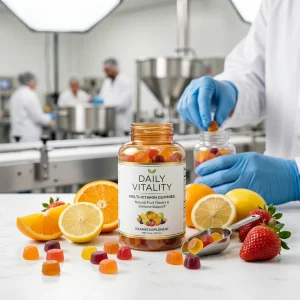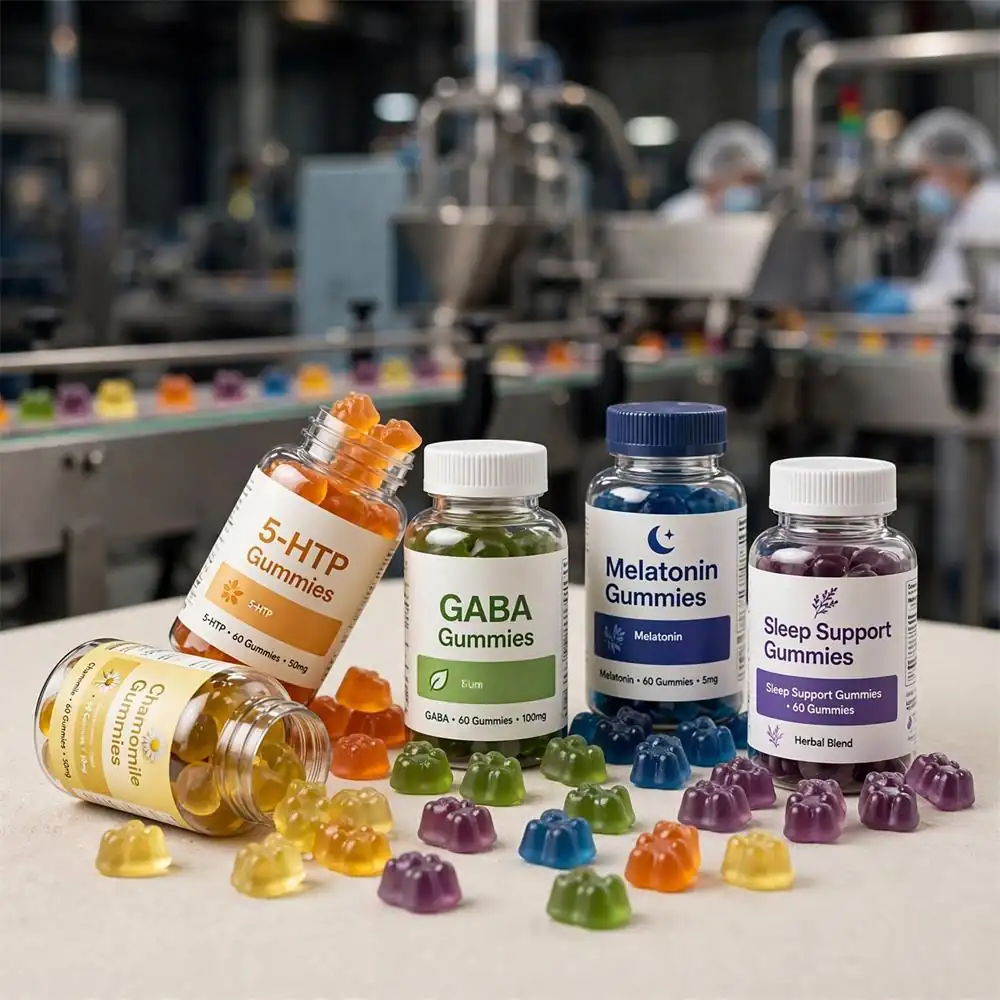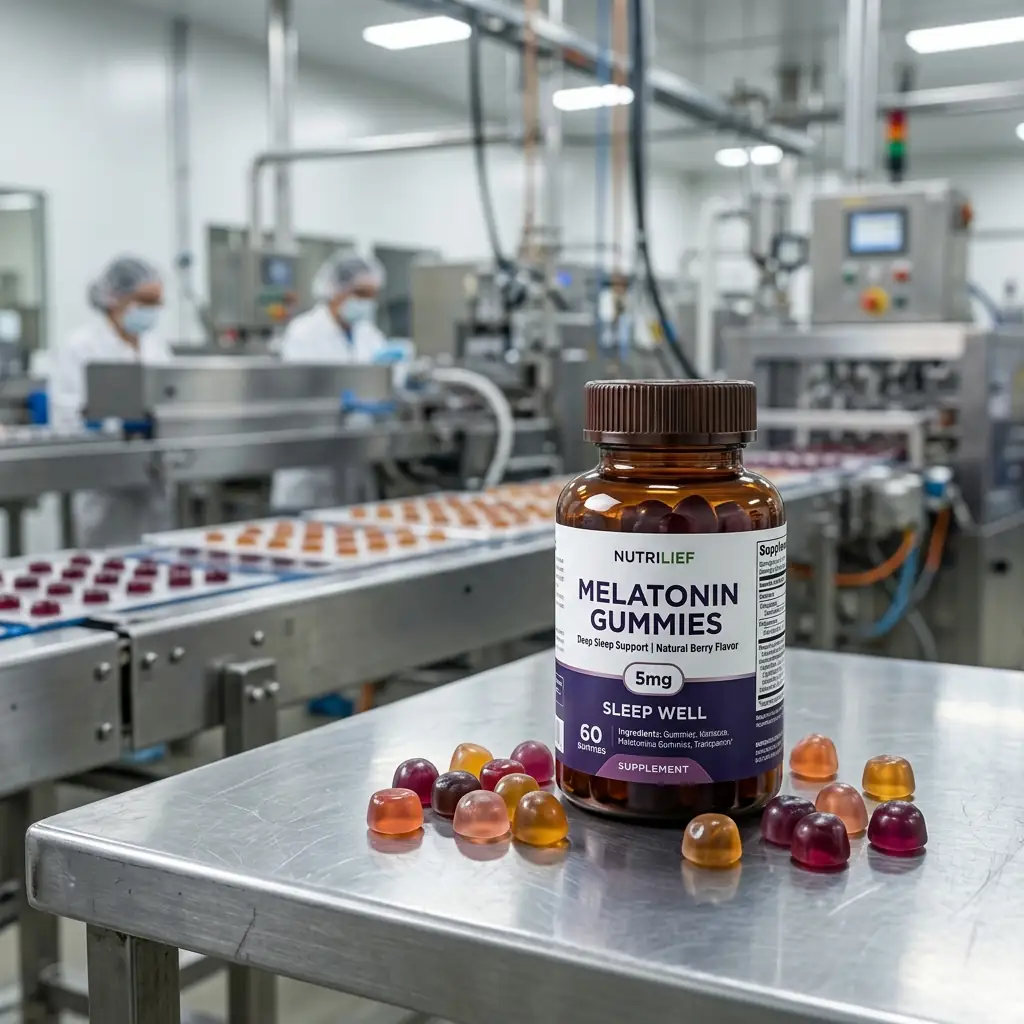

How Are Gummies Manufactured? The Short Answer for Buyers
Se stai valutando un Produttore di caramelle gommose for OEM, ODM, or private label production, gummies are manufactured by hydrating a gel system, cooking a sugar and syrup base, adding active ingredients at a controlled temperature, depositing the mass into molds, setting, drying to target water activity, and coating and packing under GMP controls. The entire process is designed to balance gel structure, moisture, pH, and heat exposure to protect actives and deliver consistent texture and dosage.
Most B2B buyers search this topic not for a general curiosity, but to answer a commercial question: Can my formula be made at scale, at the right dosage, with stable texture and acceptable cost? This guide explains commercial produzione di gomme from a factory perspective, including why each step exists and what decisions affect manufacturability, cost, and stability.
Why Understanding the Process Helps You Source Smarter
Gummies look simple, but they are one of the most process-sensitive supplement formats. Texture, water activity, active degradation, and batch consistency are all determined during manufacturing, not just formulation.
For brand owners, procurement teams, and product developers, understanding the process helps you avoid three common commercial risks: a formula that works in the lab but fails on high-speed depositing lines, an active load that forces an oversized gummy or two-piece serving, and a packaging choice that shortens shelf life. When you know what the manufacturer must control, you can provide better specifications and evaluate suppliers faster.
Commercial Gummy Production: End-to-End Process in a GMP Facility
Below is the production flow used by most GMP-certified gummy factories. Not every product uses every step, but the logic remains the same.
1. Concept and Specification Review
Every project starts with a specification review. The manufacturer evaluates target actives, dosage per serving, gummy weight, gel system, flavor profile, claims, target market, and packaging. This stage determines feasibility before any lab work. For example, 500 mg of calcium carbonate per gummy is not feasible at a standard 3.0 g gummy weight without major texture and taste trade-offs.
2. Formulation Development and Ingredient Compatibility Check
R&D develops a base that fits your actives. Key checks include solubility of actives, interaction between minerals and pectin, acid required for flavor versus gel stability, and flavor masking load. Botanical extracts with strong color or bitterness and hygroscopic powders like magnesium citrate often require a modified base or coating strategy.
3. Raw Material Testing and Dispensing
All raw materials are tested against specifications and COA. Critical tests include potency of actives, heavy metals, solvent residues for botanicals, and microbiological status. Materials are then weighed in a controlled dispensing area to ensure batch accuracy.
4. Gel Preparation and Sugar Cooking
The gel system, typically gelatin or pectin, is hydrated separately. In parallel, the sugar, glucose syrup, and water are cooked to a target Brix. Cooking removes excess water and builds solids. The cooked syrup is then blended with the hydrated gel. Temperature and Brix at this stage directly affect final texture and drying time.
5. Active Ingredient Addition – The Critical Control Point
Most vitamins, minerals, and botanicals are heat-sensitive. Manufacturers cool the mass to a defined window, often 70-85°C for gelatin and 80-95°C for pectin, before adding actives, acids, flavors, and colors. Adding too early causes degradation of vitamin C, B vitamins, or probiotics. Adding too late causes poor distribution and dosage non-uniformity.
6. Mixing, Vacuum Deaeration, and Homogenization
The mass is mixed under vacuum to remove air bubbles that cause weight variation and surface defects. For oil-based actives like DHA, CBD, or vitamin D3, homogenization or emulsification is required to prevent oil separation and ensure content uniformity.
7. Deposito negli stampi
Commercial lines use Mogul or starchless depositing systems. The mass is deposited into silicone or starch molds at precise weight. Nozzle temperature, mass viscosity, and mold temperature must be aligned. If viscosity is too high, tails and incomplete fill occur. If too low, leakage and weight variation increase.
8. Raffreddamento e impostazione
Gummies are cooled in cooling tunnels to set the gel network. Gelatin sets on cooling, while pectin sets on pH drop and solids concentration. Rushing this stage creates soft centers and deformation during demolding.
9. Drying and Conditioning
After demolding, gummies are dried in conditioning rooms to reach target water activity, typically Aw 0.60-0.75, and moisture content. Drying controls stickiness, prevents microbial growth, and stabilizes texture. Pectin gummies generally require longer drying than gelatin due to different water-binding behavior.
10. Coating and Polishing
Coating may be oil, wax, or sanding with sugar or acid. Coating reduces sticking, improves appearance, and can add taste masking. For sugar-free or vegan products, coating selection must match labeling requirements.
11. Inspection, Metal Detection, and Packaging
Gummies pass through visual inspection, metal detection, and weight checking. Primary packaging must provide moisture barrier. Most manufacturers use sealed bottles with desiccant, or high-barrier pouches. Packaging compatibility directly affects shelf-life validation.
12. Finished Product Testing and Release
Finished batches are tested for active content, water activity, texture, microbiology, and contaminants before release. Batch traceability is maintained from raw material lot to finished goods lot.
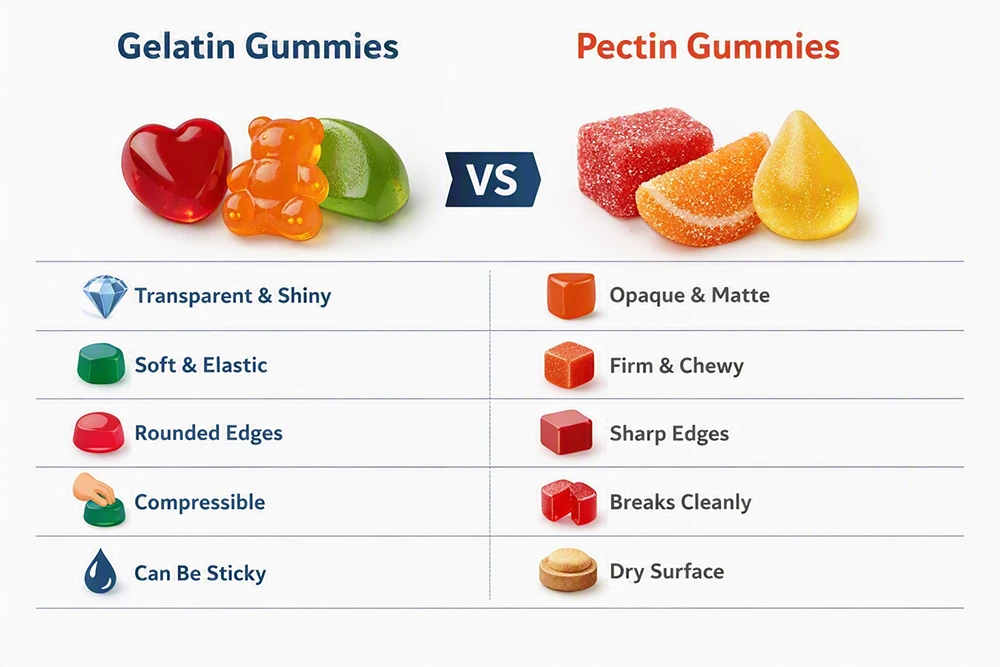
Gel System Defines Your Product: Gelatin vs Pectin vs Other Hydrocolloids
Your choice of gel system affects everything from processing temperature and pH to texture, vegan status, and drying time. This is one of the first decisions a Produttore di caramelle gommose will discuss with you.
| Sistema gel | pH di lavorazione | Meccanismo di impostazione | Profilo della trama | Ideale per | Manufacturing Watch-Out |
|---|---|---|---|---|---|
| Gelatin (Type A/B, 150-250 Bloom) | 3.5-5.0 | Thermo-reversible, sets on cooling | Elastic, chewy, melt-in-mouth | High active loads, classic chew | Not vegan, sensitive to high heat and proteases from pineapple, kiwi extracts |
| Pectina ad alto metossile | 3.2-3.6 | Sugar-acid, high solids | Short bite, less elastic | Vegan, fruit-flavored, sugar-based | Requires precise acid addition, longer drying, sensitive to calcium |
| Low Methoxyl Amidated Pectin | 3.5-4.2 | Calcium-reactive | Morbido, flessibile | Low sugar / sugar-free vegan | Calcium from mineral actives can pre-gel the mass |
| Carrageenan / Starch Blend | 4.0-6.0 | Termoreversibile | Firm, low chew | Cost-sensitive or specific texture targets | Can mask flavors less effectively, needs tight cooling control |
Formulation and Compatibility: Where Most Gummy Projects Fail or Succeed
Heat Sensitivity and Active Degradation
Vitamins C, B1, B12, vitamin A, probiotics, and some botanicals degrade at cooking temperatures above 100°C. The manufacturing logic is to cook the base first, then cool to a safe window before adding actives. For highly sensitive actives, the factory may use a lower-temperature process or add overage based on stability data, not arbitrary percentages. Probiotics require additional controls, including low Aw and specialized packaging, and are generally not suitable for standard high-temperature pectin cooking without process modification.
pH, Acids, and Gel Integrity
Flavor and pH are linked. Citric acid improves taste but can hydrolyze gelatin and weaken pectin if added too early or at too high a dose. In pectin systems, acid is added at the very end of mixing, just before depositing, to prevent premature setting inside the hopper. If your product is high-acid, such as apple cider vinegar or high-dose vitamin C, pectin selection and buffer salts become critical to maintain gel structure.
Active Loading, Gummy Weight, and Serving Size
Gummy weight directly limits active loading. A standard commercial gummy is 2.5 g to 4.0 g. Higher loads increase viscosity, affect texture, and can cause gritty mouthfeel for minerals like zinc citrate or calcium. When actives exceed 20-25% of gummy weight, manufacturers often recommend a two-gummy serving to keep texture acceptable and avoid excessive size. This affects label design, cost per bottle, and consumer compliance.
Minerals, Botanicals, and Flavor Masking
Iron, zinc, magnesium, and some B vitamins create metallic or bitter notes. Botanical extracts can bring color migration and earthy taste. Flavor masking in gummy manufacturing uses a combination of flavor system, sweetener blend, acid balance, and coating, not just stronger flavor. Oil-based masking agents must be emulsified to avoid surface oiling and potency loss.
Moisture Control and Water Activity
Water activity, not just moisture percentage, determines microbiological stability and stickiness. Target Aw below 0.75 inhibits most yeast and mold, but drying too far creates hard texture and weight loss. Hygroscopic ingredients like honey, glycerin, or certain mineral salts pull moisture during storage, leading to stickiness or sugar recrystallization. Packaging with proper moisture barrier and desiccant is part of the stability strategy, not an afterthought.
Scale-Up: What Changes Between Pilot and 16 Tons Per Day
Lab samples are made in 1-5 kg batches with manual mixing and slow cooling. Commercial production introduces shear, holding time, and heat transfer differences that change texture if not controlled.
In a large-scale facility such as Shenzhen Gothink Biotech Co., Ltd., which operates a GMP-certified facility with a 100,000-class cleanroom, a 10,000-class R&D laboratory, and approximately 16 tons of daily capacity, scale-up focuses on depositing accuracy, cooling uniformity, and drying consistency across tons of product. Large Mogul lines require consistent mass viscosity over several hours, which means tighter control of cooking Brix and holding temperature.
Equipment requirements also change. Pilot mixers cannot simulate vacuum deaeration or continuous homogenization. Manufacturers with commercial depositors, automated starchless molding, and controlled conditioning rooms can better predict texture and weight variation at volume. Without this, a product that looks good at 100 pieces may show tails, air bubbles, or soft centers at 500,000 pieces.
Quality Control, Microbiological Testing, and Shelf-Life Validation
Quality control for gummies starts before cooking and continues after packing. Key controls include Brix, pH, and temperature during cooking, gummy weight during depositing, water activity after drying, and seal integrity after packaging.
Microbiological testing typically includes total plate count, yeast and mold, and pathogens, reflecting the higher water activity compared to tablets. Stability protocols evaluate texture, Aw, color, flavor, active content, and microbiology over time under defined storage conditions. Shelf-life validation must be tied to actual packaging, not open-tray data. If you change from bottle to pouch, revalidation is required.
Documentation for B2B customers should include manufacturing flow, specifications, COA for raw and finished product, allergen statement, and batch traceability. Regulatory requirements vary by market, and manufacturing certifications do not automatically equal market approval. Separate manufacturing quality systems from market-specific regulatory filings.
What Drives Cost and MOQ in Gummy Manufacturing
Buyers often focus on price per gummy, but cost is driven by formulation and process complexity more than the molding step.
| Fattore di costo | Come influisce sul prezzo | What Buyer Can Control |
|---|---|---|
| Active ingredient type and dosage | High-cost actives, overage for stability, and high load requiring larger gummy | Confirm efficacious vs marketing dosage, accept 2-per-day serving if needed |
| Gel system and sugar type | Pectin and sugar-free systems cost more and dry longer | Decide vegan claim early, confirm sugar vs sugar-free |
| Gummy weight and mold | Custom molds and heavy gummies increase material and line time | Use standard shapes for first run, keep weight 3.0 g +/- 0.3 g |
| Coating and sanding | Added step, added materials, potential allergen cross-check | Specify if oil-wax coating is acceptable vs sugar sanding |
| Test e documentazione | Full panel, heavy metal, and stability testing add cost | Align testing with target market requirements, not all possible tests |
| MOQ e volume | Low volume increases per-unit cost due to cleaning, setup, and drying time | Plan 100k-300k gummies per SKU for better economics, consolidate flavors |
MOQ becomes commercially important when you have multiple flavors or custom molds. Each change requires line clearance and setup. For startups, ask whether the factory offers MOQ flexibility for pilot batches and whether pilot cost can be credited toward commercial orders.
How to Evaluate a Gummies Manufacturer: What to Verify Before You Order
Choosing a supplier on price alone creates risk. Verify capabilities that directly affect your product type.
- GMP and quality systems: Look for GMP-certified facility, ISO9001, ISO22000, HACCP, plus market-relevant systems like FDA registration, BRC, FSSC 22000, HALAL, KOSHER. Ask for recent audit summary and quality manual table of contents.
- Capacità di ricerca e sviluppo: Does the factory have a dedicated R&D lab and pilot depositor? Can they provide formulation adjustment rationale, not just trial and error?
- Gel system experience: Gelatin experience does not automatically equal pectin expertise. Ask how many pectin commercial batches per month and what acid dosing method they use.
- Capacità e costanza produttiva: Daily and annual capacity, number of depositing lines, conditioning room capacity, and weight variation data. A 10,000-class R&D lab and 100,000-class cleanroom indicate contamination control level.
- Test e controllo qualità: In-house vs outsourced testing, water activity meter, texture analyzer, HPLC for active verification, and microbiology turnaround time.
- Approvvigionamento degli ingredienti: Approved supplier list, COA requirements, and handling of hygroscopic or heat-sensitive actives.
- Scale-up record: Can they show pilot-to-commercial case history for similar active loads without disclosing confidential client data?
- Capacità di confezionamento: Bottle, pouch, blister, jar, and desiccant insertion, plus seal integrity testing.
- Documentation and export experience: COA, allergen, MSDS, manufacturing statement, and experience shipping to your target market with required labeling support.
- Tracciabilità dei lotti: Lot tracking from raw material to finished goods, retain sample policy.
Shenzhen Gothink Biotech Co., Ltd., for example, maintains certifications including ISO9001, ISO22000, HACCP, FDA, HALAL, GMP, KOSHER, BRC, FSSC 22000, PJPH, and Vegan, and provides OEM, ODM, CMO, and CDMO services across gummy, capsule, tablet, powder, liquid, and drop formats. Use such capability lists as a starting point for verification, not as a replacement for technical discussion.
Common B2B Mistakes in Gummy OEM/ODM Projects
- Copying a capsule formula directly into a gummy: Dosage, excipients, and absorption considerations differ. Mineral salts that work in capsules may cause bitterness or texture failure in gummies.
- Ignoring water activity: A gummy with Aw above 0.78 may pass initial QC but fail microbiology during storage, especially in humid markets.
- Requesting too many actives in one gummy: Combining high-dose minerals, acidic actives, and botanical extracts often leads to incompatibility, color migration, and unstable texture. Split into two formulas if needed.
- Choosing custom mold before formula is locked: Custom mold changes depositing parameters and drying. Lock formula and weight first, then finalize mold.
- Underestimating flavor masking: Masking is not just adding more flavor. It requires balancing acid, sweetness, and coating. Early sensory evaluation on aged samples, not fresh samples, is more predictive.
What to Send a Manufacturer to Get an Accurate Quotation
To receive a technically accurate quotation and avoid repeated revisions, provide:
- Target actives and dosage per serving, and whether serving is one or two gummies
- Preferred gel system and dietary requirements such as vegan, sugar-free, halal, kosher
- Target gummy weight and shape, if known, or allow manufacturer to propose
- Flavor and color preferences and any prohibited ingredients
- Packaging format, count per bottle or pouch, and target market
- Expected order volume, MOQ flexibility needs, and timeline
- Testing requirements and documentation needed for your market
- Reference sample, if available, with note that you want functional equivalence, not copy
FAQ: Commercial Gummy Production Questions From Brand Owners
1. What is the standard production process for commercial gummies?
The standard process includes gel hydration, sugar syrup cooking to target Brix, cooling and blending with gel, active addition at controlled temperature, vacuum deaeration, depositing into molds, cooling and setting, demolding, drying to target water activity, coating, inspection, and packing. Each step has defined temperature, Brix, pH, and time controls.
2. What is the difference between gelatin and pectin gummy manufacturing?
Gelatin gummies set on cooling and offer elastic chew, while pectin gummies set on acid and sugar concentration and offer a shorter bite. Pectin requires tighter pH control, acid is added at the last moment before depositing, and drying time is typically longer. Gelatin lines cannot be assumed to run pectin without equipment and process adjustments.
3. How do you handle heat-sensitive ingredients like vitamin C or probiotics?
Heat-sensitive actives are added after the base is cooked and cooled to a safe window. For probiotics, additional measures include low water activity, moisture barrier packaging, and process validation for viability. Overages are based on stability data, not arbitrary percentages, and must be agreed with the customer.
4. Why does gummy weight affect dosage and cost?
Weight limits how much active can be incorporated while keeping acceptable texture. Above about 25% active load, texture becomes hard or gritty. Increasing weight to 4.5 g+ increases raw material cost, drying time, and bottle size. Often a two-gummy serving allows better texture and lower cost per effective dose than one oversized gummy.
5. What water activity should a commercial gummy target?
Most commercial gummies target Aw 0.60 to 0.75 to balance soft texture with microbiological stability. Aw above 0.78 raises risk for yeast and mold, especially with hygroscopic ingredients. Aw is controlled by cooking Brix, drying time, and packaging barrier, not just by adding preservatives.
6. What drives MOQ for gummy OEM/ODM orders?
MOQ is driven by depositing line setup, cleaning, conditioning room occupancy, and testing. Standard MOQs are often 100,000 to 300,000 gummies per SKU for cost efficiency. Multiple flavors, colors, or custom molds increase MOQ because each requires separate clearance. Ask if the manufacturer offers pilot batch options before committing to full MOQ.
7. What should I ask a Gummies Manufacturer before placing an order?
Ask about gel system experience for your specific product type, active addition temperature and overage policy, water activity target and drying capacity, depositing accuracy and weight variation, QC tests performed in-house, batch traceability, packaging moisture barrier, and documentation provided. Request details on GMP, ISO22000, HACCP, FDA, BRC, and other relevant certifications and whether they have exported to your market.
Next Step: Move From Idea to Production Sample
If you have a concept, send your target actives, dosage, gel preference, flavor direction, packaging, volume, and market. A qualified manufacturer will return formulation feedback, feasibility notes on active compatibility and gel selection, proposed gummy weight and serving, and a quotation with MOQ, lead time, and testing scope.
For brands comparing suppliers, request a pilot sample made on commercial-style equipment, not just a lab beaker, and evaluate texture after 2-4 weeks, not just on day one. Texture, Aw, and active content change during conditioning, and day-one samples can be misleading.
If you are ready to discuss your project, contact the manufacturing team with your specifications to request a custom formulation proposal and OEM/ODM quotation. Review the technical details on your chosen manufacturer’s gummy production and quality pages to confirm capacity and quality systems before finalizing.
Jack Luo|Senior Technical Advisor, Nutrition Research Center Representing Gothink Biology, a GMP-certified dietary supplement manufacturer based in Shenzhen, China.