
الجواب القصير: A مصنع الصمغ uses certified, standardized, automated processes and can document quality at scale, while a small workshop relies on manual methods and suits only micro-batches or local testing. Most commercial brands start with OEM contract manufacturing — using an established factory as their external production facility — rather than building their own plant. Choose the model that fits your order volume, compliance needs and growth plan.
Every brand that wants to make gummies faces the same structural choice: build production, buy from a workshop, or partner with an established gummy factory through OEM. This guide compares the production models, explains how OEM lets you make gummies without owning a factory, and shows how a professional factory ensures quality and safety. For the step-by-step supplier evaluation criteria, see كيفية اختيار مصنع للحلوى المطاطية.
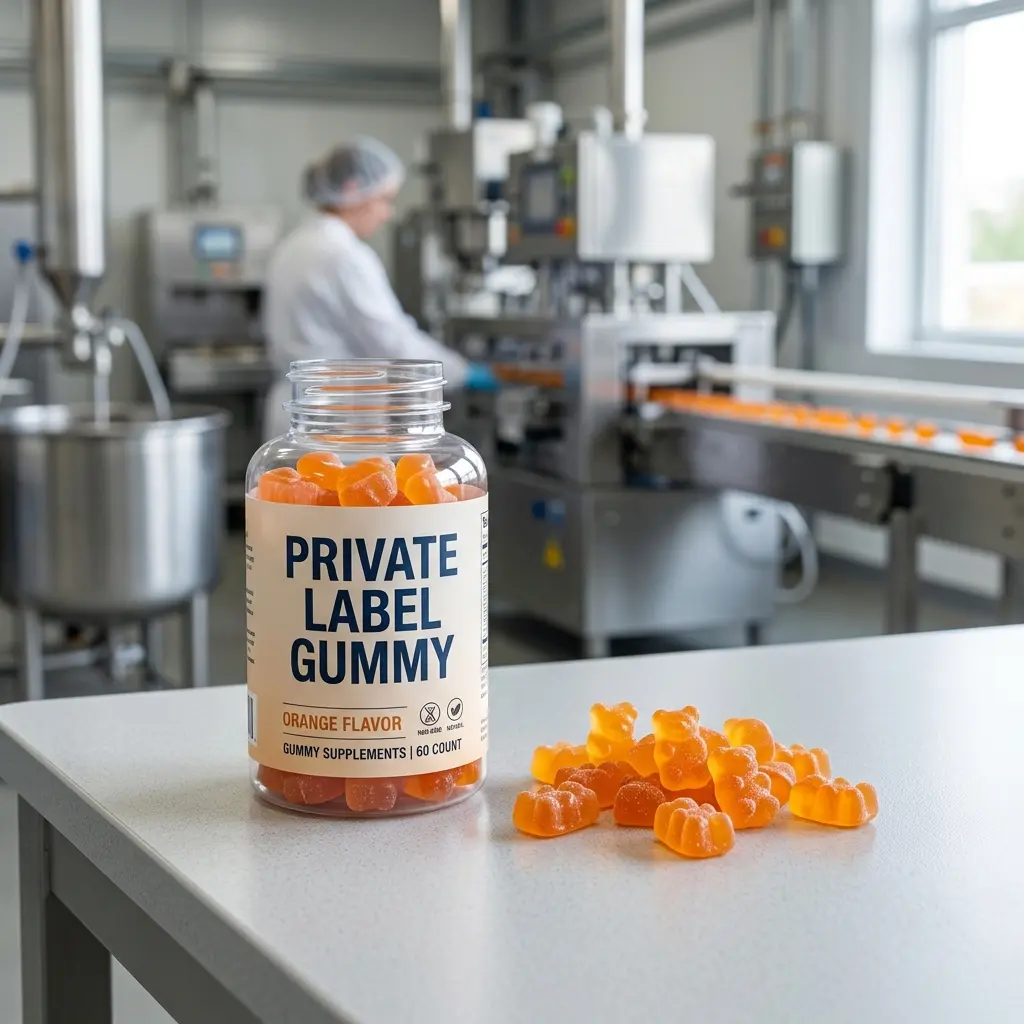
Gummy Factory vs Small Workshop: The Core Differences
A gummy factory and a small workshop differ mainly in production scale, equipment standardization and quality-system maturity. A factory offers certified quality control, higher output and consistent batch reproducibility; a workshop suits micro-batch testing or hyper-local sales. The comparison is really about how gummies move from formulation to finished product: a factory standardizes mixing, depositing, cooling, demolding and coating with calibrated equipment and documented procedures, while a workshop handles the same stages with smaller equipment, less automation and fewer formal checkpoints.
| الابعاد | مصنع الحلوى المطاطية | ورشة صغيرة |
|---|---|---|
| طريقة عملنا | Standardized, calibrated equipment; documented SOPs | Manual processes; small-batch equipment |
| نظام الجودة | GMP, ISO 9001/22000, HACCP; cleanroom classification; batch records | Informal oversight; limited documentation |
| الاختبار | Incoming, in-process and finished-product testing; often third-party | Limited or buyer-arranged testing |
| الحد الأدنى لكمية الطلب ووقت التسليم | Higher MOQ, longer first-run setup | Lower MOQ, faster informal communication |
| التوسعة | Absorbs growing orders without renegotiating capacity | Hits capacity limits quickly |
| أفضل ل | National/international distribution, OEM/ODM, retail and import compliance | Formula validation, very small regional runs |
Factories offer scalability, traceability and certification support but usually require higher MOQs and longer first-run lead times. Workshops offer flexibility and lower entry barriers but generally cannot support volume growth, consistent batch-to-batch quality, or the formal compliance documentation that retailers and import regulations require. Established brands, distributors and OEM/ODM buyers planning national or international distribution benefit from factory production; early-stage entrepreneurs validating a concept may start with a workshop and transition to a certified شريك تصنيع تعاقدي للحلوى المطاطية مع ازدياد الحجم.
Make Gummies Without a Factory: How OEM Works
Launching a gummy brand no longer requires owning production equipment, cleanrooms or a formulation team. Through OEM (Original Equipment Manufacturer) partnerships, a contract manufacturer handles formulation, production, quality control and packaging while the brand focuses on marketing, sales and distribution. In an OEM arrangement the manufacturer already operates the facility, equipment and quality systems; the brand selects a formula, flavor, shape and packaging, and the manufacturer executes production.
The economics are the main reason brands choose this model. Building an in-house factory requires significant upfront investment in equipment, facility certification and skilled labor, plus ongoing compliance and maintenance costs. An OEM partner converts those fixed costs into variable per-unit costs, letting a brand test new products, scale during demand spikes and adjust formulas without heavy capital commitment. OEM generally follows a formula the brand provides or selects from the manufacturer’s catalog; ODM involves developing a custom formula from scratch. (The full OEM/ODM/private-label comparison is in the buyer’s guide.)
The advantages are faster launch, access to established quality systems and flexible order volumes. The limits are less direct day-to-day control, dependence on the manufacturer’s capacity and lead times, and the need for clear communication to protect formula confidentiality. OEM suits brands entering the gummy category for the first time, distributors seeking private-label products, retailers building house brands and established companies expanding without diverting capital.
How a Professional Factory Ensures Quality and Safety
Quality and safety assurance is not a single final inspection — it is a continuous system spanning raw-material intake, formulation, production, packaging and post-production testing, with checkpoints at every stage. Gummies present distinct challenges versus tablets or capsules: moisture control, ingredient stability under heat during gelling, and microbial risk from a sugar-based, semi-moist matrix. That is why gummy-specific controls differ from those used in dry-form supplement manufacturing.
- Certified environment. GMP guidelines supported by ISO 9001 and ISO 22000 systems, HACCP-based hazard controls and cleanroom classification. FDA registration plus HALAL, KOSHER and Vegan certification support market access.
- Controlled sourcing. Certificates of analysis for incoming materials and traceability records that confirm ingredient origin and purity.
- Standardized production. Recipes, calibrated equipment and trained staff following documented SOPs for consistent dosing and batch reproducibility.
- التحقق. Finished-product testing for heavy metals, microbiology, active identity and potency against label claims; retained samples for reference.
- كابل بيانات. Batch records, testing reports and audit documentation provided promptly — a practical indicator of organizational readiness.
A well-controlled process yields consistent dosing, longer shelf life and fewer recalls. The main limitation is higher sensitivity to temperature and humidity in storage and transport, which requires attentive logistics planning.
Choosing and Managing the Production Partner
Match expected order volume to the supplier’s stated capacity, then review certification status, equipment lists, quality-control procedures and batch-record examples — these give a more accurate picture than marketing materials. In OEM/ODM projects, confirm the partner can support formulation development, custom packaging and private-label requirements, not just basic production. Define target formula, dosage, flavor and packaging specifications upfront to avoid delays.
Build risk control into the sourcing process: incoming raw-material inspection, in-process quality checks, finished-product testing, pre-production sample approval, agreed batch-testing thresholds and pre-shipment inspection. For long-term partnerships, weigh consistency across repeat orders, transparent communication and the ability to support growth without changing supplier. Periodic factory audits — directly or through third parties — are standard in professional supply-chain management.
For context on what goes into the product itself, see مكونات الحلوى المطاطية و البكتين مقابل الجيلاتين.
الأسئلة الشائعة
ما الفرق بين مصنع الحلوى المطاطية وورشة عمل صغيرة؟
A factory uses standardized, certified production processes at scale; a workshop relies on manual processes, smaller batches and less formal quality oversight. The choice affects consistency, compliance and the ability to scale.
Can a small workshop grow into factory-scale production?
Some do, but it requires significant investment in equipment, certification and quality systems. Most brands transition to a certified contract manufacturer instead.
ما هو تصنيع الحلوى المطاطية من قبل الشركات المصنعة الأصلية؟
An arrangement where a contract manufacturer produces gummies under your brand, using your formula or one from its catalog, and handles sourcing, production, quality control and packaging.
Can a small or new brand use OEM manufacturing?
Yes. Many OEM partners offer low MOQs that let startups launch without heavy upfront commitment — essentially treating the manufacturer as your external factory.
ما هي معايير الجودة المطبقة على صناعة الحلوى المطاطية؟
Common standards include GMP, ISO 9001, ISO 22000, HACCP and third-party testing, with FDA, HALAL and KOSHER added depending on the target market. These are maintained more consistently in factory settings.
How does a professional factory ensure product safety?
Through certified facilities, controlled raw-material sourcing, standardized processes and verified testing at multiple stages — documented in batch records and COAs available on request.
أدلة ذات صلة
- كيفية اختيار مصنّع حلوى الجيلي: دليل شامل للمشتري
- شركة جيت باك لتصنيع المكملات الغذائية: اختيار شريك لتصنيع علكات المناعة
- كيفية صنع الحلوى الهلامية: عملية التصنيع الكاملة
- مما تتكون حلوى الدببة
- GTT Bio Knowledge Hub — more production and sourcing guides
تحدث إلى مُصنِّع حلوى الجيلي: نظرة عامة على تصنيع حلوى الجيلي · إمكانيات العلامات التجارية الخاصة وخدمات تصنيع المعدات الأصلية/تصميم وتصنيع المنتجات الأصلية