
Ringkasan eksekutif: To format an FDA-compliant gummy supplement label, build a Supplement Facts panel under 21 CFR 101.36 that lists the serving size, servings per container, and every dietary ingredient in FDA order with its amount per serving and % Daily Value (%DV). The amount declared must be the amount present at the end of shelf life, not the amount added during manufacturing. For gummies, that distinction matters more than for capsules or tablets because heat, low pH, water activity, and moisture loss during drying change potency after depositing. A compliant label therefore starts with stability data, not graphic design.
Label errors are one of the most common reasons for FDA warning letters, Amazon suppressions, and retail chargebacks for gummy brands. Most errors are not design mistakes. They are formulation and stability mistakes that show up on the panel. This guide explains how to format the panel correctly and how to align it with real gummy production. For broader decisions on positioning, packaging, and margin structure, see our guides in Strategi Jenama.

1. The Anatomy of a Compliant Supplement Facts Panel for Gummies
Jawapan langsung: A dietary supplement gummy must use a Supplement Facts panel, not a Nutrition Facts panel. The panel must show serving size, servings per container, nutrients in FDA-specified order, amount per serving, %DV, and the required footnote. All other required label elements sit outside the box.
The panel structure is fixed. FDA does not allow brands to reorder nutrients for marketing emphasis or to hide low-potency ingredients.
Required Elements Inside the Box
- Title: “Supplement Facts” in bold, at the top of the box.
- Saiz hidangan: Expressed as number of gummies plus weight, for example “Serving Size: 2 Gummies (8 g).” The serving must match the directions for use.
- Hidangan setiap bekas: Based on net contents divided by serving size. A 60-count bottle with a 2-gummy serving is 30 servings, not 60.
- Amount Per Serving header: Followed by dietary ingredients in the order specified in 21 CFR 101.36.
- % Daily Value column: Calculated from the declared amount and the Daily Reference Value (DRV) or Reference Daily Intake (RDI) for that nutrient.
- Nota kaki: “* Daily Value (DV) tells you how much a nutrient in a serving of food contributes to a daily diet. 2,000 calories a day is used for general nutrition advice.” For ingredients without an established DV, use “† Daily Value not established.”
Required Elements Outside the Box
- Bahan-bahan lain: Listed below the panel in descending order by weight. This includes the gummy base: glucose syrup, sugar, water, pectin or gelatin, citric acid, natural flavors, colors, and coating agents such as carnauba wax or vegetable oil.
- Statement of identity: For example, “Vitamin C + Zinc Gummies – Dietary Supplement.”
- Kuantiti bersih kandungan: Weight or count, for example “60 Gummies – Net Wt. 240 g.”
- Manufacturer / distributor name and address: The responsible firm in the U.S., or importer information for foreign-made product.
- Directions, warnings, and storage: Keep out of reach of children, do not exceed suggested use, and storage conditions that match stability data.
- Allergen declaration: Under FALCPA, milk, eggs, fish, crustacean shellfish, tree nuts, peanuts, wheat, soybeans, and sesame must be declared if present. For gummies, gelatin source, soy lecithin, and shared-line cross-contact are the usual triggers.
- Structure/function disclaimer: If you make a structure/function claim such as “supports immune health,” you must add: “These statements have not been evaluated by the Food and Drug Administration. This product is not intended to diagnose, treat, cure, or prevent any disease.”
A sample panel format for a basic immune gummy illustrates the order:
| Tambahan Fakta | Amaun Setiap Hidangan | % Nilai harian |
|---|---|---|
| Serving Size: 2 Gummies (8 g) / Servings Per Container: 30 | - | - |
| Kalori | 25 | - |
| Karbohidrat jumlah | 6 g | 2% |
| Total Sugars / Includes Added Sugars | 4 g / 4 g | 8% |
| Vitamin C (sebagai Asid Askorbik) | 90 mg | 100% |
| Zinc (as Zinc Citrate) | 5 mg | 45% |
2. Why the Number on the Label Is Not the Number in the Kettle
Jawapan langsung: FDA expects the declared amount to be present through the expiration date. Gummy manufacturers must therefore add a stability-based overage to compensate for loss during heating, depositing, drying, and storage, then verify that the overage still delivers the label claim at expiry without exceeding safe upper levels.
This is the single largest gap between a graphic file and a compliant product. Three physical factors drive it:
Thermal Degradation During Depositing
Gummy mass is typically cooked to 100–110°C, then held and deposited at 85–95°C. Water-soluble vitamins are the most vulnerable. Vitamin C, thiamin, folate, and vitamin B12 degrade under heat, oxygen, and light. Botanical extracts with polyphenols can also lose marker compounds. A formula that is 100% of label claim at depositing will test below claim after 12 to 24 months.
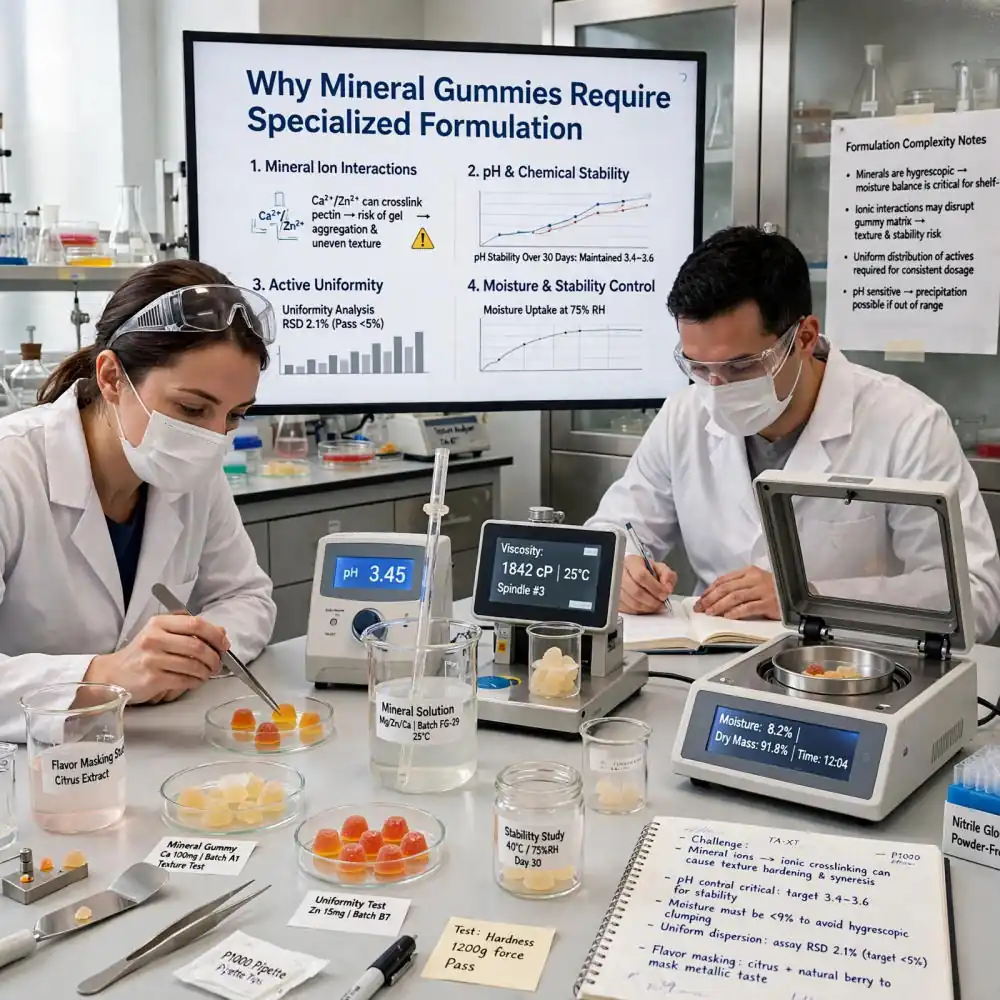
The practical fix is a degradation buffer strategy: formulate input = label claim / (1 – expected loss). If stability data shows 25% loss for vitamin C over 24 months, a 90 mg label claim requires about 120 mg input. The buffer must be validated with both accelerated (40°C / 75% RH) and real-time stability studies using a stability-indicating assay such as HPLC, not a simple titration that cannot separate active from degradants.
pH and Water Activity (aw)
Pectin gummies set at pH 3.2–3.8. That acidity is necessary for gelation, but it accelerates degradation of acid-sensitive actives and can hydrolyze certain minerals and flavors. Gelatin gummies run at higher pH, typically 4.5–5.5, which is gentler but creates a different risk: higher aw and slower drying. Target aw for finished pectin gummies is usually 0.55–0.70; for gelatin gummies, 0.65–0.75. If aw drifts upward during storage, microbial risk rises and water-soluble actives migrate and degrade faster. If it drifts downward, piece weight drops and the active concentration per gram rises, which changes the actual dose per gummy even though the count stays the same.
Piece Weight Variation and Moisture Equilibrium
High-speed depositing controls piece weight to roughly ±3–5% under good conditions. After demolding, gummies continue to lose moisture in the drying tunnel until they reach equilibrium. A 4.0 g wet piece that dries to 3.6 g will have a higher active concentration per gram. Label calculations must use the finished, equilibrated piece weight, not the wet deposit weight. Pilot-scale validation should therefore lock three parameters before label finalization: finished piece weight, aw, and assay per serving at time zero, 6, 12, and 24 months.
3. Pectin vs. Gelatin: How the Gel Matrix Changes Label Risk
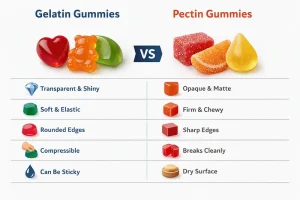
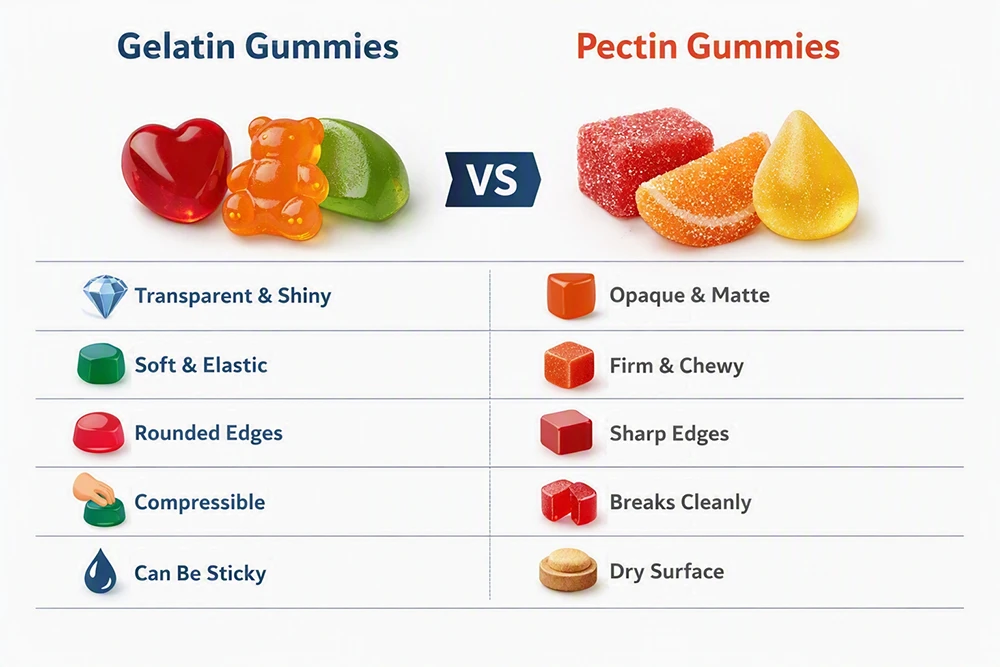
Jawapan langsung: Pectin creates a firmer, vegan, heat-stable matrix that suits acidic, high-sugar formulas but exposes actives to low pH. Gelatin creates a softer, chewier matrix that is gentler on actives but is more sensitive to heat, humidity, and melting during shipping. The choice changes stability, serving weight control, and what you can safely claim.
| Faktor | Gummy Pektin | Getah Gelatin | Label Implication |
|---|---|---|---|
| Gelation mechanism | Acid + sugar + calcium / high-methoxyl set on cooling | Thermal reversible set on cooling, melts near 35–40°C | Pectin tolerates summer shipping better; gelatin needs stronger storage warnings |
| pH biasa | 3.2-3.8 | 4.5-5.5 | Pectin needs larger overage for acid-sensitive vitamins |
| Aktiviti air | 0.55–0.70, dries faster | 0.65–0.75, dries slower | Higher aw increases potency drift and microbial control burden |
| Pemuatan aktif | Moderate; bitter or metallic actives harder to mask at low pH | Higher for minerals and botanicals; fat-soluble actives easier to emulsify | High-dose minerals often need 2-gummy serving in pectin to stay palatable |
| Dietary claims | Vegan, halal, kosher friendly | Contains animal-derived gelatin; allergen review needed | Gelatin source must be clear in Other Ingredients and allergen statement |
Flavor masking also interacts with labeling. Bitter botanicals, iron, zinc, and magnesium often require higher flavor, acid, or sweetener levels. Those masking agents add calories and sugars, which must be declared. A formula that masks iron successfully but pushes Added Sugars to 6 g per serving may fail a buyer’s “low sugar” positioning. A custom gummy manufacturing partner should show you the trade-off in a pilot batch with full nutritionals, not just a taste sample.
4. Formatting Rules Buyers Get Wrong Most Often
Jawapan langsung: The most frequent FDA label failures for gummies are misdeclared Added Sugars, incorrect calorie and %DV rounding, improper proprietary blend declarations, and serving sizes chosen for marketing rather than for actual use.
| Ralat Biasa | FDA Rule | Apa nak buat |
|---|---|---|
| Listing “0 g Added Sugars” for tapioca syrup or glucose syrup | Sugars added during processing, including syrups and honey, count as Added Sugars | Declare the full added amount. If you want a low-sugar claim, reformulate with sugar alcohols or allulose, then verify sweetness and aw |
| Declaring calories from the dry formula | Calories must reflect finished serving, including sugars, sugar alcohols, and coating oils | Use bomb calorimetry or calculated values from finished-product analysis, then apply FDA rounding rules |
| Hiding a low-dose blend as a “proprietary blend” without total weight | Proprietary blends must list total blend weight and ingredients in descending order | List blend weight, then each component. Do not list individual amounts inside the blend |
| Omitting %DV for botanicals | Ingredients without an RDI/DRV use “† Daily Value not established” | Do not invent a %DV for elderberry, ashwagandha, or collagen peptides |
| Setting serving as 1 gummy to look stronger per serving | Serving size must be consistent with directions and customary use | If the efficacious dose needs 2 gummies, label 2 gummies. Splitting the dose to inflate %DV creates a compliance and consumer-trust risk |
| Forgetting sugar alcohol declaration when making a claim | Sugar alcohols are voluntary unless a claim is made, then they become mandatory | If you claim “sugar-free” or “no added sugar,” declare sugar alcohols and add the required laxative warning if levels trigger it |
Rounding and Declaration Thresholds
FDA rounding rules in 21 CFR 101.9(c) apply to Supplement Facts. Calories under 5 per serving are declared as 0. Calories 5–50 are declared to the nearest 5. Total fat, carbohydrate, and protein follow similar increments. Vitamins and minerals follow specific rounding based on amount and %DV. Amounts below 2% of DV can be declared as 0, listed with an asterisk, or omitted with a footnote, but the choice must be consistent and defensible with assay data. Do not round up to reach 100% DV if the assay does not support it.
Claims: What the Panel Does and Does Not Allow
The Supplement Facts panel itself cannot carry disease claims. “Lowers cholesterol” or “treats insomnia” turns a supplement into an unapproved drug in FDA’s view. Structure/function claims are permitted if substantiated, truthful, and accompanied by the disclaimer and a 30-day notification to FDA. Nutrient content claims such as “good source of vitamin D” or “high in vitamin C” have defined thresholds in 21 CFR 101.54. A claim on the front panel must match the Supplement Facts numbers. If the front says “high potency vitamin D,” the panel must support it at expiry.
5. How to Evaluate a Manufacturer’s Label Support Before You Commit
Jawapan langsung: Ask for stability data, Certificates of Analysis tied to label claim, and a finished-product Supplement Facts draft before you approve artwork. A supplier who can only provide a formula sheet is not ready to support a U.S. launch.
Use this checklist in RFQ and pilot discussions:
- Stability protocol: Does the supplier run accelerated and real-time studies on your exact formula, matrix, and packaging, with assays at 0, 3, 6, 12, 18, and 24 months?
- Overage justification: Can they show the calculation from label claim to input amount, with loss data for each heat- or acid-sensitive active?
- Finished-product CoA: Does each lot CoA report assay per serving, piece weight, aw, pH, and micro results against the label specification, not just raw-material CoAs?
- Label draft service: Will they provide a Supplement Facts draft with rounding, Added Sugars, and Other Ingredients in FDA order, for your regulatory review?
- Keserasian pembungkusan: Have they tested bottle, desiccant, induction seal, and closure against moisture gain in your target climate? Gummies that pass stability in a lab pouch can fail in a retail bottle.
- Tukar kawalan: If flavor, color, sweetener, or pectin supplier changes, will they re-validate assay and aw before shipping? A minor flavor change can shift pH enough to affect stability.
For brands building a full U.S. line, private label gummy solutions should include this documentation package as part of turnkey production, not as an add-on after the first production run.
Shenzhen Gothink Biotech Co., Ltd. is a cGMP-certified dietary supplement contract manufacturer featuring a 100,000-class cleanroom facility, a 10,000-class analytical R&D lab, and 16-ton daily gummy production capacity under cGMP, NSF, FDA, ISO, HALAL, and KOSHER standards.
Soalan Lazim
Can we list the amount we add during manufacturing instead of the amount at expiry?
No. FDA expects the declared amount to be met through the end of shelf life. Listing input amount without accounting for degradation is a common cause of misbranding. Formulate with a justified overage, then verify with stability data that the product still meets label claim at expiry.
How much overage is acceptable on a gummy label?
There is no single FDA percentage. Overage must be justified by stability data and must stay within safe limits. Typical industry ranges are 10–20% for vitamin D3, 20–30% for vitamin C, and 15–25% for B vitamins in pectin gummies, but the correct value depends on pH, deposit temperature, packaging, and shelf life. Excessive overage that pushes intake above the Tolerable Upper Intake Level creates a safety and liability risk.
Do we need to declare Added Sugars if we use tapioca syrup or glucose syrup?
Yes. Syrups, honey, cane sugar, and other caloric sweeteners added during processing count as Added Sugars, even if they also serve as the gummy base. If your marketing says “no added sugar,” you must reformulate with non-sugar bulking agents and verify the new matrix still sets, dries, and tastes correctly.
What if our active ingredient has no Daily Value, like collagen or elderberry?
Declare the amount per serving and put “† Daily Value not established” in the %DV column. Do not calculate a %DV. List the ingredient by its common name and, for botanicals, include plant part and extract ratio if relevant to identity. For proprietary blends, list the total blend weight first.
Who is legally responsible for label accuracy — the brand or the manufacturer?
Both have exposure, but the brand owner / distributor whose name appears on the label is responsible for the label as marketed in the U.S. The manufacturer is responsible for producing to specification under cGMP. In practice, brands should own regulatory review, while the manufacturer must supply accurate CoAs, stability data, and a Supplement Facts draft that matches the actual product.
Can we change serving size after launch to fix a low %DV?
You can change serving size, but you must also change directions, net contents math, and the Supplement Facts values to match the new serving. Changing serving size only on the front panel, without updating the panel, is misbranding. Re-validate piece weight and stability if the change alters daily intake of any active.
Terokai lebih banyak dalam kami Hab Pengetahuan for formulation, compliance, and channel guides for gummy brands.
Jack Luo|Penasihat Teknikal Kanan, Pusat Penyelidikan Pemakanan, Biologi Gothink